
Community Rules and Regulations Best Practices: A 2026 Guide to Harmonious Governance
- Sohrab Virani

- May 23
- 12 min read
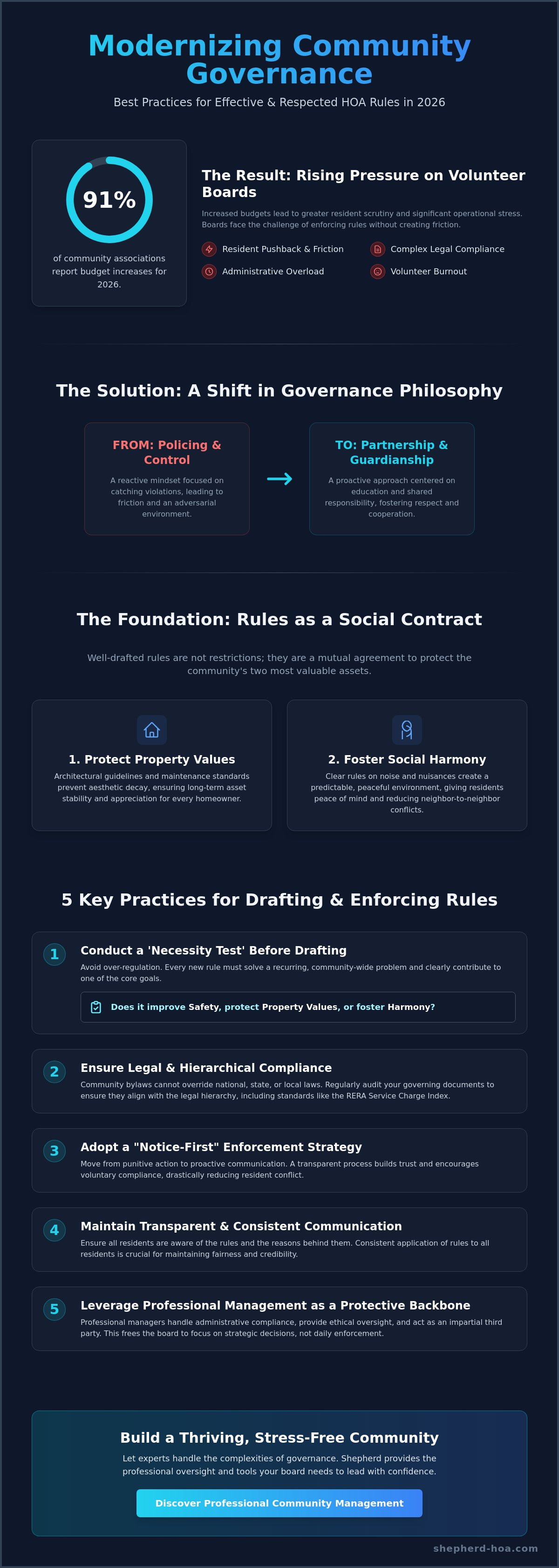
91% of community associations reported a budget increase for 2026, which means residents are scrutinizing board decisions more than ever. You probably feel the constant pressure of maintaining order while trying to avoid the friction that comes with new enforcement. It's difficult to act as a guardian of your neighborhood when you're worried about resident pushback or staying compliant with shifting laws like the new $100 fine caps in California. These administrative challenges can quickly turn a volunteer role into a source of significant operational stress.
We understand that effective governance isn't about control; it's about providing a steady hand that protects everyone's investment. This guide reveals the community rules and regulations best practices you need to draft and implement policies that residents actually respect. You'll learn how to align your board's actions with national real estate laws and create a professional, stress-free environment. We'll explore the essential frameworks for fair regulation and the latest transparency trends that ensure your community thrives well into 2026 and beyond.
Key Takeaways
Understand how viewing community rules as a social contract protects property resale values and ensures long-term asset stability.
Implement community rules and regulations best practices by auditing governing documents to ensure every policy serves a clear purpose of safety or harmony.
Navigate the hierarchy of authority to ensure your community bylaws remain compliant with national standards and the RERA Service Charge Index.
Adopt a "Notice-First" enforcement strategy to reduce resident conflict and foster a professional partnership through consistent, transparent communication.
Discover how professional community management serves as a protective backbone for boards, handling administrative compliance and ethical oversight.
Table of Contents
The Foundation of Governance: Why Community Rules Matter in 2026
5 Best Practices for Drafting Effective Community Regulations
Aligning Bylaws with National Regulations and RERA Standards
Fair Enforcement: Moving from Policing to Professional Partnership
Professional Oversight: How Shepherd HOA Secures Community Excellence
The Foundation of Governance: Why Community Rules Matter in 2026
In 2026, successful community management isn't just about administrative checklists. It's about a fundamental social contract between residents and their association. When you buy into a managed neighborhood, you're agreeing to a set of standards designed to protect your home's value and your quality of life. This collective agreement relies on community rules and regulations best practices to ensure every resident knows what to expect from their neighbors and their board. It's a mutual promise that replaces operational chaos with a sense of organized control.
The board acts as a guardian for the community's collective interests. This role involves more than just enforcement; it's a duty of care to preserve the environment everyone shares. As we move through 2026, governance is shifting toward a lifestyle-centric model. Boards aren't just looking at what's prohibited. They're looking at how rules can actively foster well-being and resident satisfaction. This modern approach recognizes that a well-governed community is a more desirable place to live, which directly impacts property resale value. A solid understanding of homeowner association governance provides the legal and ethical framework for these decisions. It ensures that the board's authority is used to build a stable, predictable environment rather than creating unnecessary friction.
Protecting Your Investment Through Standards
Architectural guidelines are often the first line of defense against aesthetic decay. When a neighborhood loses its visual cohesion, property values can stagnate or even fall. By maintaining clear standards for paint colors, landscaping, and exterior modifications, boards prevent the "broken window" effect where one neglected property leads to others. Noise and nuisance regulations play a similar role by ensuring long-term tenant stability. People stay longer in communities where they can sleep soundly and enjoy their space without interruption. Effective community governance serves as the invisible backbone of property appreciation.
Fostering Social Harmony and Resident Peace of Mind
The most successful boards in 2026 have moved away from a "policing" mindset. Instead, they embrace a partnership mindset. This means rules aren't used as weapons to catch people out, but as tools to help everyone live together peacefully. Living in an organized, predictable environment provides a significant emotional benefit. Residents feel a sense of relief when they know their investment is being watched over by a steady, expert guide. For those living in a Dubai community, this harmony is the result of clear communication and a shared commitment to the neighborhood's future. It replaces operational stress with a sense of organized control and peace of mind.
5 Best Practices for Drafting Effective Community Regulations
Creating rules that residents actually follow requires a shift from rigid enforcement to thoughtful design. When a board acts as a guardian of the neighborhood, its primary goal is to provide a framework where residents feel supported rather than restricted. Adopting community rules and regulations best practices ensures that your governance remains fair, legally sound, and easy to manage. Following a methodical drafting process helps prevent the administrative stress that often follows poorly conceived policies.
The 'Necessity Test' for New Policies
Before drafting a new regulation, your board should conduct a thorough audit of existing documents. Ask whether the proposed rule solves a recurring community-wide problem or merely reacts to an isolated incident. Over-regulation often leads to resident burnout and decreased engagement. If a rule doesn't directly contribute to safety, property value, or social harmony, it likely isn't necessary. You can gather initial feedback from your Owners Committee to gauge how a potential rule might be received before it's finalized. This proactive approach mirrors Community Associations Institute guidance on balancing self-governance with reasonable oversight.
Once necessity is established, follow these five steps to ensure your rules are effective:
Align with Goals: Every rule must tie back to a specific community objective. If you're regulating parking, the goal is safety and accessibility, not just control.
Use Plain English: Avoid complex legal jargon. Rules should be accessible to everyone, regardless of their professional background.
Define Your Standards: Don't use ambiguous terms like "reasonable" without providing a clear definition. If noise is restricted, specify the hours and the types of sounds covered.
Establish Proportional Penalties: Ensure fines are fair. For example, as of 2026, many jurisdictions like California have capped non-safety fines at $100. Your penalty system should prioritize correction over punishment.
Incorporate a Review Period: Implement new rules on a provisional basis. A 30 or 60-day review period allows the board to see how the rule works in practice before it becomes permanent.
Drafting for Clarity and Compliance
Effective rules are often "enabling" rather than purely restrictive. Instead of only listing what residents can't do, explain what they can do to stay compliant. For instance, instead of just banning certain window treatments, provide a list of approved colors and materials. This transparency builds trust and reduces the likelihood of disputes. When residents understand the "why" behind a rule, they're more likely to cooperate. If your board feels overwhelmed by the technicalities of drafting, seeking expert community management support can ensure your bylaws remain compliant with the latest 2026 regulatory standards while maintaining a focus on resident satisfaction.
Aligning Bylaws with National Regulations and RERA Standards
Community rules don't exist in a vacuum. For a board to act as a reliable guardian of its neighborhood, it must ensure that every regulation is nested within a clear hierarchy of authority. In 2026, this hierarchy remains absolute: National Law sits at the top, followed by the Master Declaration, with individual community rules at the base. Any local rule that contradicts a federal decree or a national real estate law is unenforceable and can expose the association to significant legal risk. Adopting community rules and regulations best practices means constantly verifying that your bylaws reflect the latest statutory requirements, ensuring that your governance is both powerful and compliant.
The RERA Service Charge Index is a critical tool for modern boards. It doesn't just dictate financial caps; it influences the maintenance standards that your rules are designed to support. If your community rules require a specific level of upkeep for common areas, those requirements must align with the budget approvals and service standards set by regulatory authorities. This alignment ensures that the board isn't overreaching or under-delivering, providing residents with the organized control they expect for their investment. Following established best practices for enforcing community rules helps maintain this balance, protecting the board from claims of arbitrary or illegal enforcement.
Navigating the RERA Compliance Landscape
In 2026, certain community rules require formal approval before they can be implemented. Rules regarding the use of common areas or changes to architectural standards often need to be vetted to ensure they don't violate national accessibility laws or safety protocols. For example, a rule cannot restrict access to common facilities in a way that contradicts the latest Strata Law updates. For a deeper look at these requirements, consult our RERA Dubai guide, which details the specific compliance steps for community associations. Ensuring your rules are pre-approved prevents future disputes and strengthens the board's authoritative standing.
Mollak and Financial Governance
Financial transparency is the backbone of resident trust. The Mollak system is essential for ensuring that all fines and penalties are processed through approved, transparent channels. By using Mollak Dubai, boards can demonstrate that rule enforcement isn't a revenue-generating scheme but a protective measure for the collective interest. Every fine must be documented and tied to a specific violation within the approved budget framework. This level of oversight protects the board from accusations of financial mismanagement and provides residents with peace of mind, knowing that their community's financial health is being managed with total integrity.
Fair Enforcement: Moving from Policing to Professional Partnership
Consistency is the bedrock of community trust. If one resident receives a pass while another is fined for the same infraction, the board's authority evaporates. Applying community rules and regulations best practices requires a "Golden Rule" approach where every resident, regardless of their status or relationship with the board, is held to the same standard. This uniform application replaces operational stress with a sense of organized control. It demonstrates that the board operates with integrity and transparency, acting as a watchful guardian for everyone's collective interests.
Moving from a policing mindset to a professional partnership involves implementing a "Notice-First" strategy. Most residents want to comply but may simply be unaware of a specific regulation. By providing a chance to self-correct, you foster social harmony rather than resentment. A professional management company acts as a neutral third-party mediator in these instances. They serve as a buffer, ensuring that enforcement doesn't become personal between neighbors. This protective stance helps maintain community trust, even when handling anonymous complaints. It allows the board to focus on high-level oversight while the management team handles the direct, often sensitive, interactions.
The Communication Workflow for Violations
A structured approach to violations prevents confusion and reduces pushback. In 2026, residents expect clear, documented communication before any penalties are assessed. Following a tiered workflow ensures fairness:
Level 1: Friendly Reminder. This is educational outreach. It's a supportive message designed to guide the resident toward compliance without the threat of a fine.
Level 2: Formal Notice. If the issue persists, the association issues a formal document. This notice must provide a clear, documented timeline for resolution and explain the specific rule being violated.
Level 3: Administrative Action. As a last resort, the board may issue an administrative fine or pursue legal escalation. This step is only taken after the resident has been given ample opportunity to rectify the situation.
Resolving Disputes with Integrity
Integrity in enforcement requires a formal appeal process. Residents should feel they have a voice if they believe a mistake was made or if there are extenuating circumstances. The Owners Committee can serve as a valuable sounding board for complex cases that don't have a clear-cut solution. Professional mediation preserves neighborly relationships by removing the emotional charge from the resolution process. It shifts the focus from "winning" a dispute to finding a sustainable solution that benefits the whole community. If your board is struggling to manage these delicate interactions, our team can help through expert community management that prioritizes both compliance and resident satisfaction.
Professional Oversight: How Shepherd HOA Secures Community Excellence
Implementing a fair governance framework is a complex task that requires more than just good intentions. It demands a steady, expert hand to ensure that policies remain relevant and enforceable over time. Expert Owners Association Management is the essential backbone that supports rule longevity. By providing professional oversight, Shepherd HOA allows board members to step back from the daily friction of enforcement and focus on high-level community goals. Our "Guardian" philosophy is designed to protect your collective interests while reducing the administrative burden that often leads to volunteer burnout.
We replace operational stress with a sense of organized control through ethical tendering and strict administrative compliance. When a board partners with us, they gain access to sophisticated technology that tracks compliance and resident feedback in real-time. This data-driven approach ensures that community rules and regulations best practices are applied consistently and transparently. Instead of guessing how residents feel about a new policy, boards can see actual engagement metrics and feedback trends. This level of oversight ensures that every decision is backed by integrity and a deep understanding of the neighborhood's unique needs.
Tailored Solutions for Your Community
No two developments are identical, and your bylaws should reflect that reality. We specialize in customizing regulations to fit the specific demographic and lifestyle of your residents. This includes conducting regular "Rule Checks" to ensure your guidelines remain practical and legally sound in 2026. A critical phase for many associations is the transition from developer-led rules to owner-led governance. We guide boards through this shift, helping them reclaim their community's identity and establish standards that prioritize long-term residents over short-term sales goals.
Ready to Elevate Your Community Standards?
Maintaining a harmonious neighborhood shouldn't be a source of constant stress for board members. A professional audit of your current community guidelines can identify gaps in compliance or areas where rules are creating unnecessary resident conflict. Shepherd HOA handles the heavy lifting of RERA and Mollak reporting, ensuring your financial and administrative records meet every regulatory standard without fail. We act as a watchful guardian for your assets, providing the guidance and protection your community deserves. Partner with Shepherd HOA for expert community management and experience the peace of mind that comes with professional excellence.
Building a Legacy of Harmonious Community Governance
Effective governance in 2026 requires a delicate balance between firm oversight and resident partnership. By viewing your bylaws as a social contract, you protect both the emotional well-being of your neighbors and the long-term resale value of their homes. Implementing community rules and regulations best practices ensures that your board remains a steady guardian of the neighborhood's standards while staying fully compliant with evolving national laws. This organized approach replaces the stress of administrative disputes with a predictable, stable environment where every resident understands their role.
Managing these complexities shouldn't fall solely on the shoulders of volunteers. Since 2010, we've acted as a protective backbone for associations, specializing in RERA approved management and Mollak system integration. Our team handles the technical intricacies of compliance and financial reporting so you don't have to. If you're ready to replace operational friction with professional excellence, Request a Professional Consultation for Your Community Management Needs today. You deserve a partner that values the long-term stability and social harmony of your community as much as you do.
Frequently Asked Questions
What are the most common community rules and regulations?
Common regulations typically cover parking restrictions, noise curfews, common area usage hours, and architectural standards for unit modifications. These rules provide a predictable environment for all residents. They prevent aesthetic decay and ensure that shared facilities like gyms and pools remain accessible and safe for everyone in the development.
Can an HOA board change rules without a resident vote?
Yes, most boards can change operating rules without a full resident vote, provided the change doesn't conflict with the Master Declaration or Bylaws. However, transparency is key. You should provide residents with a notice period to offer feedback before the change is finalized. This follows community rules and regulations best practices by ensuring the board remains a supportive guide rather than a demanding authority.
How do we handle a resident who consistently ignores community rules?
You should follow a structured, tiered enforcement workflow that starts with a friendly educational reminder. If the behavior doesn't change, move to a formal notice with a clear deadline for resolution. For persistent issues, administrative fines processed through the Mollak system are the final step. This professional approach protects the community's interests while giving the resident every chance to self-correct.
What is the difference between community bylaws and rules?
Bylaws dictate how the association operates as a legal entity, while rules govern the daily conduct of residents. Think of bylaws as the "owner's manual" for the board, covering meeting procedures and election protocols. Community rules are the "house guidelines" that address specific behaviors like pet policies or balcony usage to maintain social harmony and property values.
How often should community rules be reviewed and updated?
Review your community rules at least once a year to ensure they stay relevant and compliant with the latest real estate laws. As we've seen in 2026, regulatory changes can happen quickly. Regular audits help you remove outdated policies and adapt to new trends, such as the shift toward lifestyle-centric governance that prioritizes resident well-being over simple restriction.
Are community rules legally binding under UAE law?
Community rules are legally binding in the UAE as long as they're registered with the relevant authorities and don't conflict with national Strata Law. To be enforceable, these regulations must be part of the community's registered Jointly Owned Property Declaration. This legal standing ensures that the board can act as a guardian for the neighborhood's collective assets with full administrative authority.
How can we encourage residents to follow rules without being pushy?
Focus on education and the "why" behind the regulation rather than just the penalty. When you explain how a rule protects property values or ensures safety, residents are more likely to comply voluntarily. Using a "Notice-First" approach shows that you value professional partnership over policing, which reduces friction and builds a sense of organized control within the neighborhood.
What should we do if a community rule contradicts national law?
You must immediately stop enforcing any rule that contradicts national law, as the law always takes precedence. An unenforceable rule exposes the association to legal liability and erodes resident trust. Adopting community rules and regulations best practices requires the board to stay informed about legislative updates and to strike any conflicting bylaws from the books as soon as they're identified.


Comments