
Developer Liability for Building Defects: The Complete 2026 Homeowner’s Guide
- Sohrab Virani

- Jul 9
- 12 min read
The legal shield protecting your property investment in the UAE is robust, yet many homeowners still find themselves paying for mistakes they didn't make. Understanding developer liability for building defects isn't just about knowing your rights; it's about acting before statutory windows close and repair costs spiral. Within the UAE's regulatory framework, a single unaddressed structural flaw can quickly evolve from a minor nuisance into a financial crisis that threatens your community's long-term stability and social harmony.
We understand the frustration of dealing with developers who ignore maintenance requests or hide behind confusing warranty jargon while your asset's value hangs in the balance. You deserve the peace of mind that comes from organized oversight and a clear path to resolution. This guide helps you master the 2026 legal landscape, including critical updates to RERA standards and the Jointly Owned Property Law. Shepherd HomeOwners' Association provides an actionable plan for defect reporting and explains how decennial liability serves as your primary defense. You'll gain the tools to act as a watchful guardian of your property, ensuring every structural issue is met with professional accountability rather than out-of-pocket expenses.
Table of Contents
Understanding the Legal Framework of Developer Liability in 2026
The legal landscape surrounding developer liability for building defects is built on the principle that a property is more than a simple transaction; it's a long-term investment that requires structural certainty. In 2026, this liability is defined as a mandatory legal obligation under national civil codes, meaning it exists independently of any specific language in your purchase agreement. You don't need a custom warranty clause to hold a developer accountable for the fundamental integrity of your home. The law recognizes that homeowners often lack the technical expertise to spot latent issues during a brief handover, placing the burden of long-term quality squarely on the party that brought the project to life.
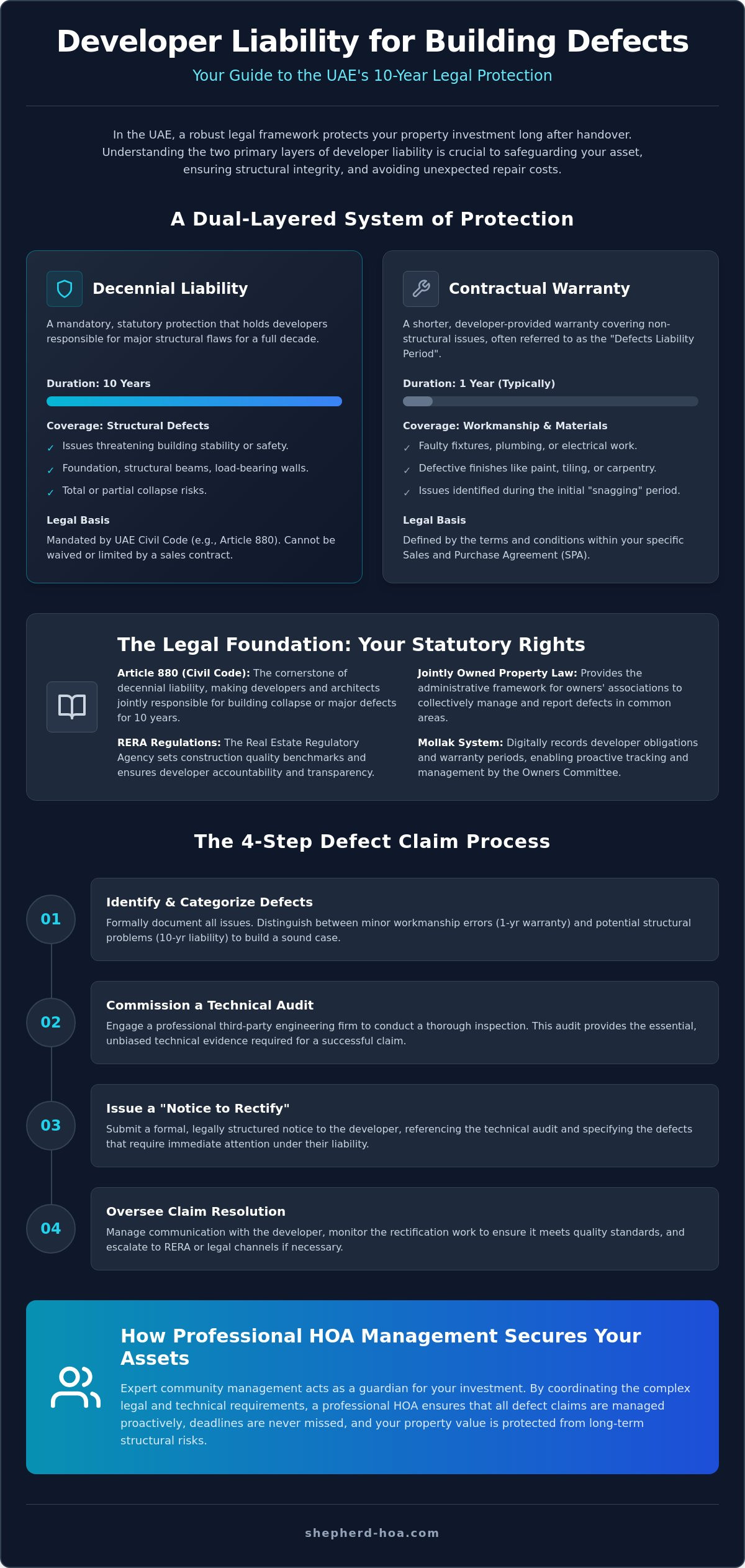
A cornerstone of this protection is Decennial liability, a strict liability regime that holds developers and architects responsible for a period of 10 years. This decade-long window focuses on structural defects that threaten the stability of the building or its "fitness for purpose." Because this is a statutory requirement, developers cannot easily "contract out" of these obligations. If a structural beam fails or the foundation shifts seven years after completion, the developer remains legally tethered to the resolution of that defect. This framework provides a steady backbone for community governance, ensuring that major repair costs don't fall on the owners' association prematurely.
The Real Estate Regulatory Agency (RERA) and the Jointly Owned Property Law provide the administrative muscle to enforce these standards. In 2026, these regulations have evolved to ensure that developer liability for building defects is tracked with high transparency. RERA acts as the primary arbiter, setting the benchmarks for construction quality and ensuring that developers maintain the financial capacity to address future claims. This regulatory oversight transforms vague legal concepts into a functional system of accountability that protects your asset's value from day one.
The Statutory Basis for Property Protection
Article 880 of the Civil Code serves as the primary legal tool for homeowners. It mandates that developers are liable for the total or partial collapse of a building, even if the developer didn't perform the physical labor themselves. This is a critical distinction; the developer's "duty of care" extends to the oversight of every subcontractor on site. Furthermore, this protection isn't limited to the first buyer. The liability follows the property title, ensuring that subsequent owners enjoy the same legal safeguards as the original investor. It's a continuous chain of protection that maintains social harmony within the building.
Why 2026 Regulations Matter for Your Community
Recent updates to building code compliance in 2026 have introduced stricter mandatory insurance requirements for developers. These policies act as a safety net, ensuring funds are available for repairs even if a development company faces financial distress. The Mollak system now plays a central role in this ecosystem by digitally recording developer obligations and warranty periods. This level of organized control allows the Owners Committee to see exactly when liability periods expire, enabling a proactive approach to technical audits and maintenance requests before the statutory clock runs out.
Decennial Liability vs. Contractual Warranties: Knowing Your Protection
Understanding the timeline of developer liability for building defects is the first step in safeguarding your community's financial health. Many homeowners mistakenly believe their protection ends when the initial one-year snagging period expires. In reality, UAE law creates a dual-layered system designed to protect you from both minor inconveniences and catastrophic failures. While developers often try to insert clauses that limit their exposure, statutory protections under the Civil Code usually override these private agreements. Navigating these overlapping timelines requires a methodical approach to documentation and a deep understanding of Owners Association Management to ensure no deadline is missed.
The distinction between structural and non-structural defects is the most important factor in determining who pays for a repair. Developers are the primary point of contact for the Owners Committee, regardless of which subcontractor performed the physical work. This centralized accountability prevents the "blame game" where developers point to plumbers or electricians to avoid their own duties. Professional management by Shepherd HomeOwners' Association acts as an invisible backbone here, keeping the developer focused on their legal obligations rather than allowing them to delegate their responsibilities away. It's about maintaining organized control over the asset's long-term stability through every stage of the liability window.
The 10-Year Structural Guarantee
The 10-year structural guarantee is a mandatory provision that cannot be circumvented by contractual fine print. This coverage ensures that the developer remains responsible for issues that compromise the building's stability or its fitness for its intended purpose, such as foundation settlement, load-bearing wall failures, or roof integrity issues. In the UAE, these protections are non-waivable. While some developers might attempt to cap their financial exposure in the sales agreement, these limitations are rarely enforceable against structural claims. This long-term commitment ensures that the entity that profited from the construction remains accountable for its fundamental safety for a full decade.
The 1-Year Defects Liability Period (DLP)
The Defects Liability Period, or DLP, typically lasts for 12 months following the project's completion. This period covers non-structural elements like Mechanical, Electrical, and Plumbing (MEP) systems, along with cosmetic finishes. It's a high-intensity phase for the Owners Committee. You must identify and report functional failures, such as faulty wiring or leaking pipes, before this window closes. Once the DLP expires, the developer is generally only liable for the 10-year structural items mentioned above. Acting quickly during this first year preserves the community's budget by shifting repair costs back to the builder. If you're unsure if your building is still within its DLP, a professional property handover audit can provide the clarity you need to move forward confidently.
Identifying and Categorising Building Defects for Legal Claims
Building a successful legal case requires more than just pointing out a flaw; it requires a precise technical categorization of the issue. Many homeowners believe they must prove negligence to trigger a claim. However, under the strict liability standards of 2026, developer liability for building defects often applies simply because the defect exists and compromises the property. You don't need to prove the developer was "careless" if the building fails to meet statutory safety or quality benchmarks. This principle of strict liability ensures that the responsibility for a safe living environment remains with the entity that profited from its creation.
Defects generally fall into three distinct categories that dictate how a claim is structured. Design defects are errors in the architectural or engineering specifications, such as a drainage system that cannot handle peak rainfall. Workmanship defects involve poor execution of those plans. This is a growing concern in 2026 as the construction industry faces a shortage of nearly 499,000 skilled workers, often leading to "supervisory negligence" on site. Finally, material defects occur when substandard or non-compliant components are used. With aggregate material prices rising 7.0% year-over-year, some builders may be tempted to cut costs by using inferior alternatives that don't meet 2026 safety standards.
The distinction between patent and latent defects is equally critical for your legal strategy. Patent defects are those visible to the naked eye during a standard walk-through. Latent defects are hidden within the structure, such as improper foundation reinforcement or faulty electrical conduits behind walls. Because latent defects often stay hidden for years, they are the primary reason decennial liability exists. They represent the "invisible threats" to your asset value that require professional technical audits to uncover before they cause significant damage.
Common Signs of Structural Failure
Identifying the early warning signs of failure is a core duty of a proactive Owners Committee. You should look for "active" cracks in the facade, which are often wider than 3mm or show signs of expanding over time, rather than simple cosmetic settling cracks. Water ingress is another major red flag; it often points to a failure in the waterproofing membrane or the building's envelope. Systemic issues in fire safety or HVAC infrastructure also qualify as major defects, as they directly impact the building's fitness for habitation and social harmony.
Documenting Evidence for Your HOA Board
To hold a developer accountable, your evidence must be indisputable. We recommend engaging independent third-party engineers who use advanced tools like thermal imaging to detect heat leaks or drone surveys to inspect unreachable cladding. This technical data should always be cross-referenced with your initial property handover dubai inspection records. By linking current failures to issues noted during the handover, you create a clear timeline that reinforces developer liability for building defects and prevents the developer from claiming the damage resulted from poor maintenance.
The Step-by-Step Process for Pursuing a Defect Claim
Moving from the identification of flaws to a successful resolution requires a methodical and logical approach. The process begins with a formal "Notice to Rectify." This document serves as the official legal foundation for your claim, outlining the specific defects and providing the developer with a clear timeframe to respond. Professional directness here is vital. It signals to the developer that the Owners Committee is acting with organized control and is prepared to enforce developer liability for building defects if necessary. This first step often resolves disputes before they escalate, saving the community significant time and operational stress.
If the developer fails to act, you must gather indisputable evidence. Engage an independent building surveyor or expert snagger to conduct a comprehensive technical audit. This report becomes your primary weapon in mediation or litigation. We recommend seeking mediation through regulatory bodies like RERA before moving toward the courts. This path is generally more efficient and fosters a spirit of social harmony rather than protracted conflict. If these efforts fail, your next step is escalation to the Rental Dispute Center (RDC) or the civil courts for a binding judgment. Once repairs are completed, always ensure the developer provides a new warranty specifically for the remedial works to protect the asset's future value.
The Importance of Timely Reporting
Time is a critical factor in legal success. Article 883 of the Civil Code establishes strict statutes of limitations for defect claims. The legal countdown often begins the moment you have "knowledge of the defect," meaning any delay in reporting could jeopardize your standing. You must act quickly to preserve evidence, especially if emergency repairs are required to prevent further damage. Document the "before and after" of every repair with high-resolution photos and technical logs to maintain a clear chain of accountability. If you need assistance managing these deadlines, our community management services can help you stay compliant and protected.
Leveraging the Mollak System
The mollak dubai portal is a powerful tool for enforcing developer compliance. By reporting non-performance through this official government channel, you create a transparent record of the developer's failure to meet their obligations. This transparency is essential for budget planning and service charge oversight. While some committees consider service charge holdbacks as leverage, these must be handled with extreme care to avoid violating RERA regulations. Integrating your claim data into the Mollak framework ensures that the financial health of the community is protected while you pursue the repairs your property deserves.
How Professional HOA Management Secures Your Property Assets
Understanding the legal framework of developer liability for building defects is the foundation of property protection, but managing the recovery process requires a dedicated partner. Shepherd HomeOwners' Association acts as a watchful guardian for your community, bridging the gap between complex legal requirements and practical technical resolutions. We provide the invisible backbone that allows the Owners Committee to focus on community harmony while we handle the intense coordination required with developer legal teams. Our goal is to replace the operational stress of defect management with a sense of organized control and peace of mind. By maintaining a protective stance toward your collective interests, we ensure that the developer remains accountable for the quality of their work long after the initial sale.
Effective management ensures that your community doesn't just identify problems but solves them through methodical execution. We manage the reserve fund with precision, ensuring that the capital required for technical audits and legal consultations is always available without straining the community's daily operations. This proactive financial oversight is essential for maintaining long-term asset value. By positioning ourselves as a steady, expert guide, we ensure that every interaction with the developer is rooted in transparency and professional integrity. We lead with the specific benefit of asset preservation, explaining the technical mechanisms of the law only to reinforce the results we achieve for the homeowners.
Expert Oversight of the Handover Phase
The handover phase is the most critical window for preventing future liability disputes. Professional snagging during this period ensures that workmanship errors are caught before they evolve into expensive latent defects. We rigorously review "As-Built" drawings against the physical structure to confirm that what was promised in the engineering specs is exactly what was delivered on-site. To maintain a clear chain of evidence, we establish a digital defect tracking log for the entire community. This organized record-keeping ensures that no issue is forgotten and every developer obligation is tracked until a final resolution is reached, providing a comforting cadence to the administrative process.
Financial and Legal Safeguards
Protecting your investment requires a strategic approach to financial planning and risk mitigation. Shepherd HomeOwners' Association ensures that your community service charge budget dubai accounts for necessary maintenance and the potential costs of enforcing developer liability for building defects. Our team excels at tendering third-party contracts for independent building health checks, providing an unbiased assessment of your property's condition that developers cannot easily dispute. This rigorous compliance oversight serves as a definitive solution to the administrative challenges of community governance. If you want to ensure your property is fully protected by an expert partner, contact Shepherd HomeOwners' Association for a professional community audit to secure your asset's future today.
Securing Your Investment for the Decade Ahead
Mastering developer liability for building defects is about more than just legal knowledge; it's about taking proactive steps to preserve your home's structural integrity. You now understand that your protection extends far beyond the initial handover, with statutory decennial liability providing a 10-year shield against major failures. By categorizing defects accurately and following a methodical reporting process, you ensure that the financial responsibility for construction errors remains with the builder rather than your community's reserve fund. This organized approach protects your asset value and ensures long-term stability for all residents.
Maintaining this level of oversight requires a steady and expert partner who understands the nuances of 2026 regulations. Since 2010, we've provided RERA-approved community management and specialized in Mollak compliance and developer handovers. We act as an invisible backbone for your Owners Committee, replacing administrative stress with organized control and transparency. Protect your community’s future with Shepherd HOA management and gain the peace of mind that comes from professional guardianship. Your property asset is your most significant investment; we're here to help you defend its value with confidence and integrity.
Frequently Asked Questions
How long is a developer liable for structural defects in the UAE?
Developers are liable for structural defects for a period of 10 years from the date of building completion. This decennial liability is a mandatory requirement under Article 880 of the UAE Civil Code. it's designed to ensure that the fundamental integrity of your property remains protected long after the initial handover phase is finalized.
Can a developer waive their liability through a contract clause?
A developer cannot legally waive their statutory liability through a contract clause. Any agreement that attempts to limit or remove decennial liability is considered void under UAE law. This statutory protection overrides private contracts to ensure social harmony and the long-term preservation of property assets regardless of what the fine print says.
What is the difference between a patent defect and a latent defect?
Patent defects are flaws that are obvious and visible during a standard inspection, such as cracked tiles or leaking faucets. Latent defects are hidden issues, like improper foundation reinforcement, that only become apparent over time. Because latent defects are harder to spot, they are the primary focus of long-term developer liability for building defects.
What should our HOA do if the developer ignores our defect notices?
If a developer ignores your formal "Notice to Rectify," your HOA should immediately report the non-compliance through the Mollak system. This creates an official government record of the dispute. From there, you can seek mediation through RERA or escalate the matter to the Rental Dispute Center for a binding resolution that enforces repairs.
Does the 10-year liability period restart if the building is sold?
The 10-year liability period doesn't restart when a property is sold; it begins on the date of the building's completion. However, the legal right to pursue a claim for developer liability for building defects transfers to the new owner. This ensures continuous protection for the asset regardless of how many times the property title changes hands.
Who pays for the independent engineering report needed for a claim?
The Owners Association typically pays for the initial independent engineering report using the community's reserve fund. This technical audit is a necessary investment to prove the validity of your claim with concrete evidence. If the claim is successful, these costs are often recoverable as part of the settlement or court judgment against the developer.
Is decennial liability applicable to MEP systems and elevators?
Decennial liability generally doesn't apply to MEP systems or elevators unless their failure leads to the total or partial collapse of the building. These components are usually covered under the one-year Defects Liability Period. For long-term protection, communities must ensure rigorous maintenance contracts are in place once that initial one-year window expires.
How does the Mollak system help in resolving developer disputes?
The Mollak system helps resolve disputes by providing a transparent, digital platform for tracking developer obligations and service charge compliance. It allows the Owners Committee to log non-compliance issues directly with RERA. This organized oversight often encourages developers to settle claims quickly to avoid regulatory penalties or restrictions on their future projects.


Comments