
DIY Community Management Pros and Cons: A 2026 Guide for UAE Boards
- Sohrab Virani

- May 9
- 12 min read
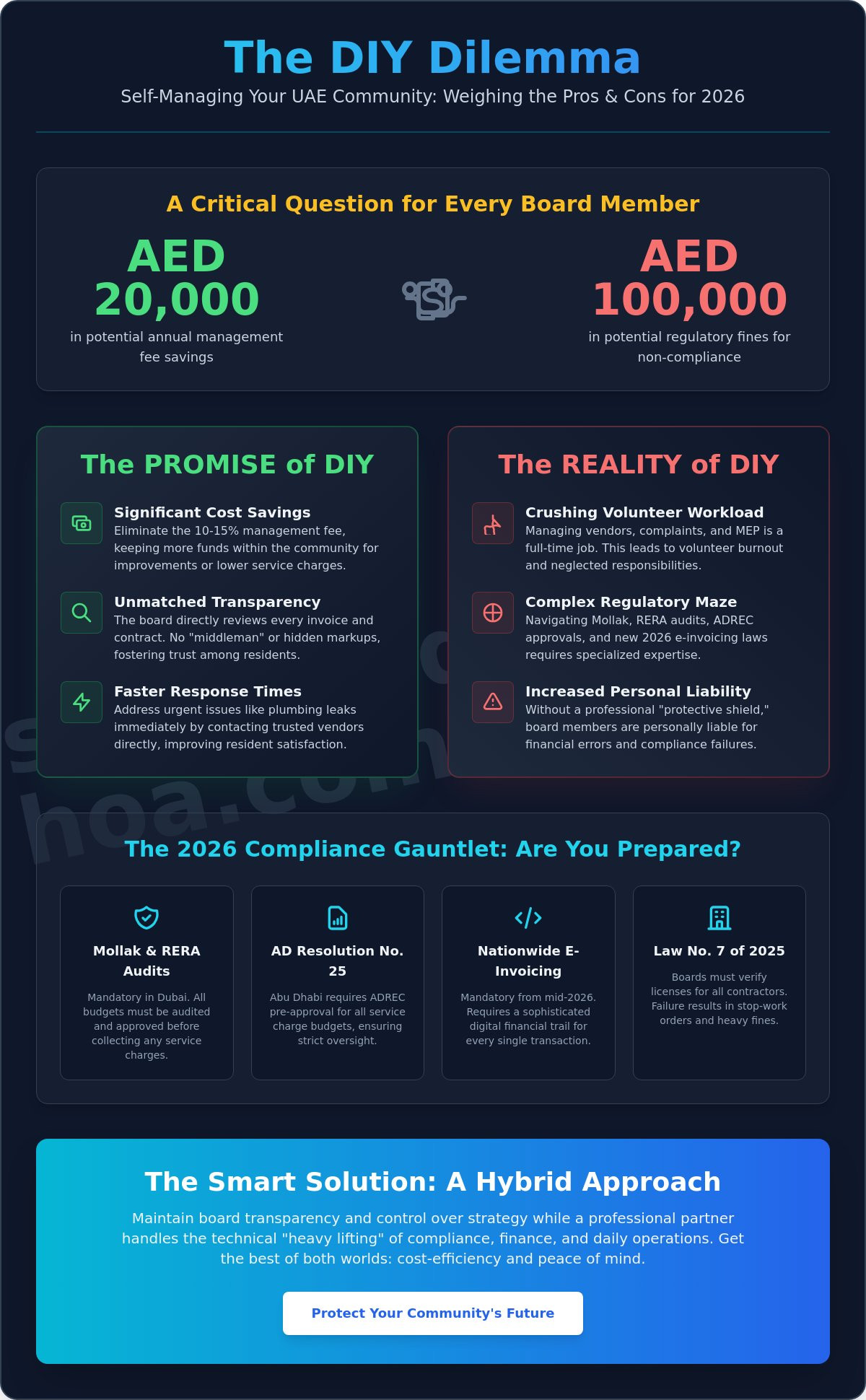
Could saving your community AED 20,000 in management fees actually cost you AED 100,000 in regulatory fines? Many UAE board members feel the weight of rising service charges, which are a constant concern across various developments. You likely want more transparency and lower costs for your neighbors; it's natural to think that doing it yourself is the best way to achieve that. Evaluating the diy community management pros and cons is a responsible step for any board member acting as a protective guardian of their community's assets.
We understand that you want to replace administrative stress with organized control and peace of mind. This guide will show you how to balance potential savings against the strict legal requirements of 2026, such as the mandatory nationwide e-invoicing system and other relevant national regulations. You'll discover if self-management can truly deliver community harmony or if the risk of non-compliance with the country's regulatory frameworks is too high for volunteers to carry alone. We provide a clear look at the operational realities of 2026 to help you protect your property values without the fear of legal oversight.
Key Takeaways
Evaluate the true balance of diy community management pros and cons to determine if immediate service charge savings justify the long-term risk to property values.
Identify the critical compliance traps within the Mollak system and RERA audit requirements that often lead to legal complications for self-managed boards.
Discover how to prevent volunteer burnout by distinguishing between strategic board decisions and the technical "heavy lifting" of facility management.
Learn how the latest 2026 regulations, including mandatory e-invoicing and Abu Dhabi's Resolution No. 25, have increased the personal liability of board members.
Explore a hybrid management approach that maintains board transparency and control while utilizing professional oversight to safeguard community harmony.
Table of Contents
What is DIY Community Management in the UAE Context?
In the UAE, DIY community management occurs when an Owners Committee chooses to handle the daily operations of their building or villa cluster without a licensed third-party firm. It represents a shift from a policy-making board to an executive one. Instead of supervising a manager, the board members themselves become the managers. They take on everything from service charge collection to facility maintenance. While the concept of a Homeowner Association is global, the UAE application is strictly defined by local statutes. Understanding the diy community management pros and cons starts with recognizing that this isn't just about saving money; it's a fundamental change in how your community is governed.
The 2026 landscape has brought this model into focus. Following the "Year of Community" in 2025, the UAE government launched the "Community-Managed Virtual Authority" in January 2026 to empower residents. This initiative, combined with service charges in Dubai ranging from AED 3 to AED 70 per square foot, has pushed many boards to look for ways to trim costs. However, self-management differs significantly from professional owners association management dubai. Professional firms act as a protective shield, providing the specialized expertise that protects the board from personal liability and technical errors.
The Legal Framework for Self-Management
Self-management doesn't mean operating in a regulatory vacuum. In Dubai, the Mollak system remains mandatory, requiring all budgets to be audited and approved by RERA before a single dirham can be collected. Abu Dhabi boards must navigate Administrative Resolution No. 25 of 2025, which mandates ADREC pre-approval for all service charges. These laws ensure that even DIY communities maintain a high level of financial transparency and structural integrity. You aren't just a group of neighbors; you're a registered legal entity with a fiduciary duty to every homeowner in the project.
The Scope of DIY Responsibilities
The workload of a self-managed board is heavy. Daily tasks include managing vendor contracts, responding to resident complaints, and overseeing MEP (Mechanical, Electrical, and Plumbing) repairs. Under Law No. 7 of 2025, boards must ensure every contractor hired for structural or partition work is properly licensed. Failure to verify a contractor's competence can lead to immediate stop-work orders and heavy fines. Additionally, the transition to mandatory nationwide e-invoicing in mid-2026 means boards must now manage a sophisticated digital financial trail for every transaction. It's a full-time commitment that requires a deep understanding of the diy community management pros and cons before your board takes the leap.
The Perceived Benefits: Why Boards Choose the DIY Route
Choosing to self-manage isn't a decision made lightly. Most boards start exploring the diy community management pros and cons when they feel a disconnect between the fees they pay and the service they receive. The most immediate draw is the direct reduction in annual management contract fees. In a market where Dubai service charges can reach AED 70 per square foot, cutting out the management fee can represent a 10% to 15% saving for the community. This capital stays within the association's accounts rather than leaving as an administrative expense.
Transparency is another driving factor. When a board manages its own affairs, every invoice is scrutinized by the people paying the bills. There's no "middleman" slowing down the process or potentially favoring specific vendors. If a pipe bursts in a common area, the board can call a trusted contractor immediately rather than waiting for a management company's procurement department to clear a work order. This speed often leads to higher resident satisfaction because issues are addressed with the urgency that only a fellow homeowner can feel. If you're weighing these benefits against your current workload, a quick consultation with a professional community advisor can help clarify your path.
Cost Savings and Service Charge Reduction
Removing a professional management fee has a cascading effect on the community service charge budget dubai. These saved funds don't just vanish; they can be reallocated to enhance the property. Imagine upgrading gym equipment or installing smart IoT sensors for energy optimization, which can reduce operational costs by up to 30%. In 2026, homeowners are increasingly price-sensitive. A lower service charge makes a property more attractive to potential buyers and tenants alike. However, these savings must be balanced against the administrative burden of using the Mollak system in Dubai to ensure every dirham is accounted for correctly.
Hyper-Local Focus and Community Pride
Residents often feel they understand their community's unique quirks better than an off-site manager. There's a certain pride in "living where you work." When a board member walks through the lobby, they notice the chipped paint or the flickering light because it's their home. This hyper-local focus fosters a sense of shared ownership. It transforms the association from a sterile administrative body into a group of neighbors working toward a common goal of harmony. This volunteer spirit can be contagious, leading to better-attended meetings and a more vibrant, connected neighborhood. Understanding the diy community management pros and cons involves recognizing that this personal touch is something a corporate entity simply cannot replicate.
The Hidden Risks: Where DIY Management Often Falters
While the financial allure of self-management is clear, the hidden costs often outweigh the initial savings. Professional management acts as a protective shield for your community's assets, a role that volunteer boards struggle to fill consistently. When evaluating the diy community management pros and cons, you must account for the "Neighbor Factor." It's incredibly difficult to enforce late payment penalties or noise complaints against the person you share a lift with every morning. This emotional friction often leads to inconsistent rule enforcement, which eventually erodes community harmony and property values.
Personal liability is the most significant risk for any volunteer. Board members carry a fiduciary duty to act in the best interest of all owners. Under the 2026 regulatory framework, including the tightened oversight from the Abu Dhabi Real Estate Centre (ADREC), a single administrative error can lead to personal legal exposure. If a board fails to secure proper insurance or mismanages a major repair fund, they can be held accountable for the resulting financial loss. This burden of protection is heavy, and without professional guidance, it often leads to a sense of overwhelming stress rather than organized control.
Volunteer Burnout and Continuity Issues
Most board members manage their community responsibilities alongside demanding full-time careers. This "free" labor comes at a high cost: burnout. When a dedicated volunteer decides to sell their unit or step down due to exhaustion, they often take years of institutional knowledge with them. Without a professional management firm to maintain a centralized, digital record of every contract and repair, the community faces a "knowledge cliff." This lack of continuity results in erratic service levels and a frantic scramble for information every time the board changes membership.
The Burden of Technical Oversight
Managing a building's life-safety systems or a complex chiller plant requires specialized technical knowledge. Under Law No. 7 of 2025, any DIY project involving MEP or structural changes requires a licensed contractor. Boards without professional procurement expertise often fall into the trap of hiring the cheapest vendor rather than the most competent one. This leads to sub-par repairs that can cause long-term property devaluation. Well-managed communities typically see property values increase by 5% to 15% over time because of proactive, expert maintenance. In contrast, a DIY approach that neglects long-term asset planning can lead to catastrophic equipment failure and emergency levies that frustrate homeowners. Balancing the diy community management pros and cons requires a realistic look at whether your board has the technical bandwidth to be a watchful guardian of the building's infrastructure.
Compliance and the Mollak System: The DIY Stumbling Block
Compliance serves as the ultimate barrier for many volunteer-led initiatives. While the diy community management pros and cons often center on immediate savings, the technicality of the law is where most self-managed projects fail. In Dubai, the Mollak system isn't just an option; it's a mandatory digital gateway for every financial interaction. Boards must navigate the complexity of understanding Mollak dubai to ensure they can legally issue invoices and collect funds. Without this approval, a board has no legal authority to demand payment from homeowners.
The 2026 regulatory landscape has significantly increased the pressure on volunteer boards. With the nationwide e-invoicing system launching in mid-2026, the era of informal record-keeping has ended. Every transaction must now meet strict digital standards. Meeting RERA dubai audit requirements requires a level of financial precision that few volunteers can maintain without professional software or support. If you're feeling overwhelmed by these requirements, you can consult with our experts for seamless Mollak and RERA approval.
Financial Transparency and Auditing
Under national real estate law, every jointly owned property must undergo an independent annual audit. This process ensures that every dirham is spent according to the approved budget. The Mollak system provides a transparent trail that protects owners from mismanagement. DIY boards often fall into the trap of "informal" collections or cash-handling for small repairs. These practices are now high-risk. In 2026, regulators look for a clear, digital path for every expense. Failure to provide this can lead to the suspension of the board's authority and significant financial penalties.
Legal and Regulatory Filings
Compliance is a continuous cycle, not a one-time event. Boards must manage annual reporting, budget submissions, and the complex transition of property handover dubai records. If a developer hasn't fully transferred all technical and financial data, a DIY board may struggle to establish a baseline for its maintenance funds. Non-compliance leads to more than just fines; it can result in stop-work orders or the inability to renew essential building insurance. These failures directly impact property values, turning a well-intentioned cost-saving measure into a significant financial liability. Protecting your community requires a methodical approach to these filings that leaves no room for error.
Transitioning to Professional Oversight: Protecting Your Community’s Future
Deciding between self-management and professional oversight often comes down to a choice between short-term savings and long-term stability. While evaluating the diy community management pros and cons helps clarify your board's capacity, the ultimate goal remains the protection of your community's assets. Professional management acts as a steady guardian, or a shepherd, for your property. It replaces the frantic energy of volunteer-led crisis management with a methodical, logical system designed to preserve property values and ensure community harmony.
The most effective governance model for 2026 is often a hybrid approach. In this model, the board retains its vision and decision-making authority while outsourcing the "heavy lifting" to experts. This allows you to focus on the big picture without getting bogged down in the technical minutiae of service charge collection or MEP maintenance. Professional oversight provides a definitive solution to administrative headaches, ensuring that your community benefits from institutional knowledge and industry-standard efficiencies.
The Value of a Professional Buffer
A professional firm provides an essential ethical buffer between the board and the community. This third-party presence ensures that vendor tendering is transparent and that management decisions are free from personal bias. When conflicts arise, a professional manager handles dispute resolution with an authoritative yet partner-like quality. This maintains living in a dubai community harmony by removing the awkwardness of enforcing rules against neighbors. Additionally, strategic reserve fund planning ensures that your building is prepared for major capital expenditures, preventing the need for sudden, stressful emergency levies.
How Shepherd HOA Simplifies Governance
Shepherd HOA acts as the invisible backbone of the communities we serve. We leverage smart community platforms to drive cost reductions of up to 30% through energy optimization and automated maintenance. Our team handles the entire lifecycle of Mollak compliance and RERA reporting, so you don't have to worry about the legal risks associated with the diy community management pros and cons. We provide the protective oversight needed to navigate 2026 regulations with absolute confidence.
Our approach is designed to instill peace of mind. We lead with results, ensuring that your community’s financial and physical health is always the priority. By choosing a partner that values transparency and integrity, you're not just hiring a service; you're securing your neighborhood's future. It's time to replace the stress of community administration with organized, authoritative control. Speak with a Shepherd expert about your community management needs today to discover how we can help your board excel.
Empowering Your Board for 2026 and Beyond
Navigating the diy community management pros and cons requires a clear vision of your board's long-term goals. While the appeal of direct control is understandable, the 2026 regulatory environment in the UAE demands a level of precision that often exceeds volunteer capacity. We've explored how professional oversight protects you from the personal liability of Mollak non-compliance and the technical risks of sub-par maintenance. By choosing a partner-like management model, you preserve your community's harmony and ensure property values continue to thrive.
Shepherd HOA has provided RERA-approved management since 2010. Our deep expertise in UAE Strata Law and the Mollak system acts as a protective shield for your assets, ensuring every dirham is accounted for through ethical governance. We replace the administrative stress of board life with organized, authoritative control. It's time to step back from the daily heavy lifting and lead your community with confidence. Request a Professional Community Management Consultation to secure your neighborhood's future. You've worked hard to build your community; let us help you protect it.
Frequently Asked Questions
Is self-management legal for community associations in the UAE?
Self-management is legal but carries heavy regulatory requirements under Law No. 6 of 2019 in Dubai and Resolution No. 25 of 2025 in Abu Dhabi. Your Owners Committee must register as a legal entity to manage common areas or sign vendor contracts. While you have the right to manage your property, you're still bound by the same transparency and audit standards as professional firms. Most boards find that the legal complexity requires at least some professional consultancy to stay compliant.
How much can a community save by switching to DIY management?
Most communities save between 10% and 15% of their annual budget by removing professional management fees. However, these savings are often offset by the lack of bulk-buying power that large firms possess. When you analyze the diy community management pros and cons, you must also account for the cost of volunteer time. Technical errors in maintenance procurement or missed energy optimization can quickly lead to higher operational costs that exceed the initial fee savings.
What are the biggest risks for board members in a self-managed HOA?
Personal liability for financial errors or safety breaches is the primary risk for volunteer board members. You carry a fiduciary duty to act in the best interest of all homeowners. Under the 2026 regulatory framework, a failure to secure proper building insurance or hire licensed contractors for MEP work can lead to lawsuits against individual members. This burden of protection is significant; mistakes in governance can lead to property devaluation and legal fines.
Does RERA allow communities to collect service charges without a management company?
RERA allows service charge collection only if the community has an approved budget within the Mollak system. You cannot legally collect funds through personal accounts or informal invoices. A self-managed board must ensure their budget is audited by a RERA-approved auditor and uploaded to the platform. Without this digital approval, your collection efforts have no legal standing, making it impossible to enforce payments against defaulting owners.
What is the Mollak system and can a DIY board access it?
Mollak is the mandatory online system used in Dubai to regulate service charges and ensure financial accountability. A DIY board can access the system, but the submission process is highly technical and requires specific documentation. You must provide audited financial statements and detailed service contracts for approval. Most self-managed boards find the platform's requirements difficult to navigate without professional software or an experienced administrative partner to guide the process.
How do we transition from DIY to a professional management company?
Transitioning starts with a comprehensive audit of your current financial records and vendor agreements. You should appoint a management partner that specializes in property handover to ensure no data is lost. The new manager will register with the relevant authority, such as RERA or ADREC, and take over the legal responsibility for filings. This process usually takes 30 to 60 days to complete properly, ensuring a seamless shift in governance.
Can a professional management company help reduce our current service charges?
Professional managers often reduce service charges by 20% to 30% through optimized procurement and smart building technology. While the management fee is an added cost, the savings found in utility management and preventive maintenance typically result in a lower net service charge for owners. Expert managers use data-driven decision making to eliminate waste in the budget that a volunteer board might overlook during their review of the diy community management pros and cons.
What insurance does a self-managed board need to protect against liability?
A self-managed board must maintain Directors and Officers (D&O) liability insurance to protect individual members from personal financial loss. You also need comprehensive property insurance that includes third-party liability and employer’s liability for any staff you hire directly. Failing to maintain these policies is a major risk. In the event of an accident on the property, lack of adequate coverage can lead to catastrophic financial claims against the association and its board members.


Comments