
Dubai Property Snagging & Inspection Checklist: The 2026 Owner’s Guide
- Sohrab Virani

- Mar 18
- 15 min read
Updated: Mar 25
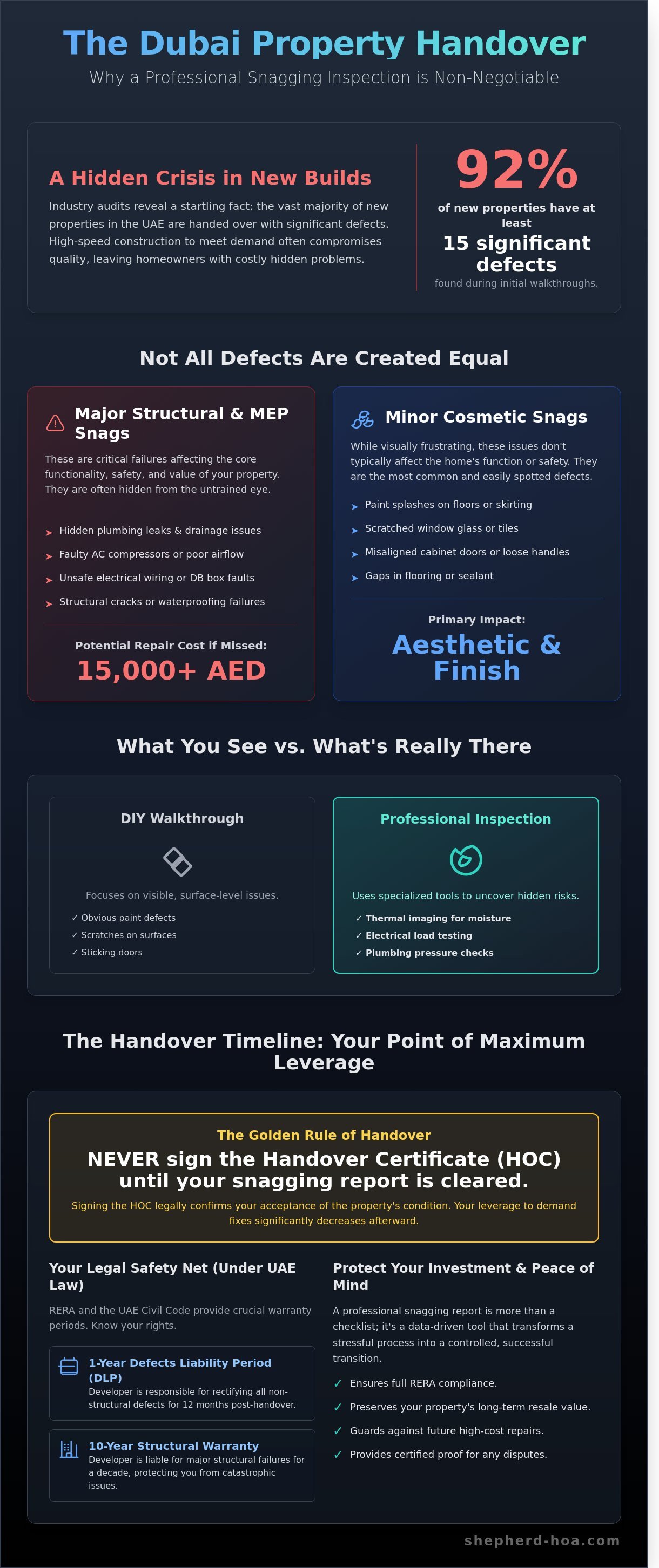
Would you hand over 2,000,000 AED for a luxury villa without checking if the plumbing actually works? Most owners assume a new build is flawless, yet recent industry audits reveal that 92% of new properties in the UAE contain at least fifteen significant defects during the initial walkthrough. Utilizing a professional-grade snagging and inspection checklist Dubai is the only way to protect your investment from hidden structural flaws or MEP failures. It’s natural to feel a mix of excitement and anxiety as your 2026 completion date nears. You’ve worked hard to secure this asset, and you shouldn't have to settle for anything less than perfection because of developer pressure or complex legal jargon.
This guide provides the definitive framework you need to ensure a seamless handover and total peace of mind. We’ll act as your expert guide through the technical landscape of structural integrity and finishing standards. You’ll learn exactly how to identify hidden issues and maintain full compliance with RERA standards before you collect your keys. This methodical approach transforms a stressful administrative hurdle into a controlled, successful transition that preserves the long-term value of your property.
Key Takeaways
Distinguish between minor cosmetic flaws and major structural failures to ensure your investment is fully protected before the final handover.
Utilize a professional-grade snagging and inspection checklist dubai to audit every room and identify high-cost defects in "invisible" MEP systems.
Understand the limitations of a DIY walkthrough and how specialized tools like thermal imaging uncover hidden moisture issues and electrical risks.
Navigate RERA regulations and the UAE Civil Code to confidently enforce your rights regarding 1-year and 10-year developer warranty periods.
Guard your property’s long-term resale value and support community harmony by addressing defects before they impact your service charge efficiency.
Table of Contents What is Property Snagging and Why is it Critical in Dubai? The Ultimate Snagging and Inspection Checklist Dubai Professional Snagging vs. DIY: Making the Right Choice The Legal Framework: RERA Rights and Developer Obligations From Handover to Harmony: Protecting Your Property Value
What is Property Snagging and Why is it Critical in Dubai?
Property snagging is the final line of defense for any homeowner. It's a formal, systematic inspection process designed to identify defects, omissions, or poor craftsmanship before you officially take possession of a new unit. To understand the technical roots of this process, many experts refer to the construction industry standard of What is a snagging list? which serves as a roadmap for contractors to rectify errors. In the context of the Dubai real estate market, this isn't just a courtesy; it's a vital protective measure for your capital.
We categorize these issues into two distinct groups. Minor cosmetic snags include things like paint splashes on skirting boards, scratched window glass, or misaligned cabinet doors. While these are visually frustrating, they don't impact the home's functionality. Major snags, however, involve structural integrity or MEP failures. A faulty AC compressor or a hidden leak in the ensuite plumbing can cost upwards of 15,000 AED to repair if not caught early. By utilizing a professional snagging and inspection checklist dubai, you ensure that these high-stakes issues are documented and resolved at the developer's expense.
The Dubai market in 2026 is moving at a relentless pace. With over 40,000 units scheduled for handover this year alone, construction timelines are tighter than ever. This speed often results in overlooked details and rushed finishes. Rigorous inspections have become a necessity because the volume of delivery increases the statistical likelihood of human error. You aren't being difficult by demanding perfection; you're acting as a responsible guardian of your asset.
Beyond the financial protection, there's a significant psychological benefit. The handover process is naturally high-pressure and can trigger intense anxiety. Professional snagging replaces that stress with organized, data-driven control. Instead of wondering if the water pressure is sufficient or if the balcony drainage works, you'll have a certified report that provides total peace of mind. It transforms you from a nervous buyer into an informed owner who's ready to manage their property with confidence.
The Snagging Timeline: When to Inspect
The ideal window for inspection opens once the developer issues the Completion Certificate but before you attend the final "key collection" appointment. You must never sign the Handover Certificate (HOC) until the items on your snagging and inspection checklist dubai are cleared. Most developers provide a 14-day notice for the walkthrough. Coordinate early to ensure your professional inspector can attend, as this is your primary leverage to ensure the unit meets the promised standards before the final payment is released.
Key Terminology for Dubai Homeowners
MEP (Mechanical, Electrical, Plumbing): These are the "internal organs" of your home. Inspections cover everything from DB box wiring to AC airflow and drainage gradients.
DLP (Defects Liability Period): This is your 12-month safety net. Under Dubai law, developers are usually responsible for non-structural defects for one year after handover.
DLD (Dubai Land Department): The regulatory body that oversees the entire process. They ensure that the handover follows the specific laws governing property sales and consumer protection in the emirate.
The Ultimate Snagging and Inspection Checklist Dubai
A comprehensive snagging and inspection checklist dubai serves as your final line of defense before taking ownership of a new property. It transforms a subjective walkthrough into a technical audit. You're looking for more than just paint chips; you're protecting an investment that often exceeds 2,000,000 AED. By categorizing issues into Critical, Functional, and Cosmetic, you ensure the developer prioritizes repairs that impact your property’s structural integrity and long-term value. Critical snags involve safety hazards like exposed wiring, while functional snags cover items like sticking doors or slow drainage. Cosmetic issues, though frustrating, are purely aesthetic.
Documenting these findings requires a methodical approach to ensure the contractor understands exactly what needs fixing. Use a high-resolution camera to capture every defect, ensuring you include a wide shot for context and a close-up for detail. Digital location tagging is essential in larger villas or apartments where multiple rooms look similar. Marking the physical location with low-tack "snagging tape" helps the site team find the issue quickly, but your digital report remains the primary legal record of the property's condition at handover.
Interior Finishes and Civil Works
Flooring issues often hide beneath the surface. Use a specialized sounding tool or a simple golf ball to identify hollow tiles. These hollow sounds indicate poor adhesive coverage, a defect that leads to cracked tiles within the first 12 months of occupancy. Ensure grouting is uniform and check for lippage, where tile edges sit at different heights, creating a trip hazard. Examine walls for hairline cracks or damp spots, particularly near window frames. In the UAE's coastal climate, these often signal failing seals that lead to 8,000 AED repair bills once the heat intensifies. Test every wardrobe and kitchen cabinet for alignment. Doors should swing freely without catching on the floor or frame, indicating proper hinge installation.
MEP and Technical Systems
Electrical systems require a methodical approach. Test every socket using a plug-in tester to confirm grounding and polarity. Verify that the Distribution Board (DB) has clear, accurate labeling for every circuit to avoid confusion during future maintenance. For plumbing, run all taps for 5 minutes to test drainage speed and water pressure. Look under sinks for the slightest moisture; a tiny leak today becomes a mold colony tomorrow. The HVAC system is your most vital asset. Measure the airflow at each vent. A temperature variance of more than 4 degrees Celsius between rooms suggests ducting issues or poor insulation. These inefficiencies can inflate your DEWA bills by 20% or more over a single summer season.
External Areas and Balconies
Since the record rainfall events in April 2024, balcony drainage has become a high-priority item for Dubai homeowners. Pour a bucket of water on the balcony floor to ensure it flows directly toward the drain and doesn't pool against the sliding door tracks. Inspect glass balustrades for stability; they shouldn't move when firm pressure is applied. Check for scratches in the glass that exceed 25mm in length, as these represent structural weaknesses. For villas, examine the external facade for paint peeling or salt crystallization. These signs indicate moisture ingress from the ground or irrigation systems that can compromise the masonry. Maintaining these standards is easier when you have a partner in community management to oversee common area integrity alongside your private unit.
Professional Snagging vs. DIY: Making the Right Choice
Deciding between a self-guided walkthrough and hiring a specialist is a pivotal moment for any property owner in Dubai. While a basic snagging and inspection checklist dubai helps you identify obvious surface flaws, it rarely uncovers the deep-seated structural or mechanical issues that compromise long-term property value. First-time buyers often underestimate the technical complexity of modern high-rise and villa builds. A specialist brings calibrated equipment that your eyes simply cannot replicate, ensuring your investment is protected from the day you receive the keys.
The DIY Approach: What You Can Catch
Conducting your own inspection provides a sense of personal oversight and saves on immediate costs. You'll likely spot visible paint drips, scratches on parquet flooring, or missing cabinet handles. Testing every tap and flushing every toilet ensures basic functionality is present. This process offers emotional satisfaction, but it's limited to the 20% of the property that's visible. You're effectively checking the aesthetics rather than the integrity of the build.
The Professional Edge: What You Might Miss
Professional inspectors look behind the finishes to find defects that lead to expensive maintenance later. Thermal imaging cameras detect cold air leaks in AC ducting, which can increase your DEWA bills by 15% to 25% annually. Moisture meters identify hidden seepage behind bathroom tiles that eventually causes mold or structural rot. Without a socket tester, you might miss ungrounded electrical points that pose a genuine fire risk to your family. These invisible snags are the ones that cost the most to rectify once the developer's initial liability period ends.
The financial logic for professional intervention is clear. A comprehensive inspection for a two-bedroom apartment typically costs between 1,800 AED and 2,500 AED. This small fee often pays for itself tenfold. Data from local inspection firms show that professional reports identify an average of 80 to 120 defects per unit that homeowners miss. Fixing a single faulty AC compressor or a leaking pipe behind a kitchen wall can easily exceed 15,000 AED. By catching these issues early, you shift the financial burden back to the developer where it belongs.
Professional reports also carry significantly more weight during final negotiations. Developers in Dubai are accustomed to dealing with specialized firms. When you present a stamped, technical report backed by photographic evidence and RICS standards, the developer is far less likely to dismiss your claims as minor or within tolerance. This documentation creates a clear paper trail. It serves as your primary defense if you ever need to escalate a dispute to the Dubai Land Department or the Real Estate Regulatory Agency (RERA). Using a professional snagging and inspection checklist dubai ensures your home is delivered to the standard you were promised.
Thermal Imaging: Detects insulation gaps and AC leaks that raise utility costs.
Moisture Meters: Finds dampness before it ruins your walls or cabinetry.
Socket Testers: Verifies that your electrical system is safe and correctly grounded.
Laser Levels: Ensures floors and walls are perfectly straight and within construction tolerances.
Your home is likely your largest asset. Protecting it requires more than a quick glance. A professional inspection acts as a guardian for your finances, ensuring that moving in doesn't turn into moving into a renovation project. It provides the peace of mind that every component of your property, from the visible tiles to the hidden wiring, meets the required safety and quality standards.
The Legal Framework: RERA Rights and Developer Obligations
The UAE Civil Code, specifically Federal Law No. 5 of 1985, provides the foundational protection for every property buyer in Dubai. It establishes that a developer's responsibility doesn't end when they hand you the keys. This legal framework ensures that the investment you've made is guarded against poor craftsmanship and structural failures. By utilizing a professional snagging and inspection checklist dubai homeowners can rely on, you're not just looking for paint chips; you're exercising your statutory rights to a sound asset.
Article 880 of the Civil Code introduces what's known as Decennial Liability. This is a mandatory 10-year warranty that holds developers and contractors jointly liable for any structural defects that threaten the stability or safety of the building. This protection is non-negotiable and remains in place even if the contract suggests otherwise. It offers a decade of security, ensuring that the heavy lifting of building maintenance doesn't fall solely on the owners' association or individual owners due to original construction errors.
To manage this long-term liability, forward-thinking developers and contractors now rely on digital systems to ensure every aspect of construction, especially critical structural work, is documented and compliant. For instance, managing welding records, a key component of structural integrity, is often automated through platforms like SOCWeld to provide a verifiable paper trail of quality from the ground up.
For non-structural issues, the law typically provides a shorter window. Most sales and purchase agreements (SPAs) in Dubai align with RERA guidelines to offer a one-year warranty on mechanical, electrical, and plumbing (MEP) systems. This period is your primary opportunity to ensure the developer rectifies functional flaws. If a developer refuses to address legitimate snags, they're often in breach of the 2019 Jointly Owned Property Law, which demands that developers deliver units in the promised condition. Clear documentation is your best tool here; a detailed report serves as an objective record that's difficult for any developer to dismiss.
The Defects Liability Period (DLP)
The standard 12-month DLP covers everything from faulty light switches to poor cabinet alignment. It's a critical phase where the developer must fix "latent defects" that weren't visible during the initial handover. You must log every issue through the developer's official maintenance portal or via registered email to create an undeniable paper trail. It's vital to keep your original snagging and inspection checklist dubai report as a baseline. This document proves whether a crack in the tile was present on day one or if it developed six months later, which clarifies who's responsible for the repair costs.
Escalating Disputes to RERA
When a developer becomes unresponsive or disputes their liability, the Real Estate Regulatory Agency (RERA) acts as the mediator. You don't need to hire a lawyer immediately; you can file a formal dispute through the Dubai REST app. This digital platform simplifies the process, allowing you to upload your evidence and track the case status. Legal precedents in Dubai courts have shown that significant unrectified snags can legally justify a delay in the final payment or handover, provided the owner can prove the unit is "unfit for its intended purpose." RERA's intervention often prompts developers to settle issues quickly to avoid fines or blacklisting.
The Mollak system plays a silent but powerful role in this process. Introduced by Law No. 6 of 2019, it brings total transparency to service charges and community management. It ensures that the developer has fulfilled their obligations before they can even request service charge approvals. This system protects the community's harmony by ensuring that the developer doesn't offload their construction-related repair costs onto the homeowners' service charge budget. This oversight maintains property values and ensures that your community starts on a solid financial and physical footing. To ensure your investment remains secure from the first day of ownership, you should protect your community's long-term value through professional oversight and management.
From Handover to Harmony: Protecting Your Property Value
Receiving your keys marks a major milestone. It isn't the end of the process. It's the start of your responsibility as a Dubai homeowner. Using a comprehensive snagging and inspection checklist dubai during this window protects your financial interests for years. If you overlook a structural crack or a faulty HVAC seal now, you'll pay for it later through personal repair bills or inflated community service charges. Your unit's health is intrinsically linked to the building's overall performance.
Service charges in Dubai typically range from AED 12 to AED 30 per square foot. These fees cover the maintenance of shared elevators, gyms, and cooling systems. When individual units are poorly inspected during handover, the entire building's mechanical efficiency often drops. This puts unnecessary strain on communal resources. Shepherd HomeOwners' Association steps in during this transition to ensure the developer delivers a building that functions at peak performance. We act as a bridge, reducing the likelihood of unexpected fee hikes for the Owners Committee by holding developers accountable for their construction obligations.
Before you move furniture, you must finalize three administrative steps. First, activate your DEWA account; expect to pay a refundable deposit of AED 2,000 for apartments or AED 4,000 for villas. Second, if you're an investor, register the tenancy contract via Ejari for approximately AED 220 plus VAT. Third, apply for a Move-In Permit through your building’s management portal. Most Dubai developers require 48 hours' notice before allowing moving trucks on site. This organization prevents chaos in the loading bays and protects the lobby finishes.
Joining the Owners Association
You have a legal right to join the Owners Committee. This group provides oversight on how your service charges are spent. Professional community management is the most effective way to preserve your asset’s resale value. Data shows that well-managed buildings in areas like Dubai Marina or JLT maintain 12% to 15% higher valuation than those with neglected common areas. Shepherd HomeOwners' Association provides the fiduciary oversight needed to keep operational costs low while keeping standards high. We ensure that unit maintenance and community costs stay balanced through proactive planning.
Final Handover Checklist: The Last 24 Hours
Your final day of the handover process requires focused attention. You aren't just looking for paint chips; you're verifying that the developer actually fixed the 40 or 50 items identified in your initial report. This is the "de-snagging" phase. Do not sign the final handover document until every major functional issue is resolved. Once you sign, the liability for minor cosmetic issues often shifts to you.
Check that all "de-snagging" repairs meet professional standards.
Collect every set of keys, including balcony, window, and mailbox keys.
Obtain all access cards for the gym, pool, and gate barriers.
Request the physical copies of appliance warranty manuals and AC maintenance logs.
Verify the final meter readings for DEWA to ensure you aren't paying for the developer’s construction utility usage.
Secure Your Dubai Investment for 2026 and Beyond
Your property handover marks the transition from a financial commitment to a tangible asset. Using a comprehensive snagging and inspection checklist dubai ensures you don't inherit the developer's unfinished business. This process isn't just about cosmetic fixes; it's about protecting your long-term property value under RERA guidelines. By identifying structural or mechanical faults before signing the final papers, you save yourself from future maintenance costs that can easily exceed AED 15,000 for minor oversights.
Success in the Dubai market requires a partner who understands the specific regulatory landscape. With over 15 years of Dubai real estate experience, Shepherd HOA provides the steady oversight needed to navigate complex per-unit handovers. We act as your expert guide, ensuring every detail meets the highest standards of compliance and quality. Our RERA-approved management team removes the stress of administrative hurdles, allowing you to focus on the joy of ownership.
Let Shepherd HOA guide your property handover to success with our specialized per-unit management services. You've worked hard for this investment; let's make sure it's delivered exactly as promised.
Frequently Asked Questions
How long does a typical snagging inspection take in Dubai?
A professional snagging inspection typically takes between 2 and 4 hours for a standard apartment and up to 7 hours for a large villa. This timeframe allows experts to examine every detail from MEP systems to cosmetic finishes. Using a comprehensive snagging and inspection checklist dubai ensures that no structural or aesthetic defect is overlooked during this critical window, providing you with a reliable baseline for your property's condition.
Can I move into my property before the snags are fixed?
You can move into your property before snags are resolved, but it's rarely advisable for long term peace of mind. Once you move your furniture in, proving that a scratch or dent was the developer's fault becomes significantly more difficult. Most owners wait the standard 14 to 21 days it takes for a developer to complete the initial rectification list to protect their investment's value and ensure a seamless transition.
Does the developer have to fix everything on my snagging list?
Developers are legally obligated to rectify all legitimate defects identified during the handover process. Under UAE law, most contracts include a one year Defects Liability Period for minor issues and a 10 year structural warranty. We recommend documenting every finding clearly to ensure the developer meets their contractual duty of care to provide a defect-free home. This oversight acts as a protective shield for your new community investment.
What happens if I find a major leak after I have already moved in?
If you discover a major leak after moving in, you must notify the developer's maintenance team immediately through their official portal. Since most properties carry a 365 day warranty for MEP systems, the developer is responsible for the repair costs. Keep a record of the incident and the response time to ensure your rights are protected. Acting as a watchful guardian of your asset ensures these issues don't compromise your home's stability.
Is professional snagging mandatory for off-plan properties in Dubai?
Professional snagging isn't a legal requirement in Dubai, but 95% of savvy investors hire experts to safeguard their assets. Relying on a professional snagging and inspection checklist dubai helps identify hidden issues like poor insulation or faulty wiring that an untrained eye might miss. Skipping this step often leads to higher maintenance costs once the initial warranty period expires, making it a vital step for financial protection.
How much does professional property snagging cost in 2026?
In 2026, professional snagging services in Dubai typically range from AED 1,500 for a studio to AED 4,500 for a five bedroom villa. These prices reflect the specialized equipment used, such as thermal imaging cameras and moisture meters. Investing this amount early prevents the much higher costs associated with repairing structural defects out of your own pocket later. It's a small price to pay for the organized control of your property's future.
What is the difference between snagging and a home inspection?
Snagging focuses on identifying defects in brand new properties before handover, while a home inspection is a deeper dive into the condition of a secondary market home. A snagging report highlights cosmetic and functional issues for the developer to fix. A home inspection evaluates the long term health of older systems, providing a clear picture of future maintenance liabilities. Both services aim to instill confidence and ensure transparency for the property owner.
How do I set up my DEWA account after the handover is complete?
You can activate your DEWA account online via the official website or smart app using your Title Deed or Oqood and Emirates ID. The process requires a security deposit of AED 2,000 for apartments or AED 4,000 for villas. Once you submit the application and pay the connection fees, your water and electricity services are usually activated within 24 hours. This straightforward digital process ensures your home is ready for immediate occupancy without administrative headaches.


Comments