
HOA Budget Planning Guide 2026: A Strategic Roadmap for Community Boards
- Sohrab Virani

- Apr 15
- 12 min read
Updated: Apr 16
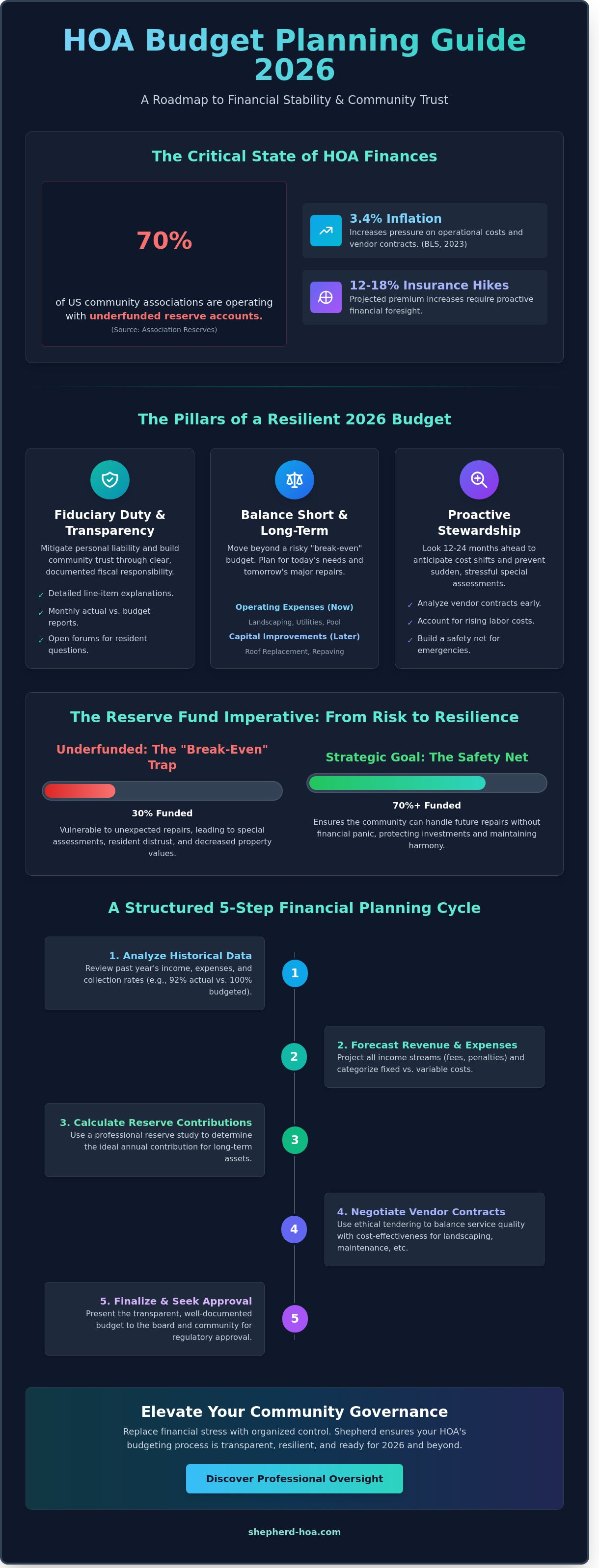
Did you know that approximately 70% of community associations across the United States are currently operating with underfunded reserve accounts according to data from Association Reserves? This statistic represents more than just a line item; it's a direct threat to the long-term stability of your neighborhood. As a volunteer board member, you likely feel the pressure of this responsibility as you navigate the 3.4% inflation rate reported by the Bureau of Labor Statistics in 2023. This hoa budget planning guide 2026 is designed to act as a steady guide, replacing that stress with organized control and professional oversight.
You probably agree that protecting property values shouldn't come at the cost of community harmony or resident trust. We promise to help you master the complexities of financial management with a strategy for resilient and transparent budgeting. This roadmap details how to audit your current standing, negotiate vendor contracts effectively, and achieve the seamless regulatory approval your board deserves for the upcoming fiscal year.
Key Takeaways
Learn how to build a resilient financial roadmap using our comprehensive hoa budget planning guide 2026 to ensure long-term community stability.
Discover how to master reserve fund requirements and identify diverse revenue streams to protect your neighborhood from unexpected special assessments.
Gain strategies for balancing operational costs through ethical tendering and the strategic categorization of fixed and variable expenses.
Establish a structured financial planning cycle that leverages historical data and clear timelines to streamline your board’s decision-making process.
Understand the value of professional oversight in navigating complex RERA regulations to maintain transparency and preserve property values.
Table of Contents The Pillars of HOA Budget Planning in 2026 Forecasting Revenue and Mastering Reserve Fund Requirements Analyzing Operational Expenses: Balancing Quality and Cost A Step-by-Step Financial Planning Cycle for HOA Boards Elevating Community Governance with Shepherd HOA
The Pillars of HOA Budget Planning in 2026
HOA budget planning is the formal process of estimating annual income and expenses to ensure community stability. It's the most critical task your board performs each year. By 2026, the budget must serve as a strategic roadmap for both the physical and financial health of your neighborhood. It's no longer enough to simply match last year's spending. This hoa budget planning guide 2026 helps you transition from reactive spending to proactive stewardship. A well-constructed budget acts as a guardian for your community, ensuring that common areas remain pristine and property values stay high. When homeowners ask What is an HOA?, the answer should reflect a professional organization dedicated to protecting their largest investment through disciplined financial oversight.
The year 2026 brings unique challenges that require a shift in mindset. With insurance premiums projected to rise by 12% to 18% in many regions and labor costs for maintenance increasing steadily, boards can't afford to be passive. Proactive stewardship means looking ahead at the next 12 to 24 months and preparing for these shifts before they impact your cash flow. This foresight prevents the sudden, stressful special assessments that can fracture community harmony.
Fiduciary Responsibility and Board Duty
Board members hold a legal and ethical obligation to manage association funds with the same care they'd use for their own finances. This fiduciary duty is the foundation of your role. Professional budget planning mitigates personal liability for volunteers by providing a clear, documented paper trail of fiscal responsibility. It shows that you've acted in good faith and with due diligence. Transparency is your best tool for maintaining trust during the 2026 cycle. You should aim to provide:
Detailed line-item explanations for assessment increases.
Monthly financial updates that compare actual spending to the budget.
Open forums where residents can ask questions about the community's 5-year financial trajectory.
Balancing Short-Term Needs and Long-Term Stability
It's vital to distinguish between daily operational costs and future capital improvements. Operating expenses cover the "now," such as landscaping, pool chemicals, and utilities. Capital improvements are the "later," including roof replacements or road repaving. Many boards fall into the trap of a "break-even" budget, which leaves zero margin for error. This approach is a significant risk to the community’s long-term health. If an unexpected pipe bursts or a storm causes $10,000 in damage, a break-even budget fails. Strategic boards set financial goals that align with a 5-year vision, ensuring that reserves are funded at 70% or higher to handle future repairs without financial panic. This hoa budget planning guide 2026 encourages you to build a safety net that provides peace of mind for every resident.
Forecasting Revenue and Mastering Reserve Fund Requirements
Reliable budgeting begins with a clear view of where every dollar originates. For your hoa budget planning guide 2026, you shouldn't rely on guesswork. Revenue streams extend beyond basic service charges to include late payment penalties, move-in fees, and amenity bookings for community spaces. Boards that track these secondary income sources accurately can often offset minor inflationary increases in vendor contracts without raising primary fees.
Accurate Revenue Modeling
Projecting 2026 income requires a deep dive into the 2025 collection data. If your community saw a 92% collection rate last year, don't budget for 100% in 2026 without a concrete plan to address delinquencies. New developments must account for unit handovers and the transition from developer control to owner-funded operations. To ensure compliance and clarity, boards are increasingly using Mollak service charge management. This system provides a transparent framework for invoicing and helps maintain the fiduciary trust required for smooth community governance. It's a tool that replaces administrative stress with organized, verifiable data.
The Science of the Reserve Study
A reserve study isn't just a suggestion; it's the financial backbone of your community. By 2026, the cost of labor and raw materials for major repairs like roof replacements or elevator overhauls will likely be higher than in previous cycles. You must analyze the remaining useful life of assets like HVAC systems and pools to calculate the ideal annual contribution. Following HOA budget best practices ensures you maintain a funding level that prevents the need for emergency special assessments. These assessments are often the primary source of friction between boards and homeowners.
When residents question a contribution increase, frame it as a strategy to protect their property values. It's an investment in the building's longevity, not just another bill. A well-funded reserve protects the community from the shock of sudden, large scale repairs. Effective communication here is vital for maintaining harmony. To keep your community's financial health in peak condition, you can explore management tools that simplify these complex calculations for you.
Managing delinquency rates is the final piece of the revenue puzzle. A proactive approach includes:
Implementing automated payment reminders 15 days before the due date.
Offering flexible payment plans for owners facing temporary financial hardship.
Reviewing the 2026 legal budget to ensure it covers necessary enforcement actions.
Applying late fees consistently to discourage chronic payment delays.
By treating revenue forecasting as a precise science rather than a series of estimates, your board can enter the 2026 fiscal year with confidence. This methodical approach ensures that your hoa budget planning guide 2026 serves as a true roadmap for stability and growth.
Analyzing Operational Expenses: Balancing Quality and Cost
Operational expenses form the largest portion of your community's annual spend. Effective management requires a clear distinction between fixed costs and variable expenses. Fixed costs, such as management fees and basic security contracts, remain steady. Variable costs, including seasonal landscaping or emergency repairs, require more flexible forecasting. This hoa budget planning guide 2026 provides the framework to maintain this balance without sacrificing the community's aesthetic or safety standards.
Professional oversight protects your board from overpaying for facility management. When a community operates without a clear audit of its service levels, costs often creep upward by 5% to 10% annually without a corresponding increase in quality. Regular reviews of insurance premiums are also vital. With property insurance rates in some regions seeing 20% increases between 2024 and 2025, your 2026 budget must account for these adjusted market realities early in the planning phase. Taking a proactive stance ensures that your community remains a secure and desirable place to live.
Managing Inflationary Pressures in 2026
Utility trends suggest that energy and water costs will continue to fluctuate through the coming year. Boards can offset these increases by implementing energy-saving measures, such as smart irrigation controllers which can reduce water waste by 20% or more. To secure financial stability, negotiate multi-year vendor contracts by the fourth quarter of 2025. This strategy locks in 2026 rates and protects the association from sudden price hikes. As part of your hoa budget planning guide 2026, you must also address the hidden costs of aging infrastructure. Communities over 20 years old often face a 15% rise in maintenance needs as mechanical systems reach the end of their expected lifecycle.
The Ethics of Vendor Tendering
A transparent bidding process is the cornerstone of fiduciary responsibility. It ensures the board acts as a faithful steward of neighbor funds. You should obtain at least three competitive bids for any major project or service contract. This process prevents the appearance of favoritism and guarantees the community receives the highest value rather than just the lowest price. Choosing the cheapest option often leads to service degradation, eventually costing more in corrective repairs. Your management company serves as a vital partner here, vetting vendor compliance and ensuring all contractors carry appropriate liability insurance and licenses. This professional guidance provides the peace of mind that your community remains protected and well-maintained.
Fixed Expenses: Management fees, insurance premiums, and scheduled debt service.
Variable Expenses: Snow removal, pool chemical treatments, and minor common area repairs.
Contract Review: Audit all service level agreements (SLAs) to ensure vendors meet 100% of their obligations.
A Step-by-Step Financial Planning Cycle for HOA Boards
Financial stability doesn't happen by accident. It requires a methodical approach that starts long before the first check is signed in January. For your hoa budget planning guide 2026, the first step is appointing a dedicated budget committee. This group should ideally include the treasurer and at least two volunteers with financial or project management backgrounds. By delegating the initial analysis to a specialized team, the full board can focus on high-level strategic decisions rather than getting bogged down in line-item debates during general meetings.
The 2026 Budget Timeline
Successful boards begin their cycle 4 to 6 months before the fiscal year ends. For a January 1 start date, your first committee meeting should occur no later than August 15, 2025. This window allows for three distinct phases: data collection, draft refinement, and the 30-day legal notification period required by most bylaws. Aligning this schedule with owners association management best practices ensures you aren't rushing to meet statutory deadlines or overlooking critical vendor price increases that typically surface in the fourth quarter.
The drafting phase must be rooted in reality. The committee should analyze three years of historical data alongside 2025 year-to-date performance reports. If utility costs rose 12% in the previous year, don't assume they'll level off in 2026. Draft your revenue conservatively. Relying on "other income" like late fees or clubhouse rentals can create a deficit if those numbers fall short. Focus on realistic expenses, especially for aging infrastructure that may require more frequent repairs as the community matures.
Communicating the Budget to Residents
Transparency builds trust and reduces friction during the approval process. When you present the 2026 figures, move beyond dense spreadsheets. Use clear charts and visual aids to show exactly where every dollar goes. We view the board as a shepherd of the community assets. This role involves a duty of care to protect property values, which sometimes requires unpopular but necessary fee adjustments to maintain the neighborhood's standards.
Host Town Halls: Schedule a meeting at least 14 days before the final vote to address concerns.
Visual Data: Use pie charts to show the split between reserves, utilities, and maintenance.
The "Why" Factor: Explain the specific projects or inflationary pressures driving changes.
This proactive communication prevents the budget from feeling like a surprise. It positions the board as a steady, expert guide focused on long-term stability. Following this hoa budget planning guide 2026 helps ensure that by the time the final vote occurs, the community understands the necessity of the figures presented.
Ensure your community remains financially resilient by implementing these steps early.
to save your team hours of manual work and provide total financial clarity.
Elevating Community Governance with Shepherd HOA
Managing a homeowners association shouldn't feel like an exhausting second career. Shepherd HOA acts as the invisible backbone of a healthy community, providing the structural support and calm reliability that boards need to thrive. This hoa budget planning guide 2026 emphasizes that professional management is no longer a luxury; it's a necessity for long-term property value preservation. We provide the expert guidance required to navigate the complex RERA regulations that define Dubai's real estate market. Our systems ensure every dirham is accounted for through advanced financial reporting, replacing the stress of manual spreadsheets with organized control.
By partnering with Shepherd HOA, your board gains a watchful guardian that values transparency above all else. We understand the personal stakes involved in neighborhood governance. Our team works to ensure your 2026 budget season is seamless and predictable. We lead with results, using a methodical approach that mirrors the structure of a well-run board meeting. This allows you to fulfill your fiduciary duties without the typical administrative headaches that plague volunteer leaders.
Expertise in Administrative Compliance
Administrative tasks often drain the energy of even the most dedicated volunteer board members. We handle the heavy lifting by navigating the Mollak system to ensure transparent and approved service charge invoicing. This system is critical for maintaining the legal standing of your community. Our team prepares detailed quarterly progress reports that satisfy both residents and regulators. These reports provide a clear audit trail and build trust within the community. By automating these essential functions, we reduce the administrative burden on you. You can focus on high-level community decisions while we manage the technical compliance requirements that keep the association running smoothly.
The Shepherd Approach to Financial Stewardship
We combine modern technology with traditional service values to protect your community's financial health. Our partner-like quality makes us the ideal choice for your hoa budget planning guide 2026 strategy. We don't just offer a software solution; we provide a steady, expert guide that acts as a protective shield for your assets. Our communication is direct and functional, designed to give you peace of mind through every fiscal quarter. We believe that community harmony starts with financial integrity. To ensure your neighborhood remains a premier destination for years to come, request a community service charge budget consultation today. Let's work together to make 2026 a year of stability and growth for your residents.
Take Command of Your Community's 2026 Fiscal Strategy
Effective financial leadership requires more than just balancing spreadsheets; it demands a proactive stance against market fluctuations. This hoa budget planning guide 2026 highlights the necessity of precise reserve fund forecasting and the rigorous analysis of operational costs to protect property values. Boards must follow a disciplined 12 month financial cycle to ensure transparency and full compliance with RERA Law No. 6 of 2019. As a RERA approved community management firm, Shepherd HOA provides the steady hand your board needs to manage these responsibilities. We specialize in expert Mollak system integration to streamline your mandatory filings and financial reporting. Being a 100% Emirati owned company, we bring deep local expertise to every community we protect. You don't have to navigate these complex regulatory requirements alone. Our team acts as a watchful guardian for your neighborhood assets, ensuring long term stability through proven fiscal strategies. We're here to help you turn administrative burdens into a clear roadmap for success.
Your board has the power to create a thriving, well funded environment where every homeowner feels secure.
Frequently Asked Questions
What are the main components of an HOA budget in 2026?
An effective budget consists of three primary pillars: operating expenses, reserve contributions, and a contingency fund. In 2026, boards must account for utility inflation, which averaged 4.5 percent in 2024 according to Bureau of Labor Statistics data. This ensures your hoa budget planning guide 2026 accounts for rising vendor costs and insurance premiums. It's about balancing daily needs with long term financial health to maintain community standards.
How much should an HOA contribute to its reserve fund annually?
Most industry experts, including those from the Community Associations Institute, recommend funding reserves at 70 percent to 100 percent of the fully funded balance. This usually requires allocating 15 percent to 40 percent of total annual assessment income to the reserve account. Maintaining these levels prevents the need for sudden special assessments when major infrastructure, like a roof or elevator, fails unexpectedly.
Can an HOA board increase service charges without resident approval?
Boards can typically increase assessments by a specific percentage, often 10 percent to 20 percent annually, without a community vote based on your CC&Rs and local laws. For example, California Civil Code Section 5605 limits increases to 20 percent per year. You should always review your governing documents before finalizing the 2026 fiscal plan. This ensures your board remains compliant while meeting its fiduciary duties to the community.
What happens if our HOA budget is not approved by RERA?
Failure to receive RERA approval can result in administrative fines and a legal freeze on collecting service charges. Under Law No. (6) of 2019 in Dubai, boards must submit audited financials to the Mollak system for validation, a process often facilitated by Bin Hamad Mathew Joseph and Associates Chartered Accountants. Without this certification, the association cannot legally enforce payment from owners. This creates a significant risk to community maintenance and can halt essential services like security and cleaning.
How can we reduce our community’s operational costs in 2026?
Implementing smart irrigation systems can reduce water consumption by 30 percent according to EPA WaterSense studies. Boards should also transition to LED lighting, which uses 75 percent less energy than traditional bulbs. Reviewing vendor contracts every 3 years ensures you're receiving competitive market rates for landscaping and security. These proactive steps lower monthly bills and help stabilize assessments for all homeowners in the community.
Is professional community management a budgeted expense?
Professional management is a standard operating expense that typically accounts for 10 percent to 15 percent of an association's total budget. This investment provides the administrative backbone needed to manage vendor relations and financial reporting accurately. It's a reliable way to protect property values and ensure the board's fiduciary duties are met. Expert guidance helps volunteer members avoid costly legal mistakes and administrative headaches.
How often should an HOA conduct a formal reserve study?
Boards should conduct a professional reserve study every 3 years to maintain financial accuracy and compliance. Some jurisdictions, like Washington state under RCW 64.38.065, mandate these updates to protect homeowners from financial surprises. Regular studies provide a 30 year outlook on major repairs. This allows the board to adjust contributions incrementally before a financial shortfall occurs, keeping the community on a stable path.
What is the difference between the general fund and the reserve fund?
The general fund covers daily operating costs like pool chemicals and landscaping, while the reserve fund is a savings account for long term capital projects. Using this hoa budget planning guide 2026, boards can distinguish between recurring monthly bills and once a decade expenses like repaving parking lots. Clear separation between these funds ensures the community's long term stability and protects the financial interests of every resident.


Comments