
HOA Waste Management Contract Guide: 2026 Governance & Logistics
- Sohrab Virani

- Jun 27
- 12 min read
Your community’s waste management contract shouldn't be a source of financial stress; it should be a guardian of your property’s long-term value. Many boards in the UAE currently face unpredictable service charge escalations and frequent resident complaints regarding hygiene, leaving them feeling like they've lost control of their overheads. This hoa waste management contract guide provides a clear path to reclaiming that authority through structured governance and logistical precision. It's time to move beyond basic collection and toward a professional framework that prioritizes transparency and asset preservation.
We understand the weight of your administrative responsibilities, especially when you're trying to balance resident satisfaction with strict RERA compliance. In this guide, you'll learn how to negotiate terms that reduce service charge pressure and implement AI-driven auditing to ensure every dirham is accounted for. We'll walk through the essential logistics of 2026, from digital performance tracking to sustainable disposal methods that meet national regulations. By the end of this article, you'll have the tools to establish a waste management system that functions as a silent, efficient backbone for your entire community.
Table of Contents
Scaling Waste Management for Modern Large-Scale Communities
Large-scale waste management is far more than a simple collection schedule; it's a sophisticated logistical and governance framework designed to protect the health and financial stability of a community. In the UAE’s high-density towers and sprawling master developments, the traditional "dump and haul" approach often fails. This outdated method doesn't account for the massive volume of refuse or the specific flow of waste within a complex environment. When collection systems aren't scaled correctly, they lead to hygiene bottlenecks that quickly erode resident satisfaction and property appeal. Using this hoa waste management contract guide helps boards transition from reactive cleaning to proactive oversight.
Adopting a "Guardian" mindset means viewing waste management as a protective measure for your community’s most valuable assets. Efficient systems don't just keep the bin rooms clean; they preserve the long-term market value of the property by preventing the physical degradation of common areas and maintaining a premium living standard. To understand the full scope of these operations, it's helpful to review a comprehensive overview of waste management, which outlines the complex journey from initial collection to final treatment and disposal. Professional oversight ensures that every step of this journey is optimized for both cost and cleanliness.
The Hidden Costs of Inefficient Waste Systems
Inefficient waste systems create a ripple effect of financial strain that many boards overlook until it's too late. Poorly managed bin rooms or irregular pickups lead to secondary expenses, such as increased pest control treatments and premature wear on waste chutes and compactors. These preventable costs directly impact your community service charge budgets, often leading to deficits that are difficult to recover without raising fees. Logistical waste is the primary driver of budget overruns. This occurs whenever a provider charges for inefficient routes, underutilized equipment, or unnecessary pickups that don't align with actual community needs.
Identifying Community-Specific Waste Profiles
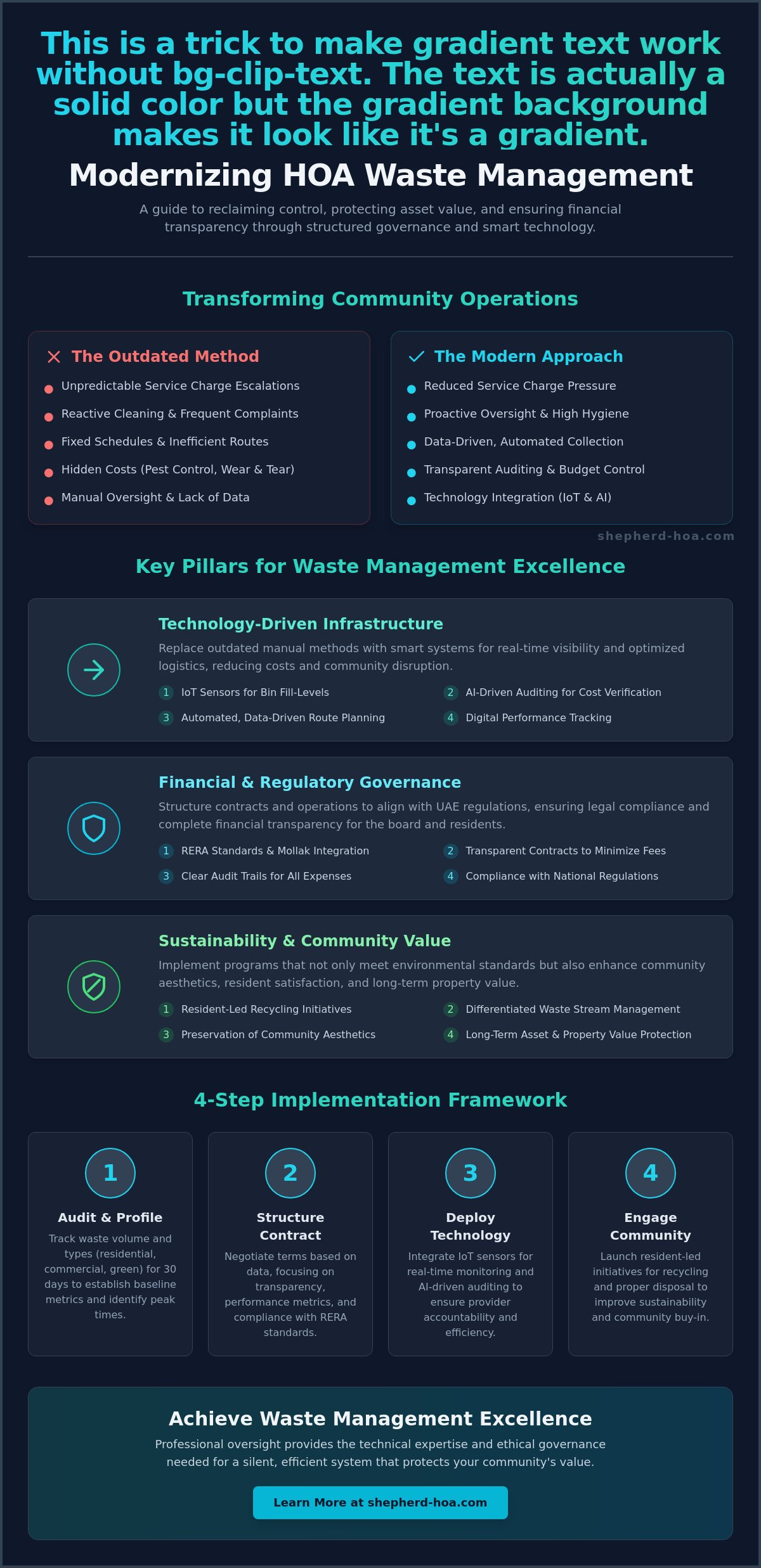
Every development has a unique footprint that requires a tailored approach. A successful hoa waste management contract guide starts with a detailed audit to understand exactly what your community produces. You should begin by tracking volume trends over a 30-day period to identify peak disposal times. It's also vital to differentiate between residential, commercial, and green waste requirements, as each stream carries different disposal costs and regulatory demands. Setting these baseline metrics is essential for meeting national sustainability reporting standards, ensuring your community remains compliant with evolving UAE environmental regulations while providing a clear audit trail for financial transparency.
Implementing Technology-Driven Collection Infrastructure
Modern community governance requires a shift from manual oversight to automated, smart systems that provide real-time visibility into waste operations. In high-density Dubai developments, relying on fixed collection schedules often results in either overflowing bins or unnecessary truck visits. This hoa waste management contract guide emphasizes the adoption of technology to eliminate these inefficiencies. By integrating data-driven routing, providers can significantly reduce heavy vehicle traffic within residential zones. This lowers noise pollution and protects the physical integrity of community roads, which are often damaged by the weight of underutilized refuse trucks.
To ensure your community adheres to global best practices, it's beneficial to consult resources from the Solid Waste Association of North America. Their research highlights how professional oversight and modern infrastructure directly correlate with improved community hygiene. When you implement these standards, you transition from guesswork to a system of organized control. If you're looking to upgrade your community's infrastructure, our team can assist with budget planning to ensure these technological investments align with your long-term financial goals.
Smart Bins and Sensor Integration
Ultrasonic fill-level sensors represent the front line of modern waste logistics. These devices use sound waves to measure the exact volume of refuse in large containers, transmitting this data to a central dashboard. This allows for real-time alerts that prevent hygiene incidents before they occur. Instead of contractors following a rigid path, sensor data enables dynamic scheduling. This means trucks only arrive when necessary. This methodical approach optimizes labor costs and reduces the carbon footprint of your waste operations while keeping common areas pristine.
Underground and Pneumatic Waste Systems
For ultra-large master developments, underground storage and pneumatic systems offer a superior return on investment compared to traditional skip bins. Underground containers keep waste at a cooler temperature. This is crucial for odor control in the UAE climate. Pneumatic systems take this further by using vacuum pressure to transport waste through a network of pipes to a central collection point. These systems remove the need for large trucks to enter residential clusters at all. This preserves the aesthetic integrity of the community and significantly enhances public health standards by keeping waste completely hidden from view.
Navigating Regulatory Compliance and Financial Oversight
Managing a community in Dubai requires more than just operational efficiency; it demands strict adherence to a complex regulatory framework. This hoa waste management contract guide serves as a roadmap for ensuring your refuse services align with national standards. Every waste provider you engage must be approved by the Real Estate Regulatory Agency (RERA). This isn't just a formality. It's a protective measure that ensures contractors meet specific safety, hygiene, and financial stability criteria before they ever set foot on your property. By verifying these credentials, you fulfill your duty of care as a guardian of community health and safety.
Ethical tendering is the backbone of financial integrity for any homeowners association. When you select a third-party waste contractor, you must implement a transparent bidding process that avoids any perception of conflict of interest. This involves drafting clear bid requirements, using objective scoring matrices, and conducting thorough vetting of a provider’s past performance in similar high-density developments. Maintaining these high standards ensures that the community receives the best value for every dirham spent while fostering a culture of trust and transparency among residents.
Service Charge Transparency and Waste Budgets
Transparency is no longer optional in Dubai's real estate market. All waste-related expenses must be integrated into the Mollak system for service charges. This ensures that every expense for collection, transport, or disposal is visible to homeowners and subject to RERA-approved auditing. When you propose capital expenditures, such as upgrading to smart sensor-equipped bins, you must provide a clear business case to the community. Show residents how these initial investments will lower long-term service charges by reducing manual labor and preventing expensive pest control escalations.
Contractor Performance Management and KPIs
A contract is only as strong as its enforcement. You need to define essential Key Performance Indicators (KPIs) that move beyond simple collection schedules. Track specific metrics such as waste diversion rates, bin room cleaning frequency, and contractor response times to resident complaints. Effective owners association management ensures that these KPIs are not just written on paper but actively monitored through regular site audits. This professional oversight guarantees that your community remains legally compliant while providing the high standard of living your residents expect.
Driving Sustainability Through Resident Participation Programs
Resident behavior is the most significant variable in the success of any waste program. Even the most technologically advanced infrastructure fails if the people using it don't understand their role. This hoa waste management contract guide shifts the focus from trucks and bins to the residents themselves. When community members take ownership of their waste, the entire system becomes more efficient and cost-effective. This collective effort fosters a profound sense of community harmony, as clean, well-managed common areas reduce daily stress and promote shared pride in the neighborhood.
Launching a community-wide recycling initiative requires a methodical 5-step framework to ensure long-term adoption. First, conduct a behavioral audit to identify where sorting errors occur most frequently. Second, standardize recycling infrastructure across all floors and clusters to remove confusion. Third, deploy clear, multilingual educational content via community apps. Fourth, implement real-time reporting tools that allow residents to flag overflows or maintenance issues. Finally, provide regular feedback on community-wide diversion milestones to keep momentum high. Our team at Shepherd HomeOwners' Association can help you implement these engagement strategies through our specialized community management services, ensuring your sustainability goals are met with professional precision.
Utilizing community apps for educational outreach is a modern necessity. These platforms serve as a central hub for reporting incidents and sharing success stories. Instead of static posters, digital outreach can include short videos on proper sorting or real-time updates on how much waste the community has diverted from landfills. This transparent communication replaces operational stress with a sense of organized control, showing residents that their participation has a tangible impact on both the environment and the community’s financial health.
Designing Intuitive Sorting Systems
Sorting should never feel like a chore. The placement and color-coding of recycling stations must be strategic, positioning bins in high-traffic areas where disposal is naturally convenient. In a diverse market like Dubai, clear, multilingual signage is essential to avoid contamination of recycling streams. We utilize "nudge theory" to influence better choices; by making the recycling bin the easiest and most visible option, we naturally guide residents toward the right behavior without relying on punitive measures. This approach simplifies interactions and reinforces our identity as a supportive guide for the community.
Incentivizing Circular Economy Practices
Shifting toward a circular economy involves rewarding positive participation. Reward-based recycling programs, where residents earn points for consistent sorting, have proven effective in high-density developments. For communities with extensive landscaping, implementing on-site composting can turn organic waste into valuable nutrients for local gardens. This reduces the need for external fertilizers and lowers maintenance costs. Reporting these community-wide carbon footprint reductions to owners provides a sense of accomplishment. It demonstrates that their service charges are being used to build a resilient, sustainable future for their community.
The Shepherd HomeOwners' Association Approach: Professional Oversight for Waste Excellence
Professional management serves as the invisible backbone of waste logistics; it ensures that complex systems function without friction. This hoa waste management contract guide has demonstrated that while smart infrastructure and resident programs are vital, they require a dedicated guardian to remain effective over time. Just as Van Treese Management provides expert oversight for residential and commercial real estate, professional management ensures that every operational detail is handled with precision. At Shepherd HomeOwners' Association, we provide that oversight by acting as a protective layer between the board and service providers. Our commitment to ethical governance ensures that every contract is managed with absolute transparency. This replaces the traditional stress of administrative tasks with a sense of organized control and peace of mind for volunteer board members who carry heavy responsibilities.
A critical phase for many Dubai communities is the transition from developer-led waste systems to owner-led governance. During a property’s initial years, waste contracts are often established based on the developer’s immediate operational needs rather than the community’s long-term financial health. We guide boards through this complex transition. We help you reclaim authority over your service providers and realign contracts with the residents' actual best interests. This shift ensures that the community’s assets are protected by those who actually live there. It fosters a culture of accountability and social harmony that preserves the property's premium status in a competitive market.
Guardian Oversight of Facility Management
Shepherd HomeOwners' Association acts as the central coordinator between the board, the residents, and third-party waste contractors. We don't just monitor collection schedules; we audit performance to ensure that every dirham of the community’s budget is used effectively and ethically. By utilizing the Mollak system for all financial reporting, we provide homeowners with a clear and verified view of how their service charges are allocated. This level of detail is a cornerstone of RERA-approved administrative compliance. It ensures that your community meets every legal requirement while maintaining a standard of hygiene that protects resident health.
Next Steps for Your Community Board
The first step toward optimizing your waste logistics is a thorough review of your current contracts to identify hidden efficiency gaps. Many communities find they're paying for services that don't match their actual waste profile. Others suffer from recurring hygiene issues due to poor contractor performance or lack of oversight. Professional budget planning for 2026 is the most effective way to address these challenges before they impact your service charges or property value. We invite you to consult with Shepherd HomeOwners' Association for expert community management and a professional audit of your current waste strategy. Let us implement a framework that serves as a watchful guardian for your community’s future and collective interests.
Securing Your Community’s Logistical Future
Transforming your waste operations from a recurring headache into a strategic asset requires a blend of modern technology and strict regulatory oversight. This hoa waste management contract guide has outlined how smart infrastructure and resident-led sustainability programs can lower service charge pressure while preserving property value. By moving toward a data-driven framework, you ensure that every dirham spent is a direct investment in community hygiene and long-term social harmony. These logistical shifts create a ripple effect of efficiency that benefits every homeowner and simplifies your administrative burden.
Effective governance isn't something you have to handle alone. Our team brings over 15 years of national community governance experience to your board, acting as a steady, expert guide for your collective interests. We are specialists in Mollak financial transparency and offer RERA-approved management expertise to streamline your most complex administrative duties. It's time to replace operational stress with a system of organized control and peace of mind. Request a Professional Community Management Consultation with Shepherd HomeOwners' Association today to audit your current strategy and build a more resilient community. You have the power to create a cleaner, more efficient future for all your residents.
Frequently Asked Questions
What are the most common waste management challenges in large communities?
Hygiene bottlenecks, unpredictable service charge escalations, and contractor performance auditing are the most frequent hurdles. High-density developments often struggle with bin room odors and overflowing chutes due to rigid, non-responsive collection schedules. This hoa waste management contract guide suggests that moving to data-driven routing is the most effective way to address these logistical gaps while maintaining high resident satisfaction and property appeal.
How does the Mollak system impact waste management budgeting?
The Mollak system mandates absolute financial transparency by requiring all waste management expenses to be audited and approved by RERA. This framework prevents hidden costs and ensures that service charges are based on actual, verified provider invoices. Boards must ensure their waste contracts are structured to provide the clear, line-item reporting required for Mollak compliance and successful annual budget approval.
Can a community board change waste contractors without RERA approval?
No, all facility management providers, including waste contractors, must be registered and approved through the RERA system. Changing a provider requires the new contractor to meet specific licensing and insurance criteria. The board or their community management partner must facilitate this transition through official channels to ensure the new contract is legally recognized and the expenses can be processed via Mollak.
What is the average ROI for implementing smart waste technology in an HOA?
While specific financial returns vary by community size, industry data suggests that smart technology can reduce collection trips by nearly 50% and operational costs by up to 25%. These savings come from eliminating "empty" pickups and reducing wear on community roads. Over time, lower labor and transport costs help stabilize service charges, providing a clear return on the initial investment in IoT sensors.
How can we encourage residents in a high-rise building to recycle effectively?
Success relies on making the right choice the easiest choice through "nudge theory" and clear, multilingual communication. Placing color-coded bins in high-traffic areas and using community apps for educational outreach are proven strategies. When residents see real-time data on their community’s diversion milestones, they feel a sense of collective pride that encourages long-term participation and significantly reduces contamination in recycling streams.
What are the national regulations regarding hazardous waste in residential communities?
UAE regulations strictly prohibit the disposal of hazardous materials, such as batteries, electronics, and chemicals, in general residential waste streams. Communities must establish separate, secure collection points for these items and engage specialized, licensed contractors for their disposal. Failure to comply can result in significant municipal fines and potential environmental health risks, compromising the safety of the entire community.
How often should a large community conduct a professional waste audit?
A comprehensive waste audit should be conducted at least once a year or whenever there is a significant change in community occupancy. Regular audits help boards identify shifting waste profiles and volume trends. This data is essential for renegotiating terms within your hoa waste management contract guide, ensuring that service levels remain aligned with actual needs and preventing budget overruns.
What role does the Owners' Committee play in waste management decisions?
The Owners' Committee acts as the primary advisory body, reviewing waste management proposals and ensuring the board's decisions align with the community's best interests. They provide essential feedback on resident hygiene concerns and help vet potential contractors during the tendering process. Their oversight ensures that waste contracts prioritize both financial transparency and the long-term preservation of property asset value.


Comments