
How Service Charges Cover District Cooling in UAE Communities: 2026 Guide
- Sohrab Virani

- May 8
- 12 min read
Did you know that district cooling can add between AED 2,000 and AED 6,000 to your annual property costs on top of standard fees? For many homeowners, the lack of transparency around demand charges and the confusion between chiller-free and district cooling setups creates unnecessary financial stress. You shouldn't have to guess why your community's energy costs are climbing while common area cooling remains inefficient. Understanding exactly how service charges cover district cooling in uae communities is the first step toward regaining control over your property's financial health.
We're here to help you master the financial relationship between community service charges and cooling systems to ensure transparent budgeting and long-term asset protection. We'll show you how to navigate the 2026 tariff structures from providers like Empower and Tabreed; we will also explain how the Mollak system protects your interests through rigorous auditing. This guide explores how professional oversight of these contracts serves as your primary lever for reducing service charges and ensuring every dirham is accounted for. You can expect a clear path toward lower annual fees and more efficient energy management for your entire community.
Key Takeaways
Differentiate between community-owned chiller systems and third-party district cooling to clarify maintenance responsibilities and billing structures.
Learn how service charges cover district cooling in uae communities by separating fixed capacity charges from variable consumption costs in your approved budget.
Understand how the 2026 BTU metering mandate and the Mollak system provide essential oversight to prevent utility overcharges.
Discover how owners committees can fulfill their fiduciary duty by negotiating demand charges and tendering contracts to reduce community overhead.
Identify the specific auditing steps required to optimize common area cooling and lower the overall service charge burden for your homeowners.
Table of Contents What is the Difference Between Chiller-Free and District Cooling? How Cooling Costs are Factored into UAE Service Charges The Role of Mollak and BTU Metering in Transparency Fiduciary Duties: How the Owners Committee Manages Utility Costs The Shepherd Approach: Optimizing Your Communitys Cooling Budget
What is the Difference Between Chiller-Free and District Cooling?
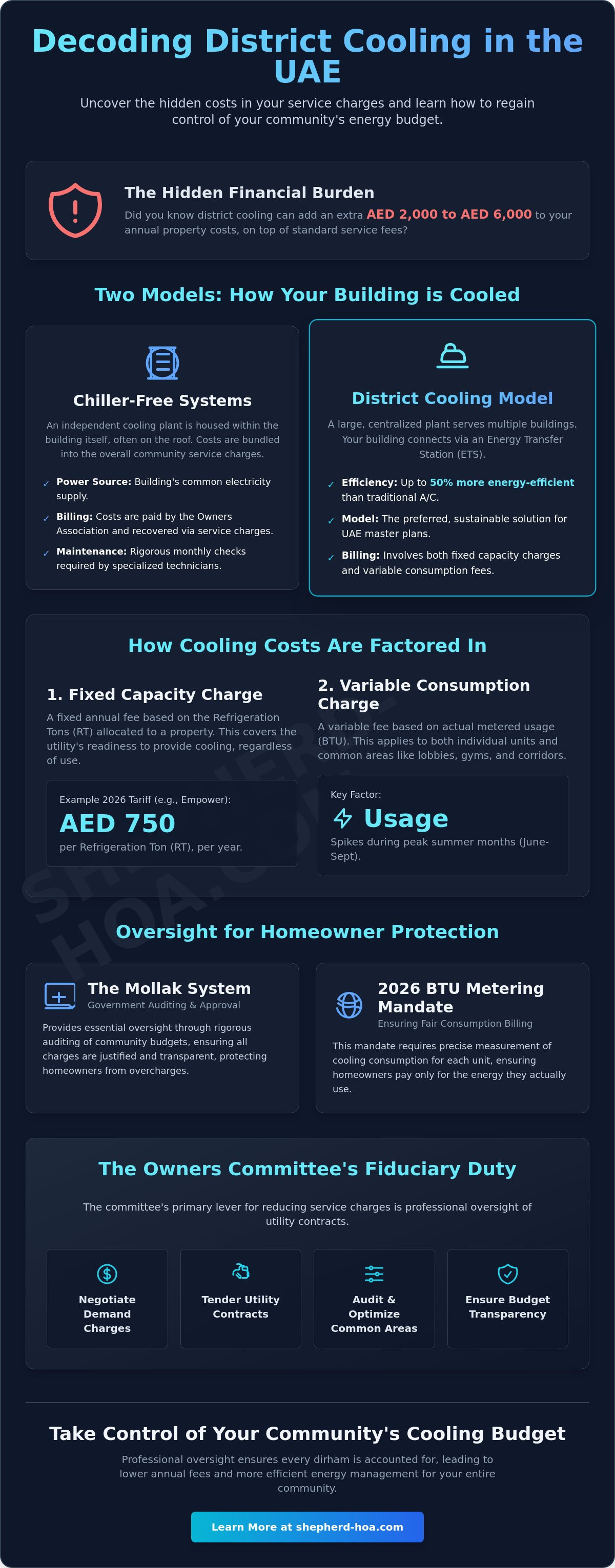
Many homeowners encounter the term "chiller-free" while browsing property listings, often assuming it means cooling is a gift from the developer. In reality, cooling is never free; the distinction lies in the infrastructure and the billing method. Understanding how service charges cover district cooling in uae communities requires a clear view of these two separate engineering models. While one relies on equipment inside your building, the other connects to a massive network spanning the entire neighborhood. Knowing which system your community uses is the first step toward accurate budget oversight.
The Mechanics of Chiller-Free Systems
In a chiller-free setup, the building houses its own independent cooling plant, typically located on the roof or in a dedicated mechanical room. These units draw power directly from the building's common electricity supply. Because there's no third-party utility provider sending individual bills to residents, the Owners Association must pay the electricity and maintenance costs for the entire system. This expense is then distributed among owners, which is why you'll often see higher community service charge budget dubai allocations in these buildings. Maintenance cycles for these independent plants are rigorous. Specialized technicians must perform monthly checks on compressors and cooling towers to prevent system failures during the peak of summer.
The District Cooling Model
District cooling is a centralized utility model where a large-scale plant serves multiple buildings or entire communities. Instead of having a chiller on your roof, your building features an Energy Transfer Station (ETS). This station receives chilled water from the external plant and uses heat exchangers to cool the air inside your unit. If you're wondering What is District Cooling?, it's a more sustainable, high-density solution that reduces energy consumption by up to 50% compared to traditional air conditioning. It's currently the preferred model for UAE master plans due to its long-term efficiency.
By May 2026, UAE regulations have become stricter regarding how these costs are presented to homeowners. Board members now have a fiduciary duty to ensure the annual budget clearly distinguishes between common area cooling and individual consumption. This transparency is vital; it prevents homeowners from being double-charged for cooling that should be covered by their service fees. Mastering how service charges cover district cooling in uae communities ensures that your association remains compliant with RERA standards while protecting property values from the strain of inefficient utility management.
How Cooling Costs are Factored into UAE Service Charges
Deciphering the financial mechanics of a community budget often reveals that cooling is the largest variable expense. Understanding how service charges cover district cooling in uae communities requires looking past your monthly utility bill to the annual community budget. While your individual unit consumption is billed directly, the cooling for shared infrastructure, such as lobbies, gyms, and corridors, is funded through your square-footage-based service charges. This dual-layered approach ensures that the entire building remains climate-controlled while maintaining individual accountability for private usage.
Fixed vs. Variable Cooling Expenses
The cooling budget is split into two distinct categories: capacity charges and consumption charges. The capacity charge is a fixed annual fee based on the Refrigeration Tons (RT) allocated to a property. For example, Empower's 2026 tariff sets this at AED 750 per RT per year. This fee remains constant even if a unit is vacant, as it covers the cost of maintaining the central plant's ability to provide cooling on demand. In contrast, consumption charges are variable. Owners committees use historical data to forecast seasonal utility spikes, ensuring the association has enough liquidity to cover higher bills during the peak summer months from June to September. BTU Meters are the standard for 2026 cost distribution, ensuring each owner pays only for the energy they actually consume within their unit.
Cooling in the Service Charge Index
Transparency is the cornerstone of modern community governance. The rera dubai framework ensures that these fees are audited through the Mollak system before a single dirham is collected from homeowners. This regulatory oversight prevents developers from inflating utility costs or hiding inefficiencies within the service charge. Compliance with official district cooling regulations is mandatory for all providers in the UAE, protecting owners from arbitrary price hikes. A professional community management partner ensures these calculations remain accurate, providing the board with clear data to justify the annual budget.
Beyond daily operations, a well-managed community must account for the long-term health of its cooling infrastructure. This involves budgeting for a "Cooling Reserve Fund" within the sinking fund. By setting aside a small percentage of the service charge specifically for future upgrades to the Energy Transfer Station (ETS) or heat exchanger replacements, the board prevents sudden special levies. This proactive financial planning preserves property values and ensures that the transition to more efficient technology, which can be 40% to 50% more energy-efficient than traditional systems, is seamless and stress-free for all residents.
The Role of Mollak and BTU Metering in Transparency
Transparency is the backbone of a stable community. In 2026, understanding how service charges cover district cooling in uae communities requires a deep dive into the digital systems that safeguard your funds. RERA has moved beyond simple oversight; it now utilizes a sophisticated digital infrastructure to ensure that every fils allocated to cooling is justified and audited. For board members, these tools replace administrative guesswork with organized control, ensuring that the community's financial health remains a top priority.
Mollak System Integration
The mollak dubai system acts as a protective barrier between your community funds and potential overcharging. Every cooling contract between an Owners Association and a provider like Empower or Tabreed must be uploaded to this platform for RERA approval. This process ensures that the capacity charges and consumption rates align with the Service Charge Index. As your management partner, we secure these financial approvals to prevent developers from padding utility budgets with hidden costs. Homeowners can log into the system at any time to audit their community's utility spending, ensuring that the actual invoices match the approved annual budget.
Advancements in BTU Metering
A significant SERP gap in most guides is the failure to explain the 2026 mandate for individual BTU metering. By May 2026, all managed communities must have functional, calibrated BTU meters for every unit. These smart meters provide real-time data that is essential for reducing energy waste in common areas. When meters are calibrated correctly, they ensure that how service charges cover district cooling in uae communities remains fair for everyone. If a resident disputes a high bill, the board can rely on certified meter readings to resolve the issue quickly and fairly.
Proper meter maintenance is a legal requirement. Inaccurate readings often lead to friction between neighbors, which can disrupt the peace of living in a dubai community. Our role is to oversee the regular calibration of these devices, ensuring that the cooling load for the gym or lobby isn't accidentally being billed to a private apartment. This methodical approach to utility management protects individual property values and fosters a sense of trust across the entire neighborhood. By leveraging technology, we turn a complex administrative headache into a seamless, automated process that benefits every homeowner.
Fiduciary Duties: How the Owners Committee Manages Utility Costs
Board members carry a significant legal weight known as fiduciary duty. This responsibility means every decision must prioritize the financial well-being of the homeowners. When evaluating how service charges cover district cooling in uae communities, the committee must look beyond the surface of monthly invoices. Active management of the master cooling contract is the most effective way to prevent budget deficits and ensure that service charges remain stable. A passive approach to utility management often results in communities paying for inefficiencies that could have been avoided through professional oversight.
Auditing Third-Party Contracts
The master agreement with a district cooling provider is not a "set and forget" document. Board members must actively tender these contracts to ensure the community receives competitive rates on maintenance and service fees. One critical area for negotiation is the demand charge. While consumption rates are often fixed by regulation, the terms surrounding capacity and service maintenance can sometimes be refined during contract renewals. If a provider implements an unfair demand charge increase, the board has the right to challenge these hikes through RERA or legal channels. Professional owners association management dubai audits prevent utility fraud by cross-referencing actual meter data against provider billing statements.
A thorough audit should include the following checks:
Verification of the Refrigeration Tons (RT) actually required versus what is being billed.
Review of Energy Transfer Station (ETS) maintenance logs to ensure peak efficiency.
Analysis of VAT application on common area cooling to ensure 5% compliance.
Validation of meter rental fees against the number of active units in the building.
Energy Conservation Initiatives
Lowering the community's energy footprint directly reduces the annual service charge burden. Implementing motion-sensor cooling in gyms, hallways, and lobbies can reduce common area consumption by up to 15%. Board members should also lead resident education campaigns. Teaching homeowners that keeping thermostats at a steady 24°C instead of 18°C significantly reduces the load on the building's infrastructure. These small adjustments help manage how service charges cover district cooling in uae communities by lowering the total variable cost the association must pay each month.
Energy efficiency is also a major driver of property resale value. In 2026, buyers are increasingly looking for "green" buildings with a track record of low utility overhead. By conducting annual energy audits to identify insulation leaks or window seal failures, the board protects the long-term asset value of the neighborhood. If your board is struggling to reconcile cooling costs with your current budget, it's time to partner with an expert in budget planning to restore transparency and control.
The Shepherd Approach: Optimizing Your Communitys Cooling Budget
Managing the intersection of utility contracts and owner expectations requires more than just administrative effort; it demands a protective stance toward your community's assets. At Shepherd HomeOwners' Association, we act as a steady guide for board members who feel overwhelmed by the technicalities of energy management. Our methodical process begins with a deep audit of your cooling plant's operational efficiency. Whether your building utilizes an on-site chiller or a third-party district cooling provider, we ensure every fils spent contributes to the long-term stability of the neighborhood. Understanding how service charges cover district cooling in uae communities is only the first step. The real value lies in the active oversight that prevents waste and ensures 100% transparency in service charge collection.
Expert Budget Planning
We rely on data, not guesswork. By analyzing historical consumption patterns and 2026 tariff updates, we forecast cooling requirements with precision. This proactive approach allows us to align your community budget with the RERA Service Charge Index, ensuring your rates are both fair and compliant. We prioritize accurate utility accruals to prevent the budget deficits that often lead to unpopular special levies. Our team handles the complex technicalities of utility account setup and Mollak financial approvals, lifting the administrative burden from the Owners Committee so they can focus on community harmony. This organized control replaces the stress of utility management with a sense of peace of mind.
Enhancing Property Value
A well-managed cooling budget is a powerful tool for asset protection. There is a direct link between lower, more efficient service charges and higher investor ROI. When potential buyers see a building with a healthy sinking fund and transparent utility reporting, the property's market appeal increases. We implement proactive maintenance strategies for on-site plants to extend their lifespan, delaying the need for expensive capital replacements. This foresight preserves the value of your investment and ensures the neighborhood remains a desirable place to live.
Our commitment to integrity means we provide the invisible backbone for the communities we serve. We turn complex utility data into actionable insights that protect your fiduciary standing. If you're ready to restore financial health to your neighborhood, contact Shepherd HomeOwners' Association today for a comprehensive utility and service charge audit. We'll handle the complexities of how service charges cover district cooling in uae communities so you can enjoy the benefits of a well-run home.
Take Control of Your Community Cooling Costs
Mastering the nuances of how service charges cover district cooling in uae communities is a fundamental requirement for modern board members. By leveraging the Mollak system and ensuring individual BTU meter accuracy; you protect every homeowner from arbitrary costs and administrative errors. These tools don't just provide data; they offer a definitive solution to the stress of utility management. Our methodical approach ensures that your community budget aligns with the 2026 RERA Service Charge Index; providing the transparency your residents deserve.
As a RERA Approved Community Management firm with UAE National Coverage; we specialize in Mollak financial reporting and budget optimization. Our team acts as a watchful guardian for your association's assets; ensuring that common area cooling remains efficient and transparent. You don't have to navigate these complex regulatory frameworks alone. We've designed our services to act as the invisible backbone of your community; allowing you to focus on neighborhood harmony while we handle the technical oversight.
Ready to bring organized control to your neighborhood's finances? Request a Professional Utility Audit for Your Community to identify immediate savings and ensure long-term stability. We're here to help you build a more harmonious and financially secure community for everyone. It's time to replace administrative headaches with peace of mind.
Frequently Asked Questions
Is chiller-free really free for the homeowner in the UAE?
No, chiller-free cooling is not actually free. While you don't receive a separate utility bill for consumption, the electricity and maintenance costs for the building's central plant are included in your annual budget. This is a primary example of how service charges cover district cooling in uae communities or on-site chiller costs. Owners pay for these operational expenses through their square-footage-based fees rather than a direct meter reading.
Why is the cooling demand charge the same even when I am not home?
The demand charge is a fixed fee for the cooling capacity reserved specifically for your property. It covers the capital and maintenance costs of the central plant regardless of your actual usage. Even if your unit is vacant for months, the provider must maintain the infrastructure to deliver cooling instantly upon your return. This fixed cost ensures the system remains operational for the entire community 24/7.
Can an Owners Association switch from district cooling to on-site chillers?
Switching from district cooling to on-site chillers is rarely feasible for existing communities. Most master developments are designed around a centralized plant agreement that is legally binding for the life of the building. Retrofitting a tower with independent chillers requires significant structural changes and approvals from relevant regulatory bodies that are difficult to obtain. Boards should instead focus on optimizing existing Energy Transfer Station efficiency to lower costs.
What is a BTU meter and why is it mandatory in 2026?
A BTU meter measures the actual thermal energy used by your specific apartment. By May 2026, these meters are mandatory for all managed communities to ensure fair and individual accountability. Without a calibrated meter, it's impossible to distinguish between your private consumption and the cooling used for common areas. This technology prevents owners who use less energy from subsidizing those with higher consumption habits.
How do regulatory oversight systems protect me from high cooling charges?
Government-mandated financial platforms act as digital auditors for your community's finances. They require management companies to upload all utility contracts and invoices for review by relevant authorities before any service charges can be collected. This prevents developers from inflating utility budgets or hiding inefficiencies. It provides a transparent view of how service charges cover district cooling in uae communities by verifying every dirham against approved rates.
What happens if the community fails to pay the district cooling provider?
If an Owners Association fails to pay the provider, the district cooling company can legally apply late penalties or eventually restrict services. This usually leads to a reduction in common area cooling before individual units are affected. To protect your property values, Shepherd HomeOwners' Association prioritizes diligent service charge collection and maintains a healthy reserve fund specifically for utility payments to avoid any service disruptions.
Does a regulatory body regulate the tariffs set by district cooling companies?
Relevant regulatory bodies across the UAE ensure that the charges applied to the community budget are accurate and approved. While these bodies don't directly set the cooling tariffs, they oversee district cooling regulations and ensure that providers adhere to fair pricing standards and transparent billing practices across the UAE.
Who is responsible for the AC maintenance inside my individual unit?
Homeowners are responsible for the maintenance of the Fan Coil Units and ductwork inside their private apartments. While the community service charge covers the chilled water supply to your door, your internal system's efficiency depends on regular filter cleanings and coil checks. Neglecting this maintenance can lead to higher consumption bills and reduced cooling performance, even if the central building system is working perfectly.


Comments