
How to Pay Your Service Charge via Mollak: The Complete 2026 Guide
- Sohrab Virani

- 2 days ago
- 12 min read
Your service charge payment is the single most important contribution you make to your community's health, and it's the primary way you protect your asset's long-term value. We understand that the process can feel daunting, especially when you don't recognize specific invoice descriptions or fear a technical glitch during the login phase. If you've been searching for a clear path on how to pay service charge mollak fees without the stress, you're in the right place. This guide simplifies the administrative journey to provide you with organized control and a sense of calm reliability.
You likely want to know that your money is being allocated correctly and that your standing with the owners' association remains secure. This article provides the definitive walkthrough for the 2026 Mollak interface, covering everything from the Dubai REST app login to the final Noqodi payment confirmation. We'll explore how to verify audited financial records and even how to leverage 0% interest plans from local banks. By the end of this guide, you'll have mastered the payment process and gained a clear understanding of the transparency standards that govern your community's funds.
Table of Contents
The Foundation of Financial Transparency: What is the Mollak System?
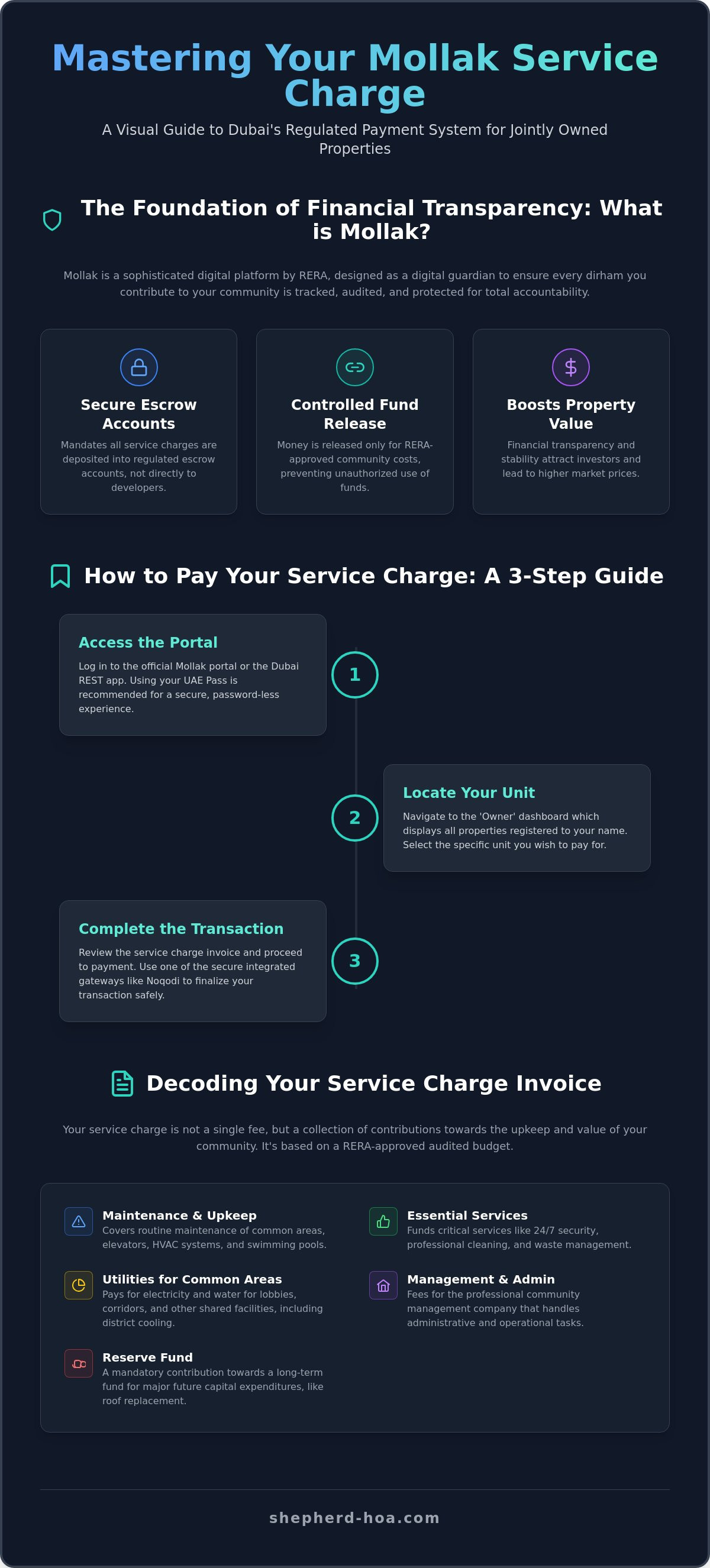
The Mollak system is a sophisticated digital platform developed by the Real Estate Regulatory Agency (RERA) to govern the financial landscape of jointly owned properties in Dubai. It acts as a digital guardian, ensuring that every dirham you contribute toward your community's upkeep is tracked, audited, and protected. When owners look for information on how to pay service charge mollak fees, they aren't just looking for a payment gateway; they're engaging with a system designed for total accountability. By centralizing all financial interactions, Mollak eliminates the ambiguity that previously clouded community management.
The primary purpose of this system is to mandate that all service charges are deposited directly into secure escrow accounts. This mechanism prevents developers or management firms from accessing funds for unauthorized expenses. Instead, money is released only for RERA-approved community costs. Gaining a deep understanding Mollak and its regulatory framework is essential for any homeowner who values long-term community harmony and financial security.
Why Direct Payments to Developers are a Thing of the Past
Dubai's real estate laws underwent a significant shift to prioritize owner protection. The days of writing cheques directly to a developer's general account are over. This legal mandate ensures that your contributions are shielded from the developer's corporate liabilities. These escrow accounts act as a financial watchdog, ensuring funds are available for essential services like security, cleaning, and cooling. This structural change provides peace of mind, knowing that your investment is protected by government-level oversight.
The Link Between Mollak and Your Property Value
Transparency is a powerful magnet for high-quality investors. When a community can demonstrate clear, audited financial records through Mollak, it signals stability and professional governance. Well-funded service accounts lead directly to better facility maintenance and higher standards of living. This isn't just about paying a fee; it's about active asset preservation. A building that maintains a healthy reserve fund and transparent ledger will always command a higher market price than one struggling with administrative chaos. Learning how to pay service charge mollak invoices correctly ensures you remain in good standing, contributing to the collective value of your home.
How to Pay Your Service Charge via Mollak: A Step-by-Step Guide
The transition to a digital-first regulatory environment has made managing property obligations more efficient than ever. To begin, you must ensure your user account is correctly linked to your property's title deed. This digital connection is the foundation of secure ownership in Dubai. Property owners can settle their dues through several channels, including the official Mollak portal, the Dubai REST mobile app, or designated self-service kiosks. Before starting, gather your essential documents to avoid session timeouts. You'll need your Emirates ID and the specific unit details found on your Title Deed.
Maintaining updated contact information with the Dubai Land Department is a critical step that many owners overlook. If your mobile number or email address is outdated, you may miss legal notices or security verification codes required for high-value transactions. When you understand how to pay service charge mollak fees correctly, you aren't just following a procedure; you're actively participating in the financial governance of your community.
Accessing the Portal and Locating Your Unit
The first stage of the process involves secure authentication and property identification. Follow these steps to reach your dashboard:
Step 1: Access the government portal or the Dubai REST app. We recommend using your UAE Pass for a secure, password-less login experience.
Step 2: Navigate to the ‘Owner’ dashboard. This centralized view displays every property registered under your name across Dubai.
Step 3: Select the specific unit for which you wish to settle the service charge. This screen provides a snapshot of your current balance and any historical arrears.
Completing the Transaction Safely
Once you've identified the correct unit, the following steps ensure your funds are transferred securely to the community's escrow account:
Step 4: Click on the 'Invoice Details' button. Carefully review the line items. This transparency allows you to confirm the charges match the budget approved by the regulator.
Step 5: Choose your preferred payment method. In 2026, the system supports a wide range of options, including major credit cards, direct net banking, and secure digital cheque uploads.
Step 6: Confirm the transaction. Wait for the browser to refresh and display the system-generated digital receipt. Do not close the window until this confirmation appears.
Verifying Your Payment Status
After the transaction, download the official PDF receipt immediately for your personal records. You can find a comprehensive 'Statement of Account' within the portal, which acts as a transparent ledger of your payment history and any credits on your account. According to RERA regulations, these digital receipts are mandatory for obtaining a No Objection Certificate (NOC) during future property sales or lease registrations. If you find the administrative requirements of the portal complex, our team provides expert community management to ensure your property remains in perfect legal standing.
Navigating Payment Challenges and Portal Troubleshooting
Digital portals provide immense convenience, but they can occasionally present technical hurdles that cause unnecessary stress during large financial transactions. It's natural to feel a sense of anxiety if a screen freezes or an error message appears after you've authorized a payment. Understanding the technical mechanisms behind the portal can replace this stress with a sense of organized control. Most digital payments require 24 to 48 hours to reflect as "Settled" in the official ledger. If your status doesn't update immediately, don't worry. This delay is usually due to the standard reconciliation process between the Noqodi gateway and the Mollak database.
Common error messages like "Gateway Timeout" or "Authentication Failed" often stem from temporary server congestion or bank-side security protocols. In these moments, a professional community management firm acts as your steady guide. We provide the administrative backbone that ensures these technical glitches don't compromise your standing with the owners' association. If you're struggling with the specifics of how to pay service charge mollak fees due to persistent errors, reaching out to your community manager is the most efficient path to a resolution.
What to Do if Your Unit is Not Listed
Discovering that your property is missing from the dashboard is a frequent point of confusion for new owners. This usually happens for three specific reasons. First, check if your title deed is correctly registered with the national land department; the Mollak system relies on this data for synchronization. Second, verify that the developer has officially handed over the community management to the owners' association. Finally, your community manager may need to manually verify your unit data within the Mollak database. A quick consultation with your manager can often resolve this visibility issue within a few business hours.
Resolving Payment Discrepancies
If you notice a line item on your invoice that seems incorrect, you should investigate before finalizing the transaction. You can cross-reference your specific rate using the Dubai Land Department's Service Charge Index to ensure the charges align with government-approved benchmarks. If a transaction fails but funds are deducted from your bank, keep the transaction ID and your bank statement ready. You can submit a support ticket through the Dubai REST app or contact the DLD technical support team directly. This methodical approach ensures your financial contributions are handled with the transparency and integrity you deserve. Learning how to pay service charge mollak dues accurately is your best defense against administrative errors.
Decoding Your Service Charge Invoice: Where Your Contributions Go
When you log in to settle your dues, the digital invoice you see is far more than a simple bill. Every dirham listed is part of a pre-approved financial blueprint. Before you even see a charge, an independent audit firm reviews the community budget, which then requires final approval from the regulator. This rigorous process ensures that your funds are handled with total transparency. Understanding these line items makes the process of how to pay service charge mollak fees feel like a meaningful investment in your property's future. The Owners Association Management team plays a pivotal role here, proposing a budget that balances high-quality service with cost efficiency.
Once you grasp the value behind these numbers, knowing how to pay service charge mollak invoices becomes the final, simple step in a process designed to safeguard your home. This system eliminates the guesswork, replacing operational stress with a clear view of how your money works for you.
General Fund vs. Reserve Fund
Your invoice is split into two distinct categories, each serving a specific protective function for your asset. The General Fund covers the daily pulse of the community. It pays for essential services like security, landscaping, and common area utilities. Without a well-funded General Fund, the immediate quality of life in your building or villa cluster would decline. In contrast, the Reserve Fund acts as the community's long-term savings account. This money is set aside for major capital expenditures that occur every few years, such as replacing central cooling systems or refurbishing the building facade. A healthy reserve fund isn't just a legal requirement; it's a primary indicator of a property's health that significantly impacts its resale value in the 2026 market.
The Breakdown of Operational Costs
Most community expenses follow a predictable structure, though the exact rates vary significantly by property type. For instance, while a villa in Arabian Ranches might see rates around AED 2.44 per square foot, a luxury tower like the Burj Khalifa requires approximately AED 67.88 per square foot to maintain its world-class standards. These costs typically include:
MEP Maintenance: Regular servicing of mechanical, electrical, and plumbing systems.
Insurance: Protecting the collective structure against unforeseen events.
Management Fees: The cost of professional oversight and administrative compliance.
Utility Accounts: Water and electricity for shared gyms, pools, and lobbies.
Calculations are based on the 'Square Foot' method, ensuring each owner pays a fair share proportional to their unit size. Professional management ensures these contracts are tendered ethically, preventing the mismanagement of funds. If you want to ensure your community's budget is managed with this level of precision and integrity, explore our service charge collection and budget planning services to protect your investment's value.
The Role of Professional Management in Financial Oversight
While the digital portal provides the tools for transaction, professional management provides the expertise required for true financial oversight. Shepherd HOA acts as a steady, expert guide for your community, navigating the intricate regulatory requirements so you don't have to. We manage the heavy administrative workload of the Mollak system, serving as the interface between the Owners' Committee and the regulator. This professional oversight is essential to prevent financial stagnation and ensure that your community's funds are always working to enhance property values. Understanding the nuances of living in a managed community involves recognizing that transparency is a collective benefit protected by expert guardianship.
Our role is to replace operational stress with a sense of organized control. By ensuring that every administrative step is handled with precision, we protect the interests of every homeowner. When you look for information on how to pay service charge mollak fees, you are engaging with a system that we've carefully prepared to ensure your money reaches its intended destination safely and legally.
Ensuring RERA Compliance and Budget Accuracy
The journey toward a RERA-approved budget is rigorous and requires a deep understanding of local real estate laws. Professional managers act as the invisible backbone of the Owners' Committee, drafting budgets that reflect the true needs of the property. We coordinate with independent auditors to verify every expense before the budget even reaches the regulator for final approval. This multi-layered verification process ensures that the invoices you receive are accurate and ethically sound. Knowing that experts are watching over your community's assets provides a level of peace of mind that self-managed buildings often lack. We ensure that third-party contracts are tendered ethically, which directly impacts the service charge rates you see when you learn how to pay service charge mollak dues each year.
Next Steps for Homeowners
Active participation is the final step in maintaining a healthy, vibrant community. We encourage all property owners to attend their Annual General Meetings (AGM) to review the Mollak reports and discuss the future of their investment. These meetings are the primary forum for transparency, where you can see exactly how your contributions have been utilized. If you feel your current management partner lacks the transparency or technical savvy required in 2026, it may be time to consider a partner that prioritizes integrity and asset preservation. Maintaining your property's value starts with a simple payment, but it thrives through professional oversight and community engagement. Reach out to Shepherd HOA for expert guidance on budget planning and service charge collection to ensure your community remains in good standing.
Empowering Your Ownership with Financial Clarity
Mastering the administrative steps of the Mollak system is about more than just settling a bill. It's about participating in a regulated ecosystem that preserves your home's value and ensures community harmony. You now have the tools to navigate the portal, troubleshoot common technical errors, and understand exactly where your contributions are allocated between general and reserve funds. This level of organized control is the best way to maintain your status as a responsible property owner in Dubai. When you know how to pay service charge mollak fees with confidence, you're contributing to the long-term stability of your neighborhood.
As expert Mollak and RERA compliance specialists, Shepherd HOA currently acts as the guardian for over 5,000 units across the UAE. We prioritize ethical and transparent financial reporting to replace operational stress with peace of mind. If you're ready to enhance your community's financial oversight, Request a Professional Community Budget Consultation from Shepherd HOA today. Your property deserves the protection of a partner that values integrity and asset preservation as much as you do. Take the first step toward a more organized and secure community future.
Frequently Asked Questions
Is it mandatory to pay service charges through the Mollak system?
Yes, it's mandatory. Law No. (6) of 2019 requires all owners of jointly owned properties in Dubai to pay their service charges through the Mollak system. This regulation ensures your contributions are deposited into secure, RERA-approved escrow accounts. It eliminates the risk of fund mismanagement by providing a transparent, government-audited trail for every transaction.
What happens if I miss the deadline for my Mollak service charge payment?
Missing a deadline triggers a formal legal process. Initially, you'll receive a notice of payment from the community manager. If the dues remain unpaid, the matter can be escalated to the Rental Dispute Center, which may result in legal blocks on your property title deed. Staying updated via the portal's dashboard is the only way to maintain your property's good standing.
Can I pay my service charges in installments through the portal?
The portal doesn't offer direct installment plans. However, you can manage the financial impact by using specific UAE credit cards. Banks like Emirates NBD and ADCB often provide 0% interest payment plans for transactions made on the portal. This is a practical solution for owners figuring out how to pay service charge mollak fees while maintaining their personal cash flow.
How do I get a breakdown of my community's total budget in Mollak?
You can access the audited budget breakdown directly through the Dubai REST app or the Mollak web portal. Every community budget must undergo an independent audit before the Dubai Land Department grants final approval. This transparency allows you to see the exact allocation for services like security, landscaping, and the reserve fund for future capital repairs.
What should I do if the amount on the Mollak invoice is different from what the developer told me?
You should always prioritize the amount shown on your official Mollak invoice. Developers no longer have the authority to set or collect service charges independently. If a discrepancy exists, the Mollak figure is the legally binding rate approved by the regulator. You can verify these rates using the Service Charge Index on the Dubai Land Department website to ensure accuracy.
Are there any additional fees for paying via credit card on the portal?
Yes, transactions processed through the Noqodi gateway typically involve standard processing fees. These charges vary depending on whether you use a credit card, debit card, or net banking. While these fees are a small addition to the total, they cover the cost of maintaining a secure, government-verified payment infrastructure. Most owners accept this as a necessary step for financial security.
How can I verify if my community management company is RERA approved?
You can verify a company's status through the "Trakheesi" system on the Dubai Land Department website or via the Dubai REST app. All legitimate community management firms must hold a valid RERA license to operate. Working with an approved partner ensures that your community's budget planning and administrative compliance meet high professional standards. It’s the best way to ensure your how to pay service charge mollak process is handled correctly.
Can I use Mollak to pay for individual property management fees?
No, the Mollak system is exclusively for community-wide service charges related to common areas. Individual property management fees, which cover private services like tenant sourcing or unit maintenance, are separate contractual matters. Those payments are handled directly between the owner and their chosen management firm. Mollak focuses solely on the collective interests and shared assets of the property.


Comments