
How to Reduce Community Service Charges: A 2026 Homeowner’s Guide
- Sohrab Virani

- Apr 13
- 12 min read
In 2024, data from the Dubai Land Department indicated that service charge disputes remained one of the primary concerns for property owners across the Emirates. What if those rising invoices aren't just an inevitable cost of residency, but a signal of operational inefficiencies that you have the power to fix? Understanding how to reduce community service charges starts with looking past the bottom line and into the heart of your association's governance. You've likely felt the frustration of a sudden AED 5,000 increase in your annual fees or wondered why building maintenance seems to decline even as costs climb. It's stressful when transparency is missing and your investment feels unprotected.
As your steady guide, we've developed a proven roadmap to lower your community's operational costs through smarter oversight and data-driven efficiency. This guide reveals how modern technology and strict fiduciary duty can transform your community into a model of financial health. We'll show you how to protect your property's value while ensuring every dirham spent serves the neighborhood's best interests. You'll gain the tools to replace management stress with organized control and the peace of mind that comes from a well-shepherded community.
Key Takeaways
Understand the core components of community maintenance to identify exactly where your AED contributions are allocated for maximum transparency.
Master how to reduce community service charges by leveraging the national service charge index to benchmark your property against UAE market standards.
Discover high-ROI operational improvements, such as LED transitions, that target the utility costs which often account for over half of a community's general fund.
Empower your Owners Committee to implement ethical tendering processes that ensure third-party service providers deliver the best value for your community.
Learn how professional 2026 budget planning identifies hidden savings in existing contracts while safeguarding your property’s long-term financial health.
Table of Contents Analysing the Factors Influencing Community Service Charges Leveraging Regulatory Frameworks for Budget Optimisation Strategic Operational Improvements: Energy, Water, and Waste Governance and Financial Oversight: The Owners Committee’s Role Partnering with Shepherd HOA for Sustainable Financial Health
Analysing the Factors Influencing Community Service Charges
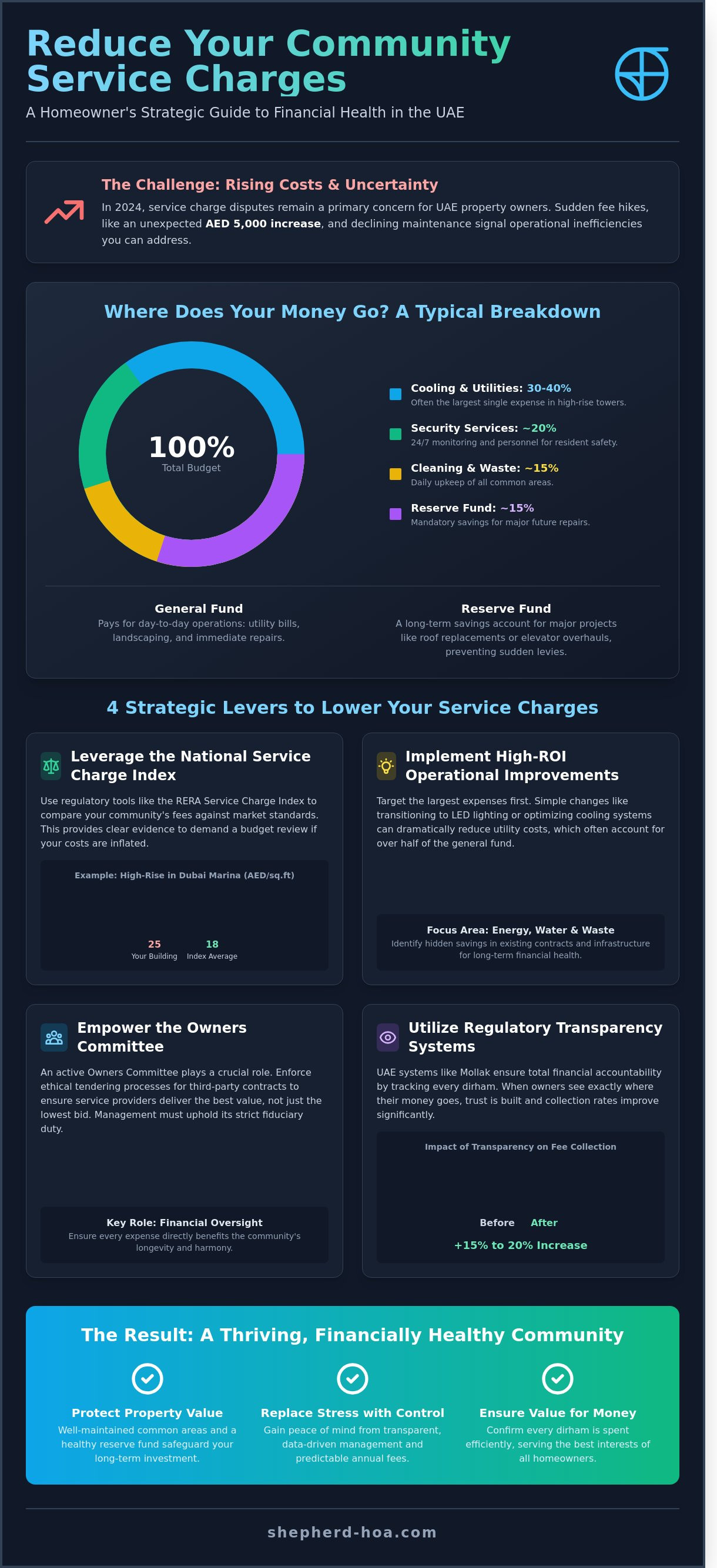
Service charges act as the essential lifeline for community maintenance and infrastructure in the United Arab Emirates. These funds ensure that the shared environment remains safe, functional, and aesthetically pleasing. Without this collective investment, property values would inevitably decline as facilities fall into disrepair. Understanding Homeowner Associations and their financial structures is the first step for any resident. Homeowners often ask how to reduce community service charges, but the answer begins with a granular look at where every dirham is allocated.
The standard components of a community budget typically include:
Cooling and Utilities: Often accounting for 30% to 40% of the total budget, especially in high-rise towers.
Cleaning and Waste Management: Daily upkeep of lobbies, corridors, and communal parks.
Security Services: 24/7 monitoring and personnel to ensure resident safety.
The Reserve Fund: A mandatory allocation for future major repairs.
National regulatory indexes, such as the RERA Service Charge Index in Dubai, provide a benchmark for fair pricing. These indexes use data from audited financial statements to ensure that charges remain within market norms. However, costs can fluctuate based on specific variables. Inflation in material costs or the needs of ageing infrastructure, particularly in buildings older than 12 years, often leads to necessary adjustments in annual fees.
The Difference Between General and Reserve Funds
The general fund handles day-to-day operations and immediate repairs. It pays the utility bills, the lifeguard at the pool, and the landscaping team. In contrast, the reserve fund serves as a long-term protective measure for major capital expenditures like elevator overhauls or roof waterproofing. A well-managed reserve fund, which typically constitutes 15% of the total budget, prevents sudden "special levies" or aggressive fee hikes when a building reaches a certain age.
Regulatory Oversight and Transparency Systems
The UAE utilizes centralised management systems like Mollak to ensure total financial accountability. Every dirham is tracked through approved regulatory portals, preventing the mismanagement of community assets. This level of oversight ensures that owners only pay for services that are actually delivered and verified. A management company carries a strict fiduciary duty to act as a watchful guardian of owner funds, ensuring every expense directly benefits the community's longevity and harmony. Learning how to reduce community service charges requires a deep dive into these transparent reports to identify inefficiencies in the procurement process.
Leveraging Regulatory Frameworks for Budget Optimisation
Navigating the regulatory landscape doesn't have to be daunting. In the UAE, the Real Estate Regulatory Agency (RERA) provides a structured path for homeowners to ensure they pay fair rates. One of the most effective ways to understand
how to reduce community service charges
is to align your budget with the national service charge index. This index acts as a protective shield, preventing management companies from inflating costs without justification. It ensures that every dirham spent is accounted for and necessary for the upkeep of your investment. All budgets must undergo a rigorous review by the relevant regulatory body before any invoices are issued to owners. This oversight ensures that the sinking fund is adequately financed and that operational expenses remain realistic. Maintaining up-to-date property data in centralised systems is essential for compliance. Failure to update unit details or owner information can lead to administrative penalties reaching 50,000 AED in some jurisdictions. Transparency is the foundation of community harmony. When homeowners see exactly where their money goes, collection rates typically increase by 15% to 20% within the first year.
Understanding the Service Charge Index
The service charge index allows you to compare your community's costs against similar properties in the same district. For example, if your building in Dubai Marina is charging 25 AED per square foot while the index average for high-rise towers is 18 AED, you have clear evidence to demand a budget review. Property type, facility count, and the age of the building all influence these benchmarks. If your community's budget exceeds the average by more than 10%, your board should initiate a forensic audit of service provider contracts. This process often mirrors global best practices on
, which emphasizes auditing insurance premiums and utility usage as primary cost-saving measures. Use these steps to challenge high costs:
Download the latest index data for your specific sub-community.
Request a line-item breakdown of the proposed budget from the management company.
Identify categories where your community is an outlier compared to the benchmark.
Maximising Centralised Financial Portals
Using government-approved portals is not just a legal requirement; it's a strategic advantage for budget control. These systems automate financial transactions, ensuring every dirham is accounted for through approved banking channels. Electronic invoicing reduces administrative overheads by eliminating manual errors and postage costs. For a deeper dive into these technical requirements, read our guide on
. Centralised portals also provide a clear audit trail that discourages financial mismanagement. By integrating your community's financial data into these systems, you eliminate the "grey areas" that often lead to budget creep. If you feel your board needs more support in these areas, partnering with a dedicated platform like
Strategic Operational Improvements: Energy, Water, and Waste
Strategic operational improvements provide a roadmap for boards to achieve long-term fiscal stability. Energy management often accounts for 40% to 60% of a community’s general fund in the UAE, largely due to the continuous demand for district cooling and common area lighting. Transitioning to LED lighting and installing motion sensors in corridors, car parks, and stairwells represents a high-ROI first step. These upgrades typically pay for themselves within 12 to 18 months by slashing electricity consumption. Many boards looking for tips for lowering HOA dues find that utility optimization is the most sustainable way to lower annual levies without sacrificing service quality.
Waste management costs are also rising as landfill levies in Dubai and other emirates increase to encourage sustainability. Implementing robust recycling initiatives reduces the volume of general waste, which lowers transport costs and disposal fees. A community that successfully separates plastic, paper, and glass can often negotiate more favorable rates with waste contractors. These small adjustments are essential when considering how to reduce community service charges effectively over a multi-year period.
Smart Technology and AI in Facility Management
Building Management Systems (BMS) provide real-time energy monitoring, allowing managers to identify consumption spikes before they drain the reserve fund. Predictive maintenance uses this data to fix equipment like chiller plants before they require emergency repairs; these reactive fixes often cost 3 times more than scheduled servicing. AI-driven cooling systems can reduce utility bills by up to 20% by adjusting temperatures based on occupancy and ambient heat levels. These tools offer a proactive way to manage overheads and understand how to reduce community service charges through precision rather than service cuts.
Sustainable Landscaping Solutions
Landscaping is a significant recurring expense. Replacing high-water-consumption plants with native, drought-resistant species like Ghaf trees or Bougainvillea reduces irrigation needs by 30% or more. Implementing smart irrigation systems that react to soil moisture levels prevents water wastage during the cooler months when evaporation rates are lower. The impact of greywater recycling on community water bills is equally significant, as it allows the association to repurpose treated water for communal gardens. Mastering these efficiencies is a core part of reducing community operational costs dubai and ensures long-term financial health for the association.
Governance and Financial Oversight: The Owners Committee’s Role
The Owners Committee serves as the strategic heart of any residential development. These elected members act as fiduciary guardians of the collective budget, ensuring every dirham spent aligns with the long-term health of the property. When residents ask how to reduce community service charges, the answer often lies in the committee’s ability to scrutinize line items and eliminate "leakage." This financial leakage involves unnecessary expenses like redundant security shifts or inefficient irrigation schedules that drain the reserve fund. By conducting annual financial audits through RERA-approved firms, committees can identify these gaps and redirect funds toward essential upgrades that preserve property value.
Building a culture of payment compliance is equally vital. If 15% of owners fail to pay their dues, the remaining 85% often face higher costs to cover the shortfall. A proactive committee works to ensure all residents understand their obligations, keeping the community fully funded and preventing the need for emergency levies or service cuts.
The Tendering Process for Service Contracts
Selecting vendors isn't just about finding the cheapest price. In the UAE market, a low-cost bid often masks a lack of qualified staff or poor equipment. Ethical tendering involves a transparent process where the committee evaluates at least three competitive quotes against a standardized scope of work. A contract that seems 15% cheaper today might lead to a 30% increase in repair costs over a three-year term because of deferred maintenance. Effective committees prioritize value by embedding Key Performance Indicators (KPIs) into contracts. These metrics, such as a 98% uptime for elevators or a 24-hour resolution window for common area repairs, ensure that service providers remain accountable and efficient.
Collaborating with Professional Management
Professional management firms provide the technical backbone for these oversight efforts. They prepare detailed quarterly progress reports that allow the committee to track spending against the approved Mollak budget in real-time. This level of transparency is vital for maintaining owner trust and ensuring the community remains compliant with the latest regulations. Managers also handle the complex task of securing regulatory approvals, which prevents costly fines and administrative delays. For a deeper look at navigating these requirements, explore this guide on owners association management dubai. When the committee and the manager work in sync, they create a streamlined operation that directly contributes to how to reduce community service charges through operational excellence.
Ready to bring professional oversight and financial clarity to your community? Partner with Shepherd HOA today to optimize your association's management.
Partnering with Shepherd HOA for Sustainable Financial Health
Achieving a balance between premium community standards and affordable living requires more than just cutting costs; it demands protective oversight. Shepherd HOA acts as a guardian for your community's financial health, ensuring that every dirham spent contributes to the long-term preservation of property values. Our philosophy centers on the idea that effective management shouldn't be a burden, but a stabilizer that allows homeowners to enjoy their investments without the constant worry of escalating fees.
Our 2026 budget planning services focus on a granular analysis of existing vendor contracts. By auditing service level agreements in sectors like landscaping, security, and facility maintenance, we often identify redundant charges that have gone unnoticed for years. When homeowners ask how to reduce community service charges, the answer usually lies in these hidden inefficiencies. We replace guesswork with data-driven procurement, leveraging our nationwide network of vetted service providers to secure high-quality results at competitive market rates.
Expert Budget Planning and Compliance
Managing a community in the UAE involves strict adherence to RERA standards and the Mollak system. Our team handles the heavy lifting of government approvals and centralized reporting, ensuring your association remains in good standing. We apply a methodical approach to cost-saving that never compromises safety or aesthetics. By consolidating service requirements and renegotiating terms based on current 2026 market benchmarks, we help boards achieve significant savings while maintaining the high standards residents expect.
Ensuring Long-Term Community Excellence
Beyond the balance sheet, our primary goal is to provide peace of mind. Board members are volunteers who shouldn't have to sacrifice their personal time to manage complex administrative tasks. Shepherd HOA provides the "invisible backbone" for your community, offering ethical governance and total transparency in every financial interaction. We treat your community’s funds with the same care we would our own, fostering an environment of harmony and trust.
If your current management structure feels disorganized or overly expensive, it’s time for a change. You can request a professional community budget review from Shepherd HOA to see exactly where your community can gain efficiency and restore financial balance. This simple step is the first move toward understanding how to reduce community service charges effectively for the long term.
Take Charge of Your Community’s Long-Term Stability
Lowering service fees requires a methodical approach to operational efficiency and strict adherence to UAE regulatory standards. You've seen that optimizing energy and water usage can significantly lower the budget while maintaining high service levels. Effective governance through the Owners Committee ensures every dirham is accounted for within the Mollak system. Mastering how to reduce community service charges isn't a one-time event; it's a commitment to transparent financial oversight and strategic planning that protects your property value over time.
Since 2010, Shepherd HOA has provided RERA-approved management that simplifies complex administrative tasks for board members. Our expertise in Mollak financial reporting and compliance provides the steady guidance your community needs to thrive. We focus on preserving and enhancing property values nationwide so you don't have to manage the stress of neighborhood governance alone. Secure your community’s financial future with Shepherd HOA and experience the peace of mind that comes with professional guardianship. Your community deserves a partner that values integrity and results as much as you do.
Frequently Asked Questions
Can a developer increase service charges without owner approval?
Developers cannot increase service charges without prior approval from the Real Estate Regulatory Agency (RERA). According to Law No. (6) of 2019, any proposed budget must undergo a formal audit by an approved firm and receive government clearance before owners are billed. This regulation ensures that 100% of fee hikes are justified by actual operational costs. It protects your investment from arbitrary price spikes and maintains financial transparency within the community.
How much should a community ideally keep in its reserve fund?
A healthy community should maintain a reserve fund covering 15% to 30% of its annual operating budget. This capital serves as a safety net for major lifecycle replacements like chillers or roof repairs. RERA guidelines suggest conducting a reserve fund study every 3 years to ensure the balance meets future requirements. Maintaining this fund prevents sudden special levies, which helps you understand how to reduce community service charges by avoiding emergency high-interest financing.
What happens if a homeowner refuses to pay their service charges?
Homeowners who fail to pay face legal consequences through the Mollak system and the Dubai Land Department. After a 30-day formal notice is served, the management can file a case with the Rental Dispute Centre. This can lead to travel bans, frozen bank accounts, or even the public auction of the property to recover debts. These measures protect the 95% of compliant owners who rely on shared funds to maintain essential building services.
How often should a community tender its facility management contracts?
Boards should tender facility management contracts every 2 to 3 years to ensure competitive market pricing. This regular review allows the community to audit performance and leverage new technologies that lower costs. By comparing at least 3 detailed bids, associations often identify 10% to 15% in potential savings. This proactive approach is a primary strategy for those looking at how to reduce community service charges without sacrificing the quality of maintenance or security.
Can smart technology really lower our annual service charge budget?
Implementing smart technology can reduce utility expenses by 20% to 30% annually. IoT sensors for lighting and AI-driven HVAC optimization eliminate the waste of cooling empty common areas. These systems provide real-time data that allows for predictive maintenance rather than reactive repairs. Investing in these tools lowers the overall operational budget, providing a direct and sustainable path to decreasing the individual financial burden on each homeowner.
What is the role of the Real Estate Regulatory Agency in setting fees?
RERA acts as the final authority and auditor for all community budgets in Dubai. They review every line item against historical data and market benchmarks before any fees are uploaded to the Mollak system. Their role is to ensure that management companies don't overcharge and that all expenses are necessary for the building's upkeep. This oversight provides an essential layer of protection for your community's financial health and long-term stability.
Is it possible to dispute a service charge hike through the Mollak system?
You can dispute proposed increases during the budget review phase before RERA grants final approval. Owners should use the Mollak portal to monitor status updates and submit formal inquiries if costs seem unjustified. If the budget is already approved, homeowners can file a collective petition through the Owners' Committee to request a re-audit. This structured process ensures that every dirham spent is accounted for and agreed upon by the regulatory authorities.
How does a professional management company differ from a facility management firm?
A management company handles the administrative, legal, and financial governance of the HOA, acting as a shepherd for the board's fiduciary duties. In contrast, a facility management firm performs the physical labor, such as cleaning, plumbing, and security. While the management company ensures compliance and collects fees, the facility firm executes the technical work. Distinguishing between these two roles is vital for clear oversight and efficient community operations.


Comments