
How to Switch HOA Management Companies: A 2026 Board Member’s Guide to a Seamless Transition
- Sohrab Virani
- May 3
- 12 min read
Your role on an HOA board is a commitment to the long-term health and harmony of your neighborhood. When management becomes unresponsive or financial reporting grows opaque, that commitment is tested by administrative stress. Learning how to switch hoa management companies shouldn't be a source of community chaos or legal anxiety. Instead, it is a decisive act of leadership that restores organized control and protects every homeowner's investment.
Shepherd HomeOwners' Association understands the volunteer nature of your position and the high stakes involved in neighborhood governance. We promise a comprehensive roadmap that allows you to transition providers without operational friction or service lapses. This guide previews the entire journey, from identifying hidden red flags and auditing contracts to executing a seamless 90-day logistical handover. By the end of this article, you will have the confidence to act as a steady guide for your community, ensuring a partnership built on transparency and professional integrity.
Key Takeaways
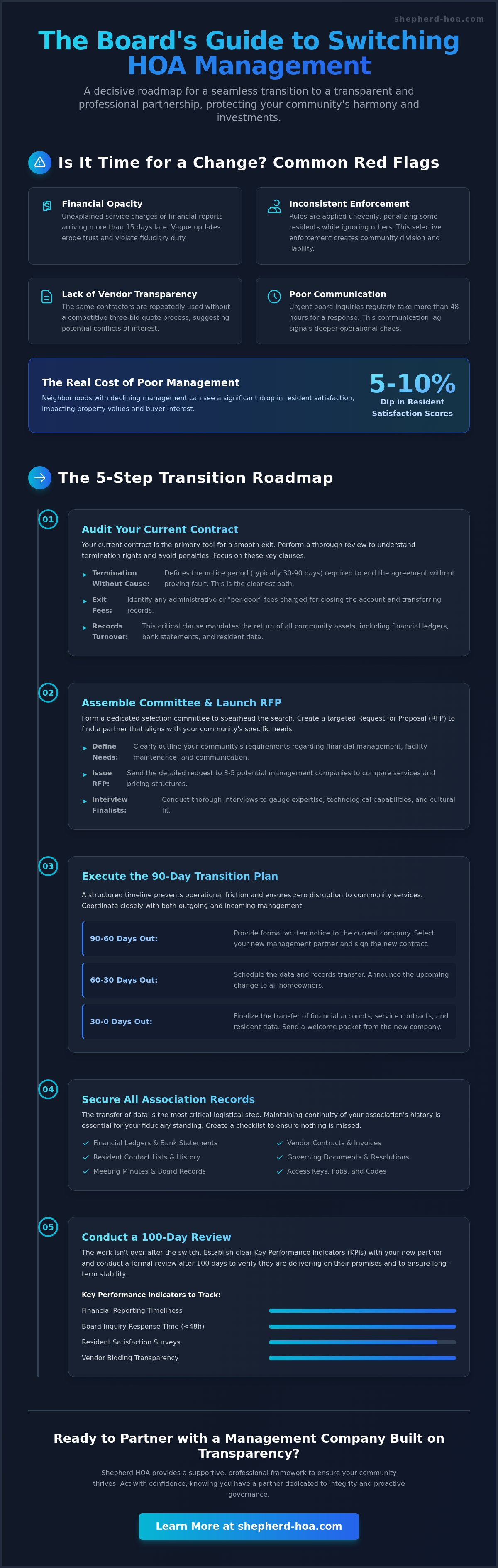
Identify the subtle signs of management decay and audit your current contract to understand your specific termination rights.
Master the logistics of how to switch hoa management companies using a structured 90-day timeline that ensures zero disruption to community services.
Build a selection committee and use a targeted Request for Proposal (RFP) process to find a partner aligned with your community's financial and facility needs.
Secure the transfer of your association's financial history and service records to maintain continuity and protect your fiduciary standing.
Establish clear Key Performance Indicators (KPIs) and conduct a 100-day review to verify that your new management partner is delivering on their promises.
Table of Contents Evaluating Your Current Management: Is It Time for a Change? The Legal Framework: Reviewing Your Current Management Contract The Selection Process: Finding the Right Management Partner Managing the Switch: A Step-by-Step Logistical Roadmap Post-Transition Success: Ensuring Long-Term Stability
Evaluating Your Current Management: Is It Time for a Change?
Board members often feel a sense of loyalty to their management partners, even when performance begins to slip. This loyalty is commendable, but your primary duty is to the health and stability of the neighborhood you serve. Identifying the subtle signs of management decay is the first step in understanding how to switch hoa management companies without jeopardizing your community's daily operations. When a community association manager starts missing deadlines or providing vague financial updates, it isn't just a minor annoyance. It is a signal that the protective oversight your community pays for is failing.
A "Service Gap" analysis offers a logical way to evaluate this decline. You compare the management company's actual daily performance against the specific requirements listed in your governing documents. If your CC&Rs mandate monthly financial reviews but you're receiving them quarterly, a significant gap exists. This misalignment directly impacts property values. Neighborhoods with poor management often see a 5% to 10% dip in resident satisfaction scores, which eventually reflects in lower buyer interest and stagnating home prices. Board members are volunteers, not professional administrators. When management fails, the administrative workload falls back onto your shoulders, leading to burnout and friction within the board.
The Board's Fiduciary Duty and Management Oversight
Your role as a board member is defined by your duty to protect the community. In 2026, fiduciary duty is the legal and ethical requirement for HOA board members to manage community assets with the same care and diligence a prudent person would exercise in their own affairs. Staying with an ineffective provider doesn't just cause stress; it exposes the board to personal liability if financial mismanagement or safety violations occur. Effective oversight means acting as a guardian for your neighbors' investments. If your current provider can't meet basic compliance standards, they're no longer a partner; they're a liability.
Common Red Flags in Community Administration
Watch for these specific indicators that your current partnership has run its course:
Unexplained service charge discrepancies or financial reports that arrive more than 15 days late.
Inconsistent enforcement of rules, where some residents are penalized while others are ignored, creating community division.
A lack of transparency in vendor bidding, especially if the manager uses the same contractors without seeking competitive, three-bid quotes.
Communication lag is rarely just about a full inbox. It's usually a symptom of operational chaos. If your manager regularly takes more than 48 hours to respond to urgent board inquiries, it's time to consider a more reliable partner. Knowing how to switch hoa management companies allows you to regain control before these red flags turn into legal crises or financial deficits.
The Legal Framework: Reviewing Your Current Management Contract
Once you've determined that a change is necessary, the legal contract becomes your primary tool for a smooth exit. Performing a thorough contract audit ensures you understand the specific steps on how to switch hoa management companies without incurring unnecessary penalties. Most professional agreements include a "Termination Without Cause" clause. This allows the board to end the partnership simply by providing written notice, usually within a 30 to 90 day window. While "Termination for Cause" exists for serious breaches of contract, it often requires significant legal documentation and can lead to prolonged disputes that disrupt community harmony.
Review the fine print for exit fees or administrative costs. Some companies charge a "per-door" fee for transferring records or a flat administrative fee for closing the account. You must also identify the "Records Turnover" clause. This provision is the backbone of your transition. It legally mandates that the outgoing manager returns all community assets, including financial ledgers, bank statements, and resident contact lists, within a specified timeframe. If you feel overwhelmed by the legal jargon, partnering with a supportive management guide can help simplify the review process and clarify your next steps.
Navigating Notice Periods and Effective Dates
Notice periods are non-negotiable. If your contract requires 60 days of notice but you only provide 30, the association could be liable for the remaining month's fees. To protect the board, draft a formal notice of non-renewal or termination on association letterhead. It's best to align the effective termination date with the end of a fiscal quarter or a service charge cycle. This timing simplifies the transfer of financial accounts and ensures that your annual financial reports, now standardized under 2026 regulations, remain accurate and uninterrupted.
Protecting Community Assets During the Exit
A successful transition requires more than just a signed letter. You must secure all physical and digital assets. This includes master keys, pool access cards, and historical maintenance logs. Under 2026 standards, the transfer of digital records is especially critical. Ensure you have full administrative access to your community website or member portal before the final day of the contract. We recommend establishing a "quiet period" during the final 30 days. This limits the outgoing manager's ability to enter into new long-term contracts or make significant financial commitments on behalf of the association, preserving your community's resources for the incoming team.
The Selection Process: Finding the Right Management Partner
Selecting a new management provider is the most critical decision your board will make this year. It requires a move from reactive frustration to proactive leadership. To manage this workload effectively, form a selection committee of three to five members. This small group streamlines the evaluation process and prevents decision paralysis. When you understand how to switch hoa management companies, you realize that the goal isn't just to find a cheaper alternative. It's to find a partner whose operational style mirrors your community's specific needs, from long-term budget planning to proactive facility maintenance.
Technology is no longer optional in this search. With 67.9% of new construction homes now part of an HOA, residents expect modern digital interactions. In 2026, your management partner must provide a secure online portal that meets state-specific transparency laws, such as the Florida website requirements for associations with 25 or more units. Evaluate their software for ease of use and its ability to provide real-time financial oversight. A technologically savvy partner acts as an invisible backbone, ensuring that records are accessible and that your fiduciary duties are met without manual struggle.
Crafting a Comprehensive Request for Proposal (RFP)
A generic RFP leads to generic service. Your proposal should ask specific questions about budget management and the frequency of financial reporting. Demand case studies that demonstrate a track record of cost reduction and operational efficiency. If your board oversees a complex portfolio or requires expertise in international standards, your RFP should include queries regarding owners association management dubai and strata law to ensure the firm possesses a global perspective on community excellence. This level of detail filters out firms that lack the specialized knowledge your community deserves.
Vetting for Integrity and Transparency
Integrity is the foundation of community harmony. Check references with boards of similar size and complexity to your own. Don't just ask if they're satisfied; ask how the company handles mistakes or vendor disputes. Inquire about their manager-to-community ratio. A manager overseeing 15 communities cannot provide the same level of guidance as one overseeing five. You should also verify their ethical tendering practices. Ensure they don't have undisclosed financial ties to the vendors they recommend. Transparency in these relationships protects your association's assets and ensures that every dollar spent benefits the homeowners directly. This methodical vetting process is the surest way to master how to switch hoa management companies while maintaining long-term stability.
Managing the Switch: A Step-by-Step Logistical Roadmap
Managing the logistical handover requires a methodical approach to ensure community operations never falter. The first 30 days after you've decided how to switch hoa management companies are the most intensive. During this initial window, your board must issue the formal termination notice and immediately request a comprehensive inventory of all association assets. This phase is about gathering the keys to the kingdom, including physical access tools, digital credentials, and a complete service charge history for every unit owner.
A critical step that many boards overlook is the deep financial audit. You must reconcile the general fund and the reserve fund accounts before the outgoing manager closes their books. This reconciliation confirms that the balances transferred to your new partner match the association's actual bank statements. Simultaneously, the board needs to update bank signatories and utility account permissions. Failing to move these permissions quickly can lead to frozen accounts or service disconnections for common areas. To ensure your transition follows these strict standards, you can download our board transition checklist for a structured path forward.
Vendor contracts also require a delicate touch. You must notify all current service providers, from landscapers to pool technicians, about the management change. This ensures that invoices are sent to the correct office on day one of the new contract. Providing vendors with clear instructions prevents payment delays and maintains the essential services that keep your community safe and functional.
Resident Communication and Community Harmony
Maintaining peace during a transition is a primary board responsibility. You should distribute a "Welcome Letter" from the new management company at least 15 days before the official start date. This letter must explain the benefits of the change while providing clear instructions for the new payment portal. Clear communication is especially vital for living in a dubai community where residents expect high levels of digital transparency and organized governance. When residents understand that the switch leads to better oversight, they're more likely to support the board's decision.
Digital Data Migration and Software Setup
The technical side of the switch involves moving years of historical data. Your new partner must secure a clean data export from the outgoing provider to populate the new management software. This includes historical compliance records, architectural review logs, and maintenance schedules. For boards with international property interests, ensuring that mollak dubai system permissions are updated correctly is a non-negotiable step for maintaining legal compliance. A seamless data migration ensures that your new manager has the context they need to protect your community's assets from the very first hour.
Post-Transition Success: Ensuring Long-Term Stability
Completing the technical handover is a significant achievement, but the true value of your new partnership emerges in the months that follow. The final stage of how to switch hoa management companies involves shifting from logistical oversight to performance measurement. You must establish clear Key Performance Indicators (KPIs) to ensure the new team remains accountable. These metrics should include a maximum 24-hour response time for board inquiries and the delivery of monthly financial packets by the 10th business day. A structured 100-day review allows the board to assess the first quarter of the partnership, ensuring that the initial promises of efficiency have translated into daily operational reality.
Professional oversight directly impacts your association's financial health. A high-performing manager provides the data needed for mastering the community service charge budget in dubai or any other major metropolitan market. This precision prevents the "budget creep" that often leads to emergency special assessments. When your governance is ethical and transparent, it protects the 43.6% of U.S. home listings that now include association fees. Buyers in 2026 prioritize communities with stable reserves and well-maintained assets, meaning your choice of manager is a direct investment in the resale value of every home in the neighborhood.
Establishing a Collaborative Board-Manager Relationship
Success requires a clear division of labor. The board sets the policy and vision for the community, while the manager executes the administrative tasks. We recommend a "Shepherd" approach to community maintenance, where the manager acts as a proactive guardian rather than a reactive service provider. This means identifying roof leaks or pavement cracks before they become five-figure repairs. Define your reporting frequency early. Whether you prefer weekly email summaries or a monthly deep-dive meeting, consistency creates a comforting cadence that mirrors a well-run organization.
Continuous Improvement and Regulatory Compliance
The regulatory landscape for HOAs is more complex than ever. Your management team must stay ahead of changes in rera dubai regulations or state-specific laws like Florida’s 2026 website mandates. Annual budget audits and strategic reserve fund planning are the pillars of long-term stability. By leveraging professional management, you don't just fix the administrative headaches that prompted you to learn how to switch hoa management companies in the first place. You build a thriving, peaceful neighborhood where homeowners feel protected and the board operates with total peace of mind.
Secure Your Community’s Financial and Operational Future
The decision to transition to a new provider is more than a simple vendor change; it's a strategic investment in your neighborhood's long-term stability. By following this roadmap on how to switch hoa management companies, you've moved from recognizing performance gaps to establishing a structure for professional growth. The focus now shifts from the initial logistics of the handover to the continuous oversight that defines a high-performing board. This organized approach ensures that your community remains a peaceful, well-maintained place to live while protecting the financial interests of every resident.
Shepherd HomeOwners' Association provides the expert guidance necessary to navigate these complex changes with total confidence. We have delivered RERA-approved management since 2010 and specialize in Mollak financial transparency and complex community handovers. Our role is to act as your invisible backbone, providing the tools and oversight needed for true community harmony. Request a Professional Community Transition Consultation with Shepherd HomeOwners' Association to begin your journey toward a more reliable partnership. You deserve a guide that values your community's legacy as much as you do.
Frequently Asked Questions
Is it difficult to change HOA management companies mid-contract?
It's a manageable process as long as you adhere to the termination clauses in your current agreement. Most professional contracts allow for termination without cause provided the board gives a 30, 60, or 90-day written notice. While a mid-term switch requires coordination, a structured plan ensures that your community's daily operations continue without interruption or legal friction.
How long does the transition process usually take?
A seamless transition usually takes between 60 and 90 days from the moment you issue the formal notice. The first 30 days focus on gathering records and auditing the current status, while the final 30 days involve setting up new financial accounts and resident portals. This timeline allows for the necessary 2026 standardized financial reporting and data migration without rushing the process.
Can our current management company refuse to hand over our records?
Legally, the association's records are the property of the HOA, not the management company. Your contract's "Records Turnover" clause mandates the return of all financial ledgers, meeting minutes, and member lists within a specific timeframe, often 20 to 30 days. If a provider refuses, it's a breach of their duty and may require legal intervention to recover association assets.
Will switching management companies increase our service charges?
Switching management doesn't automatically lead to higher service charges. Professional oversight often uncovers vendor overpayments or administrative waste that can actually stabilize your budget. While the new company has its own fee structure, the goal is to improve the value of the services provided, which preserves property values for the 77 million people living in US homeowners associations.
How do we inform residents about the management change?
You should inform residents through an official welcome letter sent 15 to 30 days before the new contract begins. This document should clearly explain the benefits of the change and provide specific instructions for accessing the new resident portal. Clear communication reduces anxiety and ensures that how to switch hoa management companies becomes a positive experience that maintains neighborhood harmony.
What are the most common mistakes boards make when switching companies?
The most frequent errors include missing the contract's notice deadline and failing to perform a full financial reconciliation during the handover. Some boards also skip the deep vetting process or fail to update bank signatories quickly enough. Avoiding these pitfalls prevents legal friction and ensures that your community's reserve funds remain protected and accessible to the board.
What should we look for in a new community management contract?
Look for a contract that prioritizes transparency, including clear "Termination Without Cause" rights and detailed "Records Turnover" requirements. Ensure the agreement specifies the manager-to-community ratio and includes access to modern digital portals as required by 2026 standards. A well-drafted contract acts as a protective shield for the board and provides the organized control you need to lead effectively.
How do we handle existing vendor contracts during a management switch?
Most vendor contracts are with the association itself, not the management company, so they typically remain in effect during a switch. You must notify all service providers of the management change at least 30 days in advance to ensure invoices are redirected to the new office. This prevents payment delays and ensures that essential services like landscaping and security continue without a lapse in coverage.