
Is My Community Management Meeting Expectations? A 2026 Evaluation Guide
- Sohrab Virani

- Jun 7
- 12 min read
If you judge your community management solely by the cleanliness of the lobby, you might be overlooking the silent risks that threaten your property's long-term value. Many board members and owners often ask, "is my community management meeting expectations," only when a major repair fails or a budget deficit appears. It's natural to feel overwhelmed by the administrative burden of oversight, especially when response times slow down or financial reports lack clarity.
You deserve the peace of mind that comes from knowing your community is in capable hands. This 2026 evaluation guide will show you how to objectively audit performance using professional benchmarks and the latest regulatory standards, such as the Jan Vishwas Act of 2026 and mandatory Mollak system requirements. We'll provide a clear checklist to measure service quality, explain how to navigate RERA 2.0 transparency rules, and give you the confidence to demand the high level of guardianship your assets require.
Key Takeaways
Define professional community management as the essential balance of administrative, financial, and technical oversight.
Use the Mollak system to verify service charge transparency and ensure your community's financial health remains protected.
Confirm your manager holds a valid RERA license, as regulatory compliance is the absolute minimum standard for any professional service provider.
Look for operational red flags, such as slow response times or infrequent site visits, to decide if your community management is meeting expectations.
Learn the structured legal steps required to transition management companies without disrupting the social or financial harmony of your home.
Table of Contents
Benchmarking Success: What Professional Community Management Looks Like in 2026
Professional community management is more than just a presence in the lobby or a name on an email signature. It's the strategic intersection of administrative, financial, and technical oversight. To answer the question, is my community management meeting expectations, you must look beyond the surface level of daily operations. True success is measured by how well a manager fulfills the specific obligations outlined in your owners association management dubai contract and the legal mandates set by regulatory authorities.
A professional community association manager acts as a steward for the property's future. Unlike reactive management, which only responds when a pipe bursts or a light flickers, proactive guardianship focuses on preventative maintenance and long-term planning. This shift in mindset is vital. The ultimate goal isn't just to maintain the status quo; it's the preservation and enhancement of the community’s asset value over time. When management is working correctly, you won't just see a clean building; you'll see a stable financial reserve and a clear roadmap for future improvements.
The Three Pillars of Management Excellence
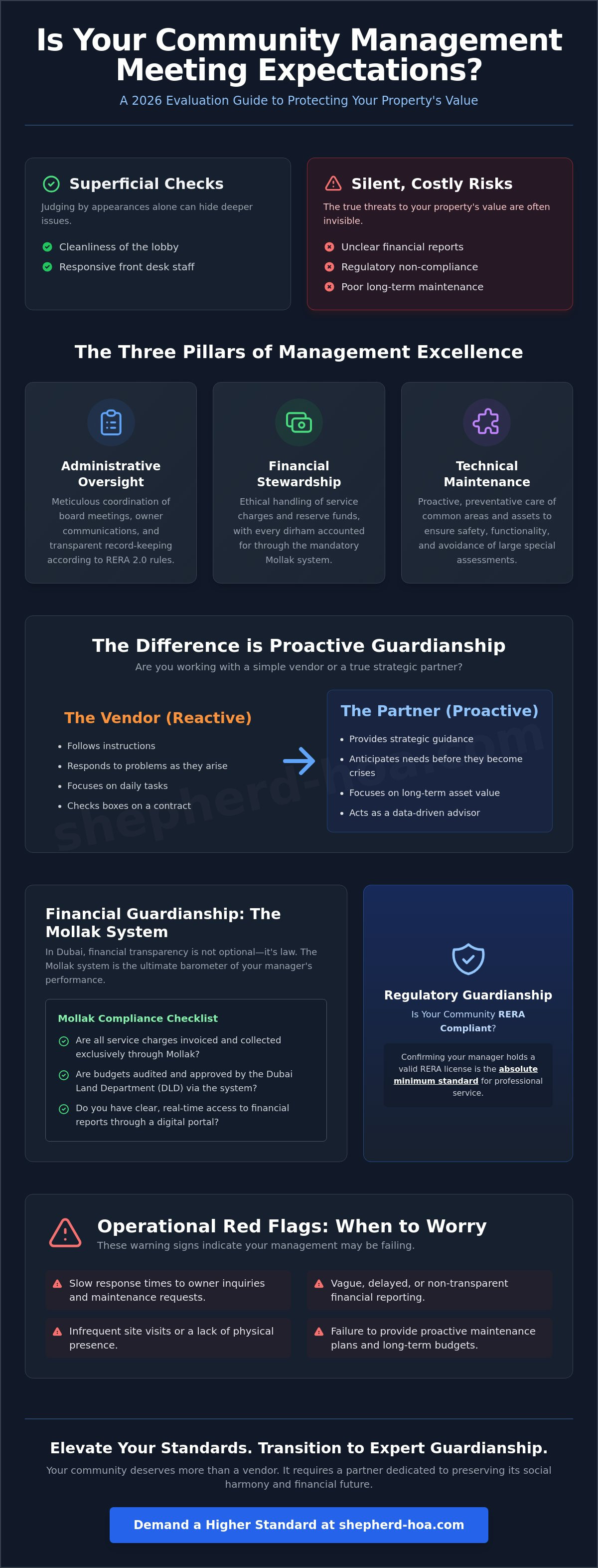
High-performing management rests on three distinct pillars. Administrative oversight involves the meticulous coordination of board meetings, owner committees, and transparent record-keeping. Financial stewardship requires ethical handling of service charges and reserve funds, ensuring every dirham is accounted for. Finally, technical maintenance protects the physical integrity of common areas. This ensures facilities remain safe and functional for years, preventing the sudden, massive special assessments that often plague poorly managed buildings.
The Difference Between a Vendor and a Partner
A common mistake is treating a management company like a simple vendor. A vendor follows instructions, but a partner provides strategic guidance. When you are living in a dubai community, you need a partner who understands the nuances of local regulations as a baseline. This expertise ensures the board doesn't stumble into compliance traps that could lead to fines or legal disputes.
True guardianship also requires empathy. Most board members are volunteers with high personal stakes in their homes. A management partner acts as an invisible backbone, supporting these leaders with data-driven advice and calm reliability. If you find yourself asking, is my community management meeting expectations, evaluate whether they are simply checking boxes or actively guiding your community toward social and financial harmony. A partner anticipates needs before they become crises, providing a sense of organized control that replaces operational stress.
Financial Transparency: Auditing Service Charges and the Mollak System
Financial health serves as the ultimate barometer for management performance. While responsive communication is a visible sign of service, the ethical stewardship of your community's funds is what truly preserves property value. When you begin to wonder, is my community management meeting expectations, your first point of inquiry should always be the ledger. A community with a healthy reserve fund and transparent collection processes is a community that is being properly guarded.
In Dubai, this transparency isn't just a best practice; it's a legal requirement enforced through the Mollak system. This mandatory platform ensures that every service charge budget is submitted, audited, and approved by the Dubai Land Department. If your management company operates with vague spreadsheets or delayed financial reports, they're failing to provide the organized control you deserve. Professional managers act as financial guardians, ensuring that every dirham collected is accounted for and utilized specifically for the community's benefit.
Mollak Compliance Checklist
You can objectively measure your management's financial performance by checking their adherence to these digital standards. A failing manager often hides behind administrative complexity, but a modern partner uses the Mollak system to provide total clarity. Ask your board or management these questions:
Are all service charges strictly approved and invoiced through the Mollak system?
Does the management provide a clear, digital trail of payments and a transparent breakdown of fund allocations?
How frequently does the management provide reconciliation reports to the owners' committee?
Budget Planning and Reserve Funds
Strategic guardianship requires looking far beyond the current month's utility bills. Managing the community service charge budget dubai effectively means balancing immediate operational needs with long-term capital expenditure. A community that lacks a robust reserve fund is a community at risk. When managers fail to plan for the eventual replacement of major assets like chillers or elevators, they leave owners vulnerable to sudden, massive special assessments.
It's essential to verify that all service charge management follows mollak dubai regulations. This ensures that sinking funds are properly calculated and protected. If you feel your current financial oversight is lacking, exploring a transition to a partner focused on professional service charge collection can restore your peace of mind and protect your investment for the years to come.
Regulatory Guardianship: Is Your Community RERA Compliant?
Compliance with the Real Estate Regulatory Agency (RERA) is the non-negotiable floor for professional service. While previous sections focused on financial transparency, regulatory guardianship addresses the legal framework that keeps your community safe. If you find yourself asking, is my community management meeting expectations, start with the most basic legal requirement: a valid rera dubai approved management license. Without this, a company cannot legally manage a jointly owned property, and any contracts they sign on your behalf could be legally precarious.
Professional managers act as a vital bridge between your community and government authorities. They secure necessary approvals, maintain administrative records, and ensure the community adheres to the latest updates in the law. This administrative backbone prevents costly legal disputes and ensures that the board’s decisions are always on solid legal ground. A manager who ignores these formalities isn't just cutting corners; they're exposing the entire community to significant risk.
Navigating Strata Law and Governance
A qualified manager understands the intricacies of local strata law and how it protects owner rights. They don't just attend meetings; they facilitate fair and legal owners' committee elections. This process is vital for maintaining social harmony and ensuring that every owner's voice is heard according to the law. By handling these formal procedures correctly, professional management acts as a shield against personal legal liabilities for board members. It's their job to ensure that the community’s governance remains as robust as its physical structure.
The Ethical Tendering Process
The way a manager handles third-party contracts, such as cleaning and security, reveals much about their integrity. Ethical tendering is a core expectation for any professional partnership. You should check if contracts are being bid out transparently or if the manager relies on 'preferred' vendors without providing a clear justification. You deserve to see a clear comparison of multiple quotes, focusing on the best value for the community rather than just the lowest price.
Low-cost vendors often lead to poor service, which eventually reflects on the management’s overall performance. To determine if is my community management meeting expectations, review how they report on vendor performance to the board. A good manager provides regular, objective feedback on whether these service providers are meeting their contractual KPIs. This level of oversight ensures that your service charges are spent wisely on quality partners who respect the community’s standards.
Operational Red Flags: When to Worry About Your Management
While financial audits and legal compliance provide the framework for success, the daily operational experience is where most owners first notice a decline in standards. Identifying these red flags early can prevent a minor service dip from becoming a major crisis of governance. If you are constantly asking yourself, is my community management meeting expectations, the answer often lies in the quality of their administrative control and physical presence on-site.
One of the most glaring indicators of failure is the "Invisible Manager" syndrome. A professional guardian must be present to observe the community's needs before they are reported by frustrated residents. If the property is only visited during emergencies or scheduled board meetings, the management is reactive rather than proactive. Similarly, delays in the property handover process or unit transitions suggest a breakdown in the administrative backbone that should be supporting your community’s growth and stability.
Communication vs. Coordination
There is a significant difference between communication and coordination. Communication is simply responding to an email; coordination is ensuring the task is actually completed. A professional standard for board inquiries is a 24-hour response window. If you have to follow up twice to get an update on a simple maintenance request, the management is failing its core duty of care. Managers often use the excuse that they are "waiting for the developer" or a third-party vendor, but a true partner takes ownership of the follow-up until the issue is resolved.
The Physical Audit
The state of your common areas tells a story that financial reports might hide. Take a walk through your community and look for these specific warning signs:
Visible deterioration in common areas, such as peeling paint or broken tiles, despite high service charge collections.
A pattern of recurring "emergency" repairs for equipment like chillers or lifts, which indicates a lack of preventative maintenance.
Poor oversight of facility management staff, leading to lapses in security protocols or hygiene standards in gyms and pools.
Unresolved neighbor disputes or frequent violations of community rules that the manager seems unable or unwilling to enforce.
A lack of oversight in these areas directly affects your property's market value and your quality of life. If you are seeing these red flags in your building, it is time to consult with a professional community management partner who prioritizes transparency and active guardianship over excuses.
Elevating Standards: Transitioning to Expert Community Guardianship
Maintaining a property is a serious responsibility that requires more than just basic administrative support. If you have concluded that the answer to is my community management meeting expectations is a firm no, you aren't just dealing with a service inconvenience. You are facing a direct threat to your community’s financial stability and social harmony. Poor management erodes asset value and creates an environment of constant operational stress. You don't have to settle for mediocrity. Transitioning to a partner that prioritizes expert guardianship is a structured, legal pathway designed to restore order and protect your investment.
Expert oversight brings a sense of calm reliability to your community governance. When specialists handle your Mollak filings and RERA approvals, you can stop worrying about regulatory non-compliance or financial opacity. High-quality management doesn't just fix problems as they arise. It preserves the physical integrity of the building, which leads to lower long-term costs and higher property resale values. Your community deserves a watchful guardian who values transparency and integrity, not just a bookkeeper who records a slow decline.
The Transition Process Simplified
The steps required to legally terminate a non-performing management contract are clearly defined under RERA guidelines. It begins with the owners' committee exercising their power to demand a higher standard of care. A professional partner manages the complex handover of essential documents, community funds, and master keys. This ensures there is no gap in service or security during the shift. This methodical approach replaces administrative chaos with organized control, allowing for a seamless transition toward better governance and social harmony.
Why Professional Oversight Matters
The peace of mind that comes with professional oversight is invaluable for volunteer board members. Knowing that your community is fully compliant with RERA 2.0 standards and that your service charges are managed through a transparent Mollak budget provides a backbone for the entire group. Better management leads to more efficient utility account setup and effective service charge collection, ensuring the community has the liquidity it needs to thrive. Professional guardianship is an investment in the long-term stability of your home.
It's time to take control of your community's future and ensure your assets are protected. If you suspect your current provider is falling short, a professional community audit can provide the clarity you need to make an informed decision. Contact Shepherd HomeOwners' Association today to learn how our specialized focus on community management and RERA approval can elevate your standards and restore your peace of mind.
Secure the Future of Your Community
Objectively evaluating your current service provider is the first step toward restoring social harmony and financial stability. You now have the professional benchmarks needed to determine if is my community management meeting expectations by auditing their RERA compliance, Mollak transparency, and operational responsiveness. True guardianship means moving beyond reactive repairs and embracing a partner who treats your property as a valuable asset to be protected for years to come.
At Shepherd HOA, we act as a steady, reliable backbone for volunteer boards. As RERA approved management and Mollak system experts, we provide the organized control you need to ensure proven asset value preservation. Don't let administrative stress or financial uncertainty undermine your investment any longer. We invite you to request a professional community audit from Shepherd HOA to gain total clarity on your property's current performance. Your community deserves a partner that values integrity and long-term stability as much as you do. Take this step today to reclaim your peace of mind.
Community Management Evaluation: Frequently Asked Questions
What are the most common signs that a community management company is failing?
Signs of failure include chronic delays in maintenance, lack of financial transparency, and poor communication. If you find yourself asking, "is my community management meeting expectations," look for a pattern where you have to follow up multiple times on a single request. Deteriorating common areas despite high service charge collections are also a clear operational red flag that suggests a lack of active oversight.
How often should I receive financial reports from my management company?
You should receive detailed financial reconciliation reports at least once every quarter. Professional managers provide these reports to the owners' committee to ensure every dirham is accounted for. These reports should match the approved budgets in the Mollak system. Regular reporting allows the board to maintain organized control over the community's assets and identify any budget variances before they become a financial burden.
Can a homeowners' association board terminate a management contract early?
Yes, a board can terminate a contract early, but it must follow the specific legal procedures outlined in the management agreement and RERA regulations. This usually involves a formal vote by the owners' committee and a structured notice period. Termination often requires documented proof of non-performance. A professional partner can help guide the transition to ensure the handover of documents, funds, and keys happens without disrupting community operations.
What role does RERA play in holding management companies accountable?
RERA acts as the primary regulatory guardian by licensing management companies and enforcing strict transparency standards. Under the RERA 2.0 framework, the agency audits service charge budgets and ensures that management companies adhere to the Jointly Owned Property Law. They provide the legal floor for performance. If a manager operates without a valid license or fails to submit budgets through Mollak, RERA has the authority to impose sanctions.
How does the Mollak system protect my service charge payments?
The Mollak system protects your payments by ensuring that all service charges are deposited into regulated accounts and used only for approved community expenses. It eliminates the risk of funds being mismanaged or co-mingled. Since every budget must be audited and approved by the Dubai Land Department through Mollak, owners have a transparent view of where their money goes. This system is a mandatory safeguard for all jointly owned properties in Dubai.
Is my management company responsible for resolving disputes between neighbors?
Management companies are responsible for enforcing community rules and the master declaration, but they don't act as personal mediators. Their role is to address violations that affect the common areas or the community's social harmony, such as noise complaints or unauthorized alterations. If a neighbor dispute violates the community's established bylaws, the manager will issue formal notices. For personal legal matters, owners must typically seek independent resolution.
What is the difference between facility management and community management?
Facility management focuses on the physical maintenance of the building, such as HVAC systems, elevators, and cleaning. Community management is the broader administrative and legal guardianship of the entire association. A community manager handles financial stewardship, RERA compliance, and board coordination. While facility managers keep the lights on, community managers ensure the community's long-term asset value and legal standing are protected through strategic planning.
Should my community manager be present at every owners' committee meeting?
Yes, your community manager should be present at every formal owners' committee meeting to provide expert guidance and record accurate minutes. They serve as the administrative backbone, ensuring that all discussions and decisions comply with local strata laws. Their presence is vital for providing real-time data on maintenance projects or financial status. This participation ensures that the board’s actions are always documented and legally sound, which is a core part of how one determines if is my community management meeting expectations.


Comments