
Landscaping Best Practices for UAE Communities: A 2026 Management Guide
- Sohrab Virani

- Jun 29
- 12 min read
What if the very greenery intended to elevate your community's prestige is actually quietly eroding your reserve funds through inefficient irrigation and regulatory non-compliance? Adopting modern landscaping best practices for uae communities is no longer just about aesthetics; it's a critical strategy for financial guardianship. It's frustrating to see high water bills and dying plants despite heavy investment, especially when you're also navigating the complexities of RERA and Mollak approvals for your landscaping contracts.
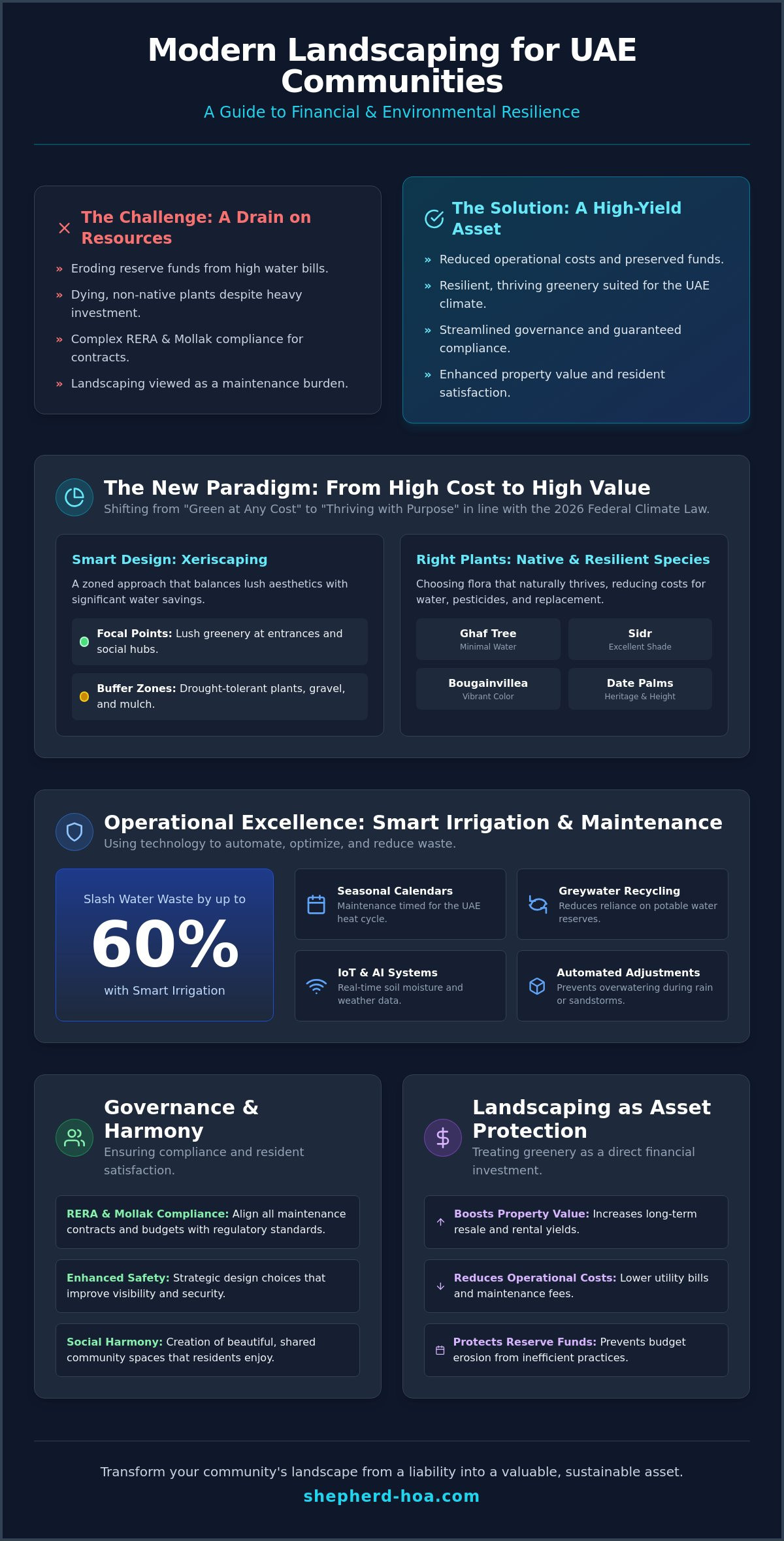
We understand that your goal is to provide a serene environment without compromising the budget. You can transform these outdoor spaces from a maintenance burden into a high-yield asset that reduces operational costs and enhances social harmony. This guide provides a clear roadmap for aligning with the 2026 Federal Climate Law, utilizing smart irrigation to slash water waste by up to 60%, and managing the governance required to protect your property's long-term resale value and curb appeal.
Table of Contents
What is Sustainable Landscaping in the UAE Context?
In the UAE, sustainable landscaping is the intentional balance between environmental resilience and long-term financial viability. For years, many developments operated under a "green at any cost" mentality, often relying on massive water inputs and expensive chemical fertilizers to maintain non-native species. By 2026, the paradigm has shifted toward "thriving with purpose." This means every plant choice must justify its existence through its ability to withstand extreme heat and its impact on the community budget.
Implementing landscaping best practices for uae communities involves seeing the greenery as a living infrastructure rather than a static decoration. As a community manager, you act as the guardian of this ecosystem. Your oversight ensures that the landscape doesn't just survive the summer but actually thrives while protecting the owners' association funds. A healthy, biodiverse landscape also supports local bird and insect life, which reduces the need for aggressive pest control and creates a safer, more natural environment for residents. Projects like Sharjah Sustainable City demonstrate how integrating water recycling with smart plant selection creates lush environments that remain financially sustainable even in an arid climate.
Xeriscaping vs. Traditional Greenery
Xeriscaping is a design philosophy focused on minimizing or eliminating the need for supplemental water. A common misconception suggests this approach results in a barren landscape of rocks and cacti. In reality, modern landscaping best practices for uae communities utilize a zoned approach. We recommend creating lush "focal points" near entrances or social nodes where residents gather. These are then surrounded by drought-tolerant "buffer zones" consisting of decorative gravel, organic mulch, and hardy succulents. This strategy maintains the premium "green feel" that residents expect while significantly slashing utility costs.
The Role of Native Species: Ghaf, Sidr, and More
The Ghaf tree is the cornerstone of UAE community landscaping for a reason. It's the national tree, it's incredibly deep-rooted, and it requires minimal water once established. Using local flora isn't just an environmental choice; it's a definitive financial strategy. Native plants are naturally resistant to local pests and diseases, which reduces the need for expensive chemical treatments and frequent plant replacements. We prioritize several salt-tolerant species that thrive in the national climate:
Sidr (Ziziphus spina-christi): Provides excellent shade and handles high temperatures with ease.
Bougainvillea: Offers vibrant, year-round color with very low water requirements.
Date Palms: The classic choice for height, heritage, and structural interest.
Desert Rose (Adenium obesum): Adds sculptural beauty and floral interest in arid conditions.
Choosing these species ensures that the community's aesthetic remains stable throughout the year, even during the peak of summer when traditional ornamental plants often struggle or die.
Operational Excellence: Smart Irrigation and Maintenance
Operational excellence is the functional backbone of any sustainable community. It requires a shift away from manual timers that often water the pavement during a sandstorm or over-saturate soil during rare rainfall. In 2026, landscaping best practices for uae communities center on precision and data-driven oversight. By transitioning to weather-based irrigation controllers, managers ensure water only flows when the environment demands it. This shift, combined with greywater recycling, allows large-scale communities to maintain lush aesthetics without depleting potable water reserves or inflating utility bills.
A seasonal maintenance calendar tailored to the UAE heat cycle is also vital for long-term health. Pruning, fertilizing, and pest control must align with local temperature shifts to avoid stressing the flora. For communities seeking to streamline these complex schedules, professional community management oversight ensures that vendors remain accountable to these high standards. This structured approach replaces operational stress with organized control, protecting the community's financial and aesthetic interests.
Implementing IoT and AI Irrigation Systems
Smart sensors now detect soil moisture levels in real-time, acting as a financial safeguard for the owners' association. These systems use AI to analyze local weather forecasts and adjust watering schedules automatically. One of the most significant benefits is automated leak detection. A small pipe burst in a large community can waste thousands of gallons before a human eye spots it. AI systems identify these anomalies instantly, shutting off the flow and alerting the maintenance team. This removes the human error factor that often leads to overwatering or plant death due to forgotten manual overrides.
Soil Management and Mulching Strategies
Soil health is the silent partner of irrigation. In sandy environments, water often drains away before roots can absorb it. We advocate for the use of moisture-retaining polymers and organic mulch to create a more resilient foundation. Organic mulch is essential because it acts as a thermal blanket, preventing root evaporation during the peak 50°C summer heat. It also breaks down over time, adding vital nutrients to the soil. Regular salinity testing is another critical component of soil management. High salt levels can burn even the hardiest plants. By monitoring these levels, you can adjust irrigation or soil conditioners before damage occurs. Referencing the UAE's national sustainability guide provides a clear framework for these soil-first approaches, ensuring your landscaping best practices for uae communities are built on a scientifically sound foundation.
Governance and Compliance: Navigating RERA and Mollak
In the UAE, landscaping isn't just about aesthetic appeal; it's a regulated financial asset that requires strict oversight. Effective governance ensures that every landscaping contract is ethically tendered through the Mollak system. This platform is the cornerstone of financial transparency, allowing owners to see exactly how their service charges are utilized. By aligning your landscaping budgets with the RERA Service Charge Index, you provide owners with the confidence that their community is managed with integrity and fiscal responsibility. This structured approach to landscaping best practices for uae communities ensures that your green spaces contribute to property value rather than becoming a source of financial stress.
Major landscape modifications require formal RERA approvals to ensure they comply with national safety and structural standards. This oversight prevents unauthorized work that could lead to property transfer freezes at the Dubai Land Department. Transparent reporting isn't just a legal obligation; it's the primary tool for building a relationship of trust between the Owners' Committee and the management company. Following established community management landscaping guidelines ensures your project meets the high standards expected in premium UAE developments while remaining fully compliant with local regulations.
The Ethical Tendering Process for Service Contracts
We prioritize long-term community value over the simple pursuit of the lowest bid. Drafting a comprehensive scope of work is the first step in protecting the community's assets. When we evaluate third-party contractors, we look at sustainability metrics like their experience with smart irrigation and their ability to source native species. Price is a factor, but a cheap contract that leads to dying plants and high water bills is a poor investment. Our role as your management partner is to oversee contractor performance, ensuring they meet every KPI defined in the Mollak-approved contract and maintain the community's aesthetic standards year-round.
Budget Planning for Landscape Renewal
Distinguishing between routine maintenance and capital expenditure is essential for long-term financial stability. Routine maintenance covers the day-to-day care of your gardens, while major renewals or irrigation system upgrades often fall under the Reserve Fund. You'll find that justifying these investments to the Owners' Committee is much easier when you have a data-backed plan that emphasizes asset protection. For a deeper look at financial oversight, see our guide on Mastering the Community Service Charge Budget in Dubai. This level of planning ensures that landscaping best practices for uae communities are integrated into the community's long-term financial health, replacing operational stress with a sense of organized control and peace of mind.
Community Harmony: Designing for Resident Experience
A community's landscape is more than just a collection of plants; it's the stage where social life unfolds. When we apply landscaping best practices for uae communities, we prioritize the resident experience to foster social harmony and reduce operational friction. One of the most common challenges for management is addressing the resident objection: "Why are we spending on plants instead of repairs?" The answer lies in asset protection. Well-maintained greenery isn't a luxury; it's a critical component of property value that prevents the "broken window" effect. High-quality landscaping signals that a community is under vigilant guardianship, which naturally encourages residents to treat common areas with more respect.
Creating "social nodes" is a strategic way to encourage neighborly interaction without creating noise disturbances. By placing benches, pergolas, or small garden squares away from bedroom windows but near natural walking paths, you create invitations for connection. This thoughtful design balances the need for community engagement with the right to domestic peace. If you need help balancing these complex resident requirements with technical oversight, our community management services provide the organized control necessary to maintain a premium environment.
Common Area Rules and Safety Guidelines
Safety is the silent foundation of a successful landscape. We advocate for a safety-first design that includes strategically placed lighting to eliminate dark corners, non-slip paths for pool areas, and clear visibility at all intersections. Managing communal assets like BBQ areas and parks requires clear, enforceable guidelines that protect everyone's enjoyment. This includes regulating light pollution to ensure that decorative garden lights don't spill into residents' homes at night. For a broader look at how these rules integrate into daily life, read our complete 2026 resident guide to harmony and governance. Establishing these standards early prevents disputes and ensures that common areas remain a source of pride rather than a point of contention.
Landscape Design as a Dispute Resolution Tool
Design can often solve social problems before they escalate into formal complaints. For example, using "soft" barriers like dense hedges or tall shrubs instead of "hard" concrete walls can manage privacy between villas more gracefully. These green screens provide the necessary seclusion without making the community feel fortified or unfriendly. Effective landscaping best practices for uae communities also involve zoning common areas to cater to diverse age groups. By physically separating a high-energy children's play zone from a quiet "zen garden" or reading nook, you reduce the friction between different lifestyle needs. Clearly marked boundaries and well-maintained pathways guide resident behavior intuitively, which significantly lightens the administrative burden on the Owners' Committee and the management team.
The Shepherd Perspective: Landscaping as Asset Protection
Landscaping is a primary driver of property resale value and rental yields in the UAE. It's the first impression a visitor receives and the lasting image a resident carries home. When we discuss landscaping best practices for uae communities, we're really discussing the preservation of a multi-million dirham asset. Proactive governance prevents "landscape decay," which is the gradual decline of common areas that eventually triggers massive, unplanned emergency repair costs. By treating the garden as an infrastructure investment rather than an optional expense, we ensure the community remains a premium destination for years to come.
Our approach to oversight centers on protecting both the financial and aesthetic interests of the owners. We act as a vigilant guardian, ensuring that the vision for the community is realized through every leaf and irrigation line. High-quality common areas don't happen by accident; they're the result of professional management that understands the intersection of horticultural science and Dubai's regulatory framework. This level of control replaces the typical stress of community maintenance with a sense of organized stability and peace of mind.
Preserving Asset Value Through Professional Oversight
A community management company serves as the long-term guardian of the community's assets. While volunteer board members bring passion and personal stakes, professional governance provides the technical expertise required for complex operations. We handle the intricacies of contractor performance, utility account setup, and regulatory compliance, allowing the Owners' Committee to focus on high-level decision-making. Professional oversight ensures that landscaping best practices for uae communities are consistently applied, protecting the collective investment from the risks of mismanagement or neglect. For a deeper look at how we drive community standards, explore our guide on Owners Association Management in Dubai.
Strategic Budgeting for Future Resilience
We plan for the 10-year landscape lifecycle to avoid sudden service charge spikes that can cause friction within the community. This involves a methodical approach to budget planning where we anticipate when irrigation pumps will need replacement or when large-scale replanting is required. The Reserve Fund plays a vital role here; it's the financial safety net that allows the community to maintain its standards without placing an immediate burden on owners. By identifying these needs early, we maintain the community's aesthetic integrity and ensure long-term financial health. We encourage board members and owners' committees to seek expert guidance to navigate these responsibilities. If you're ready to transition from operational stress to a state of organized control, our team is here to act as your expert guide in community excellence.
Future-Proofing Your Community’s Green Assets
Transitioning to native flora and smart irrigation isn't just an environmental choice; it's a financial necessity for long-term stability. By integrating these systems with rigorous governance through Mollak and RERA, you protect the owners' association funds while elevating the resident experience. Implementing landscaping best practices for uae communities ensures that your outdoor spaces remain resilient against the heat and compliant with the latest 2026 climate regulations. This proactive approach replaces the stress of reactive repairs with a methodical, organized plan for asset guardianship.
We understand the pressure of managing complex service contracts and maintaining high community standards. Secure your community's future with Shepherd's expert management services. Our team offers 15+ years of UAE community governance and RERA-approved management expertise. We are specialists in Mollak financial transparency, ensuring that every dirham invested in your landscape delivers measurable value and peace of mind for all stakeholders.
You don't have to navigate these administrative and operational challenges alone. With a steady partner to act as your expert guide, your community's landscape will become a lasting legacy of social harmony and financial value.
Frequently Asked Questions
Is xeriscaping mandatory for communities in the UAE?
Xeriscaping is not strictly mandatory by law for all existing developments, but it's the most effective strategy for complying with the 2026 Federal Climate Law regarding greenhouse gas emissions and water conservation. Most new building permits now require sustainability frameworks like Al Sa'fat 2.0 Silver, which heavily favor water-wise designs. Adopting these landscaping best practices for uae communities helps boards meet mandatory environmental targets while protecting the owners' association budget from rising utility costs.
How do we get Mollak approval for a new landscaping contract?
To obtain Mollak approval, your community management company must submit a detailed budget and the proposed landscaping contract through the official Mollak portal. RERA reviews these submissions to ensure they align with the approved service charge and community standards. This process requires transparent financial reporting and a clear, professional scope of work. Professional management ensures that all documentation meets RERA’s strict requirements, preventing delays in contract activation and service delivery.
What are the best native plants for high-salinity areas in the UAE?
The best native plants for high-salinity environments include the Ghaf tree, the Sidr tree, and the Date Palm. These species have evolved to thrive in the UAE’s specific soil conditions and require significantly less fresh water once they're established. Other salt-tolerant options like Bougainvillea and certain succulents provide vibrant color without the high maintenance needs of non-native ornamental plants. Using these species is a core component of sustainable landscaping best practices for uae communities.
Can landscaping help reduce our community's water bills?
Yes, strategic landscaping can reduce community water bills by up to 60% when smart irrigation systems are correctly implemented. By replacing thirsty grass lawns with drought-tolerant groundcover and installing soil moisture sensors, you eliminate the waste associated with manual watering. These technology-driven solutions ensure that water is only used when the environment demands it, providing a direct financial benefit to the community's operational budget while maintaining a premium appearance.
Who is responsible for maintaining the landscape in a managed community?
In a managed community, the responsibility for common area landscaping lies with the Owners' Association, overseen by the appointed community management company. The management company handles the procurement of third-party maintenance contractors and ensures they adhere to the agreed-upon scope of work and KPIs. Individual property owners are generally responsible for their private gardens, though these must still comply with the community’s overall architectural and aesthetic standards to preserve social harmony and property values.
What happens if a community doesn't follow RERA landscaping guidelines?
Failing to follow RERA landscaping guidelines or performing major modifications without a No Objection Certificate (NOC) can lead to significant legal and financial consequences. The Dubai Land Department may freeze property transfers for the entire community until compliance is met. Additionally, unauthorized modifications that damage underground utilities can result in heavy fines from Dubai Municipality. Proactive governance ensures that all work is documented and approved through the unified digital system, protecting the collective interests of all owners.
How often should we audit our community's irrigation system?
We recommend auditing your community’s irrigation system at least once per quarter. These regular checks identify hidden leaks, clogged nozzles, or malfunctioning sensors before they lead to plant loss or inflated utility bills. Frequent audits are especially critical before the peak summer months to ensure the system is capable of handling extreme temperatures efficiently. This methodical oversight acts as a safeguard for the community’s living assets and ensures long-term financial health.
Does the RERA Service Charge Index include landscaping costs?
Yes, the RERA Service Charge Index accounts for landscaping as part of the overall maintenance and upkeep costs for jointly owned properties. This index provides a benchmark that helps owners' committees determine if their current landscaping expenses are in line with industry standards for similar developments. Aligning your budget with this index ensures financial transparency and helps maintain the community’s standing with the Real Estate Regulatory Agency, providing peace of mind to all residents.


Comments