
Managing Parking Issues in a Community: The 2026 Guide to Harmony and Compliance
- Sohrab Virani

- Jul 3
- 12 min read
Imagine it is 6:00 PM on a Tuesday, and a long-term resident discovers their assigned spot is once again occupied by an unauthorized commercial van. This single moment often triggers a chain reaction of frustration, heated phone calls, and neighborly friction that falls directly onto your shoulders as a community leader. You already understand that managing parking issues in a community is about much more than just paint on asphalt. It is about protecting the peace and maintaining the collective value of the property you serve.
It is exhausting to referee "stolen" spots or guess at your legal enforcement rights, especially with new 2026 regulations like Florida's mandatory member portal requirements or California's $100 fine caps. You deserve a clear, organized framework that replaces operational stress with a sense of control. This guide provides the expert strategies you need to resolve disputes and implement fair regulations that residents will actually respect. We will explore how to leverage modern technology and professional oversight to transform parking from a source of conflict into a seamless, orderly part of your community's daily life.
Table of Contents
Why Managing Parking Issues is Critical for Community Value
When a prospective buyer or a resident's guest drives into your development, the first thing they notice isn't the architectural detail or the landscaping. It is the parking. Abandoned vehicles, commercial trucks parked in residential zones, and cars spilling onto sidewalks create an immediate sense of neglect. This parking chaos erodes the community's reputation, signaling a lack of oversight to anyone entering the premises. Effectively managing parking issues in a community is a direct investment in your curb appeal. It creates a welcoming environment that suggests order, safety, and high standards.
There is a powerful correlation between organized parking and the preservation of property asset value. A well-managed lot or garage indicates that the owners association is active and protective of collective assets. Reviewing parking fundamentals on Wikipedia illustrates how space allocation is a core component of community planning. When parking is a free-for-all, it negatively impacts resident satisfaction scores. People want to live where they feel their primary convenience, storing their vehicle safely and reliably, is guaranteed. This stability makes the community more attractive to high-quality tenants and buyers alike.
Professional community management acts as a neutral guardian in this process. By removing the personal emotion from parking disputes, a manager protects the board from direct conflict while ensuring common areas remain accessible for everyone. They provide the steady hand needed to enforce rules without the bias that often complicates neighbor-to-neighbor interactions.
The Hidden Costs of Unmanaged Parking
Neglecting parking rules creates significant financial and operational drains. Board members often find themselves buried under an administrative burden of constant complaints and heated disputes. Beyond the paperwork, unmanaged parking presents real safety risks. Blocked fire hydrants or restricted emergency access lanes can lead to tragic outcomes and massive legal liabilities for the association. Inconsistent enforcement is particularly dangerous; it opens the door for residents to claim selective treatment, leading to costly legal challenges that drain the community's budget and damage its social fabric.
Parking as a Reflection of Community Governance
A structured system provides psychological relief for every resident. When people know the rules are fair and consistently applied, it reduces daily stress and fosters a sense of peace. Managing parking issues in a community also sets a standard for all other regulations. If the board can maintain order in the parking lot, residents are more likely to respect guidelines regarding service charges or noise. This transparency establishes the board's authority, transforming the parking area from a potential battleground into a reflection of stable, professional governance.
The Legal Framework: Regulations and Governing Documents
Every effective strategy for managing parking issues in a community begins with a foundation of legal authority. This authority isn't arbitrary; it is rooted in your community's Master Declaration and Bylaws. These documents serve as the constitutional backbone of your association, defining exactly how common areas are used and how violations are addressed. Without these clearly defined powers, enforcement becomes a matter of opinion rather than a matter of law. A board's primary duty of care involves ensuring that every parking rule is explicitly supported by these governing documents to protect the association from potential litigation.
In jurisdictions like Dubai, alignment with national standards is mandatory. All parking policies must strictly adhere to RERA Dubai regulations to maintain their legal weight. It isn't enough to simply vote on a new rule during a board meeting. For a regulation to be enforceable, it must be officially registered with the appropriate authorities. This registration process transforms a simple house rule into a defensible community standard, providing the board with the necessary teeth to manage non-compliance effectively. Achieving Mollak and RERA approval for your community's specific parking regulations ensures every fine or warning stands up to legal scrutiny.
Understanding the distinction between "Common Areas" and "Allocated Spaces" is equally critical. Common areas are shared assets owned collectively by all members, while allocated spaces are typically deeded or assigned to specific units. Legally, the board has broad power to regulate common areas, but interfering with allocated spaces requires a more nuanced approach. Clear definitions in your legal documents prevent "stolen" spot disputes from escalating into complex legal battles over property rights.
Standardizing Rules Across the Community
A "Parking Charter" serves as a transparent guide that simplifies rights for residents and guests. This document should explicitly address modern challenges like oversized transport and commercial vehicles, which often block sightlines or damage pavement. Managing parking issues in a community also requires a strict protocol for abandoned vehicles. Your charter must outline specific legal timelines for notifications and towing to ensure you don't infringe on owner rights while clearing space. Most jurisdictions require a documented 72-hour or 15-day notice period before a vehicle can be legally removed from common property.
Administrative Compliance and Reporting
Transparency is the best defense against resident friction. Every violation must be meticulously documented and uploaded into the Mollak system to ensure financial and administrative compliance. This digital trail provides an ethical record of enforcement, proving that the board is acting consistently and fairly. All enforcement decisions, including the selection of third-party towing or security contracts, should be formally minuted during board meetings. This creates a "paper shield" that demonstrates the board is fulfilling its fiduciary duty to protect the community's assets and social harmony.
Tactical Solutions: Permits, Technology, and Barriers
Once your legal foundation is secure, you must select the right tools to implement your policy. Effectively managing parking issues in a community requires a strategic choice between traditional physical controls and modern digital solutions. While physical permits have served communities for decades, the shift toward cloud-based technology is accelerating. By 2026, many residential sectors are moving away from manual checks in favor of automated systems that reduce the administrative burden on volunteer boards and management teams alike.
Physical barriers, such as automated gates or retractable bollards, offer the most direct form of guest management. These tools provide a clear psychological and physical boundary that prevents unauthorized entry. However, they come with maintenance costs and the potential for traffic bottlenecks. To mitigate these issues, many communities are now integrating Automatic Number Plate Recognition (ANPR) technology. This system acts as a digital guardian, identifying resident vehicles instantly and opening barriers without the need for fobs or scan cards. It provides a seamless experience for residents while maintaining a high level of security.
Smart Parking sensors represent the next level of oversight. These small devices, installed in individual bays, monitor real-time availability and usage patterns. This data is invaluable for boards when making long-term decisions about space allocation or potential expansions. Instead of guessing which areas are overcapacity, you can rely on concrete analytics to justify your management strategies.
Permit-Based Systems for High-Density Communities
In high-density environments where space is at a premium, a permit system remains a reliable standard. If you choose physical permits, they must be visible and tamper-proof to prevent duplication. Designing a distinct color-coding system for residents, guests, and service providers helps security teams identify unauthorized vehicles at a glance. The administrative workflow for these permits should be centralized; using a digital portal for renewals ensures that records stay current and reduces the risk of lost paperwork. Providing daily or weekly visitor passes through this portal allows residents to take responsibility for their guests' compliance.
Leveraging Technology for Enforcement
Mobile applications are transforming how residents interact with parking rules. Instead of calling a security desk, residents can register guest vehicles instantly through an app, which updates a cloud-based database in real-time. This ensures that security personnel always have the most accurate information during their rounds. Managing parking issues in a community becomes significantly more peaceful when you implement digital "warning" systems. These platforms can send an automated text or push notification to a resident before a fine is issued or a vehicle is towed. This proactive approach reduces hostility and reinforces the board's role as a supportive guide rather than a punitive authority.
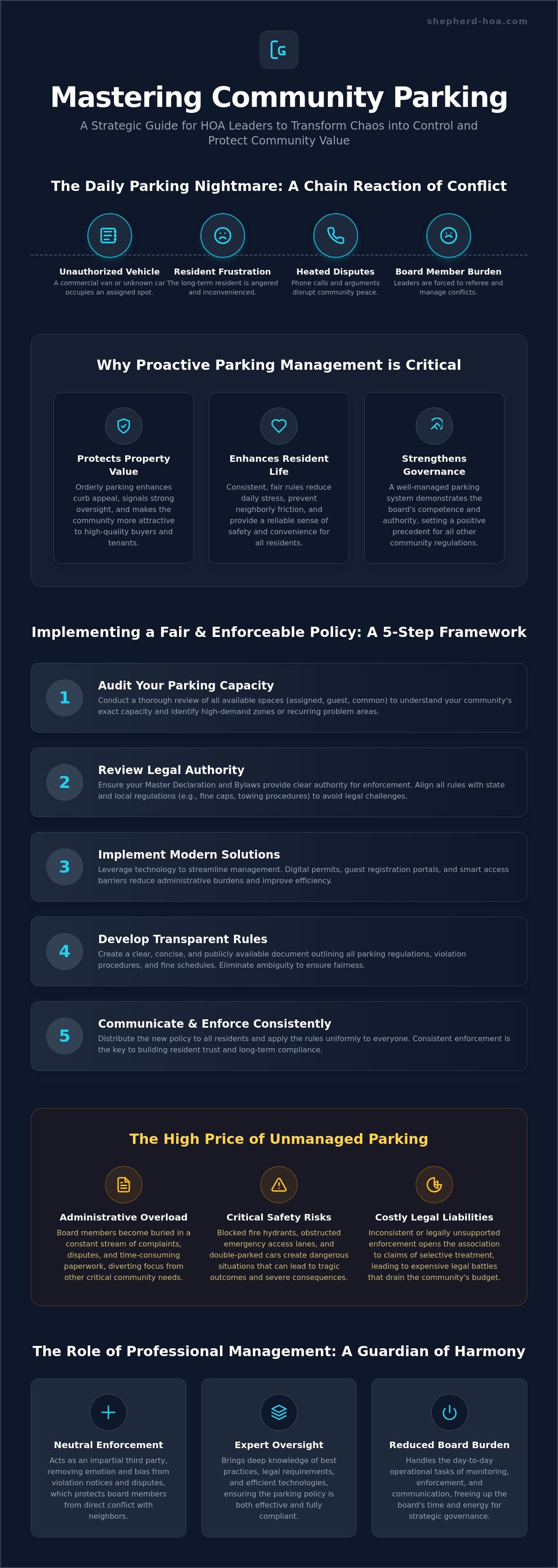
How to Implement a Fair Parking Policy: A 5-Step Process
Implementing a new strategy for managing parking issues in a community requires a methodical approach to ensure resident buy-in. You can't simply change the rules overnight without risking significant friction. Instead, follow this five-step process to transition from operational chaos to organized control. This sequence prioritizes transparency and fairness, positioning the board as a guardian of community standards rather than a source of arbitrary punishment.
Step 1: The Audit. Start by mapping every available inch of parking. Identify high-demand zones and underused areas. Use the data from smart sensors mentioned earlier to understand peak usage times and resident behavior patterns.
Step 2: Drafting. Create a concise policy using the "Parking Charter" framework. Before publishing, have your management company and legal counsel review the draft to confirm it aligns with national property laws and your community's specific bylaws.
Step 3: The Grace Period. Launch a 30-day communication campaign before enforcement begins. This "warning only" phase gives residents time to adjust their habits, register their vehicles, and resolve any questions about the new standards.
Step 4: Signage. Install professional signs at every entrance and near restricted zones. These must meet national regulatory requirements to be legally defensible. Clear visual reminders reduce the "I didn't know" defense during disputes.
Step 5: Impartial Enforcement. Once the grace period ends, apply the rules consistently to everyone. This is where managing parking issues in a community becomes a routine administrative task rather than a source of neighborly conflict.
The Communication Strategy
Transparency is your greatest tool for maintaining social harmony. Use your community portal and digital newsletters to explain the "Why" behind the "What." Residents are far more likely to comply when they understand that the goal is to protect their property value and safety. Hosting a town hall meeting allows people to voice their concerns directly, making them feel like partners in the process. Providing a clear FAQ document will also significantly reduce the volume of administrative inquiries hitting your inbox during the rollout.
Impartial Enforcement Tactics
Fairness is maintained through a logical "Three-Strike" rule: a first warning, a secondary fine, and finally, vehicle removal. This progression proves that the board prefers compliance over punishment. If removal becomes necessary, only work with ethical towing partners who follow documented legal procedures. Always provide a clear appeals process so residents feel they have a voice if they believe a mistake occurred. If you find the administrative side of this process overwhelming, you can partner with a professional community management team to handle the heavy lifting of policy implementation and enforcement.
The Role of Professional Community Management in Parking
The most effective strategy for managing parking issues in a community involves introducing a neutral third party to oversee daily operations. When board members attempt to enforce rules directly, it often leads to personal friction and strained neighborly relationships. A professional manager acts as a vital buffer, removing the emotional weight from enforcement actions. By positioning the management company as the primary point of contact for disputes, the board can focus on high level governance while residents receive consistent, objective responses to their concerns. This professional distance is essential for maintaining a peaceful environment where rules are respected without being resented.
For those overseeing residential developments, ensuring that owners association management in Dubai includes robust facility oversight is a non negotiable requirement. Parking areas are high traffic assets that require constant administrative attention and technical maintenance. A dedicated manager provides the oversight needed to monitor usage patterns, coordinate with security teams, and ensure that digital enforcement tools are functioning correctly. This comprehensive approach transforms parking from a reactive problem into a proactively managed utility. It allows everyone to enjoy the benefits of living in a Dubai community that values social harmony and orderly conduct.
Budget Planning for Parking Infrastructure
Effective management requires financial foresight. Professional managers assist boards with Budget Planning to ensure funds are available for essential infrastructure, such as high visibility signage, fresh bay painting, and technological upgrades like ANPR cameras. These investments shouldn't be viewed as mere expenses; they are tools for asset preservation. Organized parking increases property demand and resident retention, providing a clear return on investment. A professional partner also manages the ethical tendering process for security and enforcement service contracts. This ensures the community receives high quality service at a fair market rate without any conflicts of interest.
Shepherd HomeOwners' Association: Your Partner in Community Guardianship
At Shepherd HomeOwners' Association, we view ourselves as the guardian of your community's collective interests. Our approach combines calm, authoritative enforcement with meticulous administrative oversight. We handle the complexities of the Mollak system, ensuring that any parking related fees or fines are reported with total financial transparency and integrated into your community's broader fiscal records. By providing this invisible backbone, we keep community life moving smoothly and predictably. We take on the operational stress of managing parking issues in a community so you can enjoy the peace of mind that comes from a well ordered home environment. Our goal is to replace the friction of unauthorized vehicles with the reliability of a professionally managed system.
Securing Community Harmony Through Orderly Management
Successfully managing parking issues in a community requires more than just reactive enforcement. It demands a strategic blend of legal precision, modern technology, and neutral oversight. By establishing a clear Parking Charter and leveraging digital tools like ANPR, you can protect your residents' peace of mind and your development's long term value. These steps transform a source of constant friction into a seamless, predictable part of daily community life. You've seen how a structured process can replace operational stress with organized control.
As you look toward the future, you don't have to carry the administrative burden alone. Shepherd HomeOwners' Association acts as a steady guardian for your community, providing professional RERA approved management and expert Mollak system integration. Our focus on social harmony and asset preservation ensures that your community remains a desirable and stable place to live. Partner with Shepherd HomeOwners' Association for Expert Community Management to restore order and confidence to your association. You have the tools to turn administrative challenges into a success story; it's time to build a more harmonious environment for every resident.
Frequently Asked Questions
Can an HOA legally tow a vehicle from a common area?
Associations generally possess the legal authority to tow vehicles that violate community rules, provided this power is explicitly stated in the Master Declaration or Bylaws. You must also comply with local or national regulations regarding notice periods and required signage. Working with a professional manager ensures that every tow is meticulously documented and remains legally defensible if challenged by a resident.
How many parking spaces should be allocated per residential unit?
Most developments allocate one to two spaces per unit, though this depends on local zoning requirements and the community's specific design. Some cities are currently moving away from minimum parking mandates to encourage higher density and reduce construction costs. If you are managing parking issues in a community with limited space, a professional audit helps you determine the most efficient allocation strategy based on actual usage data.
What is the best way to manage visitor parking in a gated community?
Implementing a digital registration system is the most effective method for modern visitor management. Residents can use a mobile app to register guest vehicles instantly, which updates the security team's database in real-time. This eliminates the need for manual paper logs and ensures that guest spots remain available for actual visitors rather than becoming unauthorized long-term parking for residents.
How do we handle abandoned or non-operational vehicles in the parking lot?
You should follow a standardized notification process that begins with a physical warning notice placed directly on the vehicle. Most jurisdictions require a specific grace period, often ranging from 72 hours to 15 days, before the vehicle can be legally removed from the property. Documenting every step of this process protects the board from liability while clearing valuable space for active residents.
Are digital parking permits more effective than physical stickers?
Digital permits offer superior efficiency because they link directly to a vehicle's license plate and cannot be lost, stolen, or forged. They provide managers with real-time data and significantly simplify the renewal process for residents. While physical stickers offer a quick visual check for security, digital systems paired with ANPR technology provide much more robust oversight for managing parking issues in a community.
What should be included in a community's official parking signage?
Effective signage must clearly state the parking rules, the specific consequences for violations, and the contact information for the authorized towing provider. It should also reference the sections of the community's governing documents that authorize enforcement. Placing these signs at every entrance and within high-demand zones ensures that no resident or guest can claim they were unaware of the regulations.
How can we prevent residents from using visitor spots for their second cars?
Enforcing strict time limits and utilizing digital tracking are the most reliable ways to curb this behavior. By monitoring license plates over time, management can identify vehicles that exceed guest time allowances or appear too frequently in visitor zones. Imposing consistent fines for these violations reinforces the fact that visitor spaces are a shared community resource rather than personal overflow parking.
What role does the Owners Committee play in approving parking fines?
The Owners Committee is responsible for approving the overarching parking policy and the specific schedule of fines for different violations. While the management company handles the daily enforcement and administrative tracking, the committee provides the necessary governance and final oversight. This partnership ensures that fines are applied fairly and that the community's long-term financial interests remain protected.


Comments