

Mastering the RERA Service Charge Index in Dubai: The 2026 Homeowner’s Guide
- Sohrab Virani

- Mar 21
- 14 min read
What if that 25,000 AED invoice sitting on your desk isn't just a fixed cost, but a figure you have the legal right to challenge? For many Dubai homeowners, the annual billing cycle brings a sense of dread rather than the pride of ownership. You likely feel that managing a luxury property shouldn't involve guessing games about where your money goes. It’s natural to worry about legal penalties or whether your building’s budget reflects actual market rates. This is where the rera service charge index acts as your financial guardian, ensuring that every dirham contributed to your community's upkeep is transparent and legally sound.
We believe you deserve total clarity regarding your property’s operational expenses. This guide provides the exact roadmap you need to master Dubai’s regulatory landscape with confidence by understanding how the index protects your investment and ensures community transparency. You’ll learn how to verify the legality of your specific fees, interpret the complex breakdown of the 2026 index, and discover practical ways to lower community costs through more efficient oversight. Let’s turn that administrative stress into organized control over your investment.
Key Takeaways
Understand how the rera service charge index establishes a standardized price per square foot, ensuring your community fees are fair and regulated.
Learn to distinguish between the General and Reserve Funds to safeguard your building’s long-term maintenance and financial stability.
Master the use of the Dubai REST App and Mollak to verify your specific project’s costs and maintain organized control over your investment.
Explore strategic cost-management techniques that empower HOA boards to optimize service contracts through ethical tendering and performance benchmarks.
Discover how a dedicated management partner serves as a watchful guardian for your community, ensuring seamless compliance and transparent financial reporting.
Table of Contents What is the RERA Service Charge Index and Why Does it Matter? Breaking Down the Components of Dubai Service Charges How to Calculate and Verify Your Service Charges via Mollak Strategic Cost Management: How HOA Boards Can Optimize Fees Ensuring Compliance and Harmony with Shepherd HOA Management
What is the RERA Service Charge Index and Why Does it Matter?
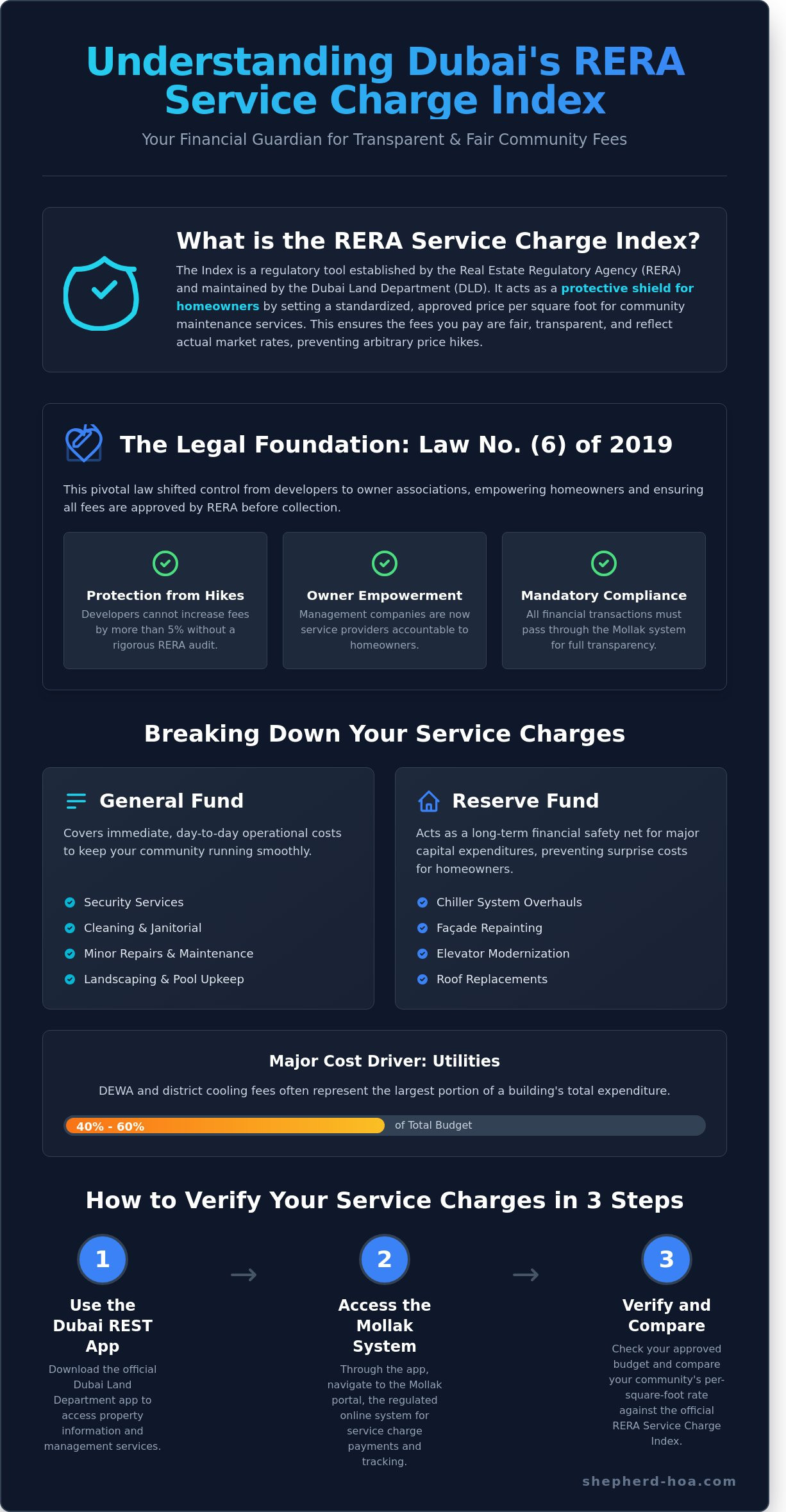
Every homeowner in Dubai deserves absolute clarity on where their money goes. The rera service charge index serves as the definitive regulatory compass for community costs across the emirate. Established by the Real Estate Regulatory Agency (RERA), this index provides a standardized price per square foot for maintenance services in specific Dubai communities. It's a protective shield for your investment. The Dubai Land Department (DLD) maintains this index to ensure that the fees you pay reflect the actual market value of the services provided. This prevents arbitrary pricing and ensures that your community remains financially healthy.
The index functions by categorizing properties based on their location and type, such as high-rise apartments in Dubai Marina or villas in Arabian Ranches. By setting a benchmark in UAE Dirhams (AED), RERA creates a transparent environment where developers and management companies can't simply inflate costs without justification. It's a tool for oversight. 2026 stands as a pivotal year for this framework because it marks the full maturation of the DLD's 100% digital transparency initiative. By this time, the integration of the Mollak system with AI-driven auditing will make the rera service charge index even more precise, leaving no room for financial ambiguity in community management.
The Legal Foundation: Law No. (6) of 2019
Understanding the Jointly Owned Property Law is essential for any board member. Law No. (6) of 2019 fundamentally changed how Dubai communities are managed. It effectively stripped developers of their unilateral control over service fees. This law ensures that RERA must approve all service charges before a single fils is collected from homeowners. It shifted the management landscape from developer-led models to owner-association-led oversight, where the focus is on the community's long-term interests rather than profit margins. This legal framework acts as a guardian, ensuring that fees are capped and regulated according to the actual needs of the building.
Protection from Hikes: Developers can't increase fees by more than 5% without a rigorous audit and RERA's express permission.
Owner Empowerment: Management companies are now service providers to the owners, not the other way around.
Compliance: All financial transactions must flow through the Mollak system to ensure every AED is tracked and verified.
The Purpose of the Index for Homeowners
The index exists to ensure you receive genuine value for money. Without a benchmark, it's difficult for a board to know if they're overpaying for elevator maintenance or pool cleaning. By consulting the rera service charge index, owners can compare their community's costs against the regional average. This transparency prevents the mismanagement of community funds, which often happens when there's a lack of professional oversight. It's about peace of mind. When a board can demonstrate that their fees align with RERA standards, it fosters trust within the neighborhood.
The index is also a powerful tool for financial dispute resolution. If a management company proposes a budget that exceeds the index's standardized rate, the board has the legal standing to challenge those figures. This keeps maintenance costs predictable and protects property values. A well-maintained community with fair service charges is always more attractive to future buyers. It ensures that the shepherd's duty of care toward the community's assets is fulfilled with integrity and financial precision.
Breaking Down the Components of Dubai Service Charges
Understanding the rera service charge index requires a look under the hood of your community's budget. These fees aren't arbitrary figures; they're calculated based on the specific operational needs of your building or master community. Service charges are primarily split into two distinct buckets. The General Fund covers your immediate, day-to-day operational requirements like security, cleaning, and minor repairs. In contrast, the Reserve Fund acts as the community's long-term financial safety net. A healthy reserve fund prevents sudden, expensive special assessments when a chiller system needs a total overhaul after 15 years of service.
Utility costs, specifically DEWA and district cooling fees, often represent 40% to 60% of a building's total expenditure. The index accounts for these by factoring in the specific consumption patterns of a building's common areas. Historically, transparency was a challenge for many owners, leading to discrepancies in Dubai property service charges that caused friction between developers and investors. Today, the index provides a standardized benchmark to ensure these utility costs remain within a predictable, fair range based on actual usage data from the previous fiscal year.
Luxury amenities like temperature-controlled infinity pools, high-speed elevators, or 24/7 concierge services drive up your specific rate. Maintaining a gym to 2026 health and safety standards costs roughly 12% more than basic equipment upkeep. Administrative and management fees are also heavily scrutinized by RERA. For 2026, the authority generally considers management fees between AED 1.50 and AED 2.50 per square foot as a fair market average for mid-to-high-end developments. If your board feels these administrative costs are drifting, implementing a professional management framework can help track every dirham spent with total precision.
Facility Management and Maintenance Costs
Facility management is divided into hard services and soft services. Hard services involve technical systems like HVAC, plumbing, and fire safety systems; soft services cover aesthetics like landscaping and waste removal. Effective boards prioritize preventative maintenance over reactive repairs. Spending AED 50,000 on annual pump servicing can save a community AED 500,000 in emergency replacements. The Reserve Fund acts as the community's long-term financial safety net.
The 2026 Shift: Sustainability and ESG Fees
Dubai's 2030 sustainability goals now directly influence the rera service charge index filings. Buildings with LEED Gold or Platinum certifications often see a 10% reduction in their initial service charge approval due to lower projected energy use. Retrofitting older communities in areas like Dubai Marina or JLT with LED lighting or smart irrigation can yield a return on investment within 24 months. RERA now offers "Green Rebates" or expedited budget approvals for communities that demonstrate a 15% reduction in carbon emissions. This shift ensures that modern communities aren't just cheaper to run, but also more attractive to environmentally conscious tenants.
By breaking down these components, board members can act as steady guides for their neighbors. This transparency builds trust and ensures the neighborhood remains a stable, high-value asset for years to come. When every expense is accounted for, the stress of community governance disappears, replaced by the peace of mind that comes from organized, expert oversight.
How to Calculate and Verify Your Service Charges via Mollak
Verifying your property costs shouldn't feel like a mystery. You can confirm your fees in four logical steps using the digital infrastructure provided by the Dubai Land Department. First, download the Dubai REST app or visit the official DLD website. This platform acts as the primary gateway for real estate transparency in the emirate. Second, use the Official RERA Service Charge Index to locate your specific project. You'll need your project name or land number to pull up the data. Third, examine your Mollak invoice and locate the total AED amount due for the current period. Finally, compare your invoice against the approved range shown in the index. If the rera service charge index shows a maximum of AED 16 per square foot, but your invoice demands AED 19, you've identified a discrepancy that requires immediate investigation.
Navigating the Mollak System
The Mollak system is a mandatory oversight framework that protects your community funds. It ensures every dirham you pay enters a RERA-approved escrow account rather than a developer's private bank. When you receive an invoice, look for the Mollak logo and the unique invoice number. This number proves the budget was audited and approved by RERA for the current fiscal year. A standard invoice breaks down costs into categories like general fund and sinking fund. You should never transfer service charges to a personal or company account that isn't explicitly linked to the Mollak payment gateway. This protocol prevents the misappropriation of funds and maintains the financial health of your building.
What to Do if Your Charges Exceed the Index
Discrepancies often arise from unapproved budget hikes or administrative errors. If your invoice exceeds the rera service charge index limit, your first action is to file a formal inquiry with your Owners Committee. They have the right to review the detailed breakdown of maintenance, utilities, and management fees. Ask for the specific RERA approval certificate that justifies the higher rate. If the committee or the management company fails to provide a valid explanation within 14 days, you can escalate the matter to the Rental Dispute Center (RDC). Filing a case at the RDC involves a fee of 3.5% of the annual service charge, with a minimum of AED 500 and a maximum of AED 20,000.
Shepherd HOA assists boards by providing precise administrative oversight, ensuring that every budget we manage aligns perfectly with RERA standards. We act as a protective guide, helping boards justify necessary costs or adjust spending to remain within legal thresholds. Our team analyzes service contracts and utility consumption to identify where costs can be trimmed without sacrificing quality. This proactive management keeps your community compliant and preserves property values over the long term. By serving as the invisible backbone of your HOA, we replace the stress of financial auditing with a sense of organized control and community harmony.
Strategic Cost Management: How HOA Boards Can Optimize Fees
HOA boards often view the rera service charge index as a regulatory hurdle, but it actually serves as a critical Key Performance Indicator (KPI) for assessing management performance. If your community's fees sit 15% higher than the neighborhood average in the Mollak system, it's a clear signal to audit your service providers. We help boards use these benchmarks to hold management companies accountable for every AED spent. Effective oversight ensures that your community doesn't just meet legal requirements but operates with peak financial efficiency.
The "Shepherd Approach" to ethical tendering transforms how associations handle third-party contracts. Instead of renewing legacy agreements out of habit, boards should implement a blind RFP (Request for Proposal) process every 24 months. This method requires at least three competitive bids for major services like security and cleaning. By removing personal bias and focusing on transparent metrics, boards typically see a 10% to 12% reduction in vendor costs while maintaining high standards. This disciplined procurement protects your fiduciary duty and keeps the budget lean.
Professional budget planning is the only reliable defense against "special levies." When a board conducts a detailed 10-year reserve fund study, they can spread the cost of major asset replacements over a decade. This prevents the shock of a sudden 30% hike in fees when a chiller or elevator fails. Stability in service charges is the primary driver of property value; it gives potential buyers confidence that the building is managed by a proactive, rather than reactive, board.
Reducing Operational Costs Without Sacrificing Quality
Implementing smart building technology is the fastest way to lower utility overheads, which often account for 40% of a building's operating budget. Installing motion-sensor LED lighting in parking levels and optimizing HVAC cycles can reduce DEWA bills by 20% annually. For multi-building associations, negotiating bulk-service contracts across the portfolio allows for 5% to 8% discounts on maintenance fees. Proactive snagging during the handover phase identifies structural defects early, ensuring the developer covers repair costs rather than passing them to owners through future service charge spikes.
Improving Service Charge Collection
Transparency is the most effective tool for improving collection rates. When owners see a clear breakdown of how their money is spent, payment friction disappears. However, boards must also communicate the legal consequences for non-payment under Dubai's updated 2026 regulations, which include property blocks and potential travel bans for significant arrears. Creating a culture of financial responsibility starts with monthly financial dashboards shared with all residents. Clear, consistent communication from the board reduces the need for aggressive legal action and fosters a sense of shared investment in the community's future.
Ready to bring professional oversight and financial clarity to your community management? Discover how Shepherd HOA streamlines board responsibilities.
Ensuring Compliance and Harmony with Shepherd HOA Management
Volunteer board members in Dubai often find themselves buried under a mountain of administrative weight. Managing a community is a high-stakes responsibility where legal compliance and financial transparency are non-negotiable. Shepherd HomeOwners' Association acts as the watchful guardian of your community's assets, stepping in to provide the oversight needed to protect every homeowner's investment. We don't just manage buildings; we protect the peace of mind of those who live in them. By serving as the professional "Shepherd" for your Owners Association, we ensure that the complex requirements of the rera service charge index are met with precision and care.
Our approach is built on the foundation of organized control. We understand that HOA boards are often composed of residents who have their own professional lives and families. They shouldn't have to spend their weekends worrying about budget variances or regulatory filings. We replace that stress with a sense of calm reliability. Our team monitors the rera service charge index to ensure your community's fees remain competitive while still covering the essential costs of facility maintenance and long-term upgrades. This balance is critical for maintaining property values and resident satisfaction across the UAE.
Expert RERA and Mollak Navigation
The Mollak system is the backbone of Dubai's real estate transparency, but it requires a disciplined approach to manage correctly. We handle the complex approval cycles for annual budgets, ensuring every document is submitted on time and meets the Dubai Land Department's rigorous standards. Every dirham in your community's general and reserve funds is accounted for with 100% transparency. We provide board members with clear, data-driven reports that allow them to make informed decisions without second-guessing the numbers. This meticulous financial oversight ensures that your community remains compliant and avoids the penalties associated with late filings or budget discrepancies.
Building Better Communities Together
A well-run community is a happy community. Our focus extends beyond the ledger to the actual quality of life within your neighborhood. We prioritize facility excellence, ensuring that common areas like pools, gyms, and parks are maintained to the highest standards. Ethical governance and professional management aren't just about following rules; they're about creating a legacy of stability. Communities that demonstrate strong financial health and well-maintained infrastructure often see property value increases of 10% to 15% compared to those with inconsistent management. We help you achieve this by removing the friction of administrative tasks and replacing it with a strategic vision for the future.
The transition from administrative stress to community harmony starts with a single step. We invite you to experience the difference that a dedicated, professional partner can make for your Owners Association. Our team is ready to provide the guidance and protection your community deserves.
Secure your community's financial future with Shepherd HomeOwners' Association
Future-Proof Your Community’s Financial Health
Navigating Dubai's real estate landscape requires more than just oversight; it demands a precise understanding of the rera service charge index to ensure every AED 1 invested by homeowners is used effectively. You now have the tools to verify fees through the Mollak system and identify where strategic management can reduce unnecessary spending. Since 2010, Shepherd HOA has served as a RERA-approved management partner, providing the steady guidance boards need to maintain compliance and community harmony. Our expert Mollak compliance team handles the technical heavy lifting, allowing you to focus on high-level governance with total peace of mind. We've established a proven track record in optimizing operational costs while preserving the long-term value of your assets. Don't settle for administrative stress when you can have organized control over your community's budget.
Take the first step toward a more transparent and financially stable future for your neighborhood today.
Frequently Asked Questions
Is the RERA Service Charge Index mandatory for all properties in Dubai?
The RERA Service Charge Index is mandatory for all freehold properties located in Dubai's designated investment zones. Under Law No. 6 of 2019, every developer and management company must register their service charges through the Mollak system for government approval. This process ensures that 100% of the fees collected from homeowners are transparent and verified against market benchmarks. It acts as a protective shield for your community's financial health by preventing arbitrary or unverified charges.
How often is the RERA Service Charge Index updated?
RERA typically updates the index on an annual basis to reflect current market costs, utility rates, and labor prices. You'll find these updates published on the Dubai Land Department website at the start of each fiscal year. This yearly revision allows the rera service charge index to stay aligned with the actual maintenance requirements of the 1,500+ registered buildings across the city. It provides a reliable, data-driven baseline for your board's annual budget planning and fiduciary oversight.
Can a developer increase service charges without RERA approval?
No, a developer or management company cannot legally increase service charges without formal approval from RERA via the Mollak system. Every proposed budget undergoes a rigorous audit to ensure the costs are justified and necessary for the building's upkeep. If a developer attempts to collect unapproved fees, homeowners have the right to withhold payment until a valid, approved invoice is issued. This oversight ensures 100% compliance with Dubai's real estate regulations and protects your investment.
What happens if I refuse to pay my service charges in 2026?
Refusing to pay service charges in 2026 leads to legal proceedings through the Rental Dispute Centre (RDC). After a formal 30-day notice period, the management company can file a case to recover the debt. This often results in a travel ban, the blocking of government services, or even the public auction of the property to settle the outstanding balance. Timely payments are essential to maintain the 24/7 security and essential services that protect your property's long-term market value.
Does the service charge index include chiller fees?
The service charge index generally covers maintenance and insurance, while chiller fees are often billed separately based on individual consumption or a fixed capacity charge. In approximately 70% of Dubai's master communities, cooling is provided by third-party companies like Empower or Emicool. You should check your specific building's breakdown in the rera service charge index to see if "AC and Ventilation" costs are bundled into the total AED per square foot rate or billed independently.
How do I check the service charge for my specific building online?
You can check your building's approved rates by visiting the Dubai Land Department website or using the Dubai REST mobile application. Simply navigate to the "Service Charge Index" section and enter your property's project name or land number. The system will display the exact AED rate approved for the current year. This tool provides instant transparency, allowing you to verify that your invoice matches the official government record for your specific community and unit type.
What is the difference between a general fund and a reserve fund in the index?
The general fund covers daily operational expenses like cleaning, security, and minor repairs that occur within a 12-month period. In contrast, the reserve fund is a mandatory savings account dedicated to major capital expenditures, such as elevator replacements or roof repairs, planned for the next 10 to 15 years. RERA requires a portion of your total fee to be allocated to the reserve fund to ensure the building's long-term structural integrity and financial stability without sudden levies.
How can an HOA board lower the community's service charge index ranking?
An HOA board can lower costs by conducting competitive bidding for service contracts every 2 years and implementing energy-saving retrofits. Reducing electricity consumption by 15% through LED lighting or smart sensors directly lowers the operational budget. By demonstrating these efficiencies during the annual RERA audit, the board can justify a lower AED per square foot rate. This proactive management protects homeowner equity while maintaining high standards of service and community harmony through disciplined financial oversight.


Comments