
Mollak System for Homeowners Explained: A 2026 Guide to Service Charge Transparency
- Sohrab Virani

- Apr 19
- 12 min read
What if you could track the lifecycle of every dirham in your service charge budget with the same precision you use to monitor your own bank account? Having the mollak system for homeowners explained clearly is the first step toward regaining control over your property's financial future. Most homeowners in Dubai feel a sense of unease when an annual invoice arrives, especially when the breakdown of costs feels vague or unverified. You've likely questioned if your maintenance funds are being managed with the fiduciary care your investment deserves.
This guide ensures you never have to guess about your community fees again. You'll discover how this RERA-mandated platform protects your assets by enforcing strict transparency and ensuring every management company is fully compliant with the latest 2026 regulations. We'll walk through the specific steps to verify your community's financial health and exercise your legal rights as a co-owner, providing the steady guidance you need to protect your home's value and ensure long-term community harmony.
Key Takeaways
Gain peace of mind by understanding how RERA’s digital oversight ensures that every AED you pay is backed by a mandatory, audited budget.
This mollak system for homeowners explained guide shows you how to use the Service Charge Index to verify that your community fees remain fair and competitive.
Learn how to navigate the Dubai REST app to access your unit’s real-time financial statements and maintain an accurate record of your property investment.
Understand the vital link between digital compliance and the UAE Strata Law to help your Owners' Committee operate with maximum transparency and legal authority.
Discover how expert guidance from Shepherd HOA simplifies the complexities of RERA regulations, protecting your community through professional, ethical governance.
Table of Contents What is the Mollak System and Why Was it Created? How Mollak Regulates Your Service Charges The Homeowner's Digital Dashboard: Accessing Your Data Compliance, Governance, and Your Rights Navigating Mollak with Shepherd HOA: Professional Guidance
What is the Mollak System and Why Was it Created?
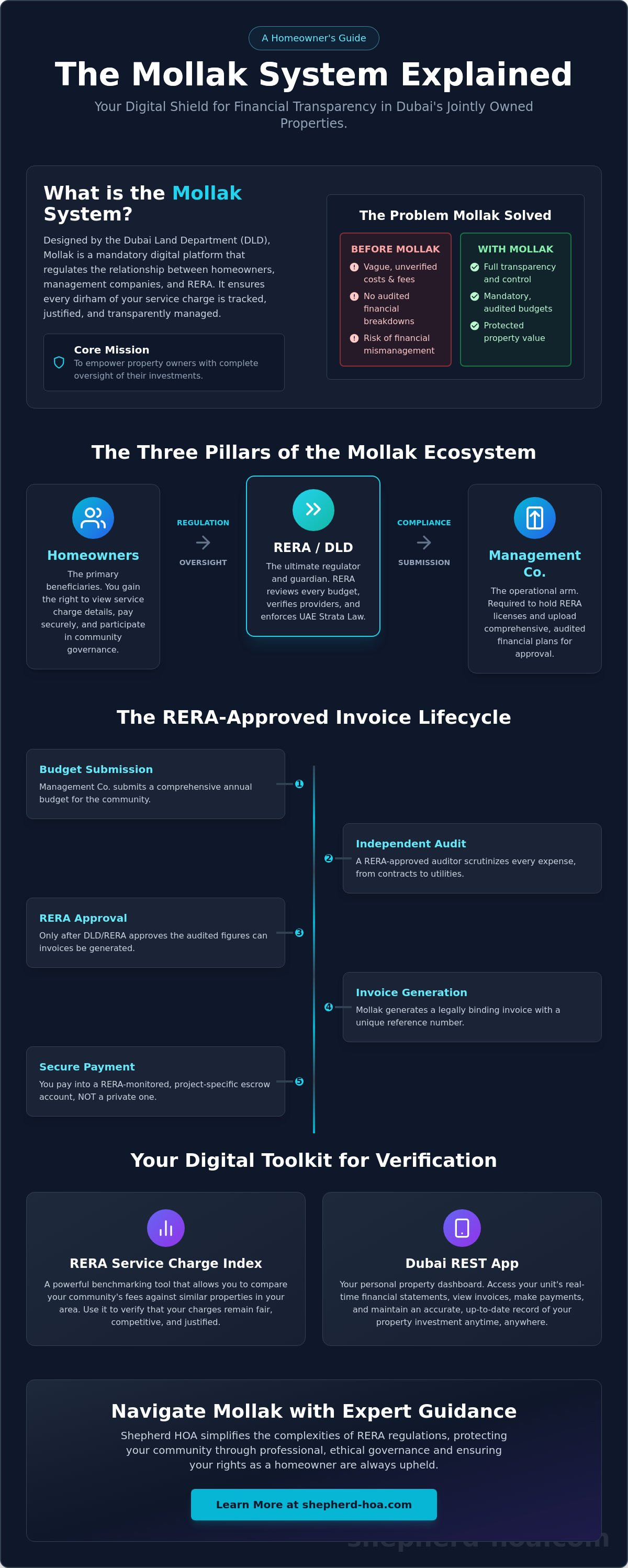
The Mollak system is the digital gateway designed by the Dubai Land Department (DLD) to regulate the relationship between homeowners and management companies. In Arabic, "Mollak" translates directly to "Owners," a name that reflects its core mission: empowering property owners with oversight of their investments. This integrated platform serves as a centralized hub for managing service charges, ensuring every dirham paid toward community upkeep is tracked and justified. By standardizing how Jointly Owned Properties (JOP) operate, the Real Estate Regulatory Agency (RERA) provides a protective layer of governance that keeps Dubai's real estate market stable and attractive. This guide offers the mollak system for homeowners explained in a way that simplifies complex regulations into actionable knowledge for every co-owner.
The Problem Mollak Solved: Transparency in Jointly Owned Property
Before the full implementation of this system in late 2019, homeowners often faced a lack of clarity regarding service charge allocations. Management companies frequently collected fees without providing audited financial breakdowns, leading to disputes and costs that frustrated investors. Mollak changed this dynamic by digitizing the entire approval process. Today, a management company cannot issue an invoice for a single AED without first obtaining RERA approval for their annual budget. This shift ensures that fees are based on actual, audited requirements rather than arbitrary estimates. It forces professional accountability across the board, protecting your property value from the risks of administrative mismanagement.
Who are the Stakeholders in the Mollak Ecosystem?
Understanding the Mollak ecosystem requires recognizing the three primary pillars that keep the system balanced. This structure acts as a digital backbone for your community, ensuring that no single party can act without oversight.
Homeowners (Co-owners): These individuals are the primary beneficiaries of the system. They gain the right to view service charge details, access electronic invoices, and participate in community voting.
Management Companies: These entities serve as the operational arm of the community. They're required to hold valid RERA licenses and must upload comprehensive, audited financial plans for every project they manage.
RERA: This agency acts as the ultimate regulator and guardian. They review every budget submission, verify the credentials of service providers, and ensure that the law is followed by all parties.
This collaborative framework creates a reliable environment where community harmony can flourish. By removing the stress of financial ambiguity, the system allows owners to focus on the long-term health and value of their neighborhoods. It's a professional standard that replaces uncertainty with organized control.
How Mollak Regulates Your Service Charges
The Mollak system for homeowners explained in a modern context is essentially a digital shield for your property investment. It replaces manual, paper-based billing with a rigorous regulatory framework that ensures every AED you pay is justified and tracked. Under the 2026 financial reporting standards, the system now requires real-time data integration, providing a level of oversight that prevents the mismanagement of community funds. This regulation centers on the mandatory escrow account mechanism. Your service charges don't go into a management company's private bank account. Instead, they're deposited into a project-specific escrow account monitored by RERA. This structure ensures that your money is only used for the specific upkeep and operational needs of your building.
The Approval Process: From Budget to Invoice
A management company cannot legally issue an invoice whenever they choose. They must first submit a comprehensive annual community budget for review. This budget is scrutinized by independent, RERA-approved auditors who verify the necessity of every expense item, from cooling charges to security contracts. Only after the Dubai Land Department (DLD) approves these figures can the system generate invoices. Every legal service charge bill now carries a unique Mollak reference number. If an invoice lacks this digital fingerprint, it isn't legally binding, and homeowners aren't obligated to pay it. This process effectively eliminated the unauthorized "administrative fees" that were common before these strict digital controls were implemented.
The RERA Service Charge Index Explained
The RERA Service Charge Index is a benchmarking tool that brings a layer of market reality to community management. It allows you to compare your community's costs against national averages for similar property types. This index is vital for preventing arbitrary price hikes. If a developer or manager proposes a fee increase that significantly exceeds the index average for your area, the system flags it for additional justification. You can use the index to verify if your community is overpaying for services compared to similar developments in Dubai. It provides the data you need to hold management companies accountable for their spending habits. For board members seeking to achieve this level of organized financial control, the index serves as a primary guide for fiduciary duty. By anchoring costs to these verified averages, the system maintains community harmony and protects long-term property values across the emirate.
The Homeowner's Digital Dashboard: Accessing Your Data
Accessing your property data shouldn't feel like a chore. The Dubai Land Department simplified this by integrating the Mollak portal into the Dubai REST app. To begin, download the app and log in using your UAE Pass. Once inside, select the 'Mollak' icon from the dashboard to view all properties linked to your Emirates ID. This centralized hub provides immediate clarity, allowing you to download your specific unit's financial statement and review every transaction in your payment history since the building's registration.
When you receive a service charge notification, you must verify its authenticity to protect your investment. A legitimate, Mollak-approved invoice contains four specific markers: the RERA logo, a unique invoice number generated by the system, the property's specific Unit Map ID, and a clear breakdown of the General and Reserve Fund contributions in AED. The mollak system for homeowners explained in its simplest form is a shield against unauthorized collections. The Unit Map within Mollak serves as the digital footprint of your ownership, defining the exact boundaries and square footage used to calculate your fees.
Viewing Your Community’s Financial Health
Transparency extends beyond your own front door. Through the portal, you can monitor the total collection rate of your entire community. This percentage is a vital indicator of future maintenance quality. If the collection rate stays below 85 percent, the management may struggle to fund essential repairs or utility payments for common areas. You can also track the balance of the Reserve Fund, which is dedicated to long-term capital expenses like elevator replacements, versus the General Fund used for daily operations. Managers are required to upload Quarterly Progress Reports every three months, providing you with a documented trail of how community funds are utilized.
Verifying Your Management Company's Status
Professional oversight is the backbone of a stable community. You can use the Mollak portal to verify that your management company holds a valid, active RERA license. It's equally important to check the status of third-party service providers, such as security and cleaning firms, who must also be registered within the system. This ensures that every Dirham you pay goes to a compliant entity. Never pay a service charge to any bank account that isn't the specific, RERA-approved escrow account listed on your Mollak invoice. This direct payment method is the only way to guarantee your funds are protected by Dubai's strict financial regulations.
Compliance, Governance, and Your Rights
The mollak system for homeowners explained in this guide isn't just a convenience; it's a legal requirement rooted in Law No. (6) of 2019. This legislation, often called the Dubai Strata Law, governs Jointly Owned Property and mandates that all service charge dealings occur through the Mollak portal. This legal framework ensures that your community management company doesn't operate in a vacuum. By law, they must upload audited financial statements and obtain RERA approval before a single fils is requested from you.
You have the absolute right to dispute any invoice that doesn't originate from the official system. If a management company sends a manual invoice or a payment link via email that doesn't correspond to a Mollak-generated demand, it lacks legal standing. Under Article 25 of the Strata Law, management companies that bypass these protocols face severe penalties. RERA has the authority to issue fines reaching up to AED 2,000,000 for serious financial violations or unauthorized collection of funds. This strict oversight protects your investment from mismanagement and ensures every AED is spent on actual community improvements.
The Role of the Owners' Committee in Mollak
The Owners' Committee acts as the community's financial guardian. Within the Mollak portal, committee members review and approve contracts for service providers like security, cleaning, and landscaping firms. This ensures that the community isn't overpaying for essential services. Members have a fiduciary duty to act in the best interest of all residents. To understand how these volunteers shape your living experience, you can read more about the role of your owners committee and how they collaborate with RERA to maintain standards.
What to Do If You Spot a Red Flag
Identifying "off-system" payment requests is the first step in protecting your community's assets. A red flag is any request to deposit service charges into a bank account that isn't the RERA-approved escrow account for your specific project. These requests are dangerous because they bypass the audit trail that Mollak provides. If you notice financial discrepancies or unauthorized charges, you can file a formal enquiry through the Mollak portal. RERA monitors these complaints and can intervene by auditing the management company's records or, in extreme cases, appointing a new management firm to restore order.
Staying informed is your best defense against administrative errors. If you're looking for a partner to help your board maintain these high standards of transparency, explore our management solutions today.
Navigating Mollak with Shepherd HOA: Professional Guidance
Managing a modern community in Dubai requires more than just good intentions. It demands technical precision and a deep understanding of local laws. We act as your expert guide through the maze of regulatory requirements, turning complex filings into a seamless process. By handling the heavy lifting of compliance, we let board members reclaim their time. We function as the invisible backbone of your association, providing the structure needed for community harmony without the typical administrative stress.
Our role is to provide a sense of organized control. Board members often feel overwhelmed by the personal stakes involved in neighborhood governance. We replace that anxiety with a professional, reassuring presence. We've seen how a well-managed mollak system for homeowners explained by experts can transform a struggling association into a model of efficiency. Our team ensures that your fiduciary duties are met with absolute transparency and ethical reporting at every turn.
Our Approach to Mollak Management
We ensure 100% compliance with RERA Dubai standards from day one. This isn't just about ticking boxes. It involves meticulous budget planning that passes RERA audits with zero friction. We use active oversight to monitor every AED allocated to your service charges. Our communication style is direct and functional. We translate "Mollak data" into plain English for homeowners, ensuring that everyone understands the value they receive for their investment. This proactive transparency prevents the friction that often arises from financial ambiguity.
Automated filing systems that eliminate human error in service charge calculations.
Real-time tracking of collection rates to ensure liquidity for essential services.
Direct integration with Dubai Land Department portals for instant budget approvals.
Protecting Your Property Value for the Long Term
Accurate reporting leads directly to a well-funded reserve for future repairs. When your Mollak filings are precise, you aren't just paying today's bills; you're securing the building's structural integrity for the next decade. There's a clear correlation between high compliance ratings and high resale value in the current market. Savvy investors look for communities with clean financial records and no history of sudden, unbudgeted special levies.
We act as a watchful guardian of your assets. Our methodical approach ensures that your community remains a desirable place to live and a profitable place to own. By maintaining a steady, expert hand on the administrative tiller, we protect the financial health of your neighborhood. Ready to simplify your administration? Request a professional community budget plan from Shepherd HOA today and experience the peace of mind that comes with expert management.
Protecting Your Investment Through Transparency
The RERA-mandated Mollak system ensures every AED you contribute to service charges is tracked, audited, and spent appropriately. It's a transformative shift that replaces administrative uncertainty with clear, digital oversight of your community's financial health. This mollak system for homeowners explained guide highlights how these regulations empower you to hold management companies accountable while safeguarding your property's market value.
Managing these requirements effectively takes professional oversight. Shepherd HOA provides RERA-approved management expertise backed by 10 years of community governance in the UAE. We act as a watchful guardian for your association, ensuring dedicated transparency in service charge collection and full compliance with the latest laws. Our team simplifies the complex so you don't have to worry about the technical details. We provide the steady guidance needed to maintain an organized, well-governed home. Let us handle the administrative heavy lifting while you focus on building a thriving neighborhood.
Your journey toward a more transparent and stable community starts with the right tools and a reliable partner. You've got the power to demand clarity, and we're here to help you achieve it with confidence.
Frequently Asked Questions
Is it mandatory for all homeowners to use the Mollak system?
Yes, the use of the Mollak system is mandatory for all homeowners within jointly owned properties in Dubai. Since Law No. 6 of 2019 took effect, the Dubai Land Department (DLD) requires every service charge invoice to be issued through this platform. This ensures that 100% of your payments are tracked and audited by RERA. You can't legally pay service charges to a developer or management company unless they provide a Mollak-approved invoice with a unique 9-digit reference number.
How do I pay my service charges through the Mollak portal?
You pay your service charges by logging into the Dubai REST app or the DLD portal using your UAE Pass. Once you access your dashboard, you'll see your outstanding balance in AED and can choose to pay via the Noqodi gateway or credit card. This integrated process eliminates the need for manual bank transfers or physical cheques. It provides a secure way to fulfill your financial obligations while maintaining a digital paper trail for your records.
What happens if my property management company is not registered in Mollak?
If a property management company isn't registered in Mollak, they're operating in violation of RERA regulations and can't legally collect service charges. You should report such instances to the Dubai Land Department immediately to protect your interests. Unregistered companies lack the authority to manage community funds, and any payments made outside the system aren't legally recognized. This mollak system for homeowners explained guide emphasizes that registration is a non-negotiable requirement for all 1,200 active management firms in the emirate.
Can I dispute a service charge increase if it's approved in Mollak?
You can dispute a service charge increase by filing a formal complaint with the Rental Dispute Center (RDC) if you believe the charges are unfair. While Mollak approves budgets based on RERA-audited financial statements, homeowners retain the right to challenge discrepancies. You'll need to provide evidence of the dispute and pay a filing fee, which is typically 3.5% of the annual service charge amount. This mechanism ensures that community management remains transparent and accountable to the owners they serve.
What is the difference between a Mollak invoice and a developer invoice?
A Mollak invoice is a legally binding document approved by RERA, whereas a developer invoice is often just a private request for funds. Every valid Mollak invoice contains a specific QR code and a DLD-validated breakdown of costs. Since 2020, developers are prohibited from collecting service charges directly into their private accounts. All funds must go into a RERA-regulated escrow account to ensure they're used exclusively for your community's maintenance and upkeep.
How often should I check my Mollak account for updates?
We recommend checking your Mollak account at least once every quarter to stay informed about your property's financial status. Most service charge cycles follow a 3-month billing period, often starting in January, April, July, and October. Regular monitoring helps you catch any billing errors early and ensures you don't miss payment deadlines. Staying proactive with your account helps maintain community harmony and prevents the accumulation of late payment penalties.
Does the Mollak system handle individual utility bills like DEWA?
No, the Mollak system doesn't handle individual utility bills like DEWA or district cooling charges. It focuses exclusively on communal service charges, sinking funds, and administrative fees related to the management of jointly owned property. You'll continue to pay your DEWA bills through their dedicated app or payment channels. Understanding this mollak system for homeowners explained distinction helps you manage your household budget more effectively without confusing different types of residential costs.
Who can I contact if I have trouble accessing my Mollak dashboard?
You should contact the Dubai Land Department helpdesk at 800-4488 if you encounter technical issues with your dashboard. Their support team is available to resolve login errors or data discrepancies between your title deed and the portal. If the issue relates to your specific property details, your registered property management company can also assist in verifying your information. They act as a steady guide through the administrative landscape, ensuring your access remains uninterrupted and secure.


Excellent explanation of the Mollak system and how it improves transparency in service charges for homeowners. Understanding these regulations is essential for anyone buying or investing in Dubai real estate. For those looking for trusted property investment opportunities and expert guidance across Dubai, it's also worth exploring Leading Properties at http://leadingproperties.ae/. Thanks for sharing such a clear and informative guide!