

Owners Association Management UAE: The 2026 Executive Guide to Community Governance
- Sohrab Virani

- Mar 14
- 12 min read
Updated: Mar 15
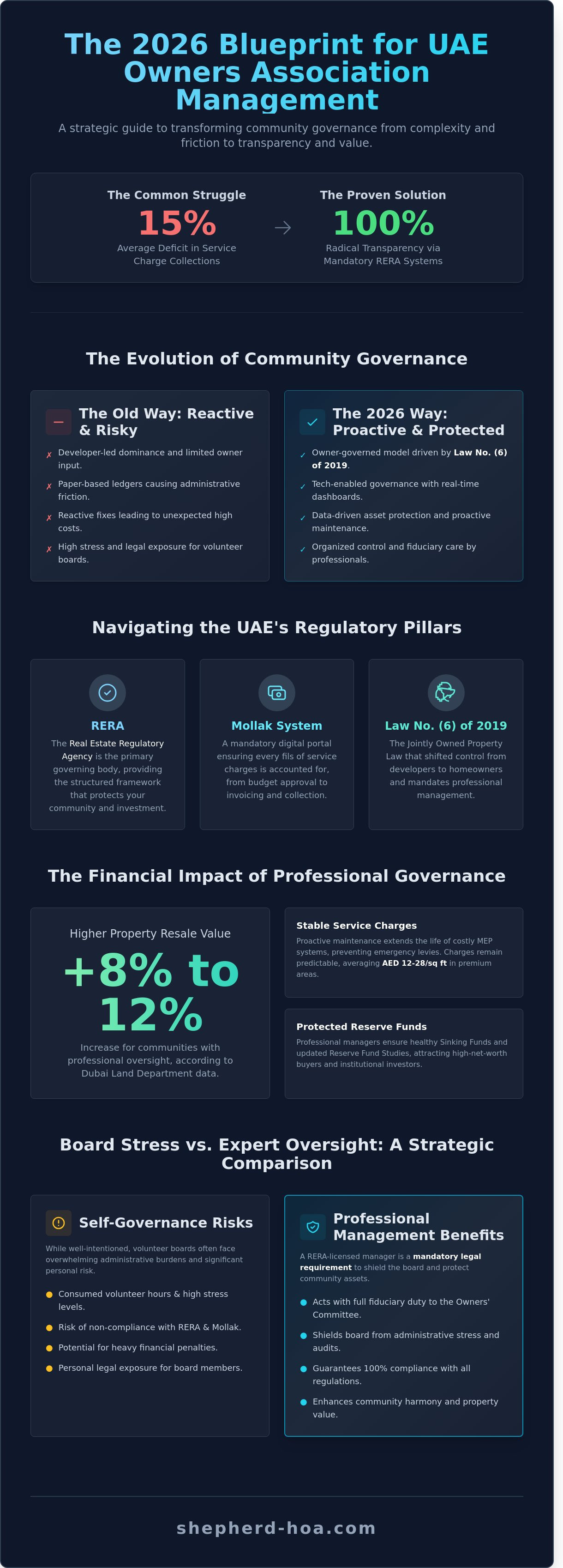
Why do many UAE community boards struggle with a 15% deficit in service charge collections when the solution lies in radical transparency rather than aggressive enforcement? You likely understand the stress of balancing rising operational costs with the high expectations of your neighbors. It's difficult to act as a watchful guardian of your community assets when the complexities of the Mollak system and RERA compliance consume your limited volunteer hours. Mastering owners association management in the UAE should feel like a steady hand on the wheel, not a constant scramble to avoid penalties.
We've designed this 2026 executive guide to help you master Law No. (6) of 2019 and leverage seamless financial reporting to protect every AED in your reserve fund. You'll learn how to replace administrative friction with organized control, ensuring your property value grows while resident satisfaction improves. This article provides a methodical roadmap to transform complex strata governance into a predictable, stress-free framework for your entire neighborhood.
Key Takeaways
Gain clarity on Law No. (6) of 2019 to successfully transition your community from developer-led oversight to a more empowered, owner-governed model.
Master the technical requirements of the Mollak system and RERA compliance to ensure every AED of your community funds is managed with absolute transparency.
Evaluate the strategic benefits of professional owners association management in the UAE compared to self-governance to reduce administrative stress and enhance community harmony.
Learn the critical benchmarks for appointing a RERA-approved management partner that offers protective oversight rather than just the lowest service fee.
Discover how a dedicated "shepherd" approach to governance can safeguard your property’s long-term value through proactive maintenance and expert fiduciary care.
Table of Contents
The Evolution of Owners Association Management in the UAE
Navigating the Regulatory Pillars: RERA, Mollak, and Strata Law
Professional Management vs. Self-Governance: A Strategic Comparison
How to Evaluate and Appoint an OA Management Partner
Shepherd HOA: Your Protective Partner in Community Governance
The Evolution of Owners Association Management in the UAE
By 2026, owners' association management in the UAE will have matured into a sophisticated discipline focused on data-driven asset protection and community wellbeing. It's no longer a simple administrative task; it's the strategic oversight of a building's physical and financial health. This evolution ensures that the common areas of a property, from the high-speed elevators to the temperature-controlled pools, operate at peak efficiency for the benefit of all title deed holders.
The landscape shifted permanently with the full implementation of Law No. (6) of 2019. This legislation ended the era of developer-led dominance and placed control into the hands of homeowners through elected Owners’ Committees. While organizations like the Building Owners and Managers Association (BOMA) provide a global framework for these standards, the UAE has refined them through the RERA Mollak system. This digital portal ensures that every fils of service charge is accounted for and every contract is transparent.
Modern management acts as the invisible backbone of a thriving community. Old-school property management relied on reactive fixes and paper-based ledgers. Today, the shift toward tech-enabled governance means managers use real-time dashboards to track utility consumption and maintenance schedules. This proactive stance prevents the friction that often arises in multi-cultural residential hubs, replacing chaos with organized control.
Why Professional Governance is Mandatory for 2026 Communities
Non-compliance with RERA’s latest circulars carries heavy financial penalties and legal exposure for board members. Professional managers carry the fiduciary duty to act solely in the best interest of the Owners’ Committee, ensuring that 100% of community funds are utilized for their intended purpose. They shield the board from the stress of administrative deadlines and regulatory audits. A RERA-licensed manager is a mandatory legal requirement for any jointly owned property in the UAE to ensure compliance and financial oversight.
The Impact of Professional Management on Property Value
A well-managed building is a more valuable building. Data from the Dubai Land Department consistently shows that communities with professional oversight maintain resale prices 8% to 12% higher than those with neglected common areas. When a manager implements a rigorous preventative maintenance plan, they extend the life of expensive MEP (mechanical, electrical, and plumbing) systems. This reduces the need for emergency levies and keeps service charges, which currently average between AED 12 and AED 28 per square foot in premium areas, stable and predictable.
Institutional investors and high-net-worth buyers prioritize these managed environments. They look for communities where the "Sinking Fund" is healthy and the "Reserve Fund Study" is updated every three years. Professional management provides the transparency these investors demand, confirming that the property isn't just a place to live, but a protected financial asset. The result is a seamless living experience in which the technical complexities of building operations never disrupt the peace of residents.
Navigating the Regulatory Pillars: RERA, Mollak, and Strata Law
Navigating the legal landscape of owners' association management in the UAE doesn't have to be stressful. The Real Estate Regulatory Agency (RERA) serves as the primary governing body, providing a structured framework to protect your investment. RERA operates under the Dubai Land Department to ensure that every community follows the Jointly Owned Property Law of 2019. This legislation moved the UAE away from developer-controlled environments toward a more transparent, regulated system where professional management companies handle daily operations under strict government oversight. This shift ensures that your community is treated as a professional entity with fiduciary duties to its members.
Ethical tendering is a non-negotiable duty for any board. When you're selecting third-party contractors for landscaping, security, or MEP services, you must implement a transparent bidding process. This prevents conflicts of interest and ensures the community receives the best value for every dirham spent. RERA mandates that service charge collection occurs only after the budget is approved and invoices are generated via the official portal. If a management company tries to collect fees outside this system, they're violating the law. Staying compliant isn't just about following rules; it's about acting as a watchful guardian for your neighbors' assets.
Mastering the Mollak System for Financial Transparency
The Mollak system is the digital backbone of community finance in Dubai. It eliminates the risk of manual invoicing by requiring all service charges to be processed through its secure portal. By 2026, the emphasis on financial auditing within Mollak will intensify, making it impossible for funds to be mismanaged without detection. Board members must ensure that annual audits are conducted by RERA-approved firms. These audits verify that every AED collected is spent on the community's actual needs. You can gain a deeper edge by understanding The Mollak System & Service Charges to keep your community's ledger balanced and compliant.
Step 1: The management company uploads the RERA-approved budget into Mollak.
Step 2: The system calculates the individual unit share based on the total area.
Step 3: Invoices are sent directly to owners with a unique reference number for payment.
Step 4: Funds are deposited into a RERA-regulated escrow account, not a private company account.
Compliance with 2026 RERA Standards
Board members are now required to align their budgets with the RERA Service Charge Index. This index provides a benchmark for what maintenance should cost, preventing arbitrary price hikes. To secure annual budget approvals, management companies must submit detailed financial projections to the owners' association management in the UAE regulatory authorities. A key component of this process is the "Administrative Compliance and Reporting Fee." This fee, which often averages around AED 1.05 per square foot in various districts, ensures your association remains in good legal standing. It covers the cost of government monitoring and the preservation of legal safety for all residents. If you're feeling the weight of these requirements, choosing a partner that prioritizes automated compliance oversight can help restore a sense of organized control to your board meetings.
Professional Management vs. Self-Governance: A Strategic Comparison
Choosing between self-governance and professional owners association management in the UAE isn't just a matter of saving on monthly fees. It's a decision about the long-term health of your property investment. While the idea of a volunteer-led community sounds cost-effective, the reality in large-scale UAE developments often leads to administrative gridlock. Professional management provides a steady hand, acting as an expert guide that handles the heavy lifting while the board retains the power to make strategic decisions.
The most common objection homeowners raise is whether the management fee is worth the investment. In a community of 200 units, a professional management fee might range from AED 8,000 to AED 20,000 per month. This cost is frequently offset by the manager's ability to negotiate bulk service contracts for MEP (Mechanical, Electrical, and Plumbing) and security. Professional procurement often reduces annual operating expenses by 12% to 18%, making the management service effectively pay for itself while increasing the property's market value.
The Burden of Administrative Oversight
Managing a modern UAE community involves a massive volume of paperwork and coordination. Setting up accounts with DEWA or Empower, managing service provider contracts, and tracking service charge collections can take 20 to 30 hours of work every week. Volunteer board members often find themselves overwhelmed, leading to burnout and a resignation rate of 40% before their terms end. Professional managers eliminate this stress by providing a structured framework for operations.
Accuracy in financial reporting is another critical differentiator. Amateur bookkeeping often misses small details that lead to significant audit failures. Professional managers use specialized software to ensure every dirham is accounted for, providing IFRS-compliant reports that give homeowners peace of mind. This level of precision is vital for maintaining the community's reserve fund, which should ideally hold 15% of the annual budget for future capital expenditures.
Risk Mitigation and Legal Safeguards
The legal landscape for property ownership is precise and demanding. The UAE Cabinet Resolution on Owners Association provides the executive regulations for community governance, and failure to comply can result in significant fines. Professional owners association management uae firms stay updated on these legislative shifts, ensuring the association remains in good standing with the Real Estate Regulatory Agency (RERA). This rigorous regulatory environment extends to all sectors, which is why many entrepreneurs rely on professional consultants like Dubai Setup to ensure their new ventures are established in full compliance with local laws.
Risk management extends to financial protection. Certified management firms carry Professional Indemnity Insurance, which protects the community's assets against errors or omissions. This safety net doesn't exist in a self-governed model. Additionally, managers act as neutral third parties in neighbor disputes, enforcing community rules without the personal bias that often complicates volunteer-led mediation. For those transitioning into this structured environment, our Guide to Living in a Managed Dubai Community offers practical insights into what to expect from a professionally run association.
How to Evaluate and Appoint an OA Management Partner
Choosing a partner for owners association management in the UAE is one of the most significant decisions a board will make. This choice dictates the community's financial health and the daily experience of every resident. By 2026, RERA regulations will have become more stringent, requiring firms to maintain specific professional indemnity insurance and full Mollak system proficiency. You aren't just hiring a clerk; you're appointing a fiduciary guardian for your community’s multi-million dirham assets. A professional firm acts as a shield, protecting the board from legal liabilities while ensuring the building’s physical integrity remains intact for decades.
Don't fall into the trap of selecting the lowest bidder. A proposal that's 15% cheaper than competitors often results in "ghost management," where one manager oversees 12 properties simultaneously. This lack of oversight leads to neglected maintenance, eventually causing service charges to spike when major systems fail prematurely. High-quality management pays for itself by optimizing utility consumption and negotiating better rates with facility management (FM) providers. You're looking for long-term value, which is measured by the preservation of property prices and the reduction of emergency repair costs over a five-year horizon.
The 5-Step Selection Framework
Follow this methodical process to ensure your community remains in safe hands. First, verify that the firm holds a valid RERA license for owners association management, and check its Mollak compliance score for the current year. Second, assess their track record by requesting references from at least three communities of similar scale, such as 200-plus-unit towers. Third, audit their tendering ethics; they should provide at least three competitive quotes for any job over 5,000 AED. Fourth, test their digital tools to ensure they offer a seamless resident portal for service requests. Finally, prioritize firms with expertise in "Property Handover". For new developments, a manager who can identify developer snags during the first 12 months can save the association millions in future structural repairs.
Identifying Red Flags in Management Proposals
Watch for "low-ball" service charge projections in the initial proposal. If a firm suggests a budget of 14 AED per square foot while similar buildings in the same Dubai district average 20 AED, they're likely underfunding the reserve fund to win the contract. This creates a financial crisis three years down the line when the cooling system or elevators require major overhauls. Transparency is the only foundation for a healthy partnership, so any lack of detail in the budget should be an immediate deal-breaker.
Another red flag is the presence of hidden markups. Some firms add a 10% "coordination fee" to third-party maintenance invoices without disclosing it to the board. You should also avoid "hands-off" managers who don't commit to regular site presence. If the contract doesn't guarantee at least two formal site inspections per week, your property will suffer from invisible decay. Effective management requires boots on the ground to spot leaks, cracks, or security lapses before they become expensive liabilities. A partner who stays behind a desk cannot protect your investment.
Protect your community’s future by choosing a partner that prioritizes transparency and professional oversight. Explore Shepherd HOA management solutions today.
Shepherd HOA: Your Protective Partner in Community Governance
Shepherd HomeOwners' Association isn't just another management firm; it's a dedicated guardian for your property investment. Following a strategic 2024 rebranding that solidified its identity, the association draws on deep roots in the Dubai property market dating back to 2010. This 14-year legacy informs the association's "Shepherd" philosophy, which prioritizes a duty of care and protective oversight above all else. For board members, this means having a partner that anticipates risks before they become financial liabilities. The association acts as a watchful guardian, ensuring that the volunteer members of
Secure Your Community’s Legacy with Strategic Governance
Navigating the complexities of RERA compliance and Mollak integration requires more than just administrative effort; it demands a strategic guardian for your community assets. Effective owners' association management relies on balancing strict fiduciary duties with the long-term goal of enhancing property values across the Emirates. Since 2010, Shepherd HOA has served as a RERA-approved partner, providing wholly Emirati-owned expertise that simplifies the 2026 regulatory landscape for busy board members. We replace the stress of community governance with organized control, ensuring every AED of your service charge budget is managed with absolute transparency and care. You don't have to carry the burden of oversight alone when you have a dedicated guide to lead the way. Our team acts as the invisible backbone of your neighborhood, preserving harmony through proven systems and a protective philosophy. Your community deserves a legacy of stability, financial health, and long-term peace of mind.
Frequently Asked Questions
Is it mandatory to have a RERA-approved management company in Dubai?
Hiring a RERA-approved management company is mandatory for all jointly owned properties in Dubai under Law No. (6) of 2019. This regulation ensures that only licensed professionals handle the administrative and financial duties of your community. It protects your investment by enforcing strict compliance standards across the board. Shepherd HOA helps boards navigate these legal requirements with an intuitive platform designed for owners' association management.
How does the Mollak system protect my service charge payments?
The Mollak system protects your payments by requiring all service charges to be deposited into a RERA-regulated escrow account. Since its full implementation in 2019, the system has prevented management companies from accessing funds without direct approval from the Dubai Land Department. This oversight ensures that 100% of your AED contributions are spent only on approved community expenses. You can track your payment history and view invoices through the portal for total financial clarity.
Can an Owners’ Committee fire their management company?
Owners’ Committees have the authority to recommend terminating a management company, but the final decision rests with a majority vote at a General Assembly. You must provide a 30 to 90-day notice period as specified in your signed service contract. Our team guides boards through this transition to ensure no lapse in essential services. We prioritize a seamless handover process that keeps community operations running without interruption.
What is the difference between property management and owners' association management in the UAE?
Property management focuses on individual units, including tenant sourcing and rent collection for a specific landlord. In contrast, owners' association management involves the administration of common areas like lobbies, pools, and gyms for the entire building. While a property manager serves one owner, an association manager serves the collective interest of all homeowners. This distinction is vital for maintaining the 15% to 20% premium often found in well-maintained communities.
How are community service charges calculated in 2026?
In 2026, service charges are calculated based on the total annual operating budget divided by the square footage of each unit. This budget includes a mandatory 10% to 15% reserve fund allocation for long-term capital repairs. RERA must audit and approve every budget before any invoices are issued to homeowners. This process ensures that fees remain fair and reflective of the actual costs required to maintain high-quality community standards and asset longevity.
What happens if a homeowner refuses to pay their service charges?
Homeowners who refuse to pay face strict legal consequences under Dubai’s Jointly Owned Property Law. After 30 days of non-payment, the management company issues a formal notice through the Mollak system. If the debt remains, the case moves to the Rental Disputes Center where a judge can order the sale of the property at auction. These measures protect the 90% of compliant owners who rely on these funds for essential community upkeep.
Who is responsible for the maintenance of common areas in a jointly owned property?
The appointed management company is responsible for the daily maintenance of all common areas including elevators, swimming pools, and landscaped grounds. They act on behalf of the Owners’ Association to ensure all facilities meet the safety standards set by the Dubai Municipality. By coordinating with at least three vetted service providers, managers keep the community functional. This oversight preserves property values and ensures a safe, premium living environment for all residents.
How does Shepherd HOA ensure transparency in third-party contract tendering?
Shepherd HOA ensures transparency by using a digital tendering module that requires a minimum of three competitive bids for every community contract. Our platform records every interaction and document submission, creating a permanent audit trail for the board to review. This system eliminates the risk of kickbacks or hidden fees in maintenance contracts. By providing clear data on vendor performance and pricing, we help boards make informed decisions that save the community an average of 12% annually.


Comments