
Professional Community Management for Commercial Properties: A 2026 Guide
- Sohrab Virani

- Jun 11
- 12 min read
Updated: Jun 17
What if the most significant threat to your commercial asset isn't a market downturn, but the invisible friction of poor administration? For many owners, the reality of high service charge arrears and a lack of financial transparency creates a constant state of operational stress. It's a common challenge in Dubai's evolving landscape, where the stakes of community management for commercial properties have never been higher. You've worked hard to build your portfolio, and you deserve a management structure that protects that investment rather than draining your time.
This 2026 guide is designed to replace that uncertainty with a sense of organized control and peace of mind. We'll show you how professional guardianship ensures seamless RERA and Mollak compliance while fostering a truly harmonious commercial environment. By the end of this article, you'll understand the latest digital handover mandates and the strategic financial oversight required to turn shared liabilities into long-term asset excellence.
Key Takeaways
Learn why professional community management for commercial properties acts as a strategic shield, preserving your asset's long-term value through expert governance.
Navigate the mandatory Mollak system and RERA regulations with confidence to ensure absolute financial transparency and legal compliance for all owners.
Clarify the difference between tactical facility repairs and strategic community governance to ensure your property's administrative backbone remains strong.
Follow a clear path to establishing active owners' committees and transparent budget planning that directly addresses service charge arrears.
Discover how ethical guardianship and 15 years of industry expertise transform operational stress into a stable, harmonious commercial environment.
Table of Contents
Defining Community Management for Commercial Properties
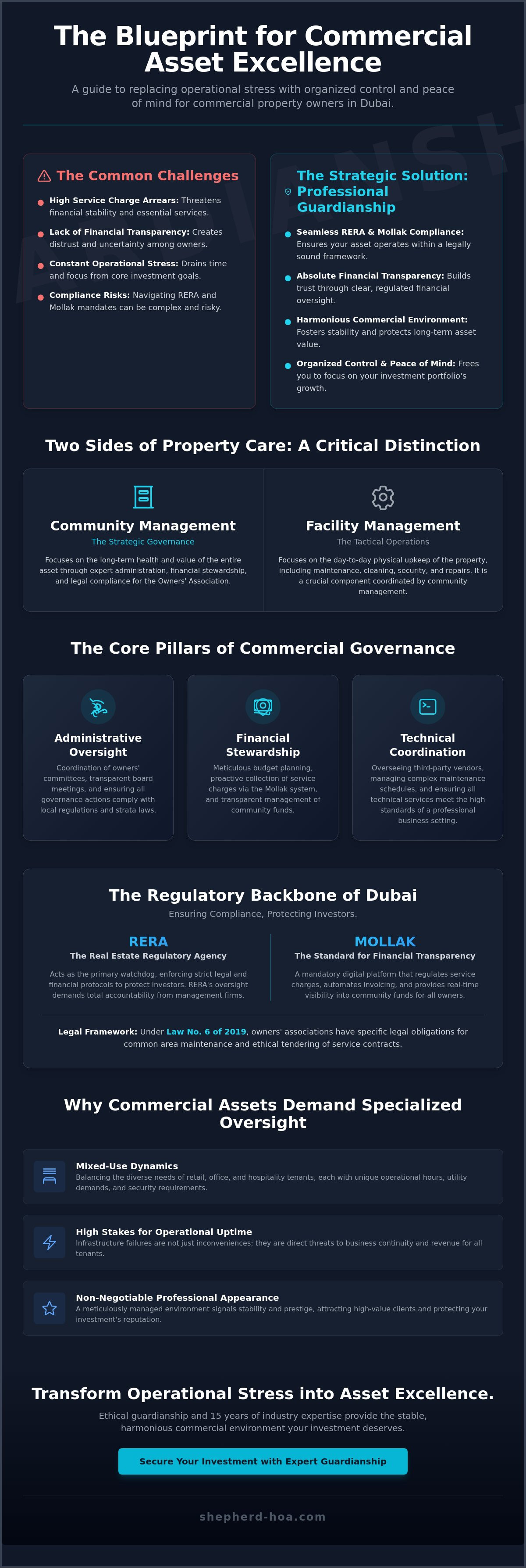
Professional community management for commercial properties represents the strategic governance of shared spaces and collective interests. It's a role that prioritizes asset preservation, legal compliance, and social harmony within a fast-paced business environment. Unlike individual property management, which focuses on the specific needs of a single landlord or tenant, community management serves the entire owners' association. It's a holistic approach to guardianship. By managing the collective interests of all stakeholders, this service ensures that the development operates as a single, efficient unit. The primary goal remains clear: protecting and enhancing the long-term investment value of the commercial development.
The Core Pillars of Commercial Governance
Strategic governance is built upon three essential pillars that provide stability to any commercial development. Administrative oversight is the first, involving the careful coordination of owners' committees and formal board meetings. This ensures that governance remains transparent and that all actions comply with local regulations. Financial stewardship is the second pillar. This involves meticulous budget planning and the proactive collection of service charges. Without this financial rigor, a community can't fund the essential services that keep it competitive. The third pillar is the technical coordination of third-party service providers. This goes beyond basic Building management. It involves overseeing complex maintenance schedules and ensuring that vendors meet the high standards expected in a professional business setting.
Why Commercial Assets Require Specialized Oversight
Commercial properties demand a level of precision that residential buildings rarely require. The mixed-use dynamics of modern developments create a landscape where retail, office, and hospitality tenants must coexist. Each has different operational hours, utility needs, and security requirements. Specialized oversight ensures these diverse needs are balanced without causing friction. The stakes for operational uptime are also incredibly high. A malfunction in shared infrastructure isn't just an inconvenience; it's a threat to business continuity and revenue. Maintaining a professional appearance is a non-negotiable requirement for high-value assets. A well-managed environment signals stability and prestige to clients and investors alike. Community management is the invisible backbone of a thriving commercial hub, and for those seeking such excellence in Riyadh, you can explore المكاتب الخاصة at Enterprise Hub. It provides the organized control necessary to replace operational stress with a sense of reliable protection.
The Regulatory Backbone: RERA Compliance and the Mollak System
The Real Estate Regulatory Agency (RERA) acts as the primary watchdog for commercial strata developments in Dubai. Its oversight ensures that every community follows strict legal and financial protocols to protect investors. For owners, this means your asset is managed within a framework that demands total accountability. Central to this protection is the Mollak system. It is a mandatory digital platform designed to regulate service charges and eliminate financial ambiguity. Without a RERA-approved firm handling your community management for commercial properties, you risk legal complications and administrative delays that can impact your property's standing.
Mollak: The Standard for Financial Transparency
Mollak has transformed how financial data is handled in the commercial sector. It automates service charge invoicing and ensures that collections happen only through approved, regulated channels. This system provides real-time visibility into community funds for both owners and board members. You don't have to wait for annual meetings to understand the financial health of your asset. For a deeper dive into these mechanisms, read our guide on Understanding Mollak and Service Charges. This level of transparency is essential for maintaining trust between the owners' association and the management team. It ensures that every fil is accounted for and utilized for the community's benefit.
Maintaining Compliance with National Strata Laws
Compliance isn't a one-time event; it's a continuous commitment to excellence. Under Law No. 6 of 2019, owners' associations have specific legal obligations to maintain common areas and manage collective funds. This includes the necessity of ethical tendering for all third-party service contracts. Every vendor must be selected through a transparent process that prioritizes the community's long-term interests rather than short-term savings. While global standards for Property Management and Leases provide a useful baseline, local regulations in 2026 require specific digital submissions. Managers must prepare quarterly progress reports and secure administrative approvals through the Mollak portal. This ensures that every dirham spent is audited, justified, and aligned with government standards.
Navigating these requirements requires a partner who understands the nuances of the law. Annual audits and government reporting are no longer manual tasks; they're digital mandates that require technical proficiency. Professional oversight ensures your community remains in good standing with the Dubai Land Department. If you're looking for a partner to simplify these complexities, our team provides the Mollak and RERA approval support you need to maintain operational excellence and peace of mind.
Community Management vs. Facility Management: Understanding the Difference
Many property owners use the terms "facility management" and "community management" interchangeably, but they represent two distinct layers of asset protection. Facility Management (FM) is tactical. It's the hands-on work of fixing pipes, coordinating cleaning crews, and ensuring physical repairs are completed. In contrast, community management for commercial properties is strategic. It focuses on the governance, legal liability, and financial health of the entire development. While your FM team keeps the lights on, your community manager ensures the building is legally authorized to operate and remains financially solvent over the long term.
A common objection from owners is the belief that a strong FM team is sufficient to handle a building's needs. While physical maintenance is vital, an FM provider lacks the legal standing to manage an owners' association or navigate the complexities of the Mollak system. Without the strategic layer of community management, a property can fall into regulatory non-compliance, even if the lobby is spotless. High-value assets require both disciplines to function as a unified, profitable ecosystem. One maintains the physical structure; the other guards the collective interests of every stakeholder involved.
Governance vs. Maintenance
The distinction between these roles becomes clear when looking at legal responsibility. The community manager (CM) handles the administrative burden of RERA approvals and ensures that the owners' association meets its statutory obligations. They hold the "duty of care" for the community's legal standing. The FM provider manages the on-site technicians and ensures that the physical infrastructure meets safety standards. There is a powerful synergy between the two. Professional governance provides the framework and funding that allows physical upkeep to happen without interruption. When these roles are clearly defined, operational stress disappears and is replaced by a sense of organized control.
Financial Oversight and Budgeting
Finance is where the difference between CM and FM is most visible. The community manager is the architect of the service charge budget. They calculate the long-term requirements for reserve funds and ensure that collections are handled through approved digital channels. The FM team, meanwhile, operates within the specific budget parameters set by the community manager. They provide the cost data for repairs, but the CM ensures that these expenses are audited and transparent for all owners. To understand how these budgets are structured for maximum efficiency, see our guide on Mastering the Community Service Charge Budget. This financial hierarchy ensures that every dirham spent on maintenance is part of a larger plan to preserve the asset's overall market value.
Key Steps for Effective Commercial Community Governance
Effective community management for commercial properties relies on a structured approach that moves beyond reactive fixes. It requires a proactive framework where every administrative and financial action is documented and justified. By following a methodical set of steps, owners' committees can transform a complex development into a well-oiled machine that attracts high-quality tenants and maintains its market premium. This organized control is what distinguishes a premier asset from one that is merely surviving.
Step 1: Establish a clear and active owners' committee. This group acts as the representative voice of the owners. It ensures that the management team remains aligned with the collective interests and long-term vision of the development.
Step 2: Implement a transparent budget planning process. Financial trust is built on clarity. In 2026, owners expect detailed breakdowns of where every dirham is allocated, from utility costs to sinking funds.
Step 3: Ensure all operations are registered through the Mollak system. This isn't optional. Digital registration is the only way to legally collect service charges and ensure government-backed transparency in all financial dealings.
Step 4: Conduct regular professional snagging and inspections. Even after the initial handover, periodic inspections identify minor issues before they become structural failures. This is especially critical given the 10-year structural warranty mandated by law for all developers.
Step 5: Foster open communication with all commercial tenants. A harmonious environment reduces turnover. Regular updates on building improvements or policy changes keep tenants informed and engaged in the community's success.
Optimizing Service Charge Collection
Reducing arrears is a primary concern for any commercial development. Professional community management for commercial properties uses data-driven reporting to justify service charge levels, making it easier for owners to see the tangible value they receive. When disputes arise, the community manager acts as a neutral mediator. They find structured repayment solutions through programs like Tayseer before matters escalate to the Rental Disputes Settlement Centre. This approach maintains essential cash flow without damaging the professional relationships required for business continuity.
Asset Preservation and Long-Term Planning
Guardianship means looking a decade ahead. Developing a 10-year reserve fund plan ensures that major capital repairs, such as HVAC overhauls or facade maintenance, are funded gradually over time. This prevents the shock of sudden financial demands on owners. We also look for cost-saving opportunities in common area utilities, utilizing the latest efficiency benchmarks to reduce the community's overall footprint and operational costs. Proactive governance acts as a financial safety net that prevents the need for emergency levies. If you're ready to implement these standards in your development, our team can assist with professional Budget Planning and governance support.
Shepherd HOA: Expert Guardianship for Commercial Communities
Choosing the right partner for community management for commercial properties is a decision that impacts your asset's future for years. Shepherd HOA brings over 15 years of specialized expertise in national community management to every project we oversee. Our commitment to ethical governance and RERA-approved standards provides a foundation of trust for owners' committees and investors alike. We don't just provide administrative support; we act as a watchful guardian for your interests. This 'Guardian' approach means we protect your assets with the same diligence and care as if they were our own, ensuring that social harmony and financial integrity remain at the forefront of our operations.
Our comprehensive suite of services covers the entire lifecycle of a commercial development. We manage everything from the initial property handover and utility account setup to ongoing Mollak management and service charge collection. This end-to-end oversight eliminates the gaps often found when multiple providers handle different stages of a building's life. By centralizing these responsibilities, we replace operational stress with a sense of organized control. Owners can rest assured that their property remains in full compliance with the latest 2026 regulations while maintaining its competitive edge in a demanding market.
Why Commercial Boards Choose Shepherd
Commercial boards face unique challenges that require more than just standard administrative support. We have a proven track record in managing high-stakes commercial strata where the requirements for operational uptime and professional appearance are absolute. Our clients benefit from direct access to expert guidance on complex regulatory changes, ensuring they are never caught off guard by new mandates from the Dubai Land Department. To learn more about our philosophy on governance, read our detailed guide on Owners Association Management Excellence. We provide the invisible backbone that allows your community to thrive without the burden of administrative overwhelm.
Get Started with a Professional Management Partner
The transition from a developer to an owners' association is a critical period that defines a building's future success. We specialize in making this transition seamless, ensuring that all documentation is digitally registered through the Mollak portal as required by 2026 standards. Our team handles the complexities of the handover process, allowing owners to focus on their core business objectives. We invite you to experience the peace of mind that comes from professional guardianship. Every asset is unique, and we are ready to provide a customized community management proposal tailored to the specific needs of your commercial development. Contact Shepherd HOA for a professional consultation today and secure the long-term value of your investment.
Elevating Your Commercial Governance Standards
Transitioning from operational stress to organized control requires a fundamental shift in how you view building administration. We've explored how professional community management for commercial properties moves beyond simple maintenance to address the legal and financial frameworks that sustain a high-value asset. By embracing the digital mandates of the Mollak system and establishing clear owners' committee protocols, you protect your property from the risks of non-compliance and financial ambiguity. These strategic steps turn shared liabilities into long-term excellence.
Shepherd HOA has served as a watchful guardian since 2010. With over 15 years of operational history, our RERA-approved and Mollak-certified team brings deep expertise to both residential and high-value commercial strata. We provide the stable, expert guidance your community needs to thrive in 2026 and beyond. Secure your commercial asset's future with Shepherd HOA. Taking this step toward professional guardianship ensures that your investment remains a source of pride and long-term stability.
Frequently Asked Questions
What is the difference between property management and community management for commercial buildings?
Community management focuses on the collective interests of all owners and the governance of shared areas within a development. Property management typically involves the administration of individual units, including lease agreements and tenant-specific maintenance requests. While property management serves a single landlord, community management for commercial properties protects the entire owners' association by ensuring the development operates as a cohesive, compliant unit.
Is it mandatory for commercial properties to use the Mollak system?
Yes, the Mollak system is a mandatory requirement for all jointly owned properties in Dubai, including commercial office towers and retail hubs. This digital platform ensures that all service charge invoices are transparent and that funds are managed according to strict RERA regulations. Failure to use the Mollak system prevents an owners' association from legally collecting service charges or securing official budget approvals.
How are commercial service charges calculated and approved?
Service charges are calculated based on a comprehensive annual budget that covers common area maintenance, utilities, and long-term reserve funds. This budget must be submitted to the Mollak system for a formal audit and approval by the Dubai Land Department. Once approved, the system generates individual invoices for each unit owner based on their specific share of the total building area.
What are the legal responsibilities of a commercial owners' committee?
The owners' committee is legally responsible for representing the interests of all unit owners and overseeing the performance of the community management firm. Their duties include reviewing annual budgets, monitoring the quality of third-party service contracts, and ensuring the property remains compliant with Law No. 6 of 2019. They act as the essential bridge between the owners and the professional management team.
Can a community management company help reduce building operational costs?
A professional management firm identifies cost-saving opportunities through competitive tendering and utility efficiency audits. By leveraging the latest industry benchmarks and data-driven reporting, managers can reduce waste in common area operations without sacrificing quality. This proactive oversight ensures that owners receive the highest standard of service while eliminating administrative inefficiencies and unnecessary overheads that drain community funds.
How does professional management impact the resale value of a commercial unit?
Professional management preserves the building's physical condition and financial reputation, which directly enhances the resale value of individual units. Investors prioritize developments with low service charge arrears, transparent financial reporting, and well-maintained shared infrastructure. A building that demonstrates long-term stability and social harmony always commands a higher market premium compared to poorly governed properties.
What should we look for in a RERA-approved community management company?
You should prioritize a company with a valid RERA license and a proven track record of proficiency in the Mollak digital portal. Experience in managing commercial strata specifically is vital, as these assets have more complex utility and security requirements than residential buildings. A firm that demonstrates a commitment to transparency and ethical governance will provide the most reliable protection for your assets.
How does Shepherd HOA handle disputes between commercial tenants?
Shepherd HOA handles tenant disputes through neutral mediation based on the established community rules and regulations. we act as a steady guide to resolve conflicts regarding shared area usage or noise without disrupting business operations. Our goal is always to maintain social harmony while ensuring that the collective interests of the owners' association are protected from legal or operational friction.


Excellent guide on professional community management for commercial properties! The insights on improving operations, tenant satisfaction, and long-term property value are very informative. Organizations such as the Event Marketing Association can also benefit from these management strategies when coordinating events and maintaining strong community engagement.