
Reporting Building Defects to Developer in Dubai: The 2026 Homeowner’s Guide
- Sohrab Virani

- Jul 11
- 12 min read
In 2026, a developer's refusal to address a structural crack or faulty wiring is no longer just an administrative headache; it's a significant legal liability. With the full implementation of Dubai Law No. (3) of 2026 and the updated UAE Civil Transactions Law, the process of reporting building defects to developer dubai has become a structured path toward accountability. These regulations shift the burden of quality back to the builders, ensuring that your investment remains a secure asset rather than a mounting liability.
We understand the anxiety that comes with seeing your property's value threatened by unresolved maintenance issues or confusing warranty periods. It's exhausting to act as your own advocate against large corporations while trying to protect your home's integrity. You deserve a clear, organized approach that replaces this operational stress with a sense of total control and professional oversight.
This guide serves as your steady expert guide through the new 2026 landscape. You'll learn the exact legal steps to secure a mandatory Quality and Safety Certificate and how to leverage the new one-year latent defect claim period effectively. We will show you how professional guardianship ensures your developer rectifies defects efficiently, protecting both your peace of mind and your financial future.
Table of Contents
Understanding the Legal Framework for Building Defects in Dubai (2026)
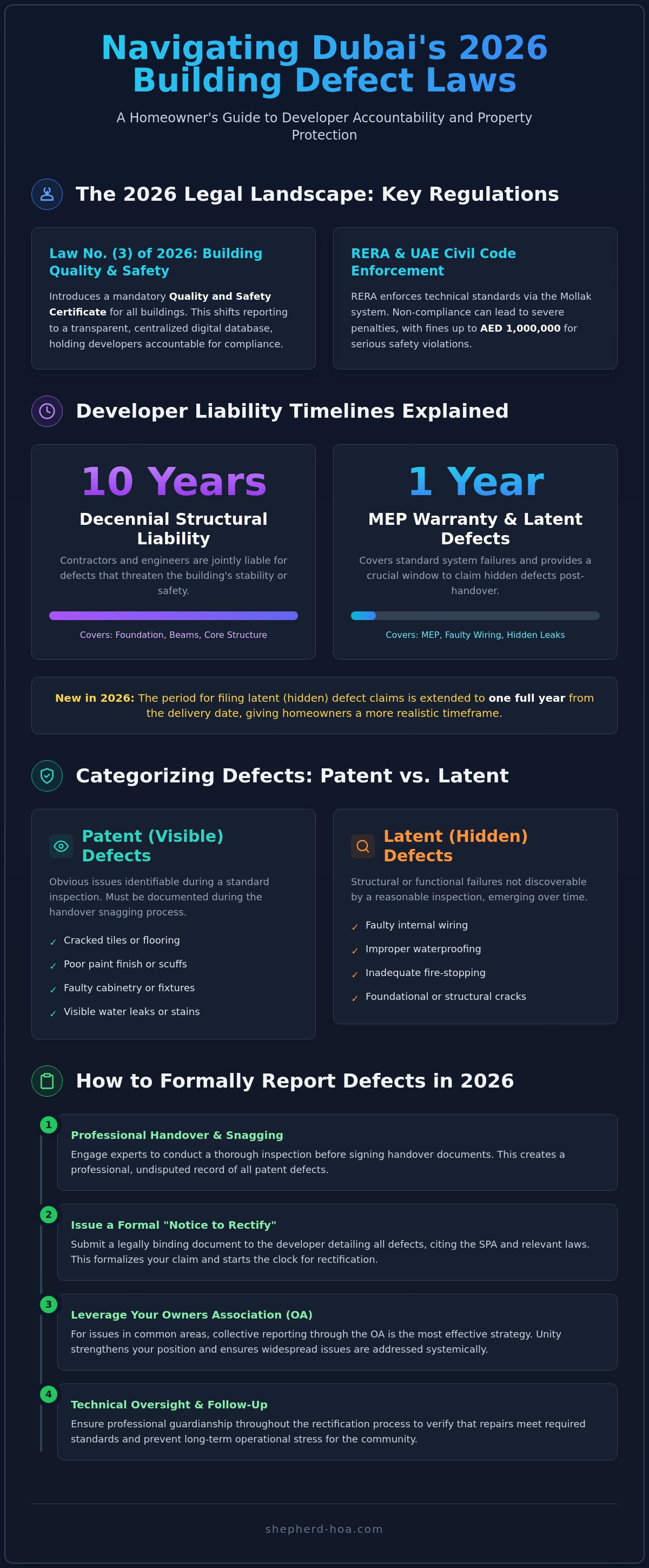
Protecting a property asset requires a clear understanding of the legal landscape. Dubai Law No. 6 of 2019 serves as the foundation for jointly owned properties, defining how common areas are managed and who remains responsible for their upkeep. In 2026, the introduction of Law No. (3) on Building Quality and Safety has added a vital layer of protection, requiring developers to obtain a Quality and Safety Certificate for all buildings. This shift toward centralized digital management ensures that reporting building defects to developer dubai is no longer a paper-heavy struggle but a transparent, tracked process within a unified database.
The Real Estate Regulatory Agency (RERA) acts as the primary enforcer of these standards. While the UAE Civil Code provides a broad legal umbrella for contract law, specific RERA regulations offer the technical mechanisms needed to hold developers accountable. By 2026, the integration of these regulations with the Mollak system has simplified how community management teams log issues. This oversight prevents developers from ignoring legitimate claims, as non-compliance now carries significant penalties, including fines that can reach AED 1,000,000 for serious safety violations.
The 1-Year MEP Warranty vs. 10-Year Structural Liability
Homeowners must distinguish between mechanical, electrical, and plumbing (MEP) systems and the building’s core structure. Standard MEP warranties typically cover internal components for 12 months following the handover date. However, decennial liability remains a cornerstone of UAE law; contractors and engineers are jointly liable for ten years regarding any structural defects that threaten the building’s stability. The 2026 amendments to the Civil Transactions Law have also extended the period for filing latent defect claims to one full year from delivery, providing owners a more realistic window to identify hidden issues that aren't immediately apparent during the first month of occupancy.
Homeowner Rights Under the UAE Civil Code
Your rights aren't limited to the developer's standard warranty pamphlet. The original Sales and Purchase Agreement (SPA) is a binding contractual tool that outlines the specific standards the developer promised to deliver. Under the UAE Civil Code, you have the right to demand that the property matches these agreed-upon specifications. If a developer fails to rectify defects, owners can seek financial compensation or mandatory repairs. Success in these claims depends on having documented the failures through professional snagging and formal notice, positioning the homeowner as a proactive guardian of their investment rather than a passive observer.
Categorizing Defects: Patent vs. Latent Issues
Successful reporting building defects to developer dubai depends on your ability to categorize the issue correctly. Not every flaw carries the same legal weight or timeline for rectification. Homeowners often face frustration when a developer dismisses a claim as "wear and tear," but understanding the distinction between patent and latent defects provides the leverage needed to demand action. While aesthetic flaws like minor paint scuffs might be overlooked after the initial handover, functional failures that compromise the property's utility or safety are strictly regulated under Dubai Law No. 6/2019.
Patent defects are visible issues that any reasonable person can identify during a walk-through. These include cracked tiles, faulty cabinetry, or visible leaks. Because these are obvious, the developer usually expects them to be raised during the property handover dubai inspection. If you miss these during snagging, proving they weren't caused by your own occupancy becomes much harder. Professional oversight during this phase acts as a protective shield, ensuring that every visible flaw is documented before you sign the final papers. For ongoing support in managing these complex transitions, you can rely on the expert guidance provided by Shepherd HomeOwners’ Association.
Common MEP Failures in Dubai Communities
Mechanical, Electrical, and Plumbing (MEP) failures are among the most frequent issues reported in Dubai's high-rise environment. AC system inefficiencies are particularly critical; poor drainage or undersized cooling units can lead to mold growth and significant discomfort during summer months. In 2026, developers are also under increased scrutiny regarding fire safety system compliance. It's the developer's responsibility to ensure that fire alarms, sprinklers, and smoke extractors are fully certified and functional. Electrical load balancing issues, often manifesting as frequent breaker trips or common area lighting failures, also fall under the mandatory one-year MEP warranty.
Structural Integrity and Decennial Liability
Latent defects represent the hidden risks that may not surface for years. These are often structural in nature, such as foundation cracks, water ingress through the building envelope, or cladding failures. Under the principle of decennial liability, developers and their contractors remain responsible for the building’s core integrity for ten years. Because structural defects are complex, they require an independent engineering audit to prove the fault lies in the original construction or design. This ten-year duty is non-negotiable; it's a legal safeguard designed to preserve the long-term value of your asset and the safety of all residents.
The Role of the Owners Association in Collective Reporting
Collective action transforms a single voice into a community mandate. While an individual homeowner might feel ignored by a large development firm, an Owners Association (OA) carries the legal and financial weight of the entire building. This unified approach is the most effective strategy for reporting building defects to developer dubai. It ensures that systemic issues, such as failing chiller systems or widespread cladding concerns, are treated as priority structural claims rather than isolated maintenance tickets. By speaking as one, the community forces a level of accountability that individual complaints rarely achieve.
The Owners Committee has a clear legal mandate to protect the common property and oversee its maintenance. This responsibility isn't just about daily cleaning; it's about the long-term preservation of the asset's value. By utilizing professional owners association management dubai, the committee gains a vital buffer. This professional layer handles the technical friction and legal correspondence, allowing board members to focus on community governance while experts manage the complexities of developer negotiations and RERA compliance.
Managing Common Area Defect Claims
Coordinating with Facility Management (FM) teams is the first step in documenting widespread failures. These teams serve as the eyes on the ground, logging patterns of equipment failure that suggest a latent defect rather than standard wear. When these patterns are identified, the OA issues a formal "Notice to Rectify" via approved digital channels or registered mail. In situations where a defect poses an immediate safety risk, the OA may strategically use the reserve fund to perform urgent repairs. This proactive guardianship prevents further damage to the building while the management team pursues reimbursement from the developer through formal channels.
Leveraging Professional OA Managers
Shepherd HOA acts as the invisible backbone for community boards, providing the technical authority needed to challenge developer pushback. We ensure social harmony by managing resident expectations and providing transparent, logical updates on the status of rectification works. A critical part of our process involves ethical tendering for third-party engineering audits. By engaging independent experts, we ensure that defect reports are impartial and legally robust. This professional standing is essential when navigating complex relationships with developers, ensuring they fulfill their duty of care toward the collective interests of the homeowners.
Step-by-Step: How to Formally Report Defects in 2026
Following a precise administrative protocol is essential when reporting building defects to developer dubai. In the 2026 regulatory environment, vague emails or verbal requests carry little weight in a legal dispute. To ensure your developer fulfills their obligations, you must establish a clear, documented audit trail that mirrors the structured nature of Dubai’s new building safety laws. This methodical approach replaces the stress of uncertainty with a sense of organized control over your property’s future.
Step 1: Conduct a professional snagging and inspection audit. Do not rely on a personal walk-through. Engage a licensed engineering office to produce a technical assessment. This document serves as the objective evidence required for any formal claim.
Step 2: Submit a formal "Notice to Rectify." Send this via registered mail or through approved digital channels. The notice must clearly list the defects identified in the audit and provide a reasonable timeframe for the developer to respond and begin repairs.
Step 3: Document all correspondence meticulously. Keep a log of every email, phone call, and developer site visit. If a contractor visits the property, record the date, the specific work discussed, and any promises made.
Step 4: Escalate through the Mollak system. If the developer remains unresponsive after the notice period, utilize the official digital platform to flag the issue. This ensures RERA has visibility into the developer's failure to comply with maintenance standards.
Step 5: Utilize the RERA Rental Dispute Center (RDC). For unresolved structural or high-value defects, the RDC provides a formal mediation path. This is a decisive step that moves the issue from a simple request to a legal proceeding.
Utilizing the Mollak System for Transparency
The mollak dubai system has evolved into a powerful tool for homeowner protection. It tracks how service charges are allocated toward maintenance, ensuring that funds intended for building upkeep aren't diverted. When claiming repair costs for developer-side failures, RERA-approved financial reporting through Mollak provides the transparency needed to prove that the community's budget is being managed with integrity. Logging every developer interaction within this system creates a permanent audit trail that is difficult for any builder to dispute. To ensure your community is fully compliant with these digital standards, consider the professional oversight of Shepherd HomeOwners’ Association.
Filing a Formal Complaint with RERA
If mediation fails, a formal complaint with RERA is the next logical progression. You must provide your original Sales and Purchase Agreement (SPA), the professional inspection reports, and proof that the "Notice to Rectify" was delivered. Once filed, RERA typically initiates a timeline for intervention, which may include a mandated technical inspection by government-approved engineers. These experts determine if the defect falls under the one-year latent defect period or the ten-year structural liability. Their findings are definitive, often compelling the developer to act immediately to avoid the heavy fines introduced by Law No. (3) of 2026.
Protecting Your Investment with Shepherd HomeOwners’ Association
Expertise matters when the stability of your home is on the line. Since 2010, Shepherd HOA has acted as a steady, expert guide for communities navigating the complexities of the Dubai property market. We understand that volunteer board members are often overwhelmed by the administrative and technical demands of their roles. By providing professional oversight, we replace that operational stress with a sense of organized control. Reporting building defects to developer dubai requires a level of technical precision and legal authority that we bring to every community we serve, ensuring that your property remains a protected, high-value asset.
Our approach is rooted in the concept of guardianship. We don't just manage buildings; we protect the collective interests of the homeowners. This involves maintaining a protective stance toward the building’s physical integrity and its financial health. Ethical governance and transparency are our primary signatures, ensuring that every resident feels the peace of mind that comes from professional management. We anchor our strategies in the preservation of asset value and social harmony, making sure your community thrives long after the initial handover phase is complete.
Comprehensive Handover and Compliance Services
Our methodology for per-unit property handover inspections is designed to catch defects before they become your liability. We provide technical oversight during the initial snagging process, identifying both patent and latent issues with professional accuracy. Beyond the physical inspection, we manage the entire administrative lifecycle, from coordinating utility account setups to securing essential government approvals. We ensure your community remains fully compliant with every updated regulation from rera dubai, handling all Mollak reporting and service charge collection with methodical precision.
Partnering for Peace of Mind
Community governance shouldn't feel like a second job for homeowners. We act as the invisible backbone of your Owners Committee, delivering direct results and efficient resolutions to maintenance challenges. By entrusting the process of reporting building defects to developer dubai to our team, you ensure that every claim is backed by expert evidence and professional authority. This methodical approach mirrors the structure of a well-organized formal meeting, where every pain point finds a clear, actionable resolution. Our goal is long-term stability, achieved through integrity and a deep understanding of the personal stakes involved in property ownership.
Protect your community’s future with Shepherd HOA and experience the confidence that comes with professional guardianship.
Securing the Future of Your Property Asset
The 2026 regulatory landscape provides homeowners with more protection than ever before, but these rights require active guardianship to be effective. Success in reporting building defects to developer dubai depends on a methodical approach that combines technical evidence with legal authority. By understanding the distinction between patent and latent issues and utilizing the Mollak system for transparent reporting, you transform a potentially stressful dispute into a manageable administrative process.
Professional oversight is the invisible backbone of any thriving community. As RERA-approved community management and Mollak system experts, we ensure your building's lifecycle is managed with integrity. Our specialized property handover inspections catch critical flaws early, preserving your asset's value and ensuring social harmony for all residents. You don't have to navigate these complex developer relationships alone.
Secure expert management for your community today and replace operational stress with organized control. Your property is a significant investment; let us help you protect it for the long term.
Frequently Asked Questions
How long is a developer responsible for building defects in Dubai?
Developers are responsible for mechanical, electrical, and plumbing (MEP) systems for one year from the handover date. Structural defects fall under decennial liability, which holds builders and engineers jointly liable for ten years regarding the building's stability. Under the 2026 amendments to the UAE Civil Transactions Law, the window for filing latent defect claims has been extended to one full year from delivery, giving owners more time to identify hidden issues.
What is the difference between a patent defect and a latent defect?
A patent defect is a visible flaw, such as a cracked tile or a broken cabinet, that's easily identified during a standard walk-through or snagging inspection. In contrast, a latent defect is a hidden structural or systemic failure that isn't immediately apparent, such as foundation issues or deep-seated plumbing leaks. Identifying these hidden risks often requires a professional engineering audit to ensure your property remains a secure, high-value asset.
Can I stop paying service charges if the developer hasn’t fixed defects?
You can't legally stop paying service charges as a protest against unresolved building defects. Service charges are mandatory for the ongoing maintenance and insurance of common areas; non-payment can lead to legal penalties and restrictions through the Mollak system. Instead of withholding funds, you should follow the formal process for reporting building defects to developer dubai, which involves documented notices and escalation to RERA to ensure professional rectification.
What should I do if the developer ignores my snagging report?
If a developer ignores your snagging report, you must escalate the matter by sending a formal "Notice to Rectify" via registered mail or an approved digital channel. This creates a legal record of your request and the developer's failure to act. If they still don't respond within the specified timeframe, the next step is to file a complaint through the RERA technical support portal or the Mollak system for government-led mediation.
Is the developer responsible for AC and plumbing issues after one year?
Developers are typically only liable for MEP systems, including AC and plumbing, for the first twelve months after handover. Once this warranty period expires, the responsibility for maintenance usually shifts to the homeowner or the Owners Association. However, if the failure is caused by a latent defect that was present but hidden at the time of delivery, you may still have grounds for a claim under the extended 2026 liability rules.
How does the Mollak system help with building defect reporting?
The Mollak system provides a transparent digital audit trail that tracks all maintenance requests and financial allocations for community repairs. It ensures that service charges are used correctly and allows RERA to monitor developer compliance with building standards. By logging defect reports within this unified platform, homeowners and community managers create a permanent, government-visible record that is difficult for any builder to ignore or dispute during a formal audit.
What is the role of RERA in resolving developer-owner disputes?
RERA acts as the primary regulatory body that enforces developer accountability and mediates disputes between owners and builders. They provide a structured framework for conflict resolution, which can include mandating technical inspections by independent engineers. If a developer fails to meet their legal obligations, RERA has the authority to issue fines or direct the developer to perform necessary repairs to ensure the building meets the safety standards of Law No. (3) of 2026.
Can an Owners Association sue a developer for common area defects?
An Owners Association, represented by its committee and professional management, can take legal action against a developer for defects in common areas. This collective approach is often more effective than individual claims because it represents the unified interests of all residents. Professional managers coordinate with legal experts to file claims at the Rental Dispute Center (RDC), ensuring that structural and systemic failures are rectified at the developer’s expense while protecting community assets.


Comments