
RERA Compliance for Owners Associations in Dubai: The 2026 Governance Guide
- Sohrab Virani

- Jun 16
- 13 min read
A single administrative oversight in your community's financial reporting could trigger a fine of up to AED 1 million under Dubai's latest 2026 housing regulations. It's understandable if the weight of these legal obligations feels overwhelming. Serving on an Owners' Committee is a significant responsibility, and the pressure to maintain rera compliance for owners associations dubai while managing complex Mollak filings can quickly turn a volunteer role into a source of constant stress. You want to protect your property's value, but the fear of hidden penalties or accounting errors often stands in the way of effective leadership.
This guide provides the clarity you need to transform these regulatory burdens into a structured system of community harmony and financial transparency. We'll break down the mandatory 2026 Mollak protocols, provide a clear compliance checklist, and show you how to safeguard your investment through expert governance. By the end of this article, you'll have a roadmap to replace operational anxiety with the peace of mind that comes from professional oversight and organized control.
Identify how the 2026 Jointly Owned Property Law updates redefine the legal structure and responsibilities of modern Owners Committees.
Maintain consistent rera compliance for owners associations dubai by using the Mollak system for transparent financial oversight and reporting.
Align your community budgets with the RERA Service Charge Index to properly manage General and Reserve funds within regulated caps.
Follow a structured roadmap to conduct thorough compliance audits and ensure your committee is formally registered with the Dubai Land Department.
Reduce legal liability for committee members by delegating complex RERA approvals and service charge collections to professional management experts.
Table of Contents
Understanding RERA Compliance for Owners Associations in 2026
Achieving rera compliance for owners associations dubai is no longer just a matter of annual paperwork. It's the invisible backbone of your property's long term value and community stability. In the current regulatory environment, compliance is defined as the strict adherence to the Real Estate Regulatory Agency’s operational, financial, and technical standards. While many residents still use the term "Homeowners Association," Law No. 6 of 2019 officially transitioned these groups into "Owners' Committees." This change wasn't merely cosmetic. It signaled a shift toward a more professional, accountable form of governance where volunteer owners work alongside licensed experts to protect collective assets.
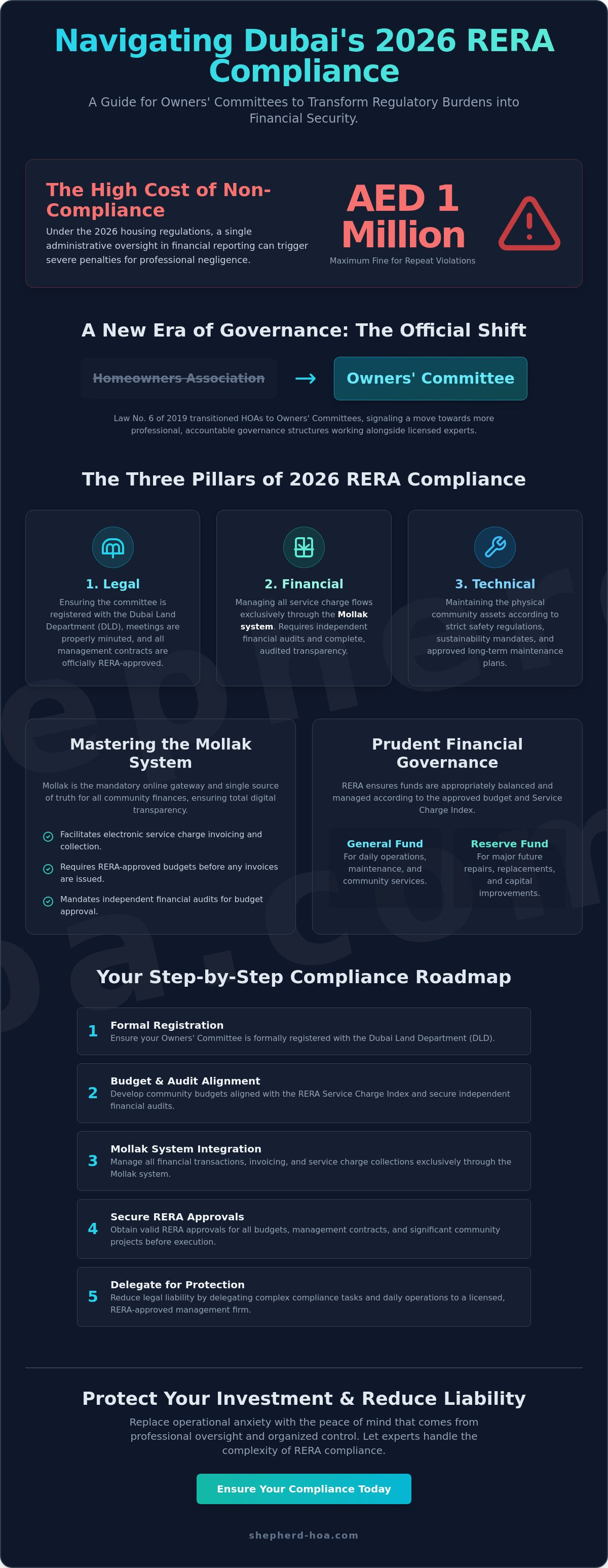
2026 stands as a landmark year for digital transparency in Dubai. With the full implementation of Law No. 4 of 2026 regarding shared housing, the margin for administrative error has vanished. Compliance now sits on three core pillars:
Legal: Ensuring the committee is registered, meetings are minuted, and all management contracts are RERA-approved.
Financial: Managing all service charge flows through the Mollak system with audited transparency.
Technical: Maintaining the physical asset according to strict safety and sustainability mandates.
The Role of the Real Estate Regulatory Agency (RERA)
Dubai's Real Estate Regulatory Agency (RERA) acts as the primary guardian of property governance. It functions as the regulatory arm of the Dubai Land Department (DLD), ensuring that the rights of both developers and owners are balanced. RERA's involvement is what gives a community its legal standing. They oversee the licensing of management companies and must approve every community budget before a single service charge invoice is issued. This oversight prevents the mismanagement of funds and ensures that the "General Fund" for daily operations and the "Reserve Fund" for future repairs are appropriately balanced.
Who is Responsible for Compliance?
Compliance is a shared duty. The Owners' Committee acts as the voice of the residents, providing oversight and direction, while the RERA-approved community management firm executes the daily operations. It's a partnership rooted in mutual accountability. While the committee provides the vision, the management firm ensures that every action remains within the bounds of the law. However, the responsibility doesn't stop at the board level. Individual owners have a legal duty to pay service charges on time. Failure to do so doesn't just hurt the community's cash flow; it can lead to legal restrictions on the property. Under the 2026 regulations, professional negligence or failure to comply with shared housing permits can result in significant fines, ranging from AED 500 to AED 500,000. For repeat violations, these penalties can reach up to AED 1 million, making professional rera compliance for owners associations dubai an essential safeguard for every stakeholder.
The Core Pillars of Regulatory Adherence: Strata Law and Mollak
Stability in Dubai's real estate market relies on two central frameworks: the Jointly Owned Property (JOP) Law and the Mollak system. These aren't just bureaucratic hurdles. They're the mechanisms that ensure your community's financial health and operational integrity. Achieving rera compliance for owners associations dubai requires a deep understanding of how these systems interact to protect your investment. In 2026, the focus has shifted toward total digital transparency, making it impossible to manage a community effectively without a firm grasp of these digital gateways.
Valid RERA approvals are the prerequisite for any community action, from hiring a new security firm to initiating a landscaping project. Without these approvals, an Owners' Committee lacks the legal authority to enter into contracts or collect funds. This structured approach replaces the "handshake deals" of the past with a rigorous, audited process that benefits every property owner. Securing expert Mollak and RERA approval support ensures your association remains on the right side of these strict 2026 standards.
Mastering the Mollak System Requirements
The Mollak system serves as the single source of truth for all community finances. It's a mandatory online gateway that facilitates electronic service charge invoicing and collection. One of the most significant 2026 updates is the requirement for independent financial audits before any budget can be approved within the system. This audit process ensures that every dirham is accounted for before an invoice ever reaches a resident's inbox.
Automated Benchmarking: The system utilizes the RERA Service Charge Index to benchmark your community's proposed costs against regional averages, preventing overcharging.
Fund Separation: Mollak prevents the co-mingling of funds by strictly separating General Funds for daily operations from Reserve Funds intended for long term capital expenditures.
Transparency: Owners can track their payment history and view community financial health directly through the Dubai REST app, which pulls data from Mollak.
Adhering to Strata Law Regulations
Strata Law, primarily governed by Law No. 6 of 2019 and updated by Law No. 4 of 2026, defines the legal boundaries of your property. It's critical to distinguish between private units and "Common Areas" like lobbies, gyms, and gardens. The law mandates that every development has a clear community constitution and a RERA-approved management contract. These documents serve as the rulebook for community life, outlining everything from noise complaints to the usage of shared amenities. Understanding these nuances is a non-negotiable step for maintaining rera compliance for owners associations dubai in the current market. If you need a deeper dive into the legal specifics, you can find Dubai Strata Law explained in our comprehensive guide. This legal clarity acts as a shield, protecting committee members from personal liability while ensuring that the community operates as a cohesive, well-governed unit.
Financial Governance and the RERA Service Charge Index
Financial health is the pulse of any community. In Dubai's regulated market, the RERA Service Charge Index acts as a vital benchmark to ensure that owners aren't overcharged for the upkeep of their assets. This index provides a transparent cap on what an association can reasonably charge based on the property type and location. For instance, while luxury towers in Downtown might see higher rates, mid-market communities in areas like JLT often average around AED 13.65 per square foot. Staying within these parameters is a non-negotiable part of rera compliance for owners associations dubai, as budgets that exceed regional averages without significant justification face immediate rejection during the approval process.
Effective governance requires a clear distinction between General and Reserve funds. Your General Fund covers the daily pulse of the building, including security, cleaning, and utility bills. In contrast, the Reserve Fund acts as a protective shield for the future. It's a "sinking fund" designed to cover major capital expenditures like elevator overhauls or facade repainting years down the line. By ensuring these funds are correctly calculated and ethically managed, you protect the long term resale value of every unit. A building with a healthy, audited reserve fund and 100% compliance is a far more attractive prospect for investors, often commanding higher prices than developments plagued by financial opacity.
Budget Planning and Approval Processes
The timeline for budget submission is strict. Committees must prepare and submit their annual budgets through the Mollak system at least 90 days before the start of the new financial year. This window allows for the mandatory independent audit that RERA requires. If your community faces a budget deficit, you can't simply increase fees overnight. You must provide an audited justification and seek specific regulatory approval to adjust the rates. To navigate these complexities without stress, you can refer to our guide on community service charge budget management for a detailed walkthrough of the 2026 requirements.
Service Charge Collection Ethics
Managing arrears is a delicate balance between financial necessity and community harmony. The Mollak system simplifies this by providing a transparent, dispute-free platform for payment tracking. When owners fall behind, the legal process for recovery is structured and sequential, beginning with formal notices through the system. A professional management company acts as an essential buffer in this process. By handling collections with firm but fair protocols, the management firm ensures the association remains solvent while preserving the social fabric of the neighborhood. This professional oversight is a core component of maintaining rera compliance for owners associations dubai, ensuring that the burden of collection never falls directly on the shoulders of volunteer committee members.
A Step-by-Step Compliance Roadmap for Owners’ Committees
Leading a community shouldn't feel like a second full-time job. Transitioning from operational stress to organized control requires a methodical approach to governance. By following a structured roadmap, your committee can ensure rera compliance for owners associations dubai while protecting the personal interests of every resident. This journey begins with a commitment to transparency and a clear understanding of the 2026 regulatory deadlines.
Step 1: Audit existing approvals. Conduct a comprehensive audit of existing RERA approvals and permits. Ensure your shared housing permits align with Law No. 4 of 2026 before the September enforcement deadline.
Step 2: Formalize the committee. Ensure the Owners’ Committee is formally registered and active. Remember that a committee can be formed once at least 10% of the units in your development are registered with the Dubai Land Department.
Step 3: Mollak synchronization. Synchronize all financial accounts with the Mollak system. This eliminates manual errors and ensures that every dirham collected is tracked through the mandatory RERA gateway.
Step 4: Maintenance scheduling. Establish a recurring schedule for mandatory facility maintenance inspections. Proactive technical oversight prevents costly emergency repairs and keeps your building in line with RERA's safety standards.
Step 5: AGM preparation. Prepare for the Annual General Meeting (AGM) by adhering to RERA-compliant notice periods, typically requiring 14 days' notice to all registered owners.
Secure your community’s future today with our comprehensive Community Management services.
Preparing for the Annual General Meeting (AGM)
The AGM is the cornerstone of community democracy. To remain compliant, you must meet specific legal requirements for quorum and voting. If a quorum isn't met during the first call, the law provides a clear pathway for a second meeting to ensure decisions can still be made. We adopt a "Guardian" approach during these sessions, ensuring every voice is heard while keeping the proceedings strictly within the bounds of RERA's procedural mandates. Documenting minutes and resolutions with precision is essential, as these records must be submitted for official RERA approval to validate any changes in community rules or budgets.
Ongoing Operational Compliance
Compliance is a continuous cycle, not a one-time event. RERA expects your management company to provide quarterly progress reporting that details financial health and maintenance milestones. If your building is new, managing the transition from the developer is critical. Utilizing professional property handover services ensures that all technical documentation and utility accounts are correctly set up from day one. Staying ahead of regulatory changes through proactive legal monitoring allows your committee to act as a watchful guardian, preserving asset value and social harmony for years to come.
Securing Your Investment through Professional Management Excellence
Attempting to manage a community without professional assistance is a significant legal risk for committee members. While the intention to save costs is understandable, the complexities of rera compliance for owners associations dubai often lead to expensive administrative errors or missed deadlines. In the current 2026 regulatory climate, a single oversight in Mollak reporting can result in fines that far outweigh the cost of professional management. Transitioning your community to a higher standard of governance isn't just about avoiding penalties. It's about instilling a culture of transparency that protects the long term value of your property assets.
Shepherd brings over 15 years of experience in navigating Dubai’s regulatory evolution. We act as a steady, expert guide for committees that feel overwhelmed by their administrative duties. This professional guardianship reduces operational costs through ethical tendering and precise budget planning. By replacing operational stress with organized control, we allow volunteer board members to focus on community harmony while we handle the technical mechanisms of compliance. Our deep roots in traditional service values, combined with modern technological tools, provide the invisible backbone your community needs to thrive.
The Value of RERA-Approved Partners
A legitimate management partner must hold valid credentials, which you can verify on the Dubai Land Department portal. Working with an approved firm ensures that every action taken on behalf of the community is legally binding and recognized by RERA. It's vital to choose a partner who understands the nuances of local culture while maintaining global standards of service. Discover why owners association management is essential for community excellence and how it transforms the resident experience from one of friction to one of seamless stability.
Next Steps: A Consultation for Peace of Mind
The first step toward true financial and legal security is a comprehensive compliance audit. We'll evaluate your current community setup, identify gaps in your rera compliance for owners associations dubai, and provide a clear roadmap for resolution. If your current management isn't meeting these high standards, the process of switching to a more reliable partner is structured and straightforward. We handle the transition with care, ensuring no data is lost and all Mollak accounts remain synchronized. Prioritizing asset protection through professional oversight is the most effective way to secure your investment and ensure lasting peace of mind for every homeowner.
Empowering Your Community Through Expert Governance
Maintaining property value in Dubai's evolving market requires more than just meeting basic legal requirements. It demands a proactive commitment to the digital standards set by RERA and the Mollak system. By following the compliance roadmap and mastering financial governance, your committee can transform administrative burdens into a strategic advantage. Achieving rera compliance for owners associations dubai ensures that your community remains a safe, transparent, and attractive investment for years to come. You've seen how digital integration and ethical auditing provide the backbone for long term asset protection.
You don't have to carry the weight of these responsibilities alone. Shepherd has provided RERA-approved community management since 2010, acting as a watchful guardian for associations across the city. We specialize in expert Mollak system integration and financial transparency, ensuring that every dirham is accounted for through ethical governance. Our team is dedicated to enhancing property values by replacing operational stress with organized, reliable control. Ensure your community’s future with Shepherd HomeOwners’ Association and experience the peace of mind that comes from professional guardianship. Your community deserves a partner that values integrity as much as you do.
Frequently Asked Questions
What happens if our Owners Association fails to meet RERA compliance?
Failure to meet compliance standards can result in severe financial penalties, with fines ranging from AED 500 to AED 500,000 under the 2026 shared housing laws. Repeated violations within a single year can double these amounts up to a maximum of AED 1 million. Beyond fines, non-compliant associations lose the legal authority to issue service charge invoices through Mollak, which can lead to a total halt in essential community maintenance and utility services.
Can individual owners check if their community is RERA compliant?
Individual owners can verify their community's status by using the Dubai REST app or the official Mollak portal. These platforms allow you to check if your Owners' Committee is registered and if the annual service charge budget has received official RERA approval. This transparency ensures that every homeowner can act as a guardian of their own investment, confirming that their service charge payments are handled through regulated, audited channels.
How often should a community budget be audited for RERA?
A community budget must be audited by an independent, RERA-approved firm every year before it can be submitted for final approval in the Mollak system. This annual requirement ensures that all financial transactions from the previous year are accounted for and that the proposed budget for the upcoming year is realistic. Maintaining rera compliance for owners associations dubai relies on this cycle of transparency to prevent the mismanagement of general and reserve funds.
Is the Mollak system mandatory for all residential communities in Dubai?
The Mollak system is strictly mandatory for all jointly owned properties and residential communities in Dubai. It serves as the only legal gateway for managing service charge budgets, invoicing, and collections. Any community attempting to collect fees outside of this system is operating in violation of Dubai's real estate laws, which exposes the board members to significant legal liability and potential fines from the Land Department.
What is the RERA Service Charge Index and how does it affect my fees?
The RERA Service Charge Index is a regulatory benchmarking tool that sets a cap on maintenance fees based on property type and location. It ensures that your fees remain fair and aligned with market averages, such as the AED 13.65 per square foot typically seen in JLT. If a proposed budget exceeds these indexed rates without a verified technical justification, RERA will reject the budget until costs are realigned with the index.
How do we register a new Owners’ Committee with RERA?
You can register a new Owners’ Committee once at least 10% of the units in your development are registered with the Dubai Land Department. The process involves holding an inaugural meeting to elect members, documenting the minutes, and submitting the required paperwork through the Mollak system. Members must be registered owners with no outstanding service charges to qualify for these leadership roles, ensuring the committee is built on a foundation of financial integrity.
What are the penalties for management companies that violate RERA standards?
Management companies that violate RERA standards face penalties ranging from heavy financial fines to the total suspension of their operating licenses. RERA monitors these firms through quarterly performance reports and Mollak financial audits to ensure they uphold their duty of care toward the communities they serve. This strict oversight protects owners from professional negligence and ensures that only qualified, ethical firms manage Dubai's property assets.
Can RERA intervene in disputes between the board and the management company?
RERA has the authority to intervene in disputes between the board and a management company to ensure community stability. If a management firm fails to perform its duties or if there are disagreements over financial reporting, RERA can mediate the situation or direct the case to the Rental Dispute Centre for a final ruling. This regulatory safety net ensures that rera compliance for owners associations dubai is maintained even when internal conflicts arise, preserving the asset's value.


Comments