
Short-Term Rental Rules in UAE Communities: The Complete 2026 Compliance Guide
- Sohrab Virani

- Jul 6
- 12 min read
The era of "set it and forget it" short-term renting in the UAE has officially ended, replaced by a sophisticated regulatory landscape that demands absolute precision. Understanding the evolving short-term rental rules in uae communities is no longer just a best practice; it's the only way to safeguard your investment from heavy fines. You likely started your holiday home journey to build a reliable stream of passive income, but the growing complexity of DTCM, RERA, and community-specific bylaws can feel like a heavy administrative burden. It's natural to feel concerned about potential friction with neighbors or the risk of non-compliance.
This guide provides the clarity you need to master these legal requirements and community-specific regulations, ensuring your property remains both profitable and respected. We act as your steady guide through the latest 2026 licensing updates across Dubai, Abu Dhabi, and Ras Al Khaimah. You'll learn how to achieve a "triple-lock" of compliance that balances national law with the specific expectations of your Homeowners' Association. By the end of this article, you'll have a clear roadmap to maintaining social harmony and protecting your asset's value in a rapidly maturing market.
Table of Contents
The National Framework for Short-Term Rental Rules in the UAE
The UAE has established a rigorous legal structure to ensure that holiday homes contribute to the nation's reputation as a world-class destination. Under the current 2026 regulations, a short-term rental is defined as a furnished residential unit that's rented out to guests on a daily, weekly, or monthly basis. To understand the broader context, it helps to ask: What are short-term rentals? and how do they differ from traditional leases? In the UAE, the answer lies in the distinction between a "Holiday Home" permit and a standard tenancy contract registered through Ejari. While national law sets the baseline for safety and quality, the specific short-term rental rules in uae communities often include additional layers of oversight that hosts must respect to maintain social harmony.
The Role of the Department of Economy and Tourism (DET)
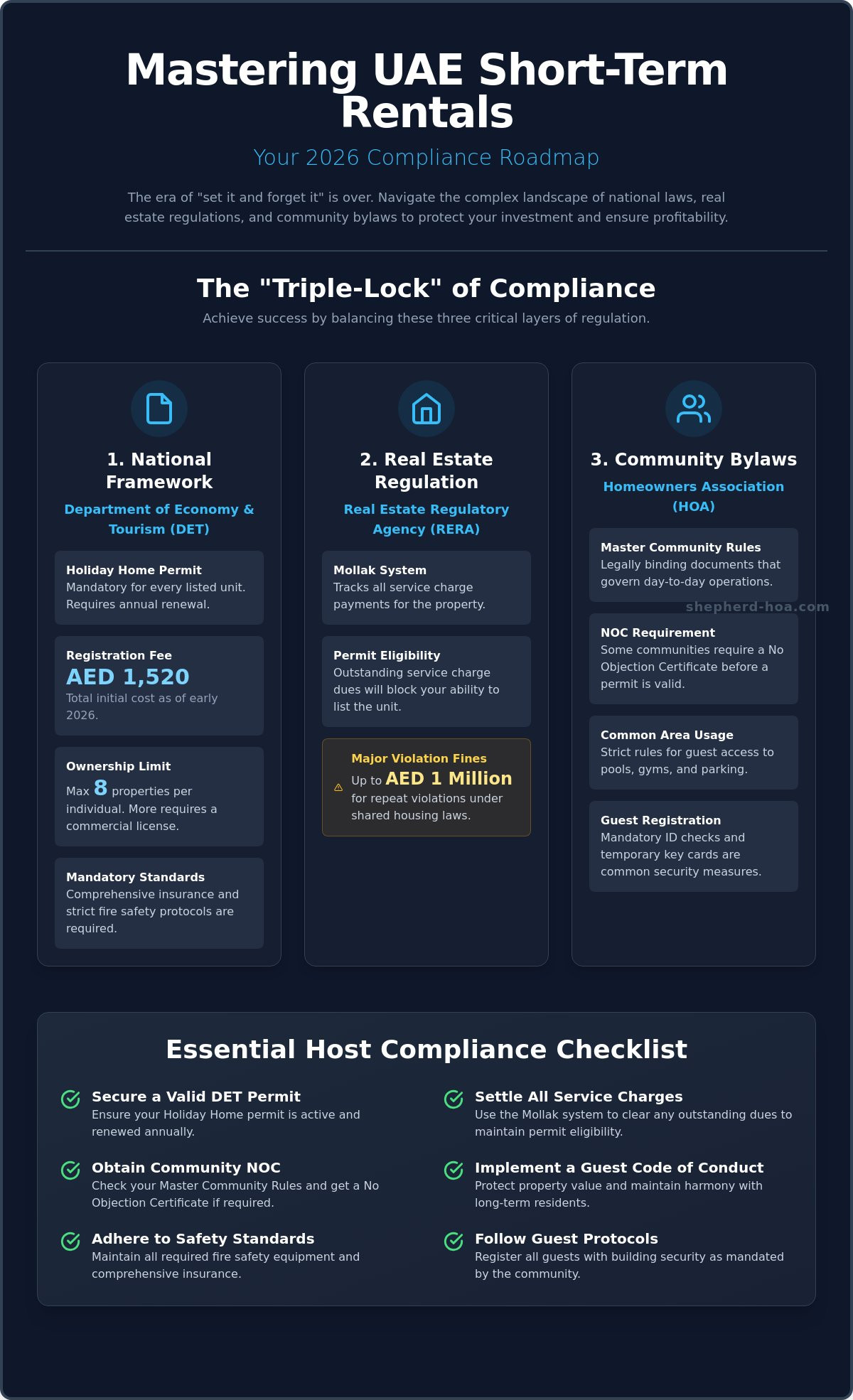
The DET serves as the primary regulator for holiday homes in Dubai, ensuring every listing meets strict hospitality standards. Every unit listed on global platforms like Airbnb or Booking.com must have a valid permit. As of early 2026, the total registration fee for a holiday home is AED 1,520. These permits aren't permanent; they require annual renewal to confirm the property still meets safety requirements. For example, hosts must maintain comprehensive insurance and adhere to specific fire safety standards. Additionally, individual owners are limited to registering a maximum of 8 properties under a single license. Beyond this number, the DET requires a commercial trade license, reflecting a shift toward more professionalized management across the Emirates. This oversight protects both the guest experience and the owner's investment.
RERA and the Strata Law Context
While the DET handles the tourism aspect, RERA Dubai manages the relationship between the property and the wider community. This is where the legal hierarchy becomes critical for hosts. National tourism laws provide the right to operate, but community-specific bylaws can dictate the terms of that operation. A key mechanism in this oversight is the Mollak system. RERA uses this platform to track service charge payments. If a property owner has outstanding dues, they'll find their eligibility to list the unit restricted. This ensures that short-term rental activity doesn't come at the expense of the building's financial health. Law No. (4) of 2026, which took effect in late 2026, introduces even stricter oversight on shared housing, with fines reaching up to AED 1 million for repeat violations. Successful hosting requires a balance between national compliance and the internal short-term rental rules in uae communities, as the Owners Association holds significant power to regulate activity that impacts resident peace or property value.
Navigating Community-Specific Bylaws and HOA Restrictions
National laws provide the legal skeleton for holiday homes, but the short-term rental rules in uae communities are the muscle that governs day-to-day operations. Every master developer, from Emaar to Nakheel, operates under a unique set of Master Community Rules. These documents aren't mere suggestions; they're legally binding frameworks that the Owners Association (OA) uses to maintain order and protect the collective interest. If you're seeking expert investment tips, the most vital advice is to scrutinize these bylaws before listing your property. Some towers require a specific No Objection Certificate (NOC) from the building management before you can even finalize your tourism permit. Without this community-level approval, your national license could be effectively neutralized by local access restrictions.
The Owners Committee and Common Area Usage
The Owners Committee acts as the guardian of the building's shared assets, ensuring that amenities like gyms, pools, and parking facilities aren't overwhelmed. Short-term guests often utilize these facilities more intensely than long-term residents, which can lead to friction. To mitigate this, many communities implement strict security protocols, such as mandatory ID registration at the front desk or the issuance of temporary guest-only key cards. A deep understanding of living in a Dubai community helps hosts appreciate that their guests' behavior directly impacts the building's social harmony. Clear governance ensures that common areas remain high-quality spaces for everyone, preserving the long-term value of the entire development.
Enforcement and Fines for Bylaw Violations
Professional community management companies don't just wait for neighbor complaints; they actively monitor compliance with short-term rental rules in uae communities to prevent disruptions before they start. If a guest violates noise ordinances or ignores parking regulations, the property owner is typically the party held accountable. The enforcement process usually begins with a formal warning, but persistent non-compliance can result in significant financial penalties. HOA managers serve as an invisible backbone for the community, acting as expert mediators in neighbor disputes. This systematic oversight replaces operational stress with a sense of organized control. If you're feeling overwhelmed by these administrative layers, partnering with an expert in community management can provide the guidance needed to ensure your rental activities remain a welcome part of the neighborhood.
Essential Compliance Steps for Short-Term Hosts in 2026
Operating a holiday home in the Emirates requires more than just a high-quality listing; it demands a commitment to a methodical compliance workflow. This structured approach serves as the invisible backbone of your business, replacing operational stress with a sense of organized control. To stay aligned with the short-term rental rules in uae communities, hosts must secure a series of approvals that protect the interests of the guest, the owner, and the wider neighborhood. Beyond the initial registration fee of AED 1,520 in Dubai, maintaining a compliant status involves ongoing administrative duties, from guest data registration to the timely remittance of government fees.
Mollak Compliance and Service Charge Standing
Your journey toward a legal listing begins with financial transparency. A clean record in Mollak Dubai is the non-negotiable first step for any property owner. The DET and RERA cross-reference these records to ensure that hosts aren't profiting from community assets while neglecting their shared financial responsibilities. If your service charges are in arrears, the authorities have the power to suspend your rental permit until the debt is settled. The 2026 regulations emphasize this link between community management and rental eligibility, positioning the payment of service charges as a prerequisite for active participation in the holiday home market. This system ensures that the infrastructure guests enjoy is properly funded and maintained.
Once your financial standing is confirmed, you must focus on guest safety and data integrity. Every host is required to register guest passport or ID details on the mandatory government portal within 24 hours of check-in. This isn't just a security measure; it's a fundamental part of the short-term rental rules in uae communities that ensures national oversight. Additionally, comprehensive property insurance is mandatory. This coverage must specifically include short-term guest liability, shielding you from the financial fallout of accidental damages or guest injuries that standard homeowner policies often exclude.
The Tourism Dirham and Tax Obligations
Managing the financial side of a holiday home involves acting as a temporary collector for the government. In Dubai, you'll collect the Tourism Dirham fee, which is calculated per room, per night. Standard units attract a fee of AED 10, while Deluxe units are charged at AED 15. These funds must be remitted to the DET on a monthly basis through the online portal. Failure to file these returns on time can lead to administrative fines that quickly erode your profit margins. If your annual turnover from rental activities exceeds the mandatory VAT registration threshold of AED 375,000, you'll also need to register with the Federal Tax Authority. Staying ahead of these deadlines ensures your business remains a steady, protected asset for the long term.
Protecting Community Harmony and Asset Value
A successful holiday home business doesn't exist in a vacuum. It operates within a delicate social ecosystem where the comfort of long-term residents is just as important as the guest experience. Every host has a fundamental duty of care toward their neighbors. This means ensuring that your commercial activity doesn't degrade the quality of life for those who call the building their permanent home. Adhering to short-term rental rules in uae communities is the primary way to fulfill this obligation. When hosts prioritize social harmony, they protect the collective reputation of the building, which directly supports long-term property appreciation.
High-density developments require a specialized approach to maintain order. This is why professional owners association management is so vital. A dedicated management team acts as a watchful guardian, balancing the rights of owners to monetize their assets with the rights of residents to a peaceful environment. Without this oversight, high guest turnover can quickly lead to friction, security concerns, and the visible deterioration of shared spaces. Implementing a formal Guest Code of Conduct is an effective way to set expectations early. This document should clearly outline rules regarding parking, trash disposal, and the appropriate use of common areas.
Noise Control and Security Protocols
Noise is the most common flashpoint for conflict in managed communities. To prevent issues before they escalate, many proactive hosts now utilize smart monitoring technology. Discrete noise sensors can alert you if sound levels exceed a certain threshold, allowing you to intervene before a neighbor feels the need to call security. Vetting guests during the booking process is another critical step. By verifying identities and understanding the purpose of the stay, you reduce the risk of security breaches. In the event of an emergency, having a clear protocol shared with the building's front desk ensures that guest issues are handled with professional discretion rather than causing a community-wide disturbance.
Maintaining Property Standards
High guest turnover naturally increases the wear and tear on a building's infrastructure. From increased elevator usage to more frequent cleaning of the lobby, these operational costs impact the community service charge budget. It's essential that your unit's maintenance schedule is rigorous and conducted during hours that don't disturb the quiet enjoyment of adjacent units. There's a documented correlation between strict rule enforcement and property value; buildings known for their order and high standards attract better tenants and higher resale prices. If you want to ensure your community remains a prestigious place to live and invest, consider the benefits of expert community management to oversee these complex interactions.
The Role of Shepherd HOA in Short-Term Rental Oversight
Managing the intersection of hospitality and residential living requires a steady, expert guide. Shepherd acts as the guardian of community standards, ensuring that the pursuit of rental income never compromises resident peace or the long-term integrity of the building. We provide the organized control necessary to replace operational stress with a sense of security. By facilitating transparent communication between property hosts, long-term neighbors, and the Owners Committee, we create an environment where short-term rental rules in uae communities are respected and understood by all parties. Our role is to serve as the invisible backbone that supports a high-functioning, harmonious neighborhood.
A primary focus of our oversight is ensuring that short-term rental activity contributes positively to the community's financial health. We streamline compliance through expert Mollak and RERA reporting, ensuring that every host is up-to-date with their service charges before they list their property. This financial oversight protects the collective interests of all owners, ensuring that the building's infrastructure remains well-funded and capable of handling the demands of holiday home guests. Our methodical approach ensures that every administrative requirement is met with precision, from permit verification to the monitoring of common area usage.
Expert Guidance for Owners Committees
Owners Committees often feel overwhelmed by the administrative responsibilities introduced by the latest 2026 regulations. Shepherd provides the technical expertise needed to draft fair and enforceable short-term rental bylaws that reflect the specific needs of each community. We manage the ethical tendering process for essential services like security and maintenance, ensuring that the building is equipped to handle the increased load that comes with high guest turnover. To maintain transparency, we provide the board with quarterly progress reports. These documents offer a clear view of community compliance levels and highlight any areas where social harmony needs additional attention.
Operational Excellence for Property Value
Protecting the value of your asset requires a proactive stance on maintenance and security. We leverage sophisticated technology to monitor and manage common area access efficiently, preventing overcrowding and ensuring that amenities remain available for all residents. This oversight is critical for protecting the reserve fund; by identifying and addressing wear and tear early, we prevent small issues from becoming expensive repairs. Our commitment to integrity and transparency ensures that every decision made serves the preservation of property value. If you're looking for a modern partner to navigate these complexities, you can partner with Shepherd HOA for professional community governance and experience the peace of mind that comes with expert oversight.
Securing Long-Term Value Through Proactive Compliance
Success in the holiday home market requires a meticulous balance between national tourism standards and the specific short-term rental rules in uae communities. By prioritizing financial transparency through the Mollak system and adhering to community-specific guest codes of conduct, you transform a potentially stressful operation into a stable, protected asset. These steps don't just prevent administrative fines; they foster the social harmony necessary for a prestigious residential environment. When hosts and owners committees work in alignment, the entire community benefits from sustained property appreciation and operational peace of mind.
Professional oversight serves as the invisible backbone that keeps these complex systems moving. Since 2010, Shepherd has provided RERA approved management and expert Mollak system integration to ensure communities thrive under our care. We remain dedicated to ethical governance and the vigilant protection of your collective assets. To maintain an organized, compliant, and profitable community, secure your community's future with Shepherd HOA management. You can move forward with the confidence that your property and its reputation are in expert hands.
Frequently Asked Questions
Do I need a license to rent my apartment on Airbnb in the UAE in 2026?
Yes, you must obtain a formal Holiday Home permit from the relevant tourism authority before listing your property on any platform. In Dubai, this license is issued by the Department of Economy and Tourism (DET), while the Department of Culture and Tourism (DCT) oversees Abu Dhabi. As of early 2026, the total registration fee in Dubai is AED 1,520, and this permit requires annual renewal to remain valid.
Can my Owners Association ban short-term rentals in my building?
While national law provides a framework for holiday homes, individual communities can implement restrictive bylaws through their Master Community Rules. An Owners Association or Committee has the power to set specific conditions for guest access to shared amenities or require an additional NOC to operate. It is essential to review your building's specific short-term rental rules in uae communities to ensure your activity aligns with local governance.
What is the Tourism Dirham fee, and who is responsible for paying it?
The Tourism Dirham is a mandatory guest fee collected per room, per night, to support the nation's tourism infrastructure. For Standard holiday homes, the fee is AED 10; for Deluxe units, it is AED 15. Although guests pay this fee at the time of booking, the property owner or operator is legally responsible for remitting these funds to the government on a monthly basis.
What happens if I list my property without a DTCM or DET permit?
Listing a property without a valid permit is a serious legal violation that results in heavy administrative fines and potential suspension of rental activities. Under Law No. (4) of 2026, penalties for repeated shared housing violations can reach up to AED 1 million. Operating without a license also voids your insurance coverage, leaving you personally liable for any guest injuries or property damage.
How do I ensure my short-term guests follow community rules regarding the pool and gym?
You should provide every guest with a clear Code of Conduct during the check-in process that explicitly outlines the building's amenity regulations. Many managed buildings require guests to register their IDs at the front desk to receive temporary access cards for common areas. Proactive communication helps guests understand that their access to these facilities is a privilege contingent on respecting the peace of long-term residents.
Can a tenant sublet an apartment for short-term rentals in the UAE?
Yes, but only if they obtain a written No Objection Certificate (NOC) from the landlord. This document is a mandatory requirement for the tourism permit application process. Subletting without the owner's explicit consent is a breach of the tenancy contract and can lead to immediate eviction under RERA regulations, regardless of whether the tenant has registered with the DET.
How does the Mollak system affect my ability to host holiday home guests?
The Mollak system tracks the payment status of all community service charges and is directly linked to the permit issuance process. If a property owner has outstanding dues, RERA and the DET may block the issuance or renewal of a holiday home permit until the debt is settled. Staying up-to-date with your financial obligations is a core part of following the short-term rental rules in uae communities and protecting your investment.
What should I do if a neighbor complains about my short-term rental guests?
You must address the complaint immediately by contacting the guest to resolve the specific issue, such as noise or improper parking. If the problem persists, you should involve your community management team to act as a professional mediator. Expert HOA managers help maintain social harmony by implementing security protocols that prevent guest disruptions from affecting the quality of life for long-term neighbors.


Comments