
Signs of a Bad Community Manager: Protecting Your Community Assets in 2026
- Sohrab Virani

- May 2
- 12 min read
What if the subtle decline in your neighborhood's curb appeal isn't a market trend, but a direct result of a guardian who has stopped watching the gate? With 78.1 million Americans living in community associations in 2026, the stakes for professional oversight have never been higher. You might find yourself wondering if your expectations are too high or if you're truly seeing the signs of a bad community manager. When service charge transparency vanishes and maintenance requests sit untouched while the average monthly HOA fee has climbed to $243, it's natural to feel a duty to protect your community's financial health.
We recognize that serving on an HOA board is a significant responsibility, and you deserve a partner who acts as a steady, expert guide. It's exhausting when the person hired to provide peace of mind becomes the source of your administrative headaches. This article will help you identify red flags before they lead to property devaluation or missed legal requirements, such as the January 1, 2026, deadline for California SB 326 inspections. You'll receive a clear checklist to evaluate your current manager's performance and a logical roadmap for a stress-free transition to a more reliable service.
Key Takeaways
Recognize the critical signs of a bad community manager that often go unnoticed before they impact your property value and community harmony.
Implement the "48-hour rule" to evaluate communication effectiveness and identify when silence becomes a liability for your board.
Protect your association's fiduciary standing by identifying red flags in financial reporting and budget transparency.
Execute a systematic audit of your current management by comparing historical meeting minutes against actual project completion and spending.
Gain a clear roadmap for transitioning to a management model that provides a proactive duty of care and organized control.
Table of Contents Identifying the Red Flags of Ineffective Community Management Communication Breakdowns: When Silence Becomes a Liability Financial and Regulatory Negligence: Beyond the Surface Level How to Audit Your Current Management Performance Transitioning to Professional Governance with Shepherd HOA
Identifying the Red Flags of Ineffective Community Management
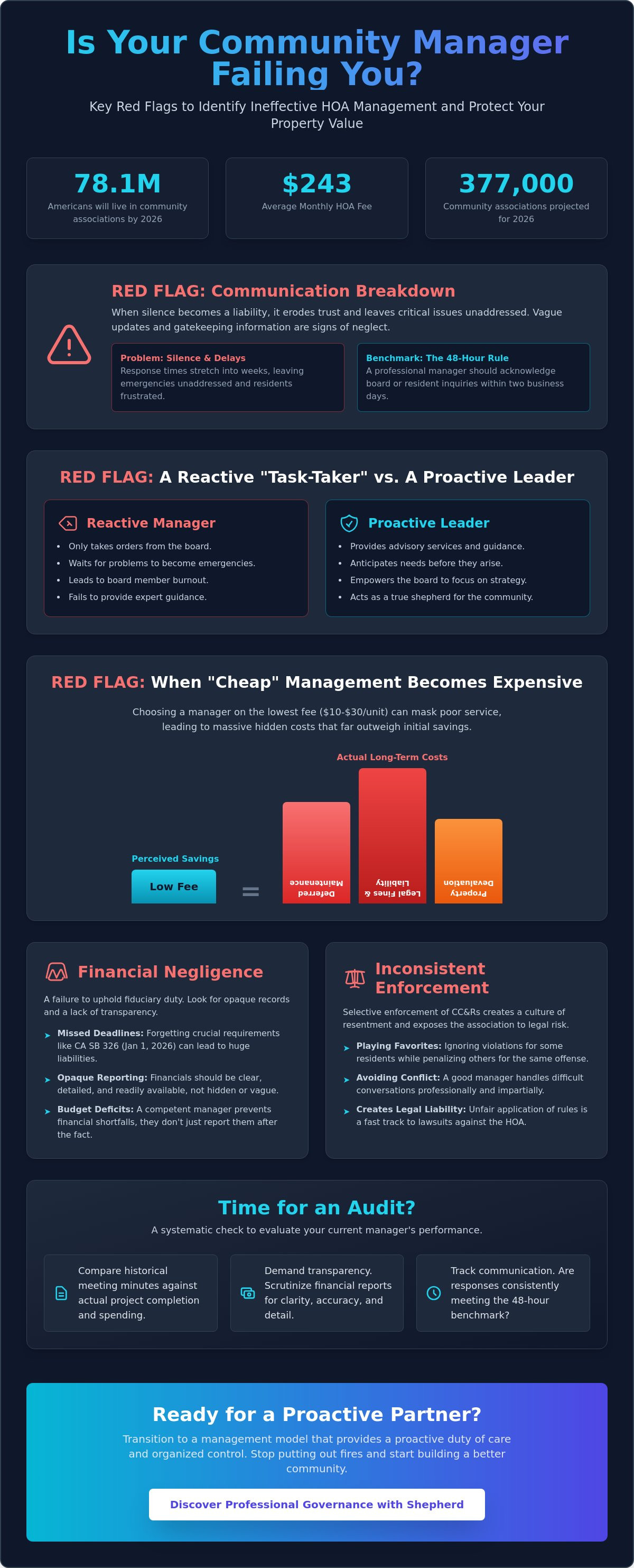
Professional management is about more than answering emails or filing paperwork. It's about protecting the community's collective assets through diligent oversight. A true manager acts as a shepherd for the neighborhood, providing a watchful eye over both the physical property and the financial reserves. When you spot the signs of a bad community manager, you're often seeing a fundamental failure to uphold a fiduciary duty. This duty requires the manager to prioritize the association’s best interests above all else. Identifying these issues early is vital because property values can drop quickly when common areas fall into disrepair or financial records become opaque. With the number of community associations projected to reach 377,000 in 2026, the demand for high-quality governance has never been more pressing.
The Difference Between Administrative Admin and Community Leadership
A manager who only takes orders is a significant red flag. While a board sets policy, the manager should provide proactive advisory services based on the standard duties of a community manager. If your manager waits for the board to notice a leaking roof or a budget deficit before acting, they aren't leading. This reactive approach leads to board burnout because volunteer members end up doing the professional's job. Systemic failures in governance occur when the manager stops offering guidance and starts acting as a mere task-taker. High-performing managers anticipate needs before they become emergencies, ensuring the board remains focused on high-level strategy rather than daily fires.
When "Cheap" Management Becomes Expensive
Low management fees are often a mask for poor service. While average management fees typically range from $10 to $30 per unit, choosing a provider based solely on the lowest price can lead to deferred maintenance and expensive legal fines. Professional owners association management saves money by catching small issues before they become structural disasters. For example, failing to prepare for the January 1, 2026, California SB 326 inspection deadline can result in massive liabilities that far outweigh any monthly savings. Value-based management is the balance between operational efficiency and resident satisfaction. By focusing on long-term stability rather than short-term cost-cutting, a competent manager preserves the community's legacy and financial health. When you observe the signs of a bad community manager, it's often a signal that the "savings" from a low-cost contract are being redirected into emergency repairs and legal fees.
Communication Breakdowns: When Silence Becomes a Liability
Silence is rarely golden in community management. It's often a signal of neglect or overwhelm. A standard benchmark for professional service is the 48-hour rule. This requires a manager to acknowledge resident inquiries or board requests within two business days. When response times stretch into weeks, it isn't just a nuisance; it's one of the primary signs of a bad community manager. This delay leaves emergencies unaddressed and erodes the trust homeowners place in their leadership. Prompt communication is the backbone of community harmony, ensuring that small concerns don't escalate into neighborhood-wide frustrations.
Vague reporting is another red flag that suggests a lack of actual oversight. If a manager’s monthly update consists of a simple "everything is fine" or "no major issues," they aren't providing the professional guidance you require. Effective management demands granular, structured updates on community projects, maintenance schedules, and vendor performance. Gatekeeping information from the owners committee is equally dangerous. When you identify these signs of a bad community manager, you're seeing the breakdown of professional governance. Transparency is the only way to ensure the long-term stability of the association and its assets.
Inconsistent Enforcement of Community Rules
Selective enforcement of CC&Rs is a fast track to legal liability. When a manager plays favorites or avoids difficult conversations with certain neighbors, they create a culture of resentment and unfairness. Professional living in a community depends on the impartial application of rules to every resident. A bad manager might ignore a violation for a friendly neighbor while penalizing another for the same offense. This inconsistency leads to neighbor disputes and potential lawsuits against the board for discrimination or failure to enforce governing documents. We believe that a manager should act as a neutral arbiter, protecting the community's standards without bias.
The "Invisible Manager" Syndrome
Physical presence is non-negotiable for a guardian of community assets. While digital tools improve efficiency, they cannot replace regular site inspections. Warning signs include a manager who is never seen in common areas or who relies entirely on remote reports from vendors. Digital-only management fails for physical property assets because a screen cannot detect the smell of a stagnant pool, the sound of a failing HVAC unit, or the subtle signs of structural wear. You can measure a manager’s effectiveness by the frequency and detail of their inspection logs. If your board feels like it's managing the property alone, it may be time to partner with an expert guide who values physical oversight as much as digital reporting.
Financial and Regulatory Negligence: Beyond the Surface Level
Financial transparency is the cornerstone of community trust. In a climate where insurance and labor costs continue to rise through 2026, a manager must account for every cent of the service charge. One of the most telling signs of a bad community manager is a persistent delay in financial reporting. If your board receives quarterly statements months late or if the manager cannot explain a 12% variance in the landscape maintenance budget, your community assets are at risk. Unethical tendering practices, such as awarding contracts to the same expensive vendors without seeking three competitive bids, suggest a lack of fiduciary care. A professional guardian ensures that community funds are spent efficiently to preserve property values and maintain long term stability.
Poor financial oversight often manifests as a lack of detail in bank reconciliations and reserve fund allocations. When a manager fails to provide a clear audit trail, the board loses its ability to make informed decisions. This lack of organized control can lead to emergency special assessments that catch homeowners off guard. We believe that financial clarity is not just a preference; it is a fundamental requirement for any community that values harmony and fiscal health. Identifying these signs of a bad community manager early allows the board to step in before the association's financial reserves are depleted by neglect or inefficiency.
Mollak and Service Charge Mismanagement
Failure to correctly utilize the Mollak system is a major compliance risk that endangers the association's legal standing and financial health. You might notice poor collection rates where arrears grow while reserve funds dwindle to dangerous levels. This often stems from a lack of forensic financial oversight and a failure to follow up on non-payments. Watch for "budget padding," where expenses are artificially inflated to hide administrative waste. A competent manager maintains organized control over these systems, ensuring that every homeowner's contribution is tracked and utilized according to the approved budget.
Regulatory Non-Compliance and RERA Risks
Operating without the necessary RERA approvals for community operations can lead to heavy fines and the suspension of essential services. An expired management license or non-compliant insurance policy should be treated as an immediate deal-breaker for any board. Regulatory compliance is the invisible backbone of property value protection. When a manager ignores these legal frameworks, they expose individual board members to personal liability and legal scrutiny. Our approach ensures that all regulatory requirements are met seamlessly, providing the peace of mind that comes from knowing your community is fully protected by law.
How to Audit Your Current Management Performance
Taking control of your association’s future requires a methodical evaluation of your current leadership. While the signs of a bad community manager might start as a gut feeling, a structured audit provides the objective data needed for board action. Begin by reviewing the last 12 months of meeting minutes and action items. If specific tasks consistently roll over from month to month without resolution, you have documented proof of administrative failure. This paper trail is often the first place where neglect becomes visible to the entire board.
The second step involves a deep dive into the numbers. You must compare your community service charge budget against actual expenditure to identify any unauthorized spending. Next, conduct a physical "snagging" walk-through of all common areas. Look for signs of wear or safety hazards that a professional manager should have identified and addressed. Complement this physical check by surveying the owners committee on manager responsiveness. Finally, verify the status of all required government filings. If you discover that your community is lagging in any of these areas, it is time to request a professional management review to secure your assets.
The Warning Signs in Your Annual Audit
Your independent financial audit is a definitive report card on your manager’s competence. Pay close attention to "qualified" audit opinions. This designation means the auditor could not verify certain financial records, which is a major red flag for any board. You should also scrutinize the ledger for unexplained administrative fees or "miscellaneous" costs that lack supporting invoices. These small, recurring discrepancies can indicate a lack of forensic oversight and often precede larger financial crises. A manager who cannot provide a clean audit trail is failing their primary fiduciary duty to the homeowners.
Evaluating the Vendor Relationship Matrix
A professional manager ensures that all service providers, including cleaning, security, and MEP teams, meet strict Key Performance Indicators (KPIs). If vendors are underperforming but the manager continues to defend their contracts, you are likely seeing the signs of a bad community manager. This behavior suggests a lack of accountability or, in worse cases, a conflict of interest. An ethical manager maintains a transparent tendering process and isn't afraid to replace failing contractors. When a manager prioritizes vendor relationships over community standards, the physical and financial health of the property inevitably suffers.
Transitioning to Professional Governance with Shepherd HOA
Moving from chaos to organized control requires a partner who understands the high stakes of community governance. Shepherd HOA acts as the invisible backbone for board members, providing the structure and expertise needed to manage complex administrative duties without the typical stress. We don't just process paperwork; we provide a proactive duty of care that mirrors the role of a true shepherd. This metaphor defines our identity as a watchful guardian of your community assets, ensuring that harmony and property values are preserved for the long term. When you recognize the signs of a bad community manager, we facilitate a stress-free transition that handles the difficult handover process on your behalf.
Our commitment to transparency and integrity is non-negotiable. We replace the uncertainty of poor management with methodical, logical reporting that keeps every board member informed. By managing the friction of a transition, we allow your board to return to its primary role: making strategic decisions for the neighborhood’s future. With the number of community associations projected to reach 377,000 in 2026, professional governance is no longer a luxury; it's a necessity for protecting your investment. We ensure that the transition from a failing manager to an expert guide is seamless and professional.
Our Approach to RERA and Mollak Compliance
Achieving 100% regulatory alignment is our standard for protecting your board from personal and legal liability. We utilize proprietary administrative reporting tools to provide real-time insights into community performance and compliance status. Our financial management systems are designed to maximize efficiency, which naturally leads to lower arrears and healthier reserve funds. By maintaining organized control over systems like Mollak, we ensure that every service charge is accounted for and utilized to enhance the community's physical and financial health. This level of oversight is essential in an era where the average monthly HOA fee has reached $243.
Taking the First Step Toward Community Harmony
Regaining control of your community starts with a clear understanding of your current performance gaps. You can request a confidential performance gap analysis to identify exactly where your current management is falling short. During the first 90 days of a Shepherd management contract, we focus on stabilizing operations, auditing financial records, and establishing clear communication channels with all homeowners. We believe that every board deserves a partner that values stability over short-term gains. To begin restoring the integrity of your neighborhood governance, you should request a professional community management audit from Shepherd HOA today.
Securing Your Community's Future Through Expert Governance
Your neighborhood deserves a guardian that values long-term stability over administrative convenience. By recognizing the signs of a bad community manager, you've already taken the most difficult step toward protecting your property value and neighborhood harmony. Professional oversight isn't just about answering emails. It's about rigorous financial transparency and meeting strict regulatory deadlines like the January 1, 2026, inspection requirements. You now have the audit tools to move from uncertainty to organized control.
Shepherd HOA has provided RERA-approved and Mollak-integrated management since 2010, ensuring your board remains fully compliant and protected from liability. Our dedicated compliance team and ethical tendering processes for all third-party contracts provide the expert guidance you need to lead with confidence. It's time to replace the stress of poor oversight with the peace of mind that comes from a steady partner. Restore harmony to your community with Shepherd HOA’s professional management services. You've worked hard to build a home here, and we're ready to help you protect it.
Frequently Asked Questions
What are the most common signs of a bad community manager?
The most common signs of a bad community manager include chronic unresponsiveness, lack of financial transparency, and failure to meet regulatory deadlines like the January 1, 2026, SB 326 inspection mandate. You'll also notice a decline in common area maintenance and a reliance on vague reporting. These red flags suggest a manager has stopped acting as a watchful guardian of your assets, leaving the board to handle administrative burdens alone.
Can an HOA board fire a management company for poor communication?
A board can absolutely terminate a management contract for poor communication, provided they follow the specific notice requirements outlined in their agreement. Most contracts include a "termination for convenience" clause requiring 30 to 90 days' notice, or a "for cause" clause if service standards aren't met. We recommend documenting every missed response or failed deadline to build a clear case for transition if the relationship becomes a liability.
How often should a community manager perform site inspections?
A professional manager should perform a comprehensive site inspection at least once every month to identify maintenance needs before they become expensive repairs. For larger communities with high-amenity usage, bi-weekly or even weekly walkthroughs are standard to ensure vendor performance stays on track. These inspections should result in a detailed report with photos and actionable tasks, ensuring the board has a clear view of the property's physical health.
What happens if our community manager fails to comply with RERA regulations?
Failure to comply with RERA regulations can lead to substantial financial penalties and the suspension of the management company’s operating license. In 2026, regulatory bodies have increased scrutiny on community governance, making non-compliance a risk to property values and board members' personal liability. If your manager misses essential filings, it's a definitive sign that your community assets are no longer being protected by a competent expert guide.
Is it normal for service charges to increase every year under new management?
Service charge increases aren't always a sign of poor management but often reflect the 2026 market reality where labor and insurance costs have risen significantly. A good manager will provide a forensic breakdown of these costs rather than a vague percentage increase. If your manager can't explain why fees are rising while services are declining, you're likely seeing one of the signs of a bad community manager.
How long does the transition to a new community management company take?
The transition to a new management company typically takes between 60 and 90 days to ensure a seamless handover of financial records and vendor contracts. This timeline allows for a full audit of existing documents and the setup of new administrative systems without disrupting daily community operations. A steady partner will manage this entire process, acting as the invisible backbone that carries the administrative weight during the changeover.
How can we tell if our manager is getting "kickbacks" from contractors?
You can identify potential "kickbacks" by reviewing the tendering process for third-party contracts like MEP or security services. If your manager consistently uses the same expensive vendors without providing three competitive bids, it's a major red flag. Ethical management requires a transparent, "arms-length" relationship with all service providers. Any resistance to a competitive bidding process suggests the manager is prioritizing vendor loyalty over the community’s financial interests.
What is the fiduciary duty of a community management firm?
Fiduciary duty is the legal and ethical obligation of a management firm to act solely in the best interest of the homeowners association. This means the manager must exercise professional care in handling finances, enforcing CC&Rs, and maintaining property assets. It's a protective stance that requires absolute integrity. When a manager fails this duty, they aren't just performing poorly; they're compromising the fundamental trust that holds a community together.


Comments