
The Essential Common Area Maintenance Checklist for Buildings in 2026
- Sohrab Virani

- May 11
- 12 min read
What if the secret to a peaceful community isn't a better social committee, but a more rigorous inspection schedule? With the median direct maintenance cost for buildings reaching $2.15 per square foot in 2026, board members can't afford to be reactive. Using a professional common area maintenance checklist for buildings is no longer just a recommendation; it's a strategic act of stewardship that protects your property's financial legacy and keeps residents happy.
You likely volunteered for your board to help your neighborhood thrive, not to feel overwhelmed by shifting regulations like the National Construction Code 2025. It's stressful to face unpredictable repair costs or the fear of legal liability when safety standards change. We understand that you need a steady guide who values transparency and integrity as much as you do. You deserve a management approach that acts as a watchful guardian over your community's assets.
This guide provides a comprehensive, professional-grade framework to master your community's upkeep. You'll learn how to implement a repeatable inspection schedule that stabilizes service charges and ensures compliance with new standards like the updated AS 1851, which became law in New South Wales on February 13, 2026. We will show you how to replace the stress of management with the peace of mind that comes from organized control.
Key Takeaways
Understand how a formal roadmap acts as the invisible backbone of a thriving community and preserves shared assets.
Prioritize high-impact zones like lobbies and entrances to maintain resident satisfaction and positive first impressions.
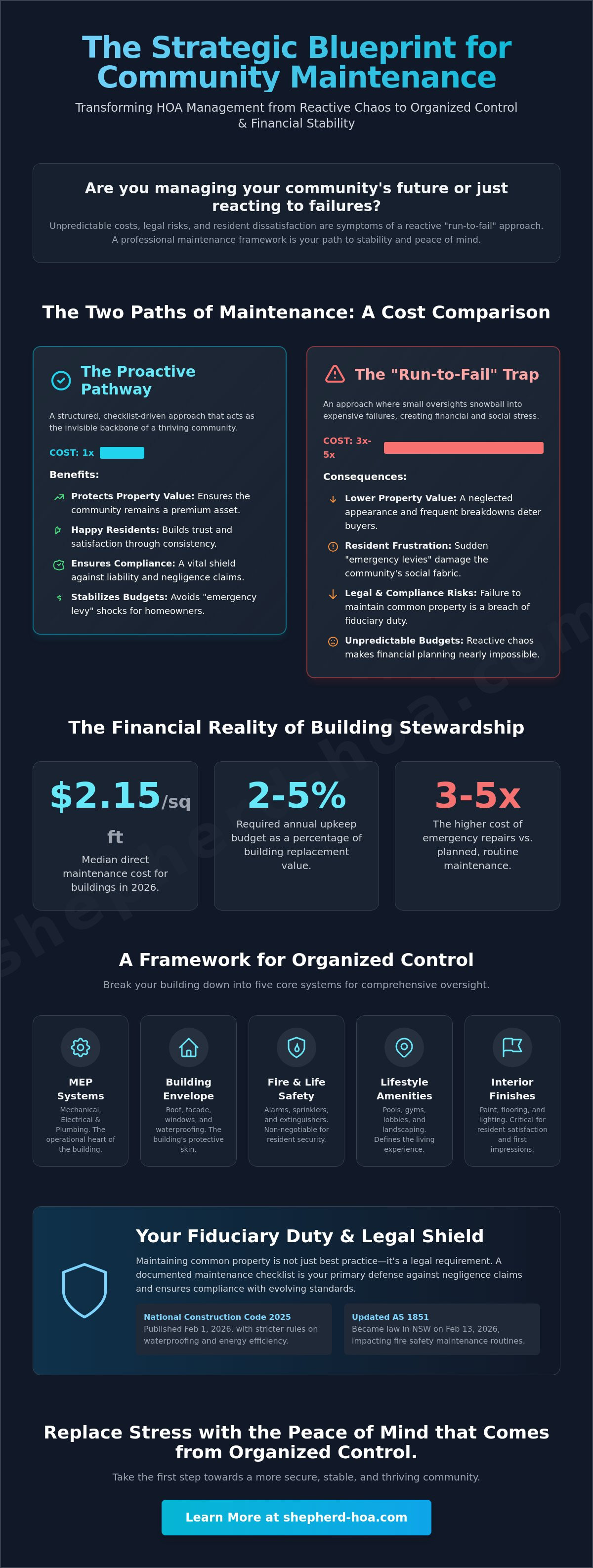
Avoid the run-to-fail trap by using a common area maintenance checklist for buildings to prevent repairs that cost 3-5x more than routine care.
Learn the two-step process for conducting a full asset audit and assigning service frequencies based on manufacturer recommendations.
Explore how professional management replaces the stress of complex administrative tasks with a sense of organized control and peace of mind.
Table of Contents
The Strategic Importance of a Common Area Maintenance Checklist
A common area maintenance checklist for buildings is the formal roadmap for preserving shared assets and ensuring every mechanical system, aesthetic finish, and safety feature receives the attention it requires. Think of it as the invisible backbone of a thriving residential community. Without this structure, small oversights quickly transform into expensive failures. When a board operates with a clear framework, they move from reactive chaos to organized control. Effective CAM stewardship is a disciplined blend of technical precision and proactive community care that ensures every resident feels secure in their investment.
Consistency is the primary driver of property value. A building that looks neglected or suffers from frequent equipment breakdowns will see its market appeal drop, often resulting in lower resale values for individual units. By following a structured approach, boards can maintain the 2% to 5% of a building's replacement asset value typically required for annual upkeep. This methodical oversight ensures that the property doesn't just survive the year, but thrives as a premium asset for decades to come.
Fiduciary Responsibility and Legal Compliance
Board members hold a significant duty of care under national strata regulations to maintain common property diligently. This isn't just a best practice; it's a legal requirement. Documented inspections serve as a vital shield, protecting the association from liability and negligence claims if an accident occurs on the premises. Since the National Construction Code 2025 was published on February 1, 2026, compliance requirements have become more stringent, particularly regarding waterproofing and energy efficiency. Using a common area maintenance checklist for buildings helps you track these updates and ensures your community remains on the right side of the law. You aren't just checking boxes; you're fulfilling a sacred promise to protect the people who live within your walls.
Protecting the Community's Financial Health
Strategic maintenance planning has a direct and measurable impact on the annual community service charge budget. When systems are neglected, the association often faces "emergency levy" shocks. These are sudden, large payments homeowners must make to cover a failed chiller, roof leak, or elevator motor. These surprises frustrate residents and damage the social fabric of the neighborhood. Using Common Area Maintenance (CAM) charges effectively requires rigorous record-keeping and a proactive mindset. These detailed records justify fund allocations during annual audits and prove that the board is acting as a watchful guardian of the community's financial legacy. This level of transparency builds trust and ensures long-term stability for every stakeholder involved.
Core Components of a Comprehensive Building Maintenance Framework
A robust common area maintenance checklist for buildings does more than just track repairs; it manages the community's emotional and financial well-being. We follow the 'First Impression' rule, which recognizes that the lobby and entrance carry the highest emotional weight for residents and visitors. While technical systems keep the building alive, the aesthetic 'soft' services like landscaping and interior finishes define the living experience. Boards must balance these technical 'hard' services with visual 'soft' services to maintain a holistic environment. For a deeper look at industry standards, you can review this comprehensive guide to commercial building maintenance to see how professional frameworks categorize these complex needs.
To act as a watchful guardian of your community, you must categorize your property from the mechanical room to the rooftop garden. This involves identifying five key entities: MEP systems, the building envelope, fire life safety, lifestyle amenities, and interior finishes. By breaking the building down into these manageable sectors, board members can replace administrative stress with a sense of organized control. This methodical approach ensures that no detail, no matter how small, is overlooked during the inspection process.
MEP Systems: The Lifelines of the Building
Mechanical, Electrical, and Plumbing (MEP) systems are the lifelines of your building. HVAC and cooling systems require regular filter changes every three to six months and compressor checks to maintain energy efficiency and resident comfort. Electrical infrastructure inspections must include switchgear, emergency lighting, and backup generators to prevent total power failures. Plumbing management focuses on leak detection in shared lines and water tank sanitization, which are critical for protecting resident health and preventing water damage.
Structural Integrity and Building Envelope
The building envelope, including the roof and exterior walls, requires constant vigilance to preserve property values. Roofing inspections should focus on drainage blocks and membrane wear, particularly after significant weather events. Façade and exterior wall monitoring identifies cracks, paint degradation, and window seal integrity. These checks are vital for preventing the condensation issues highlighted in the National Construction Code 2025. Parking structures also need attention, specifically for proper ventilation and concrete spalling, which can compromise long-term structural safety if left unaddressed.
Lifestyle Amenity and Safety Maintenance
Modern communities often feature specialized amenities that require expert oversight to stay safe and functional. Swimming pool hygiene involves daily chemical balancing and pump room inspections to ensure water quality. Gym equipment needs weekly safety checks and strict sanitization protocols to protect users. Fire Life Safety (FLS) is perhaps the most critical component of your common area maintenance checklist for buildings. Since the legislated update to AS 1851 on February 13, 2026, precise documentation for smoke detectors, sprinklers, and fire doors is mandatory. Managing these moving parts can feel complex, but professional community management provides the steady guidance necessary to keep everything running seamlessly.
Preventative vs. Reactive Maintenance: Protecting Property Value
Waiting until a system fails isn't just a management oversight; it's a financial trap known as the 'Run-to-Fail' model. Industry data consistently proves that reactive repairs cost 3 to 5 times more than consistent, preventative care. These inflated costs come from emergency labor premiums, expedited parts delivery, and the collateral damage that usually follows a sudden breakdown. By utilizing a common area maintenance checklist for buildings, boards shift from a defensive posture to one of proactive stewardship. This transition directly stabilizes the Owners Association management process, turning unpredictable crises into scheduled, manageable tasks. Beyond the financial benefits, well-maintained common areas have a profound psychological impact on the neighborhood. When amenities work perfectly, resident disputes and board friction decrease. Preventative care extends the lifecycle of expensive capital assets, ensuring that your community's most valuable equipment operates efficiently for as long as possible.
The ROI of Stewardship
The true return on investment for building maintenance is found in the 'hidden' savings of avoided downtime. Emergency call-out fees can double or triple a standard service rate, especially during peak demand periods. Consider a community that adheres to a proactive HVAC schedule; they avoid the mid-summer compressor failure that leaves residents without cooling for days. There's also a clear correlation between high maintenance standards and the resale value of individual units. Prospective buyers and real estate professionals view the state of shared amenities as a barometer for the building's overall health. A documented history of care provides the confidence they need to pay a premium for a home in your community.
Reserve Fund Planning and Lifecycle Management
A comprehensive common area maintenance checklist for buildings serves as the primary data source for long-term reserve fund studies. It allows boards to predict exactly when major assets, such as elevators or central chillers, will reach the end of their useful life. This foresight is critical for avoiding the financial shocks caused by special levies. In the context of modern regulatory environments, this level of transparency is essential for Mollak and RERA compliance. Showing owners exactly how their service charges are reinvested in the building's future through detailed maintenance reports builds lasting trust. It proves that the board is acting as a watchful guardian of every homeowner's financial legacy, rather than just reacting to the latest emergency.
Implementing Your Maintenance Schedule: Frequency and Oversight
Transforming a theoretical plan into a functional common area maintenance checklist for buildings requires a methodical five step approach. First, you must conduct a full asset audit to identify every component requiring care, from the heavy machinery in the basement to the emergency exit signs on the top floor. Second, assign service frequencies based on manufacturer recommendations and actual usage levels; a high traffic lobby floor needs more attention than a secondary stairwell. Third, establish clear 'Standards of Excellence' for third party contractors to ensure they understand your community's expectations. Fourth, implement a digital reporting system that provides real-time visibility into task completion. Finally, review and update the checklist annually using performance data to refine your strategy. This structured implementation replaces guesswork with a sense of organized control.
Daily and Weekly Operational Checks
The rhythm of a well managed building depends on consistent daily and weekly attention. Daily tasks include janitorial sweeps, waste management, and visual safety inspections of all entrances to maintain that critical first impression. Weekly checks focus on testing pool water chemistry, verifying irrigation schedules, and inspecting elevator operation for any unusual noise or vibration. Your on-site facility team plays the role of a shepherd during these frequent tasks, acting as a watchful guardian to catch minor issues before they escalate. This constant oversight ensures the invisible backbone of your community remains strong and reliable.
Monthly and Quarterly Technical Audits
Technical systems require deeper dives at monthly and quarterly intervals to maintain peak performance. Monthly audits should cover fire alarm testing, pest control treatments, and detailed inspections of all MEP rooms. Quarterly tasks are more intensive, involving HVAC filter replacements, deep cleaning of common area carpets, and clearing drainage gutters to prevent water damage. It's vital to ensure all quarterly tasks are logged accurately for Mollak compliance, as documented proof of maintenance is often required for service charge approvals. If you find these technical requirements overwhelming, our team at Shepherd HOA can streamline your community management to ensure every compliance deadline is met without stress.
Annual Strategic Reviews
Once a year, the board must step back to assess the building's long term health through structural surveys, façade cleaning, and major system load testing. These annual reviews are also the perfect time to evaluate contractor performance against their original tender agreements. You should align the findings of your annual maintenance report with the next year's budget planning to ensure your reserve funds remain healthy. For electrical systems, remember that standards like AS/NZS 3760:2022 require detailed records to be retained for 7 years. This long term data allows you to make informed decisions that protect property values and maintain community harmony for the future.
Elevating Community Standards with Professional Management
Volunteer board members often find themselves overwhelmed by the sheer volume of administrative and technical tasks required to keep a modern property running. While passion for the neighborhood is a vital starting point, the rigorous demands of a common area maintenance checklist for buildings require professional precision to execute correctly. Between managing multiple contractors and ensuring compliance with updated 2026 safety standards, the workload can quickly become an exhausting second full-time job. Shepherd HOA steps in to replace this administrative stress with a sense of calm reliability. Our approach leverages intuitive technology to provide transparent tracking and real-time financial reporting. This high level of professional stewardship directly fosters harmony and governance within the community. When systems work perfectly and budgets are clear, the tension that often characterizes board meetings simply evaporates.
The Advantage of Expert Oversight
Partnering with a professional management team gives your community immediate access to a vetted network of high-quality, ethical maintenance contractors. We don't just hire vendors; we manage these relationships to ensure results that meet our strict 'Standards of Excellence.' During critical phases like a property handover, our team provides specialized 'snagging' and inspection expertise to catch defects before they become the association's financial burden. Shepherd HOA acts as the watchful guardian of your community's assets, ensuring that every pump, panel, and playground remains in top condition. This professional oversight protects your fiduciary interests and reinforces your standing as a responsible leader in the eyes of your fellow homeowners.
Taking the Next Step Toward Peace of Mind
Transitioning from a fragmented, paper-based common area maintenance checklist for buildings to a seamless digital management ecosystem is the most effective way to secure your building's future. It turns a collection of technical chores into a strategic asset management plan that preserves property values for the long term. We invite board members to schedule a consultation to audit their current maintenance health and identify areas where professional oversight can reduce costs and improve resident satisfaction. Our goal is to provide the steady guidance you need to lead with confidence and organized control. Maintenance is the foundational pillar of a community where people truly love to live. By choosing professional guidance, you ensure that your neighborhood remains a safe, beautiful, and financially stable environment for everyone.
Securing Your Community's Legacy
Adopting a professional common area maintenance checklist for buildings is the definitive step toward replacing administrative stress with organized control. You've learned that preventative care prevents the 3 to 5 times cost increase associated with reactive repairs. It also ensures your property meets the rigorous standards of the National Construction Code 2025. By moving to a digital management ecosystem, your board can focus on long term community harmony instead of daily technical emergencies.
Shepherd HOA has provided dedicated facility management oversight since 2010. We offer RERA-approved community management and expert Mollak financial reporting to keep your association protected and compliant. As your steady guide, we handle the complexities of service charge collection and utility setup so you don't have to. Our role is to act as the watchful guardian of your assets, ensuring every maintenance task is completed with technical precision.
Let Shepherd HOA protect your community's future; request a maintenance audit today.
Your leadership can transform your neighborhood into a place where residents truly love to live. We're ready to help you build that foundation of peace and stability.
Frequently Asked Questions
What are the most critical items on a building maintenance checklist?
Mechanical, Electrical, and Plumbing (MEP) systems and Fire Life Safety (FLS) equipment are the most vital components. FLS systems must strictly adhere to the updated AS 1851 standards that became mandatory on February 13, 2026. Prioritizing these lifelines ensures resident safety and prevents the catastrophic equipment failures that lead to expensive emergency repairs.
How often should an HOA board review the maintenance schedule?
Boards should perform a formal strategic review of the maintenance schedule at least once a year. This annual audit allows you to align the checklist with the upcoming budget and RERA requirements. However, you should review monthly performance reports from your facility team to maintain organized control and catch minor issues before they escalate.
Can we reduce service charges by skipping certain maintenance tasks?
Skipping maintenance tasks is a false economy that leads to higher long-term costs. Neglected assets typically result in emergency repairs that cost 3 to 5 times more than routine care. Proactive stewardship stabilizes the budget and prevents the sudden "emergency levy" shocks that frustrate homeowners and damage community harmony.
Who is legally responsible if a common area asset fails and causes damage?
The Owners Association and its board members generally hold the legal responsibility for maintaining common property. Failing to follow a common area maintenance checklist for buildings can be used as evidence of negligence in liability claims. Documented inspections act as your primary legal shield, proving that the board acted as a watchful guardian of the community.
How do we ensure our maintenance contractors are actually doing the work?
The most effective way to verify work is through a digital reporting system that requires time-stamped photos and GPS-verified check-ins. You should also compare contractor performance against the original tender agreements during your annual review. Professional management oversight provides the steady guidance needed to hold third-party vendors to your community's 'Standards of Excellence.'
What is the difference between a general fund and a reserve fund in maintenance?
The general fund covers daily operational costs like janitorial services and utility bills. In contrast, the reserve fund is a dedicated account for long-term capital replacements, such as elevators or roofing systems. A robust common area maintenance checklist for buildings helps you predict when these major assets will reach the end of their 15 to 20 year lifecycles.
How does the Mollak system track community maintenance spending?
Mollak requires boards to submit detailed maintenance contracts and RERA-approved budgets before service charges can be collected. This system ensures that every dirham spent is transparent and linked to a specific community asset. This level of oversight prevents the misuse of funds and provides residents with the peace of mind that their fees are being managed with integrity.
What should we do if our building is nearing the end of its major system lifecycles?
You should immediately commission a professional asset audit and structural survey to assess the current health of your equipment. This data allows the board to plan for phased replacements using the reserve fund. Taking this proactive step avoids the financial stress of special levies and ensures the building continues to provide a safe environment for all residents.


Comments