
Understanding Your Service Charge Invoice: A Homeowner’s 2026 Guide to Transparency
- Sohrab Virani

- Apr 14
- 13 min read
Does your annual community bill feel like an arbitrary expense or a strategic investment in your home's future? It's natural to feel a sense of unease when a five-figure AED invoice arrives without a clear breakdown of where every dirham goes. You want to ensure your hard-earned money is actually maintaining the gym, the elevators, and the common areas rather than disappearing into a black hole of administrative costs. You deserve to know that your community is managed with integrity and financial precision.
This guide simplifies understanding your service charge invoice by breaking down the 2026 UAE regulatory standards that govern your community's finances. You'll gain the clarity needed to verify your fees and the peace of mind that comes from knowing your property value is protected by national law. We will explore the critical differences between General and Reserve funds while highlighting the legal frameworks that ensure every fils is accounted for, allowing you to approach your next payment cycle with absolute confidence and organized control.
Key Takeaways
Identify the critical difference between daily maintenance fees and the long-term Reserve Fund to see how your AED contributions protect your home’s future value.
Master the process of understanding your service charge invoice through the lens of the UAE’s Mollak system and RERA’s strict budgetary oversight.
Follow a simple two-step verification method to audit your invoice against your Title Deed and the official National Service Charge Index.
Learn how transparent financial reporting and professional oversight act as a guardian for your community’s long-term aesthetic and structural integrity.
Table of Contents Decoding the Basics of Your Community Service Charge Invoice The Anatomy of a Service Charge: What Are You Paying For? The Role of Mollak and National Regulations in Financial Oversight How to Verify and Audit Your Invoice for Accuracy The Shepherd Approach: Guiding Your Community Toward Financial Clarity
Decoding the Basics of Your Community Service Charge Invoice
Receiving your annual statement shouldn't be a source of stress or confusion. A community service charge is a mandatory fee that every homeowner contributes to cover the upkeep of shared property assets. It's the financial lifeblood of your neighborhood, funding everything from the cooling of common corridors to the maintenance of high-speed elevators. Understanding your service charge invoice is the first step toward feeling secure in your investment and your role within the community.
The primary purpose of these fees is to ensure the long-term viability, safety, and aesthetic appeal of the neighborhood. Without this collective pool of resources, essential services like 24/7 security, professional landscaping, and pool sanitation would cease to function. In the UAE's competitive real estate market, these amenities are what preserve your property's value over time. Most invoices are issued annually to align with national fiscal year budget approvals. This timing ensures that the management team has a government-approved roadmap for the coming twelve months, allowing for precise financial planning and resource allocation. Moving from administrative confusion to a state of organized control starts with understanding your service charge invoice, as it transforms a simple bill into a transparent report of community health.
The Legal Basis for Service Charges
The obligation to pay service charges is rooted in national strata laws, specifically Dubai Law No. 6 of 2019 regarding Jointly Owned Property. These regulations mandate that every owner contributes to the Master Community and Building Service funds proportionally based on their unit's area. This legal requirement applies whether your property is a freehold unit or part of a Leasehold estate. Your management contract empowers the Owners Association Management (OAM) company to collect these fees and manage the community's day-to-day operations. The management company carries a strict fiduciary duty to manage and protect community assets with the same care and diligence they would apply to their own interests.
Why Transparency Matters in 2026
By 2026, the landscape of community management has shifted toward digital-first financial reporting. Homeowners now expect real-time access to ledger balances and expense tracking through integrated portals. This move toward radical transparency is essential because clear invoicing prevents disputes and fosters community harmony. When residents can see a line-by-line breakdown of where their AED is going, it eliminates the "black box" perception of management fees. Ethical governance is the foundation of trust between boards and residents. This professional oversight ensures that your community remains a peaceful, well-maintained sanctuary rather than a source of administrative friction. High transparency standards in 2026 include:
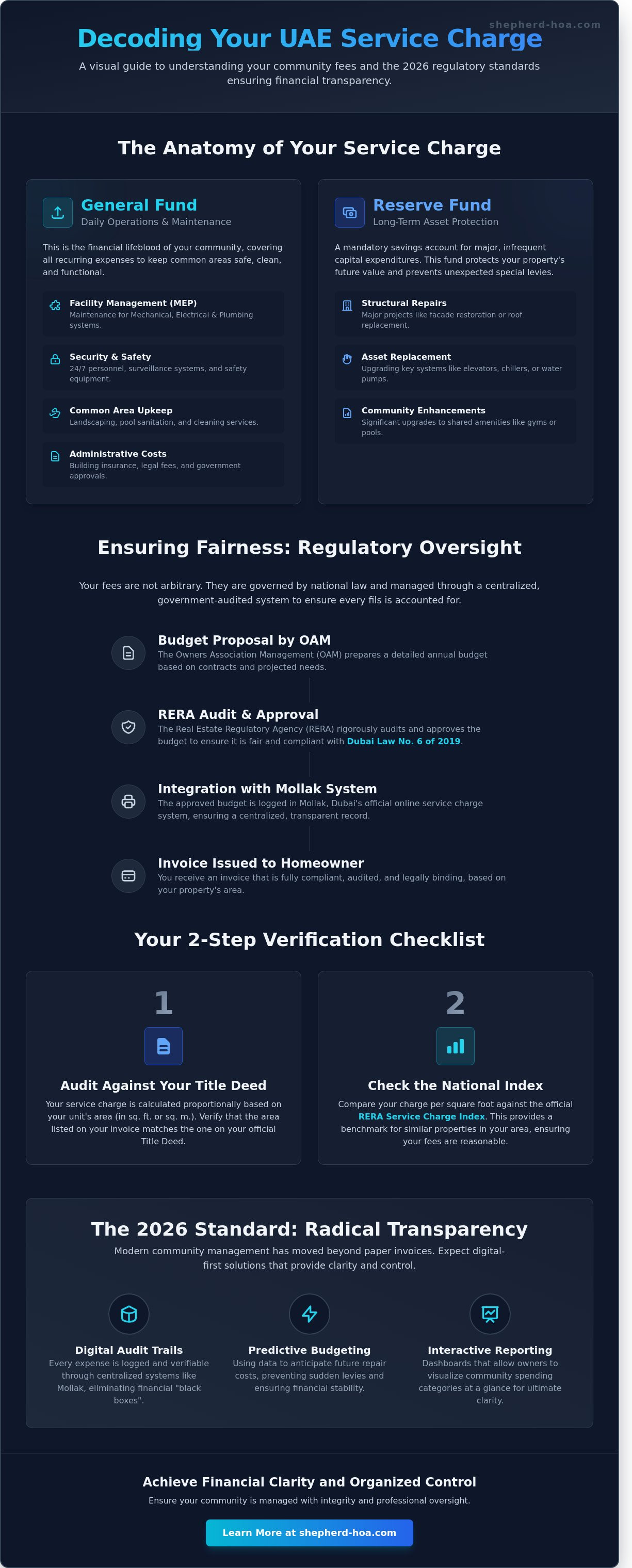
Digital Audit Trails: Every expense is logged and verifiable through centralized systems like Mollak.
Predictive Budgeting: Using data to anticipate repair costs before they become emergency levies.
Interactive Reporting: Dashboards that allow owners to visualize community spending categories at a glance.
By embracing these standards, communities move away from the frantic energy of last-minute budget fixes and toward a methodical, logical approach to neighborhood preservation. This structure provides a comforting cadence for homeowners, reflecting a management style that values long-term stability and property value protection above all else.
The Anatomy of a Service Charge: What Are You Paying For?
Deciphering your annual statement is the first step toward financial clarity. When you're understanding your service charge invoice, you're looking at a roadmap of how your community maintains its standards and protects your investment. Each AED contributed serves a specific purpose, categorized to ensure every dirham is accountable. These charges aren't arbitrary; they're calculated based on the square footage of your unit and the projected needs of the building for the fiscal year.
General Fund Breakdown: Operational Excellence
The general fund acts as the pulse of your community. It covers the daily expenses required to keep the property clean, safe, and functional. This budget includes facility management (FM) contracts for MEP (mechanical, electrical, and plumbing) services, 24/7 security personnel, and professional landscaping. Administrative costs also sit here, encompassing building insurance, legal fees, and mandatory government approvals from bodies like RERA.
Operational efficiency in this fund is vital. When a board manages these contracts effectively, it prevents waste and stabilizes the budget. This proactive oversight ensures that small issues don't escalate into expensive emergencies. By reviewing these costs annually, boards can identify areas to optimize, which often leads to lower future increases for all homeowners.
The Reserve Fund: Protecting Your Property Value
A healthy reserve fund is the hallmark of a well-managed community. Think of it as a dedicated savings account for major future capital expenditures. In 2026, transparency regarding these funds is more critical than ever. This money is set aside for high-ticket items like roof replacements, lift modernizations, or complete chiller overhauls. Without a robust reserve, communities often face "special levies," which are unexpected and often large one-off payments requested from owners.
A well-funded reserve positively impacts resale value and bank valuations. Lenders frequently look at the health of the reserve fund before approving mortgages for potential buyers. Learning the art of mastering the community service charge budget ensures the reserve fund is never underfunded, protecting the building's structural integrity for decades. This financial foresight acts as a protective shield for your equity.
Utility Costs and Management Fees
Utility charges are often the most variable part of an invoice. These include common area electricity and DEWA charges, alongside chilled water costs for air conditioning systems. In many UAE developments, these are managed through bulk meters, and the cost is distributed based on unit size or individual sub-meters. Transparency here allows you to see exactly how much energy the common areas consume versus your private usage.
The management fee covers the professional cost of administrative oversight. This pays for the expertise of managers who handle compliance, financial reporting, and vendor relations. It's a fiduciary duty to ensure these fees are reasonable and provide value. You should always feel empowered to investigate your rights regarding service charges to ensure these management costs align with industry standards. Maintaining a clear view of these expenses helps foster community harmony. If you want to simplify how your board tracks these moving parts, you can explore intuitive management tools designed for modern transparency.
The Role of Mollak and National Regulations in Financial Oversight
Financial transparency in UAE community management is no longer a luxury; it's a legal mandate. When you're understanding your service charge invoice, you're reviewing a document that has undergone rigorous government vetting. The Real Estate Regulatory Agency (RERA) acts as the ultimate guardian of your investment. No management company or developer can legally issue an invoice in 2026 without first receiving formal budget approval from the national regulator. This oversight ensures that every AED requested from homeowners is justified by actual operational costs and long-term reserve requirements.
The Service Charge Index serves as a critical benchmark in this process. By comparing proposed fees against historical data and regional averages, RERA prevents arbitrary price hikes. If a community's proposed budget significantly exceeds the index average for its category, the management must provide exhaustive documentation to justify the variance. This system maintains market stability and protects property values across the emirates.
How the Mollak System Protects Homeowners
The Mollak system is the national digital backbone for service charge transparency. It has fundamentally changed how funds are handled by removing the developer from the payment loop. All service charges are now paid directly into RERA-approved escrow accounts. These funds are legally ring-fenced, meaning they can only be used for the specific community's maintenance and cannot be diverted to other projects.
Homeowners can gain peace of mind by using the official portal to verify their unit's specific charges. This digital trail ensures that every transaction is recorded and traceable. For those interested in the technical details of these protections, understanding Mollak and compliance is essential for any proactive board member. The system also automates the issuance of electronic invoices, which reduces human error and administrative delays.
Compliance and Ethical Tendering
Regulatory oversight extends to how your money is spent on third-party vendors. National laws require a competitive tendering process for all significant service contracts, including security, cleaning, and MEP (Mechanical, Electrical, and Plumbing) services. Management companies must typically secure at least three independent bids to ensure the community receives the best value for its AED.
This competitive framework prevents conflicts of interest and ensures that vendors are selected based on merit rather than relationships. To maintain this high standard of understanding your service charge invoice, RERA mandates quarterly progress reports and annual financial audits. These audits must be conducted by accredited, independent firms that report their findings directly to the regulator. This cycle of bidding, reporting, and auditing creates a robust shield for your community's financial health.
How to Verify and Audit Your Invoice for Accuracy
Taking a proactive approach to understanding your service charge invoice ensures you only pay your fair share for community upkeep. Accuracy isn't just about the final number; it's about the data that builds it. Follow these five steps to verify your statement and protect your investment.
Step 1: Confirm your unit area. Compare the square footage (sq. ft.) or square meters (sq. m.) on your invoice against your official Title Deed. Even a small discrepancy of 10 sq. ft. can lead to hundreds of AED in overcharges over a fiscal year.
Step 2: Check the National Service Charge Index. Use the Dubai REST app to verify the approved rate for your specific community. This index provides a transparent benchmark for what you should be paying per square foot.
Step 3: Review audited financial statements. You have the right to see where the money went. Request the previous year’s audited financials to ensure the HOA board managed the community funds according to the approved budget.
Step 4: Verify the Reserve Fund. Look for a mandatory contribution to the Reserve Fund. This isn't an optional fee; it's a legal requirement designed to cover major future repairs, such as cooling system overhauls or facade maintenance.
Step 5: Validate the escrow account. Ensure the payment instructions lead to a RERA-approved escrow account for your specific project. You should never be asked to transfer service charges to a private entity's general business account.
Common Red Flags to Watch For
Inconsistencies often hide in the fine print. Watch for unit measurements that shift between billing cycles, as your property's size shouldn't change. Sudden spikes in administrative or "miscellaneous" fees exceeding 5% of the total budget without a clear explanation are also a concern. Most importantly, every invoice must feature a RERA-approved budget reference number. If this number is missing, the invoice may not be legally enforceable.
Addressing Disputes Professionally
If you find an error while understanding your service charge invoice, start by contacting your HOA board through the official community portal. Use the framework provided by RERA regulations to support your claim with specific data points. When internal communication fails to resolve the issue, a professional community management partner can provide the mediation needed to reach a fair outcome. This structured approach maintains community harmony while ensuring financial accountability.
Ready to bring total transparency to your community's finances? Discover how Shepherd HOA simplifies complex billing to give you peace of mind.
The Shepherd Approach: Guiding Your Community Toward Financial Clarity
Shepherd serves as the primary guardian of your community funds and the long-term integrity of your property assets. We recognize that homeowners association (HOA) board members are often volunteers who balance these duties with full-time careers. Our role is to provide the professional oversight needed to ensure every AED 1 collected is utilized effectively. By simplifying the process of understanding your service charge invoice, we transform a complex administrative task into a clear roadmap for community growth.
We leverage intuitive technology to make service charge collection stress-free for both the board and the residents. Our platform provides real-time financial reporting, allowing board members to view fund allocations at a glance. This level of visibility eliminates the traditional friction associated with annual audits and budget approvals. We focus on ethical governance because we know that property values are directly tied to the quality of management and the transparency of its financial dealings. Our goal is to replace the typical stress of community management with a sense of organized control.
Expert Budget Planning and Oversight
Our team uses data-driven forecasting to stabilize service charges and prevent the sudden spikes that often frustrate homeowners. By analyzing historical spending patterns and 2026 market trends in the UAE, we create budgets that are both realistic and resilient. We implement an ethical tendering process that prioritizes value and reliability over the lowest bid. This ensures your community receives high-quality maintenance that preserves the building's lifespan. Shepherd acts as the invisible backbone of the community, providing the structural support and financial precision required to keep everything running without a hitch.
Next Steps for Your HOA Board
Transitioning to a more transparent management model doesn't have to be a hurdle. Your board can begin this journey by requesting a comprehensive audit of current community finances to identify inefficiencies or unallocated funds. This baseline allows for a smoother transition to a digital-first governance style. For those committed to Owners Association Management excellence, the focus should remain on clarity and accountability. If you're ready to improve your community's financial health, consider these immediate actions:
Review your current reserve fund study to ensure it meets 2026 regulatory standards.
Schedule a consultation to see how automated invoicing can reduce late payments by 22% or more.
Implement a digital portal where owners can access their payment history and understanding your service charge invoice becomes second nature.
Our long-term vision is simple. We want to enhance your quality of life by removing the administrative burden of property management. When the financial foundation is secure, the community can focus on what truly matters: creating a harmonious place to call home. It's about moving beyond simple compliance and toward a model of excellence that benefits every resident.
Take Control of Your Community’s Financial Health
Navigating the complexities of community living in 2026 requires a proactive stance on financial oversight. By mastering the art of understanding your service charge invoice, you ensure every AED contributed to the reserve fund serves its intended purpose. The RERA-mandated Mollak system provides a robust framework for this transparency, but the real power lies in your ability to audit and verify these figures against actual community needs. Clear financial reporting doesn't just protect your wallet; it preserves the long-term market value of your property.
Shepherd HOA brings over 15 years of national governance experience to your doorstep, acting as a steady guide through the landscape of UAE real estate regulations. As a RERA-approved community management partner, we specialize in Mollak financial reporting to eliminate the stress of administrative guesswork. Our team provides the professional backbone your board needs to maintain harmony and fiscal precision. Take the first step toward total clarity today.
Request a transparent community budget review from Shepherd HOA and secure your neighborhood's financial future. You deserve the peace of mind that comes with expert oversight.
Frequently Asked Questions
How is my specific service charge amount calculated?
Your service charge is calculated by multiplying the total RERA-approved budget for your community by your unit's square footage relative to the total area. This ensures every homeowner contributes a fair share toward communal upkeep. In 2024, RERA introduced stricter auditing to ensure these calculations remain transparent. You can verify your specific rate per square foot through the Dubai REST app or the Mollak portal to ensure accuracy.
Can I pay my service charge in installments?
Most management companies allow you to pay in four quarterly installments to make the financial commitment manageable. While the invoice shows the total annual amount, you can typically set up post-dated cheques or digital payments through your owner portal. Check your specific 2026 invoice for the payment schedule. Failing to meet these dates can trigger a 1% monthly penalty fee according to standard RERA guidelines.
What happens if I refuse to pay my service charge invoice?
Refusing to pay leads to formal legal proceedings through the Mollak system and the Rental Dispute Center (RDC). After a 30-day notice period, the management company can file a case to recover the debt. This results in additional legal costs and can prevent you from selling or leasing your property. In severe cases, the RDC can issue an order to auction the property to recover the outstanding AED balance.
Is the management fee the same thing as the service charge?
No, the management fee is only one component of your total service charge invoice. It covers the professional fees paid to the management company for their administrative and oversight work. The broader service charge includes utilities, cleaning, security, and maintenance costs for common areas. Typically, management fees account for 10% to 15% of the total community budget approved by RERA each year.
How often can the service charge rate be increased?
Service charges can only be adjusted once per year during the budget approval process. Any increase requires a detailed audit and formal approval from RERA to ensure the hike is justified by actual community needs. If the 2026 budget shows a surplus from the previous year, this must be credited back to the homeowners. This regulatory oversight prevents arbitrary price hikes and protects your property value over time.
What is the difference between a general fund and a reserve fund?
The general fund covers daily operational costs like security salaries and pool chemicals while the reserve fund is for long-term capital expenditure. By law, a portion of your service charge goes into the reserve fund to pay for major projects like roof repairs or elevator upgrades. Maintaining a healthy reserve fund, often recommended at 15% of the annual budget, ensures the community remains stable without requiring sudden payments.
How do I know if my service charge invoice is RERA approved?
You can verify the status of your invoice by logging into the Dubai REST app and checking the Mollak section. Every legitimate invoice must have a unique Mollak reference number and a breakdown of the RERA-approved budget. Understanding your service charge invoice becomes easier when you cross-reference the figures with the official government portal. If the invoice isn't registered in Mollak, you aren't legally obligated to pay it.
Can I see the community’s audited financial statements?
Yes, you have a legal right to review the audited financial statements of your community association. Management companies must provide these reports annually to demonstrate how every AED was spent during the fiscal year. These documents are usually uploaded to the owner's portal or presented during the Annual General Meeting. Reviewing these statements helps you gain a clear understanding your service charge invoice and the community's overall financial health.


Comments