

Understanding Your Service Charge Invoice in Dubai: A Complete 2026 Guide
- Sohrab Virani

- Mar 23
- 14 min read
If your 2026 service charge invoice arrived today, could you prove that every AED 1,000 you're paying is actually protecting your property value? Most Dubai homeowners feel a sense of dread when that Mollak notification hits their inbox. It's frustrating to see large sums allocated to a General Fund or Reserve Fund without a clear explanation of where that money goes. You deserve to know that your investment is being managed with total transparency and care.
Mastering the process of understanding your service charge invoice dubai is the only way to ensure your community fees are RERA-compliant and fair. This guide simplifies the complex terminology and provides a clear path to financial clarity. You'll learn how to audit all 12 standard line items, verify mandatory RERA approval codes, and use the Mollak portal to confirm your community's financial health with absolute confidence. We'll show you exactly how to spot the 15% discrepancies that often signal developer mismanagement and how to act on them immediately.
Key Takeaways
Learn how the RERA-mandated Mollak system protects your interests by prioritizing financial transparency and homeowner visibility over community finances.
Master the essential skill of understanding your service charge invoice dubai by decoding the specific roles of the General Fund and the long-term Reserve Fund.
Discover how to utilize the DLD Service Charge Index to benchmark your community fees against market rates and verify RERA compliance.
Gain a practical framework for auditing your invoice accuracy, including cross-referencing Title Deed dimensions to ensure you only pay your fair share.
Explore how professional oversight and ethical tendering processes safeguard your property value and ensure every AED is invested efficiently.
Table of Contents The Evolution of Service Charges in Dubai: Why Transparency Matters A Line-by-Line Breakdown: Decoding Your Mollak Invoice Items The Role of RERA and the Service Charge Index in Cost Control How to Verify Your Invoice Accuracy and Manage Payment Disputes Protecting Your Investment: How Shepherd HOA Ensures Financial Integrity
The Evolution of Service Charges in Dubai: Why Transparency Matters
The Dubai real estate market has undergone a massive transformation in how it handles community funds. Ten years ago, developers often managed billing behind closed doors, which left many owners guessing about how their money was spent. Today, the landscape is different. Dubai's Real Estate Regulatory Agency (RERA) now mandates a level of oversight that ensures every dirham is accounted for. This shift protects the long-term health of your property and your peace of mind.
Clear financial tracking prevents community decay. It ensures that elevators work, pools stay clean, and common areas remain pristine. These factors directly preserve your property's resale value. By 2026, new regulatory updates will prioritize even greater homeowner visibility, moving the market toward a future where every expense is visible in real-time. This evolution isn't just about rules; it's about building trust between homeowners and management companies.
What is the Mollak System?
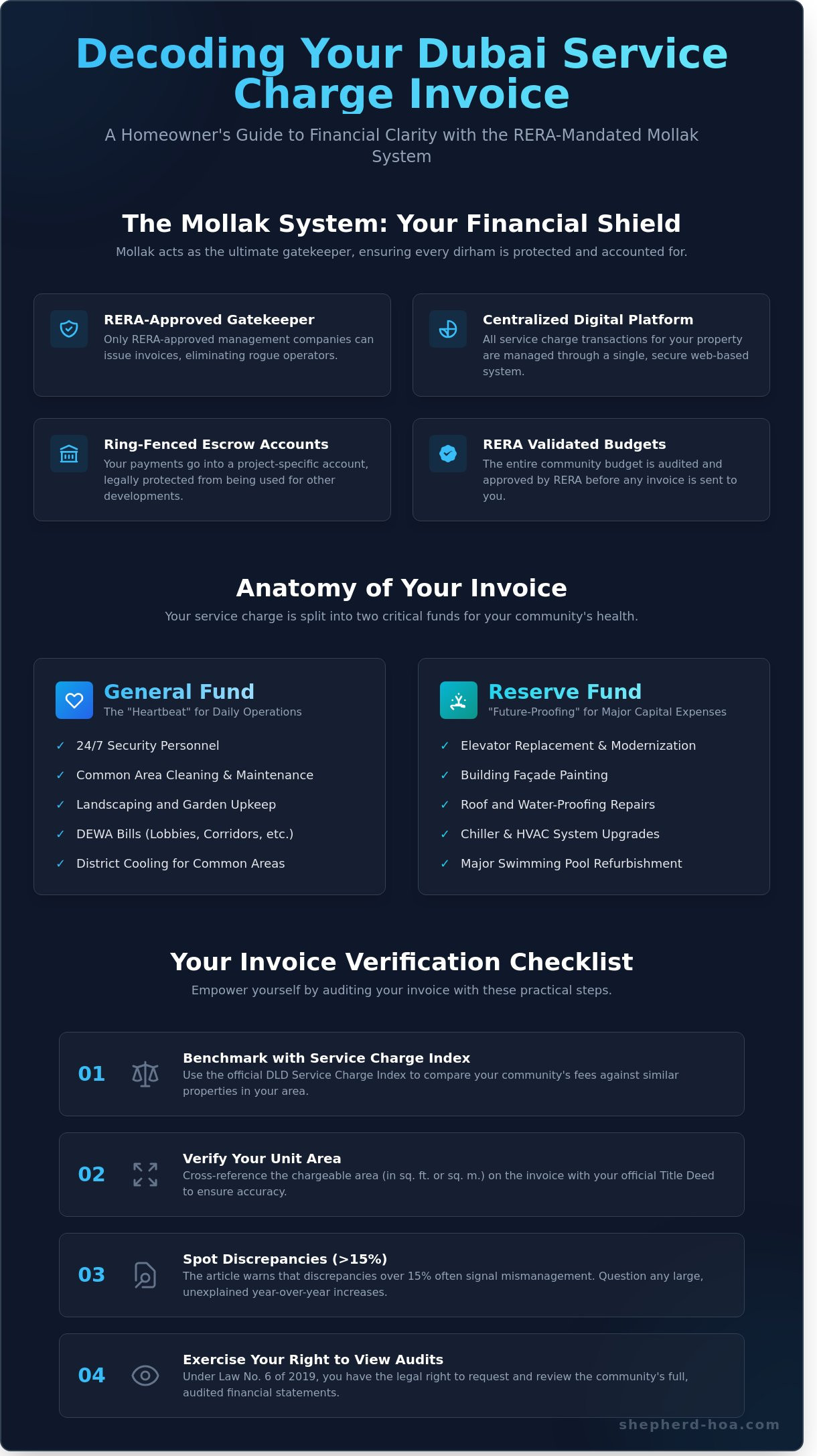
Mollak is the centralized, web-based system designed by the Dubai Land Department. It acts as the ultimate gatekeeper for all service charge transactions in the emirate. For a management company to issue an invoice, they must first be RERA-approved and registered on this platform. This requirement eliminates the risk of "fly-by-night" operators managing your community's wealth. When you're understanding your service charge invoice dubai, remember that the Mollak system has already validated the budget before the bill reaches your inbox.
This system ensures your payments don't disappear into a general corporate account. Instead, the money goes into a project-specific escrow account. These funds are ring-fenced, meaning they're used only for your specific building or gated community. It prevents developers from using one project's surplus to cover another project's deficit. This level of granular control is a major reason why Dubai's real estate sector has gained such high international investor confidence.
The Legal Foundation: Law No. 6 of 2019
Law No. 6 of 2019, commonly known as the Jointly Owned Property (JOP) Law, provides the legal teeth for owner rights. This legislation ended the era of developer-controlled monopolies over service fees. It established that owners have a fundamental right to view audited financial statements of their community. If you see a charge for AED 10,000 for "general maintenance," you have the legal standing to demand a specific breakdown of those costs.
This law also introduced the concept of the Service Charge Index. This tool allows owners to compare their fees against similar properties in the same area. It ensures that "hidden fees" are a thing of the past. If a management company wants to increase fees, they must provide a valid, audited reason that complies with RERA's strict benchmarks. This protects you from arbitrary price hikes that could impact your rental yield or personal budget.
Clear invoicing is more than just a administrative task. It's a financial safeguard. When a community is managed with clear oversight, the risk of "special assessments" or sudden emergency repairs decreases significantly. Understanding your service charge invoice dubai is the first step in ensuring your community remains a premium asset. Transparent finances lead to better-maintained facilities, which attracts higher-quality tenants and ensures your investment continues to grow in value over the coming decades.
A Line-by-Line Breakdown: Decoding Your Mollak Invoice Items
Your invoice from the Mollak system is a standardized document designed by the Dubai Land Department (DLD) to ensure transparency and accountability. Every dirham you pay is allocated to a specific category, preventing the commingling of funds and protecting your investment. Understanding your service charge invoice dubai requires a close look at how these funds are split between immediate needs and future security.
The invoice typically begins with the General Fund. This portion of your payment covers the "heartbeat" of the community. It funds the daily operations that keep the property functional and attractive. You'll see costs for 24/7 security personnel, professional cleaning crews for lobbies and hallways, and the upkeep of landscaped gardens. It also covers the DEWA bills for common area lighting and the energy costs for district cooling systems provided by companies like Empower or Emicool. RERA monitors these costs through the official Service Charge Index to ensure they remain within market norms.
Beyond daily operations, your invoice includes administrative and compliance costs. These include management fees paid to the licensed property management company and the costs of mandatory audits. Since 2018, a 5% Value Added Tax (VAT) applies to service charges in the UAE. This tax is a standard government levy and is clearly displayed as a separate line item on your Mollak statement. If you're looking for a way to simplify the oversight of these complex financial layers, Shepherd HOA offers intuitive tools that help board members track every dirham with ease.
The General Fund vs. The Reserve Fund
The General Fund handles the "now," focusing on minor maintenance like fixing a leaky pipe in the gym or replacing a broken light fixture in the parking garage. In contrast, the Reserve Fund is your community's long-term financial safety net. The Reserve Fund acts as a 10-year capital expenditure plan designed to ensure the building's structural integrity remains intact without sudden, massive levies on owners. This money is set aside specifically for high-ticket items that inevitably wear out over time, such as:
Modernizing or replacing elevator cabins and motors.
Full roof waterproofing and structural repairs.
Repainting or refurbishing the building's facade.
Replacing central chiller units or major MEP (Mechanical, Electrical, and Plumbing) infrastructure.
Facilities Management and Service Provider Costs
Your invoice often distinguishes between the "Building" fee and the "Master Community" fee. The building fee stays within your specific tower to cover its unique needs. The Master Community fee is paid to the master developer, such as Emaar or Nakheel, to maintain shared infrastructure like main access roads, street lighting, and community parks that sit outside your plot boundary. Third-party contracts for security and MEP services are reflected here, with costs often determined by the size and complexity of your building's amenities. A community with three temperature-controlled swimming pools and a 2,000-square-foot gym will naturally see higher service provider costs than a boutique building with minimal facilities. These amenities add value to your property, but they require consistent financial input to meet the high standards expected in Dubai's real estate market.
The Role of RERA and the Service Charge Index in Cost Control
RERA acts as the primary guardian of your property's financial health. It ensures that management companies don't set arbitrary fees. Instead, every dirham listed on your bill reflects a regulated price point. Understanding your service charge invoice dubai is easier when you realize that RERA calculates a fair price per square foot for every specific community. This calculation relies on 2024 market data and the actual operational costs of your building's facilities. This prevents price gouging and ensures that maintenance remains affordable for every homeowner.
The Dubai Land Department mandates a rigorous audit process before any invoice reaches your inbox. A certified third-party auditor must verify 100% of the previous year's expenses and the proposed budget. This oversight ensures that your money is spent only on essential services and community improvements. This audit is not a mere suggestion; it's a legal requirement that protects your fiduciary interests. Once the audit is complete and RERA approves the budget, your invoice receives the Mollak Approval stamp. This digital seal is your guarantee that the charges are legal, accurate, and fully compliant with UAE law. It provides the peace of mind that your investment is being managed with total integrity.
How to Use the Service Charge Index Tool
You can verify your rates by visiting the Dubai Land Department's Service Charge Index portal. This tool is a vital resource for transparency. First, select your area and project name to see the approved price range. Second, identify your "Usage" type. Residential units often have lower rates than Commercial or Retail spaces because they demand different levels of security and cleaning. If your invoice rate exceeds the RERA-approved index by even 1%, you have the right to request a formal clarification from your management team. This tool empowers you to benchmark your costs against the wider market, ensuring you never pay more than the fair market value.
Budget Approval and the Owners Committee
The Owners Committee serves as the community's internal watchman. They review every contract and service agreement before the annual budget is finalized. Shepherd HOA acts as a steady partner for these committees, providing transparent data to help them navigate the ethical tendering of services. This partnership ensures that vendors are chosen based on value and quality rather than just price. The final step in this cycle is the issuance of a No-Objection Certificate (NOC). Without this document, the budget cannot be uploaded to the Mollak system. This process provides a final layer of protection for your investment, ensuring that every expense is justified and every service is necessary for the preservation of property values. We believe that an informed committee is the backbone of a harmonious community, and our tools are designed to make this oversight process seamless and stress-free.
By maintaining this structured approach to financial management, communities can avoid the common pitfalls of administrative chaos. A well-regulated budget doesn't just keep costs down; it preserves the long-term viability of the building's infrastructure. When you see the Mollak stamp on your invoice, you're seeing the result of months of careful planning, auditing, and government oversight. It's a system designed to protect you, the homeowner, from the complexities of community management while ensuring your neighborhood continues to thrive for years to come.
How to Verify Your Invoice Accuracy and Manage Payment Disputes
Ensuring the financial health of your investment starts with understanding your service charge invoice dubai. Accuracy isn't just about the total AED amount; it's about verifying every line item against official records. Errors can creep into even the most automated systems, so a manual review is your first line of defense. Follow these five steps to ensure your invoice is correct.
First, cross-reference the square footage on your invoice with your official Title Deed. Management companies sometimes use gross area instead of the net area registered with the Dubai Land Department. If there's even a 10 sq. ft. discrepancy, it can cost you hundreds of dirhams every year. Second, scrutinize the "Service Year" listed on the document. Double-billing often occurs during ownership transfers where the billing cycle isn't properly prorated between the seller and the buyer. Always check that the start and end dates align with your period of ownership.
Third, use the Dubai REST App. This platform provides access to the Mollak system, where you can verify if the service charge rate has been approved by RERA for the current year. If the invoice rate is higher than the Mollak approved rate, you have grounds for a dispute. Fourth, reach out to your Community Management company in writing. Most errors are administrative and can be resolved through a simple clarification request. Finally, if the management company fails to rectify a clear error within 15 days, escalate the matter to the Rental Dispute Centre (RDC). The RDC provides a formal legal framework to resolve these issues under Law No. 6 of 2019, ensuring that owners aren't held hostage by incorrect billing.
Common Invoice Errors to Watch For
Watch for balcony and terrace calculations. In many Dubai master communities, balcony areas are charged at a reduced pro-rata rate, often 25% to 50% of the internal living space rate. If you're being charged the full rate for your balcony, your invoice is incorrect. Additionally, check for late payment penalties. Under RERA regulations, penalties can't be applied arbitrarily. There's usually a 30-day grace period before any interest is charged. In chiller-free buildings, ensure utility charges match your actual consumption meter readings rather than a flat-rate estimate that ignores your actual usage.
The Consequences of Non-Payment
Ignoring a service charge invoice leads to severe legal and financial hurdles. Once a payment is overdue, the management company issues a formal 30-day legal notice. If the balance remains unpaid after this period, the case is referred to RERA for enforcement. The most immediate impact is a block on your property transactions. You won't be able to obtain a No Objection Certificate (NOC) for a sale, and you'll be prevented from registering or renewing Ejari for tenants. On a community level, high arrears lead to a 20% reduction in maintenance budgets, which directly impacts the quality of security, pool maintenance, and general cleaning. This neglect eventually erodes your property's market value.
Maintaining transparency in your community starts with expert oversight. Discover how we help boards manage these complexities at
.
Protecting Your Investment: How Shepherd HOA Ensures Financial Integrity
Shepherd HomeOwners' Association adopts a "Guardian" approach to community management, treating every dirham of your service charge as a vital investment in your property's future. We move beyond simple bookkeeping by implementing rigorous budget planning that begins 90 days before the fiscal year starts. This proactive oversight ensures that 100% of community funds align with actual operational needs and RERA guidelines. By understanding your service charge invoice dubai, you can see how this meticulous planning prevents the sudden, unexpected "special levies" that often stress homeowners in less organized communities.
Ethical tendering is a cornerstone of our financial strategy. We don't simply renew existing contracts; we vet multiple service providers to ensure the community receives the best value for every dirham. For a typical residential tower in Dubai Marina, our competitive bidding process can reduce facility management costs by 12% to 18% without sacrificing quality. This transparent approach ensures that your money supports high-quality vendors who are held accountable through strict Key Performance Indicators (KPIs).
Transparency shouldn't be a once-a-year event. While many management companies provide a single annual statement, Shepherd HomeOwners' Association offers real-time financial visibility. Our digital platforms allow for continuous tracking of expenses against the approved budget. This level of detail is essential for understanding your service charge invoice dubai and seeing how funds are distributed across utilities, insurance, and maintenance. When owners can see the financial health of their community at any time, it builds a foundation of trust and stability.
Professional management also focuses on reducing long-term costs through preventative maintenance. For example, regular quarterly servicing of chiller plants can extend the equipment's lifespan by 5 to 7 years. This saves the community millions of AED in premature replacement costs. We view the service charge as a tool for asset preservation, ensuring that your home remains a valuable, high-performing asset for decades to come.
Why Professional Governance Matters
There is a massive difference between merely collecting fees and strategically managing assets. Shepherd HomeOwners' Association acts as the invisible backbone of community harmony by ensuring every financial move is RERA-compliant and fully audited. Our team handles the complex fiduciary duties and CC&R requirements, providing homeowners with the peace of mind that their community is legally and financially secure. This professional oversight keeps property values high and administrative headaches low.
Next Steps for Homeowners
Homeowners have the right to be informed. You can request a formal budget review or a copy of the latest financial audit to see exactly how your community is performing. We also encourage residents to join their Owners Committee, providing a direct voice in how funds are allocated and managed. Taking an active role in governance ensures your community reflects your standards. Discover how Shepherd HomeOwners' Association can bring transparency to your community and help you take control of your property's financial future.
Take Control of Your Community’s Financial Health
Mastering the details of your Mollak statement ensures your property remains a viable asset. It's about clarity. By 2026, RERA regulations have made transparency the mandatory standard, allowing every homeowner to track exactly how their AED contributions are spent. Understanding your service charge invoice dubai doesn't have to be a source of stress; it's a vital tool for protecting your long-term equity. When you verify line items against the RERA Service Charge Index, you ensure your building's maintenance funds stay within legal limits.
Shepherd HOA has provided RERA-approved management since 2010, specializing in the nuances of Dubai Strata Law and Mollak system compliance. We act as a steady guide for board members, replacing administrative confusion with ethical governance and clear oversight. Our team focuses on preserving property values through meticulous financial integrity and professional guidance. You can rely on our expertise to handle the complexities of fiduciary duties while you enjoy the benefits of a well-maintained home.
Secure your community's financial future with Shepherd HOA. Your peace of mind is the foundation of a thriving neighborhood.
Frequently Asked Questions
What happens if I don't pay my service charges in Dubai?
Failure to pay results in a formal legal notice through the Dubai Land Department giving you 30 days to settle the debt. If you don't pay within this window, the management company can file a case with the Rental Dispute Center. This process often leads to a travel ban or the forced auction of the property to recover the funds. You'll also face a 1% monthly late fee as stipulated by RERA regulations to ensure community financial stability.
Can my developer increase service charges without RERA approval?
No developer or management company can increase fees without prior approval from RERA via the Mollak system. Every budget must undergo a third-party audit by a RERA-approved firm before it's uploaded for final verification. This ensures transparency and protects your property value from arbitrary hikes. If you see an increase, it means RERA verified the 100% necessity of those funds for essential community maintenance and operations after reviewing the audit reports.
Is the service charge calculated on the total area or just the suite area?
Service charges apply to the total area of your unit as specified on your Title Deed issued by the Dubai Land Department. This includes both the internal suite area and external spaces like balconies or private terraces. Understanding your service charge invoice dubai requires checking your exact square footage against the RERA-approved rate per square foot. For example, a 1,200 sq. ft. apartment at a rate of AED 18 per sq. ft. results in a yearly fee of AED 21,600.
How often are service charges updated in the Mollak system?
Service charges are reviewed and updated annually to reflect the current operating costs of the building. Management companies must submit their proposed budgets for the upcoming 12 months through the Mollak system for RERA's review every year. Once approved, the system generates the official invoices for the owners. This annual cycle ensures that the community has sufficient funds to cover 365 days of maintenance, security, and cleaning services without running a deficit.
Do I have to pay service charges if the building amenities are closed for repair?
You must continue paying your service charges even if specific amenities like the gym or pool are closed for essential repairs. These fees fund the long-term upkeep and safety of the entire structure, not just daily access to specific perks. Law No. (6) of 2019 doesn't allow for a pro-rata deduction of fees due to temporary maintenance closures. Consistent payments ensure the management team has the AED 75,000 or AED 150,000 needed to complete those repairs quickly.
What is the 'Chiller Charge' and is it part of the service fee?
A chiller charge covers the cost of the air conditioning system's energy and water consumption. In many buildings, this is a separate bill from providers like Empower or Emicool, while in others, it's a line item within your service fee. If it's included in your service charge, the rate is based on the building's total cooling load. Understanding your service charge invoice dubai helps you identify if you're paying for chiller-free living or a metered cooling service.
How can I check if my community management company is RERA-approved?
You can verify any management company's status through the Dubai REST app or the official Dubai Land Department website. Every licensed manager must hold a valid RERA registration number and appear in the Mollak system to issue invoices legally. Currently, there are over 100 registered management firms in Dubai. Checking this ensures your community is guided by a professional entity that adheres to the strict fiduciary duties and ethical standards required by UAE law.
What is the difference between a general fund and a sinking fund?
The general fund covers daily operational expenses like the AED 10,000 monthly cleaning contract or staff salaries. The sinking fund is a separate reserve designated for major long-term capital expenditures, such as replacing elevators or repainting the building facade every 10 years. RERA requires this reserve to ensure the building remains financially stable for decades. It protects owners from sudden, massive special levies when an expensive piece of equipment fails unexpectedly and needs replacement.


Comments