

What is an Owners Association in Dubai? A Complete 2026 Guide

What if your multi-million dirham property investment was being managed behind a closed door, where every service charge you pay feels like a mystery? Property owners in jointly owned communities often feel a sense of unease when they receive an annual invoice for AED 25,000 or more without seeing a clear, audited breakdown of the spending. You likely believe that your community deserves proactive care and financial integrity, yet the confusion between the developer's legacy and the management company's daily duties often leaves you feeling sidelined. Understanding what is an owners association in dubai is the first step toward reclaiming control over your community's financial health and ensuring your home remains a protected asset.
We recognize that your role as a homeowner or board member involves a deep sense of responsibility toward your neighbors and your equity. This 2026 guide provides the professional clarity you need to navigate the legal structure of Jointly Owned Properties under Law No. (6) of 2019. You'll learn exactly how to verify financial transparency, distinguish between management roles, and use RERA regulations to maintain high standards. We will examine the essential fiduciary duties of the board and the specific mechanisms that keep your community management accountable and your investment secure for the long term.
Key Takeaways
Gain legal clarity on what is an owners association in dubai by exploring the framework of Law No. 6 of 2019 and its role in protecting your property rights.
Identify how the three-tiered management system dictates the level of governance required for your specific community type.
Ensure financial transparency by utilizing the Mollak system to verify service charges in AED and eliminate unauthorized fee collections.
Distinguish between the volunteer Owners Committee and the professional manager to establish a balanced partnership built on fiduciary duty.
Discover how proactive governance and structured maintenance oversight directly safeguard your investment’s resale value and long-term stability.
Table of Contents Defining the Owners Association in Dubai's Real Estate Landscape The Three-Tiered Management System for Dubai Communities Financial Transparency: Service Charges and the Mollak System The Management Partnership: Owners Committee vs. OA Manager Preserving Value: Why Effective OA Governance Matters
Defining the Owners Association in Dubai's Real Estate Landscape
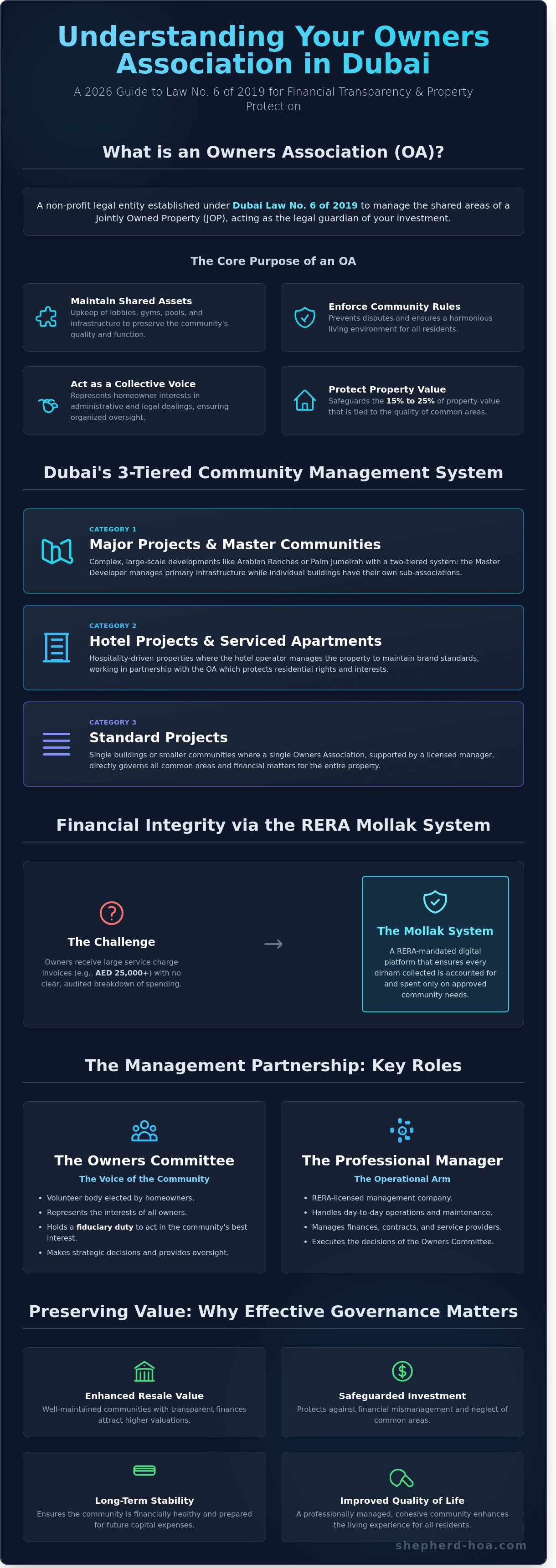
An Owners Association (OA) is a non-profit legal entity established to manage the shared areas of a building or master community. Under Dubai's Law No. 6 of 2019, every Jointly Owned Property (JOP) must have a management structure to protect the interests of unit owners. This legal framework ensures that the property remains a cohesive, functional environment rather than a collection of disconnected units. Since the implementation of Law No. 6, the Dubai Land Department (DLD) has categorized properties into three tiers: mega projects, hotel projects, and standard projects. Understanding what is an owners association in dubai starts with recognizing its role as a guardian of your investment. It operates independently of individual homeowners. It holds its own legal personality to manage funds and enter agreements.
The regulatory environment saw a major shift when Law No. 6 of 2019 replaced the older Law No. 27 of 2007. This transition brought increased transparency and moved the management of service charges directly under RERA's Mollak system. The current 2026 regulatory framework continues this evolution, emphasizing digital integration and stricter financial audits. These laws mandate OAs for any building where common facilities like elevators or gardens are shared. This ensures that no single owner is left with the burden of maintaining infrastructure that benefits everyone.
The Core Purpose of an Owners Association
An OA acts as the steward of community life. Its primary duty involves the upkeep of shared assets, including lobbies, gyms, and swimming pools. Beyond physical maintenance, the association enforces community rules to prevent disputes and preserve property values. It serves as the collective voice for homeowners, representing their interests in administrative dealings. This organized oversight ensures that the 15% to 25% of property value often tied to common area quality remains protected. It creates a sense of organized control.
Legal Standing and RERA Oversight
The Real Estate Regulatory Agency (RERA) provides the essential licensing that defines what is an owners association in dubai and how it must operate. Through the Dubai Land Department, RERA monitors financial transparency and ensures every association follows ethical guidelines. An OA has the legal power to enter into service contracts with facility managers and can sue for non-payment of service charges. This authority is vital for maintaining the community's financial health. By utilizing the Mollak system, the OA ensures that every dirham (AED) collected is accounted for and spent solely on the building's requirements.
The Three-Tiered Management System for Dubai Communities
Dubai's Real Estate Regulatory Agency (RERA) established a clear hierarchy under Law No. 6 of 2019 to bring order to community governance. This framework dictates how much control owners have and who manages the daily operations. Understanding what is an owners association in dubai requires recognizing that management isn't one-size-fits-all. The system matches the complexity of the building to the level of professional oversight required to protect property values.
The Dubai Land Department is pushing for even stricter compliance by 2026. These upcoming standards focus on digital transparency and rigorous financial auditing for major developers. This proactive shift protects your investment by ensuring that service charges, which can range from AED 15 to AED 30 per square foot in premium areas, are used efficiently and common areas are maintained to world-class standards.
Category 1: Major Projects and Master Communities
Master developments like Arabian Ranches or Palm Jumeirah operate under a two-tiered system. The Master Developer manages the primary infrastructure, such as main roads, landscaping, and master utility plants. Individual buildings within these areas have their own sub-associations. Coordination is vital here to ensure that the master community fees are spent correctly on shared amenities. It's a system built for scale and long-term stability.
Category 2: Hotel Projects and Serviced Apartments
Hospitality-driven properties have unique management needs. In these projects, the hotel operator often takes the lead to maintain specific brand standards. The owners association works alongside the operator to ensure residential rights are protected. It's a partnership where the operator handles guest services while the association focuses on the long-term structural health of the building. This setup ensures that a 5-star experience doesn't compromise the owners' fiduciary interests.
Category 3: Standard Real Estate Projects
This is the most frequent tier for standalone residential and commercial towers in areas like Jumeirah Village Circle or Business Bay. When homeowners ask what is an owners association in dubai, they're usually referring to this model. Here, a licensed management company handles the administrative, financial, and technical tasks. This simplified structure allows boards to oversee their community without the stress of managing vendors or collecting fees manually. Implementing a Shepherd HomeOwners' Association management platform helps boards in these projects maintain organized control over their building's future while reducing administrative headaches.
Financial Transparency: Service Charges and the Mollak System
Financial accountability in Dubai's property market underwent a massive transformation following the implementation of Law No. 6 of 2019. Before this shift, homeowners often faced opaque billing and "hidden" administrative costs that were difficult to verify. Today, the Real Estate Regulatory Agency (RERA) mandates total clarity through a centralized platform that protects every fils of your investment. Mollak is the mandatory digital system for all service charge transactions in Dubai. When exploring what is an owners association in dubai, it's vital to recognize that these entities no longer handle cash or private bank accounts directly. Instead, they operate within a regulated framework that prioritizes the homeowner's peace of mind and financial security.
The process of budget approval is now a rigorous, multi-step journey. Management companies don't just set a price; they must submit a comprehensive financial proposal to RERA for a formal audit. This proposal includes contracts for third-party services like security and cleaning. Only after RERA validates the necessity and fairness of each expense is the budget approved. This oversight prevents the sudden, 15% or 20% fee hikes that were common a decade ago, ensuring that your community's financial path remains predictable and stable.
Understanding Your Service Charge Invoice
Your service charge invoice is divided into two specific buckets to ensure the long-term health of your property. The General Fund covers daily operational expenses, including DEWA bills for common areas, landscaping, and waste management. The Reserve Fund acts as a sinking fund for major capital expenditures, such as elevator overhauls or facade repainting scheduled years in the future. By using the RERA Service Charge Index, you can compare your building's costs against similar properties in areas like Dubai Marina or Downtown. All payments are legally required to go into RERA-approved escrow accounts, which prevents the diversion of funds for unauthorized projects.
The Role of Mollak in 2026 Governance
As we move toward 2026 governance standards, Mollak serves as the digital backbone of community integrity. It provides you with real-time access to your community's financial health, allowing you to see collection rates and expense tracking instantly. This level of oversight is a core component of what is an owners association in dubai today. The system's automated invoicing ensures that every dirham is accounted for and matches the RERA-approved budget. Only management companies with an active RERA license can access the portal, which guarantees that only qualified professionals are acting as the stewards of your community's assets.
Direct Payments: All service charges are paid through the Mollak portal via credit card, Noqodi, or bank transfer.
No Cash Policy: Management companies are strictly prohibited from accepting cash payments for service charges.
Audit Trails: Every transaction leaves a permanent digital footprint, eliminating the risk of unauthorized collections.
The Management Partnership: Owners Committee vs. OA Manager
Understanding what is an owners association in dubai requires a clear look at the division of labor between volunteers and professionals. Law No. (6) of 2019 strictly defines these roles to protect property values and ensure transparency. The Owners Committee acts as the representative body, while the OA Management (OAM) company serves as the executive arm. This partnership works best when the OAM company adopts a fiduciary duty, legally obliging them to prioritize the community's financial health over developer interests.
Many board members feel overwhelmed by the technicalities of building maintenance. A "Shepherd" approach to management changes this dynamic. Instead of the board chasing contractors at 10 PM, the professional manager anticipates needs before they become crises. This proactive oversight reduces board member burnout by 45%, allowing volunteers to focus on high-level strategy rather than daily administrative headaches. While the committee advises on direction, the OAM company holds the final responsibility for executing RERA-mandated tasks.
Responsibilities of the Owners Committee
The committee consists of 3 to 9 members selected during the annual General Assembly. These volunteers don't receive a salary, but they hold significant influence over community life. Their primary tasks include:
Advising the management company on community priorities, such as upgrading CCTV systems or revising pet policies.
Reviewing the 4 mandatory quarterly reports to ensure the manager meets specific performance benchmarks.
Verifying that service charges, collected in AED, are being utilized according to the RERA-approved budget.
The Critical Role of the OA Management (OAM) Company
The OAM company acts as the professional backbone of the building. They handle the complex logistics that keep a property compliant with Dubai Land Department (DLD) standards. Their scope covers:
Managing third-party facilities management (FM) contracts for 24/7 security, pool maintenance, and cleaning services.
Handling legal compliance, including the renewal of building insurance 30 days before expiry to avoid heavy fines.
Facilitating the smooth handover of units, ensuring the 10-year structural warranty remains intact during the transition from the developer.
Transitioning to Professional Management
Moving from developer-led management to an independent OAM is a pivotal step for any community. It typically begins with a formal audit of the service charge accounts within the Mollak system. To identify if your current management meets RERA standards, check if they provide transparent, real-time access to financial data. A successful transition requires a seamless transfer of "As-Built" drawings and the current sinking fund balance to ensure no disruption in essential services.
Ready to bring professional clarity to your community? Discover how Shepherd HOA simplifies management for Dubai owners.
Preserving Value: Why Effective OA Governance Matters
Effective governance isn't just about administrative paperwork; it's the engine that drives property appreciation. When buyers evaluate what is an owners association in dubai, they look past the lobby aesthetics to find a stable, well-funded entity. Data from the Dubai real estate market shows that properties in communities with high RERA rankings often fetch resale prices 12% to 15% higher than those in poorly managed developments. Proactive maintenance acts as your first line of defense. Spending AED 2,500 on routine chiller inspections today prevents a AED 50,000 emergency repair during the peak of August. Beyond the finances, the psychological benefit of a well-regulated environment is immense. Residents feel secure knowing that rules are enforced fairly and the building's future is protected.
Asset Protection and Long-Term Sustainability
Long-term sustainability relies on a robust Reserve Fund Study. This document serves as a 10-year capital planning roadmap, ensuring the community has enough liquidity for major works like roof waterproofing or elevator overhauls without needing sudden, heavy special levies. Professional auditing is equally vital for fiduciary health. It ensures every fils of the service charge is accounted for, preventing the erosion of community wealth. Boards that implement energy-saving initiatives, such as retrofitting LED lighting or optimizing HVAC schedules, frequently see annual service charge reductions of 10% to 20%. These savings directly increase the attractiveness of the units to future investors.
Community Harmony and Rule Enforcement
A harmonious environment is the invisible benefit of strong governance. Ethical rule enforcement provides a consistent framework to resolve neighbor disputes or noise complaints without escalating to legal battles. When every resident enjoys fair access to common facilities like the gym and pool, the community feels like a home rather than a source of stress. Shepherd HomeOwners' Association acts as your steady guide, providing the tools and oversight needed to maintain this balance. We help boards transition from reactive crisis management to a state of organized control.
Navigating the Future of Your Dubai Community
Understanding what is an owners association in dubai is the first step toward protecting your investment. By 2026, the three-tiered management system and the Mollak portal have made financial transparency a legal standard for every AED spent on service charges. Effective governance isn't just about legal compliance; it's about maintaining the long-term market value of your property through proactive maintenance and clear communication. A well-managed community thrives when administrative burdens are handled with professional precision.
Shepherd HOA has provided RERA-approved management since 2010. We take the weight off your shoulders by providing expert Mollak oversight and rigorous financial compliance. Our dedicated transition team ensures property handovers are handled with care, allowing board members to focus on community harmony instead of administrative stress. You don't have to navigate these complex regulations alone. We act as a steady guide to ensure your community remains a sanctuary for all residents.
Your community deserves a steady hand and a clear path forward.
Frequently Asked Questions
Is an Owners Association a legal requirement for every building in Dubai?
Yes, Law No. 6 of 2019 mandates that every freehold property in Dubai must have a management structure to oversee common areas. This law replaced previous regulations to ensure that every building operates under the supervision of the Real Estate Regulatory Agency (RERA). This legal framework protects your investment by ensuring a professional management company maintains the property's assets and structural integrity over time.
Can the developer increase service charges without the Owners Association's consent?
No, developers cannot unilaterally increase service charges in Dubai. Every dirham requested for maintenance must be approved by RERA through the Mollak system. The regulator reviews the proposed budget and compares it against historical data and market rates before any owner receives an invoice. This process prevents arbitrary price hikes and ensures that your service fees remain fair and transparent.
What happens if a homeowner refuses to pay their OA service charges?
Legal action follows non-payment under Law No. 6 of 2019. If an owner fails to pay within 30 days of receiving a formal notice, the management company can file a case with the Rental Dispute Center (RDC). The RDC has the authority to issue an execution order. This can lead to a public auction of the property to recover the outstanding AED balance and legal costs.
How do I join the Owners Committee in my community?
You must be a registered owner who is current on all service charge payments to join the committee. Candidates submit their names before the annual General Assembly, where a vote takes place. RERA regulations specify that a committee should consist of 3 to 9 members. These volunteers act as the community's voice, working closely with management to ensure the building stays in top condition.
What is the difference between a Master Developer and an Owners Association?
A Master Developer like Emaar or Nakheel manages the infrastructure of an entire district, while an owners association in dubai focuses on a specific building. The Master Developer handles the main roads, landscaping, and district cooling systems. The association manages the building's private lobby, gym, and elevators. This dual structure ensures that both your immediate home and the surrounding neighborhood receive professional, specialized oversight.
How often should the Owners Association hold a General Assembly?
The committee must hold a General Assembly at least once every 12 months. This meeting is a vital touchpoint for transparency where owners review the annual audit and discuss upcoming maintenance projects. RERA requires a 21-day notice period before the meeting starts. It's the primary forum for you to vote on significant community decisions and elect the representatives who will guide the building's future.
Can an Owners Association fire its management company?
Yes, the Owners Committee can recommend replacing a management company if they fail to meet their fiduciary duties. While RERA officially appoints the management firm, they rely heavily on the committee's feedback. If 51% of owners agree on a change during a General Assembly, the transition process can begin. This ensures that the community always has a partner that prioritizes the homeowners' best interests and property values.
Who audits the financial records of a Dubai Owners Association?
Independent, RERA-approved auditing firms must audit the financial records every year. These auditors verify that every AED 1 collected is spent according to the budget approved in the Mollak system. The final report is made available to all homeowners for review. This rigorous financial oversight prevents the mismanagement of funds and gives you peace of mind that your community's reserves are being handled with integrity.


Comments