
What to Look for in a Community Management Contract: A 2026 Guide
- Sohrab Virani

- May 14
- 13 min read
What if the document designed to protect your community is actually the very thing leaving it vulnerable to million-dirham fines? It's exhausting to shoulder the weight of governance while trying to determine what to look for in a community management contract in a shifting regulatory landscape. You want to focus on social harmony and asset growth, yet you're often buried under operational stress and the fear of hidden fees. We understand that the volunteer nature of this work carries high personal stakes and requires a reliable, expert partner to act as a steady guide.
Identifying the right safeguards is the first step toward reclaiming your peace of mind and ensuring your property's value is preserved. This guide provides a transparent roadmap of duties and legal protections. You'll learn how to spot critical clauses and regulatory requirements, such as the mandatory Mollak budget approvals effective as of April 2, 2026, that transform a standard agreement into a protective shield. We'll explore the essential components of financial oversight and legal compliance that every board member needs to know to maintain long-term stability and professional integrity.
Key Takeaways
Understand how a robust agreement acts as a protective shield for your community, replacing administrative stress with organized control.
Identify what to look for in a community management contract regarding the clear distinction between daily administrative tasks and the board's decision-making authority.
Learn why full integration with the Mollak system is essential for transparent service charge collection and the preservation of your community’s financial health.
Discover how to navigate contract durations and avoid common auto-renewal traps to ensure your association maintains its legal and operational flexibility.
Ensure long-term stability by verifying that your management partner meets all current RERA licensing requirements and regulatory standards for 2026.
Table of Contents
The Management Agreement as a Guardian of Community Interests
A community management contract is the legal backbone of your community's governance. It serves as the primary agreement between the board of a homeowner association and the professional firm tasked with its oversight. When you're deciding what to look for in a community management contract, it's vital to view the document as more than a simple service list. It is a framework for organized control. A well-structured agreement replaces the daily operational stress of volunteer board members with a sense of reliable management. It clarifies expectations and ensures that every administrative duty is performed with precision and accountability.
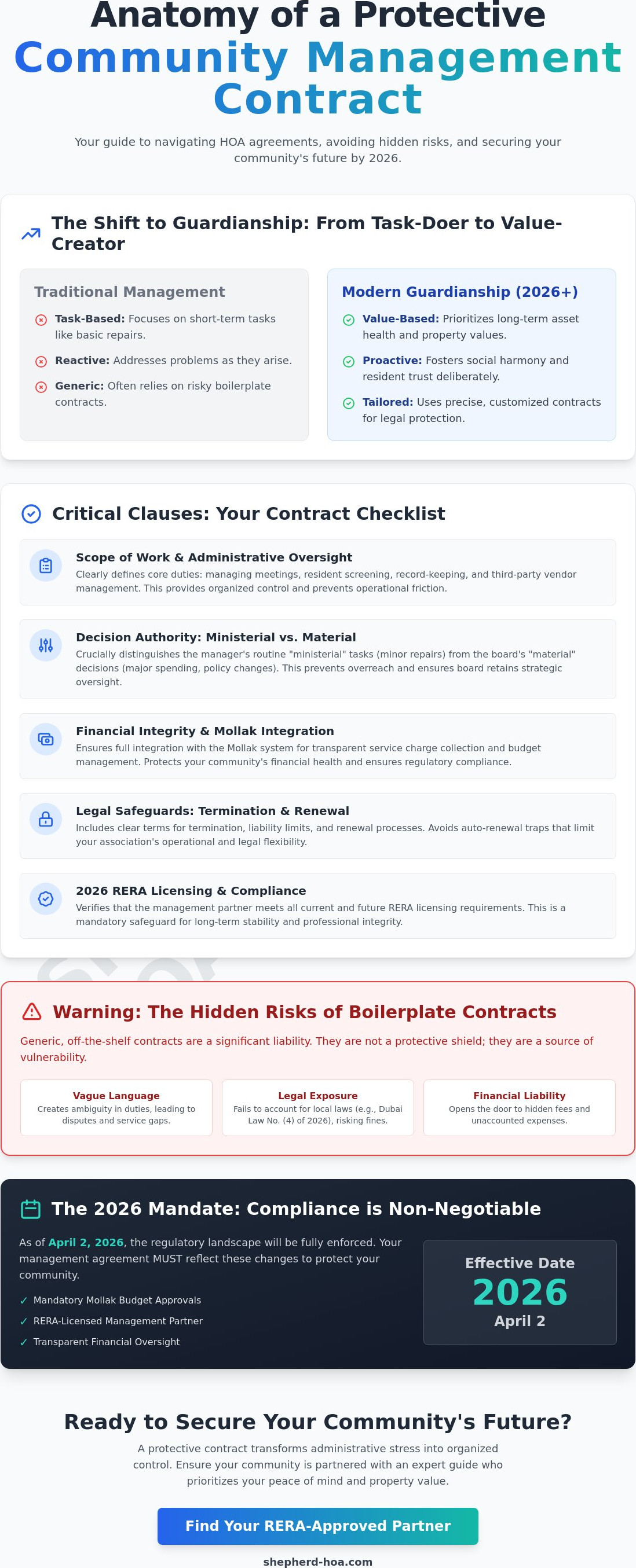
By 2026, the industry has shifted from task-based management to value-based guardianship. Traditional contracts focused on short-term tasks like basic repairs or janitorial schedules. Modern agreements prioritize the long-term health of the asset and the social harmony of the residents. This shift ensures that the manager's goals align with the board's duty to protect property values and foster a peaceful living environment. Social harmony isn't an accidental byproduct of good management; it's a deliberate contract goal. When a manager handles disputes with transparency and follows a clear set of rules, resident trust increases, creating a stable environment for everyone.
Why a Generic Boilerplate Contract is a Risk
Standard boilerplate contracts often present a significant risk to your community. These generic forms frequently use vague language that fails to account for specific local regulatory nuances, such as the strict occupancy limits and permit requirements introduced by Dubai's Law No. (4) of 2026. Without a detailed roadmap that mirrors your community's unique needs, you leave the association open to legal disputes and financial liability. A protective contract must be precise, leaving no room for ambiguity in administrative oversight or regulatory compliance. When determining what to look for in a community management contract, look for tailored clauses that address your specific asset type and local legal obligations.
The Metaphor of Guardianship in 2026 Management
The management company acts as a steady guide through the maze of modern administrative complexity. Their technical expertise in areas like RERA compliance and financial auditing provides volunteer boards with the peace of mind they deserve. They serve as a watchful guardian of collective interests, ensuring that every decision supports the community's stability. This professional partnership allows the board to focus on high-level strategy while the manager handles the technical mechanisms of daily operations. A Guardianship Charter is a contract that prioritizes the long-term health of the community over short-term tasks.
Essential Clauses for Scope of Work and Administrative Oversight
A well-defined scope of work is the difference between a community that thrives and one that struggles with operational friction. When evaluating what to look for in a community management contract, you must ensure it clearly outlines core administrative duties. These include coordinating annual general meetings, managing resident screening processes, and maintaining meticulous records. By codifying these tasks, the agreement transforms into a functional manual that provides the board with organized control. Using a comprehensive HOA management contract checklist can help you verify that no essential service is omitted during the negotiation phase.
One of the most critical distinctions in a professional agreement is the separation of "ministerial decisions" from "material decisions." Ministerial decisions are routine, day-to-day actions the manager takes to keep the property running, such as scheduling minor repairs or responding to resident inquiries. Material decisions involve significant financial commitments or policy changes that remain the sole authority of the board. This clarity prevents overreach and ensures the board retains strategic oversight. Additionally, the contract should specify how the manager handles third-party service providers like security and cleaning crews. This oversight must include ethical tendering processes to ensure the community receives the best value without conflicts of interest. If you're feeling overwhelmed by these technicalities, partnering with a dedicated Shepherd HomeOwners' Association expert can provide the steady guidance you need.
Administrative Compliance and Government Approvals
Effective management requires constant interaction with regulatory bodies. The contract must detail the manager's responsibility for obtaining and maintaining government approvals, particularly regarding RERA and Mollak requirements. This includes the coordination of owners committees and ensuring strict adherence to the latest strata laws. For a deeper look at how these regulations impact your governance, refer to our article on Owners Association Management in Dubai: The 2026 Guide to Community Excellence. These clauses ensure your community remains compliant with the legal framework, protecting the board from administrative penalties.
Property Handover and Transition Protocols
The transition phase of a new development is a high-stakes period that requires expert oversight. Your agreement should define the manager's role in unit handovers, including conducting thorough inspections and managing the snagging process. It's vital to include documentation requirements for key collection, utility account setup, and the transfer of warranties from the developer. You can find more detail on these specific requirements in our guide to Mastering Property Handover in Dubai: The Complete 2026 Homeowner’s Guide. Clear protocols during this stage prevent future maintenance headaches and protect the asset's initial value.
Financial Integrity: Mollak Integration and Budget Planning
Financial transparency serves as the primary emotional signature of a trustworthy manager. It's the foundation upon which community trust is built. When you're evaluating what to look for in a community management contract, the financial clauses must offer more than just basic bookkeeping. They should outline a rigorous system of checks and balances that ensures every dirham is accounted for and utilized to enhance the property. A professional agreement acts as a protective shield, replacing the fear of hidden fees with a roadmap of fiscal responsibility. This organized control is essential for volunteer boards who carry the personal stakes of community governance.
A non-negotiable element in modern contracts is the full management of the Mollak system. As of April 2, 2026, all service charge budgets in Dubai must be submitted and approved through Mollak before any invoices can be issued to owners. Your management partner must also be RERA-licensed to access this system, a requirement that became strictly enforced on May 6, 2026. The contract should explicitly state the manager's duty to handle service charge collection and budget submissions through this centralized digital platform. This integration ensures that your community remains compliant with national laws while maintaining a steady cash flow for essential services.
Beyond daily transactions, the agreement must mandate the preparation of detailed quarterly progress reports and comprehensive annual budget planning. A key protective measure is the strict separation of reserve funds and general funds. Reserve funds are the community's safety net, designated for long-term capital expenses like roof replacements or major plant upgrades. General funds cover the immediate operational costs. By clearly defining how these funds are handled, the contract prevents the commingling of assets and ensures the community has the liquidity needed for both today's repairs and tomorrow's improvements.
Transparent Financial Reporting Standards
Modern management systems provide an invisible backbone for financial oversight, allowing boards to monitor community health in real time. The contract should specify the process for securing service charge approvals via national regulatory indices, ensuring that fees remain fair and legally defensible. For a deeper understanding of these requirements, read our guide on Understanding Mollak Dubai: The Complete 2026 Guide to Service Charges and Compliance. These standards ensure that your financial data is always audit-ready and fully transparent.
Strategic Budget Planning for Long-Term Value
The manager's role extends into proactive financial guardianship through strategic forecasting. By accurately predicting maintenance costs, a skilled manager helps the board avoid the operational stress of special levies or sudden fee hikes. This foresight is a critical factor in what to look for in a community management contract because it directly impacts the preservation of asset value. You can learn more about managing these complexities in our article on Mastering the Community Service Charge Budget in Dubai: A 2026 Board Member’s Guide. A steady, expert guide ensures that your community remains financially resilient for years to come.
Legal Safeguards: Termination, Liability, and Renewal
Legal safeguards serve as the armor of your community's governance. They ensure your partnership with a manager remains productive and, if necessary, reversible without operational chaos. Understanding what to look for in a community management contract regarding termination and liability is essential for maintaining long-term stability. Most professional agreements span one to three years, but you must be wary of auto-renewal clauses. These "evergreen" provisions can trap an association into a commitment without a proper performance review. A fair contract should require a proactive renewal notice, giving the board time to evaluate service quality before the next term begins.
You should clearly distinguish between "Termination for Cause" and "Termination for Convenience." The former allows you to end the agreement immediately if the manager breaches their duties or fails to meet regulatory standards. The latter provides flexibility to part ways after a set notice period without needing to prove a fault. This exit strategy is vital for volunteer boards who need to adapt to changing community needs. Additionally, a smooth transition depends on data ownership. Your contract should explicitly state that all digital and physical records belong to the association. This ensures that if you change providers, your community's history and financial data remain intact and accessible.
The 4 Steps to Evaluating Contract Flexibility
A flexible contract allows your community to remain agile and responsive. Follow these four steps to verify your exit strategy:
Step 1: Verify the notice period. A standard timeframe is typically 60 to 90 days, providing enough lead time to find a new partner.
Step 2: Check for "hidden" exit fees. Some contracts include liquidated damages or administrative costs for early termination that can strain your budget.
Step 3: Ensure record ownership. All community data, from resident lists to maintenance logs, must be contractually owned by the association.
Step 4: Confirm the handover timeline. The contract should mandate a specific window, such as 30 days, for the delivery of final financial audits and keys.
If you want to ensure your community is fully protected by a RERA-compliant partner, get in touch with us for a contract consultation.
Indemnification and Insurance Clarity
Indemnification clauses define who is protected when legal disputes arise with residents or vendors. These provisions should protect the board from personal liability as long as they act in good faith and within their fiduciary duties. Conversely, the manager must be held accountable for their own professional negligence or willful misconduct. It's also a non-negotiable requirement for the manager to maintain RERA-compliant professional indemnity insurance. This coverage acts as a financial safety net for the community in the event of management errors. "A robust contract must clearly distinguish between the manager’s operational liability and the board’s fiduciary responsibility." By setting these boundaries, you create a professional environment built on mutual respect and clear accountability.
Securing a RERA-Approved Partner for 2026
Choosing a RERA-approved partner is the final, essential piece of the puzzle. When you're finalizing what to look for in a community management contract, regulatory standing isn't just a detail; it's the foundation of your community's legal safety. Only approved firms can legally operate within the Mollak system to manage your association’s finances. This certification guarantees the manager has met the state's rigorous standards for financial integrity and professional conduct. Without this approval, your community's budget cannot be legally processed, leaving your board vulnerable to administrative gridlock and potential fines.
The right partner acts as a sophisticated tool for community harmony rather than just a service provider. They bridge the gap between complex legal requirements and the daily needs of residents. An Emirati-owned firm brings a deep, nuanced understanding of local strata laws and cultural expectations, ensuring that your community’s governance aligns perfectly with national standards. This local expertise provides a level of guardianship that generic, international firms often struggle to replicate. It ensures that your asset is managed with a duty of care that respects both the law and the social fabric of the neighborhood.
The Shepherd HomeOwners' Association Approach to Ethical Governance
Shepherd HomeOwners' Association has served as a steady guide for associations since 2010, rooted in a tradition of transparency and professional excellence. Our commitment to ethical governance is reflected in our seamless integration with the Mollak system for service charge collection and budget planning. We don't view management as a series of cold, corporate transactions. Instead, we offer a partner-like quality that supports volunteer boards through every administrative challenge. This partnership style acts as an invisible backbone for your community, providing the technological tools and traditional service values needed to preserve asset value over the long term.
Next Steps: From Stress to Organized Control
Transitioning from operational stress to organized control requires a final, diligent review of your agreement. Before you sign, ensure your contract meets these final criteria for a secure 2026 partnership:
License Verification: Confirm the firm's active RERA registration and license number are explicitly listed.
Compliance History: Ensure the contract mandates full adherence to current budget submission and audit requirements.
Transparency Clauses: Verify that quarterly reporting and reserve fund separation are clearly defined.
Support Style: Look for language that emphasizes a collaborative, advisory role rather than a purely functional one.
A professional administrative compliance service can help you identify any remaining gaps in your documentation. Protecting your community starts with a contract that prioritizes integrity and oversight above all else. Request a professional contract review from Shepherd HomeOwners' Association to ensure your agreement serves as a true guardianship charter for your community's future.
Securing Your Community’s Future Through Professional Oversight
Your community deserves a management agreement that acts as a true guardianship charter. We've explored how identifying clear scope-of-work clauses and robust legal safeguards can replace operational stress with organized control. By prioritizing financial integrity through Mollak compliance and ensuring your partner holds a current RERA license, you protect both your residents' harmony and your property’s long-term asset value. Knowing exactly what to look for in a community management contract allows you to lead with confidence rather than uncertainty. It’s about moving away from vague boilerplate documents and toward a roadmap that mirrors your community's specific regulatory needs.
As an Emirati-owned firm established in 2010, Shepherd HomeOwners' Association provides the steady guidance and technical expertise required to manage these complexities. We are RERA-approved management specialists and Mollak compliance experts dedicated to the preservation of your interests. Partner with Shepherd HomeOwners' Association for Expert Community Management today to transform your administrative burden into a streamlined success. You don't have to navigate these responsibilities alone; the right partner is ready to act as your invisible backbone.
Frequently Asked Questions
What is the standard length of a community management contract?
Standard community management contracts typically run for a period of one to three years. It's common for these agreements to include a notice period for renewal or termination to ensure the association has time for a performance review. When considering what to look for in a community management contract, ensure the duration aligns with your board’s strategic planning cycle. This prevents the community from being locked into long-term commitments without periodic quality assessments.
How are community management fees typically calculated?
Management fees are typically calculated based on the number of units in the community or the total square footage of the property. This structure ensures that the service cost reflects the actual administrative workload required for the asset. Some firms may also charge for specific add-on services like property handover or utility setup. A transparent contract will clearly define these fee structures to prevent the operational stress caused by unexpected or hidden costs.
Can an owners committee terminate a contract before it expires?
An owners committee can terminate a contract before expiration by utilizing "Termination for Cause" or "Termination for Convenience" clauses. Termination for cause usually occurs if the manager fails to meet RERA requirements or breaches specific duties. Termination for convenience allows the board to part ways after a set notice period, typically 60 to 90 days. These provisions provide the flexibility needed to maintain high standards of governance and social harmony.
Does the management contract cover legal representation for the board?
Most management contracts do not provide direct legal representation, as managers are not licensed attorneys. Instead, the manager acts as a coordinator between the board and external legal counsel for matters like dispute resolution or contract litigation. The agreement should define the manager's role in gathering documentation for legal cases. This ensures the board has the necessary administrative support while maintaining a clear boundary between management and professional legal advice.
What is the difference between a general fund and a reserve fund in a contract?
The general fund covers daily operational expenses like cleaning and security, while the reserve fund is strictly for long-term capital improvements. A professional contract mandates the separation of these accounts to protect the community’s financial health. This distinction is a vital part of what to look for in a community management contract, as it prevents the commingling of funds. Proper reserve fund management ensures the association can afford major repairs without needing sudden special levies.
How does the Mollak system integrate with a management agreement?
The Mollak system integrates with the management agreement by serving as the mandatory platform for all financial transactions and budget approvals. As of April 2, 2026, all service charge budgets in Dubai must be approved through Mollak before any invoices are issued to owners. The contract should explicitly state that the manager is responsible for maintaining this integration. This ensures that the community remains compliant with RERA regulations and maintains a transparent financial trail.
What happens to community records if we switch management companies?
All community records, both digital and physical, remain the legal property of the association even if you switch management companies. The contract should specify a clear handover timeline, often 30 days, for the transfer of financial audits, resident data, and maintenance logs. This protection ensures that the transition is smooth and that the community’s historical data is preserved. Having these records available is essential for maintaining organized control during a change in leadership.


Comments