
What Your Service Charge Invoice Includes: A Comprehensive 2026 Guide
- Sohrab Virani

- Jun 1
- 12 min read
Your service charge isn't just another monthly expense; it's a mandatory investment in your property’s future value that demands professional oversight to remain fair. When you receive your bill, you might feel a sense of frustration over rising costs or a lack of clarity regarding where your money actually goes. It’s common to feel overwhelmed by administrative details, especially when the link between your payment and the quality of your community isn't immediately visible. Understanding exactly what your service charge invoice includes is the first step toward regaining a sense of organized control over your investment.
We agree that every property owner deserves complete transparency and the peace of mind that comes from ethical management. This guide promises to demystify every line item on your invoice, from reserve fund contributions to the latest 2026 regulatory changes like standardized billing formats and insurance commission bans. You'll learn how to verify that your fees are protecting your property value and how to audit your own statement with confidence. We will break down the distinction between operational costs and long-term sinking funds while exploring how new legislation ensures your community remains a well-guarded asset where every dirham is accounted for.
Key Takeaways
Identify the legal mandate behind strata laws and how these contributions function as a protective investment for your property’s long-term value.
Gain a clear understanding of what your service charge invoice includes, covering everything from community security and cleaning to essential utility costs for shared facilities.
Explore how unified government-mandated financial systems and online portals provide a layer of protection against the commingling of community funds.
Learn the specific steps to audit your own invoice by cross-referencing your Title Deed and verifying official regulatory approval codes for total accuracy.
Discover how professional community management acts as a watchful guardian, replacing operational stress with a sense of organized financial control.
Table of Contents
Decoding Your 2026 Service Charge Invoice: An Essential Overview
Understanding what your service charge invoice includes is essential for any property owner who views their home as a long-term asset rather than just a place to live. At its core, a service charge is a mandatory recurring payment made by owners to maintain and manage the common areas of a building or community. In 2026, the industry has moved away from the opaque, manual billing systems of the past. Today, national strata laws mandate these contributions to ensure that every unit owner contributes their fair share toward the collective upkeep of the environment they share.
The legal framework establishes this payment as a specific service fee, which is strictly regulated by government authorities. This shift toward transparency means you no longer have to guess how your money is being spent. Government-regulated invoices are now standard, often issued through integrated financial portals that provide real-time visibility. These platforms prevent the misuse of funds and ensure that your contributions are used exactly as intended. It's a system designed to replace administrative stress with a sense of organized control and peace of mind.
The Purpose of Community Contributions
The primary goal of these fees is to preserve the structural integrity of your building and the surrounding infrastructure. When roofs are maintained, elevators are serviced, and landscaping is manicured, the overall asset value remains stable. Beyond the physical aspects, these contributions foster social harmony. A well-maintained environment reduces friction between neighbors and creates a community where people actually want to live. For investors, there's a direct link between consistent service charge payments and higher property resale values in a competitive market.
Who is Responsible for the Bill?
Legally, the property owner is always responsible for the service charge, even if a tenant occupies the unit. While some landlords may include these costs within the total rent, the obligation to the community management company remains with the owner. Savvy investors carefully factor these charges into their rental yield calculations to ensure their net returns remain healthy. It's vital to remember that the management company acts as a professional guardian and collector of these funds, not the ultimate beneficiary. They manage the cash flow to pay third-party vendors and utility providers on behalf of the community.
Effective management ensures that what your service charge invoice includes translates directly into visible improvements. By acting as a watchful guardian for your property investment, professional managers use these funds to protect your interests and maintain the high standards you expect from your community.
A Detailed Breakdown: What Your Community Fees Actually Fund
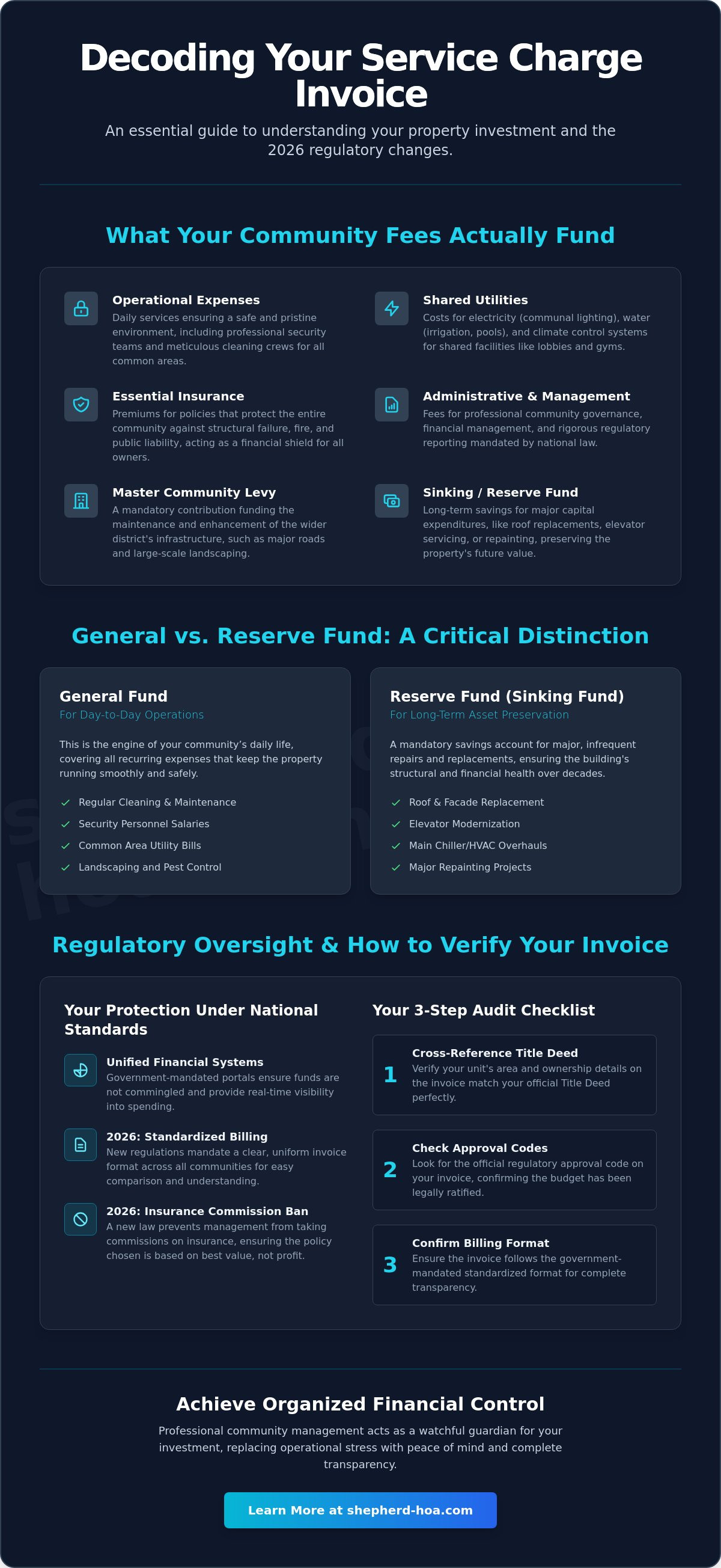
When you examine what your service charge invoice includes, you'll see a strategic allocation of funds across several critical categories. These aren't just arbitrary numbers; they represent the resources required to protect your investment. Operational expenses form the bulk of your daily experience, covering the professional security teams that guard your entrances and the cleaning crews that maintain the lobbies and corridors. These services provide the immediate sense of organized control that defines a well-managed community in the UAE.
Utility costs for shared facilities are another significant component. This includes the electricity for communal lighting, water for the irrigation of landscaped gardens, and the climate control systems that keep gyms and lobbies comfortable. Beyond these visible services, your invoice covers essential insurance premiums. These policies protect the building against fire, structural failure, and public liability, acting as a financial shield for all owners. Administrative fees are also included to cover professional governance and the rigorous regulatory reporting required by national law. The Master Community Levy is a mandatory contribution that funds the maintenance of the wider district's infrastructure, such as regional roads and major landscaping projects.
The General Fund: Day-to-Day Operations
The General Fund is the engine of your community’s daily life. It finances annual maintenance contracts for high-traffic assets like elevators, swimming pools, and fitness centers. This fund also covers landscaping and pest control to preserve social harmony and health standards. Every General Fund budget must undergo a strict approval process by national regulatory bodies to ensure the figures are fair and necessary for the community's upkeep. By partnering with Shepherd HomeOwners' Association, boards gain the peace of mind that their daily operations are managed with expert care and transparency.
The Reserve Fund: Long-Term Asset Protection
A Reserve Fund, often called a sinking fund, is your community's long-term savings account. It's specifically designed to cover major capital expenditures that occur every decade or two, such as roof replacements or massive HVAC overhauls. By contributing a small amount regularly, you avoid the stress of sudden "special levies" or emergency bills when a major component fails. A healthy Reserve Fund is a sign of a watchful guardian at the helm, ensuring the property remains viable for generations. This methodical approach to what your service charge invoice includes ensures that your long-term assets are being protected through disciplined financial planning and professional oversight.
Regulatory Oversight: How National Standards Ensure Financial Integrity
The move toward unified, government-mandated financial systems represents a significant victory for property owners. In the past, managing community accounts was often opaque, leaving many to wonder if their funds were being handled with integrity. Today, national standards require that all community financial activity occurs within highly regulated online portals. These systems are specifically designed to prevent the commingling of funds by developers or managers, ensuring that every dirham remains dedicated to its specific community. When you review what your service charge invoice includes, you can do so with the confidence that the underlying numbers have been scrutinized by independent third parties.
A core requirement in this modern framework is the mandatory third-party audit. No budget can be released to owners until it has been verified by an external auditor and approved by the relevant government body. This process ensures that all service providers, from security firms to cleaning contractors, are selected through an ethical and transparent tendering process. It eliminates the risk of "back-room deals" and guarantees that the community receives the best value for its investment. This level of oversight acts as a watchful guardian, protecting the collective interests of the homeowners.
Government-Approved Budgets and Portals
The Mollak Dubai service charges and compliance framework has become the regional benchmark for financial transparency. By utilizing such systems, regulatory bodies can review and cap annual fee increases, protecting homeowners from sudden, unjustified spikes in costs. These platforms also offer real-time financial dashboards. This technology allows you to see exactly how your community’s funds are being deployed at any given moment, providing a level of oversight that was previously impossible. It replaces operational stress with a sense of organized control.
The Service Charge Index
National indices now allow owners to benchmark their fees against similar properties in the same district. This index is a powerful tool for verifying that your community manager is operating within fair market rates. It also incorporates a "Star Rating" system for communities, which directly impacts service charge levels. High-performing communities that maintain excellent standards often see this reflected in their rating, which preserves asset value and ensures that what your service charge invoice includes aligns perfectly with the quality of life provided.
Verification Steps: How to Audit Your Invoice for Accuracy
Taking charge of your property's financial health starts with a systematic audit. You shouldn't simply accept a bill at face value. Instead, use a methodical approach to confirm that what your service charge invoice includes is both accurate and legally compliant. This process replaces administrative stress with a sense of organized control, ensuring you only pay for services that actually protect your asset. A watchful guardian doesn't just pay; they verify.
Step 1: Cross-reference the total area listed on your invoice with your official Title Deed. Even a small discrepancy in square footage can lead to significant overpayment over several years.
Step 2: Verify the RERA approval code or the national regulatory stamp on the document. In 2026, an invoice without a government-validated QR code or approval number is not legally binding.
Step 3: Compare the current year's line items against the previous community service charge budget. Any sharp increases in specific categories like "Security" or "General Maintenance" should be backed by a transparent tender report.
Step 4: Check for the mandatory Reserve Fund contribution. If your invoice lacks a clear allocation for long-term repairs, the community's future value is at risk.
Step 5: Access your government’s official property portal to ensure your payment is being directed to a regulated escrow account rather than a general corporate account.
Calculating Your Fair Share
The math behind your bill is functional and direct. To find your rate, take the total approved community budget and divide it by the total area of all units in the development. Multiply this result by your specific unit area. It's vital to understand the difference between your internal living area and the common area allocations. In many 2026 developments, balcony or terrace sizes are factored into the calculation at a different weighted percentage. If your management company hasn't explained how these outdoor spaces impact your total, it's time to ask for a breakdown.
Spotting Red Flags in Your Billing
Identifying "Miscellaneous" or "Administrative" charges that lack specific government approval is the fastest way to spot mismanagement. Every dirham listed must map back to a category approved during the budget planning phase. Another major red flag is an invoice issued by a developer's private office rather than an approved management entity. If your invoice doesn't match the government's approved index rate for your district, the management may be operating outside of market norms. If you notice these discrepancies, our experts can assist with Service Charge Collection strategies that prioritize transparency and legal compliance for your board.
The Shepherd Approach: Transparency in Community Financial Management
At Shepherd HomeOwners' Association, we believe that professional community management is more than just administration; it's a duty of care. We act as a watchful guardian for your property investment, ensuring that every dirham is allocated toward the preservation of your asset. By providing absolute clarity on what your service charge invoice includes, we replace the stress of rising costs with the confidence of organized control. Our approach centers on the idea that transparency is the foundation of social harmony within any residential or commercial community.
We utilize advanced financial software to provide homeowners with real-time visibility into their community’s accounts. This technology allows you to track spending against the approved budget instantly, moving beyond the static reports of the past. Beyond digital tools, we prioritize an ethical, transparent tendering process for all service providers. By opening contracts to competitive bidding, we reduce operational costs without sacrificing the quality of security, cleaning, or maintenance. This methodical oversight ensures that your fees work harder for you, maintaining the high standards you expect from a premium development in the UAE.
Protecting Long-Term Asset Value
Our focus extends beyond technical services to the human and financial outcomes they produce. Shepherd HomeOwners' Association takes a proactive stance toward Reserve Fund management, carefully planning for major capital expenditures years in advance. This foresight prevents the financial stress of emergency levies and ensures that the building’s infrastructure remains robust. By distributing costs fairly and communicating clearly, we protect the resale value of your unit and foster a stable environment for all residents. Professional governance acts as the invisible backbone of a thriving community, providing the stability needed for long-term growth.
Next Steps for Homeowners
If you feel your current billing lacks clarity, you have the right to take action. Start by requesting a detailed financial audit or a quarterly progress report from your board to see how the actual spending aligns with the approved budget. For boards looking to transition to a more transparent model, the process for engaging Shepherd HomeOwners' Association for Community Management or Budget Planning is straightforward and designed for ease of use. Our team can assist with everything from Mollak and RERA approval to the final Service Charge Collection process. Professional, RERA-compliant oversight provides the peace of mind that your home is being managed with integrity and that your investment is being watched over by an expert guide.
Empowering Your Property Investment in 2026
The transition toward absolute financial transparency in the UAE provides owners with a unique opportunity to protect their assets. By mastering what your service charge invoice includes, you shift from a passive payer to an informed stakeholder. You've gained the ability to cross-reference regulatory stamps and verify that your funds are directed toward the specific maintenance of your community. This knowledge is your first line of defense against mismanagement and ensures your home remains a source of pride and social harmony.
Professional guardianship is about more than just numbers; it's about the long-term preservation of collective wealth. Our team stands ready to provide the RERA-compliant oversight and Mollak reporting your board requires to operate with total integrity. Secure your community's financial future with Shepherd HomeOwners' Association. By choosing an expert guide, you replace administrative complexity with a sense of organized control and lasting peace of mind. Your property deserves a management partner that values asset preservation as much as you do.
Frequently Asked Questions
What is the difference between the General Fund and the Reserve Fund?
The General Fund covers daily operational costs such as security, cleaning, and routine maintenance, while the Reserve Fund is a long-term savings account for major asset replacements. Understanding what your service charge invoice includes requires distinguishing between these two. The General Fund ensures immediate social harmony and cleanliness, whereas the Reserve Fund acts as a watchful guardian for your property’s future resale value by funding infrequent, high-cost capital expenditures like HVAC overhauls.
Can my service charges be increased without my approval as a homeowner?
Service charges cannot be increased arbitrarily by a management company or developer without government approval. In the UAE, any proposed budget must be reviewed and approved through the Mollak system by RERA. While individual homeowners don't vote on every line item, the regulatory body ensures that any increase is justified by market rates and audited financial needs. This oversight prevents unjustified spikes and maintains financial integrity across the community.
What happens if I refuse to pay my service charge invoice?
Refusing to pay your service charge invoice can lead to significant legal and operational consequences. Initially, you may face late payment penalties and restricted access to community facilities like gyms or pools. If the debt remains unpaid, the management entity can file a legal case through the Rental Dispute Center or relevant courts, which may result in a travel ban or even the public auction of the property to recover the arrears.
Are utility bills for my specific apartment included in the service charge?
No, your specific apartment’s water and electricity consumption is typically billed directly to you by the utility provider. What your service charge invoice includes are the utility costs for shared spaces, such as lobby air conditioning, corridor lighting, and garden irrigation. It's important to set up your individual utility accounts during the property handover phase to ensure your private consumption is tracked separately from the community’s collective requirements.
How can I verify if my community management company is RERA approved?
You can verify a community management company’s RERA approval by using the official Dubai REST mobile application or the Dubai Land Department website. Licensed companies are listed in a public registry, which confirms they have the legal authority to manage budgets and collect fees. Checking this status ensures your community is being guided by a professional partner that adheres to national standards of transparency and ethical governance.
Who decides how much the community management fees should be each year?
The community management company prepares the annual budget based on actual operational needs and historical data. This budget is then submitted to RERA for a rigorous review process. The government body has the final say on the total amount, ensuring the fees align with the Service Charge Index. This collaborative process ensures that the management fees are fair and reflect the actual services provided to the community.
Can I pay my service charges in installments through the Mollak system?
Yes, the Mollak system allows homeowners to pay their service charges in multiple installments, typically through post-dated cheques or online payment portals. Most communities offer a quarterly payment schedule to help owners manage their cash flow more effectively. You should check your specific invoice for the approved payment dates and methods, as these are standardized to provide a sense of organized control over your financial obligations.
Why are service charges higher in some communities compared to others?
Service charges vary based on the range of facilities, the age of the building, and the total square footage of the development. A community with multiple swimming pools, extensive landscaping, and high-tech security systems will naturally have higher operational costs than a project with minimal amenities. Older buildings might also require higher Reserve Fund contributions to account for aging infrastructure and upcoming major repairs needed to preserve asset value.


Comments