
Getting RERA Approval for Community Changes: The 2026 Regulatory Roadmap
- Sohrab Virani

- 3 days ago
- 12 min read
Imagine facing a penalty of up to 10% of your property's total value just because a community upgrade skipped a single regulatory step. Under the 2026 Jan Vishwas Act, the stakes for getting rera approval for community changes have shifted from the threat of jail time to significant financial liabilities that can drain a resident association's reserves. You want to enhance your neighborhood's value and meet resident demands, but the maze of permits and the fear of non-compliance often bring progress to a standstill. It's stressful to act as a guardian of collective interests when the legal goalposts seem to move every quarter.
This article provides the definitive 2026 roadmap for mastering the permit process, ensuring your community modifications are both ambitious and perfectly legal. We will break down the critical two-thirds consent principle, explain how to transition from developer-led rules to your own association bylaws; and show you how to maintain asset value without the friction of regulatory fines. By the end, you'll have the clarity needed to lead your community toward a successful, compliant upgrade that offers total peace of mind.
Key Takeaways
Learn how Law No. 4 of 2026 mandates official permits for shared space modifications to avoid significant financial penalties.
Differentiate between structural and aesthetic upgrades to determine which specific community improvements require government oversight.
Master the multi-tiered process for getting rera approval for community changes, from resident feedback to formal owners committee resolutions.
Follow a structured roadmap for technical feasibility studies and budget allocation to ensure your permit application is successful.
Discover how professional community management provides a protective layer of oversight for your association's long-term asset value.
Table of Contents
The Legal Necessity of RERA Approval for Community Modifications
RERA approval isn't just a hurdle for developers; it's a vital safeguard for every homeowner. Within the context of shared community governance, getting rera approval for community changes ensures that every modification respects the original architectural integrity and safety standards of the development. The Real Estate (Regulation and Development) Act, 2016 established this foundation to protect buyers, but the landscape has evolved significantly. By 2026, the National Real Estate Regulatory Agency has fully embraced its role as a guardian of property standards, ensuring that communal living remains harmonious and assets retain their value. Law No. 4 of 2026 now mandates official permits for even seemingly minor common area changes, such as modifying a walkway or adding permanent garden fixtures. This strictness prevents unilateral decisions that could negatively impact the collective.
Understanding the Regulatory Framework for 2026
The latest legislative updates have introduced a more rigorous oversight model often referred to as RERA 2.0. This era is defined by a shift toward digital permit tracking and automated compliance monitoring. Every change to a shared property is now logged in a national database, allowing authorities to verify that modifications align with approved master plans. These national standards aren't meant to stifle community growth. Instead, they're designed to protect long-term asset value across the country. When your community management team follows these protocols, they're acting as watchful guardians of your investment, ensuring that every upgrade meets the high standards required for modern communal living.
The Consequences of Non-Compliance
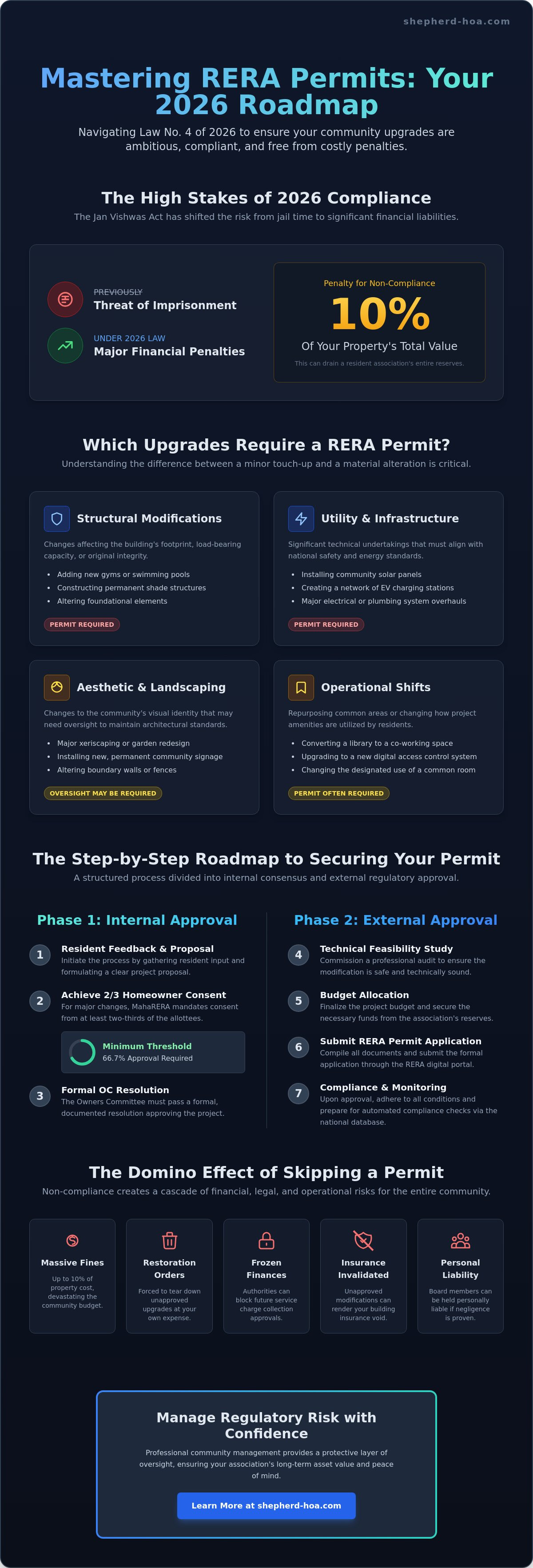
Ignoring the requirement for getting rera approval for community changes carries heavy risks. Under the Jan Vishwas (Amendment of Provisions) Act, 2026, penalties for non-compliance are now capped at a maximum of 10% of the property cost. While imprisonment for allottees has been removed, these financial penalties can devastate an Owners Committee's budget. Beyond fines, authorities can issue restoration orders, forcing the community to tear down unapproved upgrades at their own expense. Board members face personal legal liabilities if negligence is proven. Perhaps most critically, unapproved modifications often invalidate building insurance and can prevent the authority from granting future service charge collection approvals, leaving the community's finances in a precarious state.
Categorising Community Changes: Which Upgrades Require Permits?
Understanding which projects require official intervention is the first step in protecting your community's legal standing. Not every minor paint job needs a government permit, but the line between a cosmetic touch-up and a structural alteration is often finer than most boards realize. When you're getting rera approval for community changes, the process begins with a clear classification of the work intended. This ensures that your Owners Committee doesn't waste resources on unnecessary applications or, conversely, overlook a critical legal requirement.
Common community modifications generally fall into four primary categories:
Structural Modifications: These include adding new facilities like gyms, swimming pools, or permanent shade structures. Any change that alters the footprint of the common areas or affects the building's load-bearing capacity falls here.
Aesthetic and Landscaping Changes: Projects like xeriscaping, installing new signage, or altering boundary walls might seem minor, but they change the community's visual identity and often require oversight to maintain architectural standards.
Operational Shifts: Repurposing a common room from a library to a co-working space or upgrading to a new digital access control system changes how the project's amenities are utilized.
Utility and Infrastructure Upgrades: Installing solar panels or creating a network of EV charging stations are significant technical undertakings that must align with national safety and energy standards.
Major Structural vs. Minor Aesthetic Changes
The distinction between major and minor changes often hinges on the concept of "material alteration." For major structural changes, a full technical audit is typically required to ensure the modification doesn't compromise the original project's integrity. A key benchmark for these significant shifts is the MahaRERA July 2024 order, which mandates the consent of at least two-thirds of the project's residents for any major change to promised amenities. For smaller, purely aesthetic updates, a simple No Objection Certificate (NOC) from the original developer or the association board might suffice. Expert Mollak and RERA approval services can help you determine which path your specific project requires.
Sustainability and Smart City Upgrades
By 2026, many regulatory bodies have introduced fast-tracking for green energy initiatives. If your community plans to install solar panels or water conservation systems, you may find a more streamlined permit pathway. However, installing national-standard EV infrastructure still requires strict adherence to fire safety and electrical load regulations. These sustainability projects are viewed as vital for asset preservation, but they must be executed within the 2026 regulatory roadmap to ensure the community remains compliant with both local municipal codes and national real estate standards.
The Multi-Tiered Approval Process: Internal vs. External
Securing a permit is a sequential journey. It transitions from a shared vision to a legally binding authorization. Successfully getting rera approval for community changes requires a meticulous approach to internal governance before the first document reaches a government portal. This hierarchy of consent acts as a filter. It ensures that only well-conceived, community-backed projects move forward to the national stage. It's a balance between individual resident desires and the collective preservation of the project's master plan. The process is not a simple "yes" or "no" from a single official; it's a multi-stage verification that protects everyone involved.
The first external gatekeeper is often the master developer. Even after a property is handed over, the original developer usually retains rights over the community's aesthetic and structural integrity. You must secure a formal No Objection Certificate (NOC) from them before approaching RERA. This document confirms that your proposed change doesn't violate the original design intent or compromise shared infrastructure. Only once you have this internal and developer-level consensus can you proceed to the final RERA filing, where the government validates the change against national building codes and asset preservation laws.
Securing Internal Consensus
Achieving the statutory majority is the backbone of any application. For significant modifications, the Owners Committee must hold a formal vote. While the 2026 landscape emphasizes digital transparency, the requirement for a clear resolution remains. You should present proposals with detailed visualizations and benefit analyses to the community. Documenting this resolution in the official meeting minutes is vital. These records serve as legal proof of consent during the government audit. Proactive communication helps manage resident objections early, preventing disgruntled owners from filing complaints that could stall your permit for months.
The Role of the Community Management Company
Professional managers act as the essential bridge to regulatory bodies. They don't just oversee daily tasks; they serve as guardians of the community's legal standing. A management firm handles the heavy lifting of preparing the technical dossier. This includes blueprints, professional costings, and detailed impact assessments. They also ensure the proposed change aligns with the approved annual budget. This is a critical step because getting rera approval for community changes is impossible if the project isn't financially backed by a compliant service charge collection plan. Their oversight ensures that the project is feasible, funded, and fully compliant with 2026 standards.
Step-by-Step Roadmap to Securing Your RERA Permit
Success in getting rera approval for community changes depends on a methodical execution of five distinct phases. This structured approach replaces administrative stress with organized control. It ensures that no technical detail or legal requirement is overlooked during the application journey. By following this sequence, your board acts as a responsible guardian of the collective interest; protecting the community from the financial risks of unapproved works.
Phase 1: Technical feasibility study and budget allocation. Every project must begin with a professional assessment. You need to confirm that the proposed change is structurally sound and financially viable. This phase includes integrating the project into your budget planning to ensure funds are available and correctly allocated within the Mollak system.
Phase 2: Obtaining the Owners Committee formal resolution. The committee must officially vote on the project. This resolution serves as the legal foundation of your submission and proves community consensus to the regulators.
Phase 3: Securing NOCs from relevant utility and master authorities. Changes affecting water, electricity, or the master developer's plan require external clearances. These No Objection Certificates prove that your project won't disrupt the wider urban infrastructure.
Phase 4: Digital submission via the national regulatory portal. This is the technical core of getting rera approval for community changes. All documents are uploaded to the national database for government review and verification against 2026 standards.
Phase 5: Final inspection and permit issuance. Once the authorities review the filing, they may conduct a site visit. The process concludes when the official permit is issued; allowing work to commence legally and safely.
Document Checklist for a Successful Application
A complete dossier is the best way to prevent delays. You must provide detailed technical drawings stamped by certified engineering firms. These blueprints must match the current site conditions perfectly. You also need to upload proof of funds and budget approval directly from the Mollak system. Finally, ensure all contracted service providers have valid trade licenses that specifically cover the scope of work intended. Missing a single document can result in an immediate rejection. For expert assistance in compiling this dossier, you can rely on our specialized Mollak and RERA approval services to ensure total compliance.
Navigating the Digital Filing System
The national real estate portal is the primary tool for 2026 permit management. Once you log in, you can track the status of your application in real time. Authorities often issue technical queries or requests for minor modifications to the plan. Responding to these quickly is essential for maintaining your project timeline. If you are managing a large-scale, phased project, you must also track permit expiry dates. Failing to renew a permit before it expires can lead to work stoppages and significant fines. The digital system provides transparency, but it requires diligent monitoring to ensure social harmony and asset preservation remain on track.
Managing Regulatory Risk with Shepherd HOA
The journey toward a modernized community doesn't have to be defined by administrative stress. At Shepherd HOA, we act as the watchful guardian of your collective interests, transforming the daunting task of getting rera approval for community changes into a structured, predictable process. We understand that Owners Committee members are often volunteers who balance significant personal stakes with complex governance duties. Our role is to provide the expert backbone that allows your community to evolve while remaining anchored in total legal compliance.
Risk management begins with the selection of the right partners. We standardise the tendering process to ensure that only compliant, reputable contractors are considered for your community upgrades. By vetting trade licenses and ensuring that every vendor understands the 2026 regulatory requirements, we eliminate the risk of project stoppages due to contractor negligence. This protective layer ensures that your community's vision is executed by professionals who respect national building standards and safety codes.
Financial transparency is equally vital for long-term asset preservation. We utilize the Mollak system to provide rigorous oversight of all project-related funds. From initial budget planning to the final service charge collection required to fund these upgrades, every transaction is logged and verified. This level of oversight ensures that your community's reserves are protected and that all spending aligns perfectly with the approvals granted by the regulatory authorities. It replaces confusion with a clear, audit-ready financial trail.
Expert Oversight for Complex Projects
Our track record in securing permits for high-value community changes is built on a deep understanding of the 2026 legislative landscape. We don't just submit forms; we prepare comprehensive technical dossiers that anticipate the queries of government auditors. This proactive approach significantly reduces approval timelines, moving your project from the planning stage to execution faster than traditional methods. Every modification we oversee is designed to contribute to the community's long-term asset value, ensuring that today's upgrades remain a source of pride and property value for years to come.
Next Steps for Your Owners Committee
Transitioning from a community vision to a RERA-approved reality requires a steady, expert guide. If your committee is considering structural or aesthetic modifications, the first step is a thorough regulatory audit. We can help you assess the feasibility of your plans and identify the specific permit pathways required under Law No. 4 of 2026. This ensures that you move forward with confidence, protected from the liabilities and fines discussed earlier in this roadmap. To secure your community's future and master the permit process, Partner with Shepherd for seamless RERA approvals and experience the peace of mind that comes with professional guardianship.
Building a Legacy of Compliant Community Growth
The 2026 regulatory landscape demands a proactive approach to community evolution. By understanding the strict mandates of Law No. 4 and the nuances of the multi-tiered consent process, your Owners Committee can transform shared spaces without the shadow of financial penalties. Success is no longer just about the physical upgrade; it's about the precision of your administrative execution. Mastering the roadmap for getting rera approval for community changes ensures that every modification strengthens your project's integrity and preserves its market value for the long term.
Navigating these complexities requires a partner who acts as a dedicated guardian of your assets. Since 2010, Shepherd HOA has provided the deep regulatory expertise needed to manage complex Mollak and RERA compliance oversight. Our guardian-led approach replaces operational stress with organized control, ensuring your community remains a model of social harmony and legal integrity. It's time to move from administrative uncertainty to definitive results. Secure your community’s future with RERA-approved management from Shepherd HOA. Your vision for a better community is achievable when backed by a foundation of total compliance.
Frequently Asked Questions
Do we need RERA approval for small landscaping changes in our community?
Yes, you generally need approval if the landscaping modification alters the intended use or aesthetic standard of the common areas. While minor maintenance doesn't require a permit, projects like xeriscaping or altering boundary walls fall under regulatory oversight. Getting rera approval for community changes in these instances ensures the project remains compliant with the master plan and doesn't affect the building's aesthetic certificates.
How long does the RERA approval process typically take for community modifications?
The process typically aims for resolution within 60 to 90 days. This timeline depends on the complexity of the technical dossier and the speed of internal consensus. Recent pushes for faster dispute resolution and digital filing have streamlined these schedules. Committees should still plan for a three month window to account for potential technical queries or requests for modification from the authority.
Can an Owners Committee approve a change without a government permit?
No, an internal vote cannot override national real estate laws. While a statutory majority vote is a prerequisite, it is only the first step in the hierarchy of consent. Proceeding with work based solely on a committee resolution without a formal government permit exposes the board to personal liability and the community to significant financial penalties under current 2026 regulations.
What documents are essential for a community change permit application?
Applications require a professional technical dossier including engineering drawings and certifications. You must also provide proof of budget allocation through the Mollak system and a formal Owners Committee resolution. Additionally, all contractors must submit valid trade licenses specifically covering the scope of the modification. Missing any of these documents will result in an immediate digital rejection during the filing phase.
What happens if a community modification is completed without RERA approval?
The primary consequence is a financial penalty of up to 10% of the property cost under the Jan Vishwas Act 2026. Authorities may also issue restoration orders, requiring the community to remove the modification at their own expense. Furthermore, unapproved changes often invalidate building insurance and can block the approval of future service charge collections, putting the community's long term financial stability at risk.
Does the Mollak system play a role in the approval of community changes?
Yes, the Mollak system is the foundation for the financial verification of any upgrade. Regulators use it to confirm that the community has the necessary funds and that the budget was approved by the owners. Getting rera approval for community changes is impossible without showing a transparent financial trail within Mollak, as this ensures the project won't lead to a deficit in the maintenance fund.
Is a No Objection Certificate (NOC) from the developer always required?
In most cases, yes, especially if the project is still under the developer's original master plan. The NOC confirms that your proposed change doesn't violate the architectural integrity or technical specifications of the development. This document is a critical part of the external approval process and must be secured before you can successfully file your application with the national regulator.
How do the 2026 regulations affect existing unapproved modifications?
The RERA 2.0 enforcement trend focuses on bringing all shared properties into full digital compliance. Existing unapproved changes are now more visible through digital portal tracking and quarterly status updates. Communities with historical non-compliance should seek a regulatory audit to regularize these modifications. Proactive disclosure often results in more manageable resolution paths than waiting for an official inspection and a subsequent fine.


Comments