
Professional Property Handover Services for Developers: The 2026 National UAE Guide
- Sohrab Virani

- 4 days ago
- 12 min read
With off-plan properties accounting for 67.3% of transactions across the UAE this year, what if your final delivery phase acted as a catalyst for brand loyalty rather than a source of operational stress? You've worked hard to bring your vision to life, yet the final stretch often feels like a race against administrative bottlenecks and high volumes of snagging requests. Understanding the owners association role in property handover is essential during this phase to prevent delays in final payments and protect the long-term harmony of your community.
This 2026 guide provides a roadmap for navigating the latest regulatory landscapes, including relevant national laws and administrative resolutions. You'll learn how specialized handover management secures your assets, ensures regulatory compliance, and accelerates the transition to community governance. We'll explore how to streamline utility setups and RERA documentation to move from construction to active residency with zero defects and complete peace of mind.
Key Takeaways
Professional handover management streamlines the transition of bulk units, allowing your internal teams to focus on future projects while accelerating final installment collections.
You'll learn how specialized partners provide the objective oversight needed to manage buyer expectations and resolve snags more efficiently than in-house construction staff.
Understanding the owners association role in property handover is essential for bridging the gap between unit delivery and long-term community governance.
A structured framework for bulk deliveries ensures that every unit meets strict quality standards, protecting your brand reputation from the start.
Discover how accurate handover data helps you establish realistic service charge budgets and ensures a seamless transition to Mollak and RERA compliance.
Table of Contents
What Are Property Handover Services for Developers?
Property handover services for developers represent the professional management of the formal transition of units from the construction phase to the final owner. It's a specialized operation that goes far beyond simply swapping keys for final checks. In the high-velocity UAE market of 2026, where off-plan properties account for over 67% of all transactions, developers face the immense challenge of managing bulk deliveries. When hundreds of units reach completion simultaneously, the logistical pressure can quickly lead to administrative bottlenecks and reputational damage if not handled with precision.
A professional handover service acts as a protective shield for your brand. It ensures that every technical inspection, legal document, and administrative requirement is met before the buyer ever sets foot in the building. This phase is also where the foundation for future community harmony is laid. The owners association role in property handover is vital here; the data collected during these initial inspections directly informs the long-term maintenance strategy and the accuracy of future service charge budgets. A well-structured homeowner association depends on this initial transparency to protect the collective interests of all residents.
The Core Pillars of Developer-Led Handover
The first pillar is rigorous pre-handover snagging. Professional teams conduct internal quality audits to identify and rectify defects before the buyer's walkthrough. This proactive approach minimizes the volume of complaints and accelerates the collection of final installment payments. Following the technical checks, the focus shifts to administrative coordination. This includes managing utility account setup for DEWA or ADDC and ensuring all Mollak and RERA approval requirements are satisfied. The final link is the logistics of key collection, where professional mediation helps manage buyer expectations and ensures a positive first impression of their new investment.
Regulatory Compliance and the UAE Landscape
The regulatory environment in 2026 has become significantly more sophisticated. In Dubai, Law No. 4 of 2026 has strengthened the supervisory framework for off-plan property protections, while Abu Dhabi Administrative Resolution No. 25 of 2025 provides a detailed governance structure for jointly owned properties. Professional handover services ensure your project adheres to these national strata laws and building standards from day one.
Utilizing third-party inspectors provides an objective layer of validation that builds buyer trust. These experts ensure that every unit is truly ready for occupancy, which significantly reduces the risk of RERA-related delays or disputes. By outsourcing these complexities, you protect your project from the 12-month non-structural defect liability period and ensure a seamless transition to community management. This organized control replaces operational stress with a predictable, methodical flow that preserves asset value and encourages social harmony within the new development.
The Strategic Value of Outsourcing Handover Management
Outsourcing the handover process is a strategic move that allows your core project teams to pivot immediately toward the next development phase. In a market where Dubai real estate transactions reached AED 252 billion in the first quarter of 2026, speed and focus are your most valuable assets. By delegating the administrative and technical minutiae of unit deliveries, you ensure that your engineers and project managers aren't bogged down by individual buyer walkthroughs or minor snagging disputes. This transition also accelerates the collection of final installment payments. When a third-party partner manages the inspection and rectification process with clinical precision, buyers feel more confident in the quality of their asset. This confidence leads to faster sign-offs and fewer payment delays.
A professional partner also clarifies the owners association role in property handover from the outset. By ensuring that all common area data and unit-specific records are meticulously organized, you set a standard of transparency that simplifies future community management. This proactive approach reduces post-handover liability. Since developers are legally responsible for structural defects for 10 years from completion, having a rigorous, documented initial inspection protects you from future claims. It establishes a clear baseline of the property's condition at the moment of transfer.
Operational Efficiency at Scale
Managing the documentation for a residential tower with hundreds of units requires more than just spreadsheets. Specialized software for real-time snag tracking allows for instantaneous reporting between the site team and the buyer. This standardizes the experience whether you're delivering a luxury villa in Abu Dhabi or a mid-market apartment in JVC. By implementing these systems, you eliminate the risk of lost paperwork or overlooked defects. This methodical approach ensures that the 12-month Defect Liability Period for non-structural faults is managed with organized control rather than chaotic reaction.
Reputation Management and Buyer Satisfaction
The snagging phase is traditionally a point of friction. Professional handover services transform this into a collaborative experience by providing buyers with clear, consistent communication. This professional touch doesn't just satisfy the immediate owner; it protects the asset's secondary market value. When a building is known for a seamless delivery and a robust owners association role in property handover, it becomes a preferred choice for investors. This long-term stability is the ultimate hallmark of a developer who values integrity. For developers seeking to institutionalize this level of care, engaging with a dedicated property handover partner ensures every delivery strengthens your market standing.
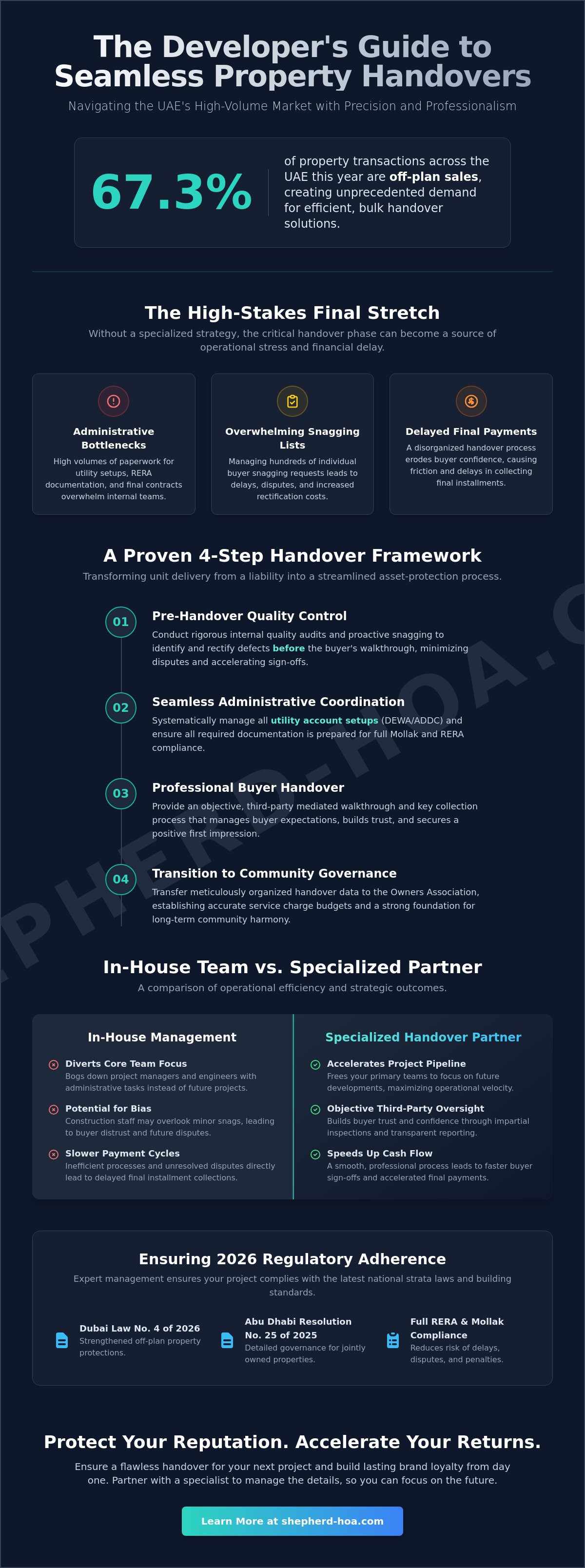
Comparing In-House Management vs. Specialized Handover Partners
Developers often face a choice: deploy existing construction staff to manage handovers or engage a specialized partner. While using internal resources might seem cost-effective on paper, the hidden operational costs tell a different story. Site engineers and foremen are trained to build; they aren't typically equipped to mediate with buyers or manage the delicate administrative requirements of RERA. This mismatch often leads to friction during the walkthrough. It results in higher volumes of reported snags and delayed final settlements that impact your cash flow.
A specialized handover partner brings an essential layer of objectivity. They act as a neutral guardian, balancing your delivery schedule with the buyer's expectations. This objectivity is particularly important when explaining the owners association role in property handover to new residents. Buyers need to understand how their individual unit delivery connects to the broader governance of the building. Without this specialized knowledge, you risk a fragmented transition that leaves residents confused and frustrated. A partner ensures the narrative remains focused on long-term value and social harmony.
Internal Resource Strains
Construction managers are often poor choices for customer-facing roles. Their primary focus is project completion, not resident satisfaction. Diverting these professionals from active sites to manage handovers creates a resource drain that can delay your next project's milestones. The training required to meet 2026 regulatory standards, such as Abu Dhabi Administrative Resolution No. 25, is extensive. Expecting construction staff to stay updated on these complex legal frameworks while managing a site is unrealistic. This strain often leads to documentation errors that cause significant bottlenecks during Mollak and RERA approval processes.
The Outsourcing ROI
The return on investment for professional handover services becomes clear when you analyze the cost-per-unit versus internal overhead. Specialized firms utilize technology to standardize the process, which reduces the time spent on each unit. This efficiency translates to faster sign-offs and reduced holding costs for the developer. By ensuring a higher standard of initial quality control, you also see a marked decrease in warranty claims during the 12-month Defect Liability Period for non-structural faults.
A professional handover facilitates a swifter transition to community management. When the owners association role in property handover is managed with expert oversight, you can hand over the keys with confidence. This allows you to close out project accounts months earlier than an in-house team could manage, freeing up capital for your next UAE investment. This methodical approach replaces frantic energy with organized control, protecting your reputation as a premier developer.
A Step-by-Step Framework for Managing Bulk Property Deliveries
Bulk deliveries require a cadence that mirrors a well-organized formal meeting. You can't treat 500 units as 500 individual projects. Instead, you need a scalable system that moves units through a predictable pipeline. This framework begins long before the first buyer arrives on site. It involves a rigorous internal audit where you hold contractors accountable for every finish and fixture. By managing these technical details early, you ensure the transition remains a source of pride for the owner rather than a source of frustration for your project team.
The owners association role in property handover becomes prominent during the transition of common areas. While individual units are being signed off, the groundwork for community governance must be laid simultaneously. This ensures that when the final key is handed over, the building's infrastructure is already under professional oversight. A methodical approach to this transition protects the long-term value of the development and fosters immediate social harmony among new residents.
Phase 1: The Internal Audit and De-Snagging
Establishing a gold standard for unit readiness is the most effective way to minimize buyer friction. By conducting internal quality audits, you identify defects that would otherwise delay final payments. A unit is only considered ready for handover when it meets all current RERA standards and is fit for immediate occupancy. This proactive stance ensures that your team isn't chasing contractors for minor repairs while trying to manage a high volume of walkthroughs. You should insist on a zero-defect policy for major systems like HVAC and plumbing to avoid costly post-handover emergency calls.
Phase 2: Administrative and Legal Finalization
Securing the Building Completion Certificate (BCC) is just the beginning of the legal finalization. You must also finalize all Mollak and RERA approval requirements to ensure transparent financial management from day one. Utilizing the Mollak system allows for the immediate setup of service charge accounts, which is critical for the long-term health of the community. For a deeper look at these requirements, consult the RERA Dubai 2026 compliance guide. This step ensures that all financial disclosures are accurate, protecting you from future audits or disputes.
Managing utility account setup across hundreds of units is another major bottleneck. For Dubai apartments, this involves coordinating the AED 2,000 security deposits for DEWA, while villas require AED 4,000. A professional service handles these national account setups, ensuring that water and electricity are active the moment the owner receives their keys. This level of organized control eliminates the administrative stress of bulk documentation and ensures a polished, professional buyer experience. To implement this framework for your next project, explore our comprehensive handover solutions today.
Protecting Long-Term Value: Integrating Handover with Community Governance
The successful delivery of a project isn't measured solely by the moment keys are handed to owners. It's defined by the long-term stability and social harmony of the community that follows. A critical link exists between individual unit handovers and the broader management of common areas. When you integrate these two phases, you ensure that the data collected during technical inspections serves as the foundation for the building's operational future. This transition is where the owners association role in property handover becomes most visible, acting as the bridge between your construction legacy and the residents' lived experience.
Professional handover data does more than just track defects. It informs the initial community service charge budget with forensic accuracy. By verifying exact unit areas and the condition of shared assets like HVAC systems and elevators, you eliminate the guesswork that often leads to financial shortfalls. This organized control protects your reputation, ensuring that the first year of residency is defined by functional excellence rather than administrative disputes over maintenance costs.
Transitioning to Owners Association Management
Accurate unit area data is essential for equitable service charge calculations. In 2026, service charges in mid-market areas like JVC and JLT average between AED 10 and AED 17 per square foot. Even a small discrepancy in recorded area can lead to significant budget imbalances and resident frustration. A specialized partner ensures that every square foot is accounted for before the building moves into full Owners Association Management. This phase also involves establishing ethical tendering processes for third-party facility providers. By securing high-quality service contracts during the handover, you set a benchmark for excellence that the OA Board can maintain for years to come.
Guardian of the Asset: The Shepherd Approach
Shepherd acts as a steady, expert guide through this complex transition. Our approach utilizes a per-unit handover fee model, providing you with a scalable solution that fits the specific needs of your project, whether it's a boutique residence or a massive tower. We leverage over 15 years of UAE expertise to ensure that every administrative and technical detail is handled with absolute integrity. This methodical oversight replaces the typical operational stress of bulk deliveries with a sense of calm reliability.
We view ourselves as the watchful guardian of your brand's legacy. By prioritizing transparency and social harmony, we help you transition from developer to community founder with complete peace of mind. Our team handles the heavy lifting of service charge collection and utility account setup, allowing you to move forward to your next project while we protect the value of your current one. If you're ready to ensure a zero-defect delivery at scale, partner with Shepherd for your next property handover and experience the benefit of organized control.
Mastering the Final Mile of Project Delivery
A successful property handover is more than a logistical checklist; it's the defining moment for your brand's legacy in the UAE market. By prioritizing technical precision and clear communication, you ensure that residents enter their new homes with confidence. We've explored how a structured approach reduces liability and how the owners association role in property handover sets the stage for years of social harmony and asset preservation. This transition shouldn't be a source of operational stress for your project teams.
Since 2010, Shepherd HomeOwners' Association has acted as a steady guide for developers across the Emirates. With over 15 years of UAE expertise, our RERA-approved and Mollak-integrated systems provide the organized control you need for bulk per-unit handover management. We handle the administrative complexities so you can focus on your next landmark development. Secure Your Project’s Reputation with Shepherd’s Handover Services and ensure your community thrives from the very first day. Your vision deserves a finish that is as flawless as its design.
Frequently Asked Questions
What is the role of a handover service provider for developers?
A handover service provider manages the technical and administrative transition of property units from the construction phase to the final owners. They act as an expert guide during the final delivery stage, ensuring that every unit meets strict quality standards before the buyer walkthrough. This oversight reduces the operational burden on your internal teams and protects your market reputation through organized control.
How does the Mollak system impact the property handover process?
The Mollak system streamlines the financial setup of a new community by providing a transparent digital platform for service charge approval. It requires developers to register the building and its units to ensure that all future financial transactions are overseen by RERA. This integration prevents delays in community governance and builds investor trust through real-time verification of property data.
Can professional property handover services reduce the number of buyer disputes?
Professional services significantly reduce disputes by acting as an objective mediator during the snagging phase. When an independent expert validates the unit condition, buyers feel more confident that their interests are protected. This transparency leads to faster sign-offs and prevents minor technical issues from escalating into legal delays or final payment hold-ups that impact your cash flow.
What is included in a professional property snagging report for developers?
A professional report includes a detailed technical audit of mechanical, electrical, and plumbing (MEP) systems alongside civil finishes. Each defect is documented with photographic evidence and categorized by severity to help contractors prioritize rectifications. This methodical documentation provides a clear baseline for managing the 12-month non-structural defect liability period with absolute integrity.
How long does the bulk handover process typically take for a large project?
Bulk handover timelines depend on unit volume, but a large residential project typically completes the process within 30 to 90 days. The speed is largely determined by how quickly the site team rectifies snags identified during the internal audit. Professional management ensures this timeline remains predictable by standardizing the workflow and documentation across all units simultaneously.
What are the legal requirements for property handover in the UAE?
Legal requirements include obtaining the Building Completion Certificate (BCC) and ensuring compliance with Dubai Law No. 4 of 2026 or Abu Dhabi Resolution No. 25 of 2025. Developers must also finalize Mollak registration and clear all administrative fees with the relevant Land Department. Understanding the owners association role in property handover is essential for meeting these statutory governance obligations.
How do handover services facilitate the setup of utility accounts for new owners?
Handover services coordinate directly with authorities like DEWA or ADDC to ensure water and electricity are active upon key collection. They manage the administrative filing for security deposits, which are AED 2,000 for apartments and AED 4,000 for villas in Dubai. This coordination removes a major point of friction for buyers and ensures a polished, professional move-in experience from day one.
Why is it important to link handover services with owners association management?
Linking these services ensures that the owners association role in property handover is supported by accurate data. Information gathered during unit inspections helps establish realistic service charge budgets and long-term maintenance plans. This integration protects the developer's legacy by ensuring the community is financially and operationally stable from the moment control is transferred to the owners.


Comments