

How to Pay Service Charge via Mollak: The Complete 2026 Homeowner Guide
- Sohrab Virani

- 10 hours ago
- 14 min read
Imagine opening your inbox to find a service charge invoice for 14,200 AED, only to realize you aren't entirely sure if your payment is reaching the correct RERA-regulated account. For many Dubai homeowners, the shift from developer-led billing to the centralized Mollak system has introduced more questions than answers. You deserve to know that your funds are protecting your community's long-term value. Learning how to pay service charge mollak shouldn't be a source of technical frustration or anxiety over hidden fees.
We understand that managing your property involves a significant personal stake and a duty of care toward your neighborhood. This guide provides a step-by-step, stress-free path to navigating the government portal with the steady hand of an expert guide. You'll gain total transparency over your billing and the peace of mind that comes with full regulatory compliance. We will walk you through the 2026 verification process, secure payment gateways, and the final confirmation steps that act as a guardian for your property investment.
Key Takeaways
Understand how the RERA-mandated Mollak system ensures financial transparency by transitioning property funds into secure, regulated escrow accounts.
Follow our streamlined, step-by-step instructions on how to pay service charge mollak via the Dubai REST app to maintain your property’s compliance effortlessly.
Identify and resolve common payment hurdles, including unit search errors and invoice discrepancies, using our expert troubleshooting strategies.
Learn how the RERA Service Charge Index determines fair rates for your building, ensuring every dirham (AED) contributed is audited and approved.
Discover how Shepherd HomeOwners' Association serves as a steady guide, managing the complexities of budget planning and Mollak registration to protect your community's long-term value.
Table of Contents What is the Mollak System and Why is it Mandatory in Dubai? Step-by-Step: How to Pay Your Service Charge via Mollak Troubleshooting Common Mollak Payment Issues Understanding the RERA Service Charge Index and Budget Approvals How Shepherd HOA Simplifies Your Mollak Compliance
What is the Mollak System and Why is it Mandatory in Dubai?
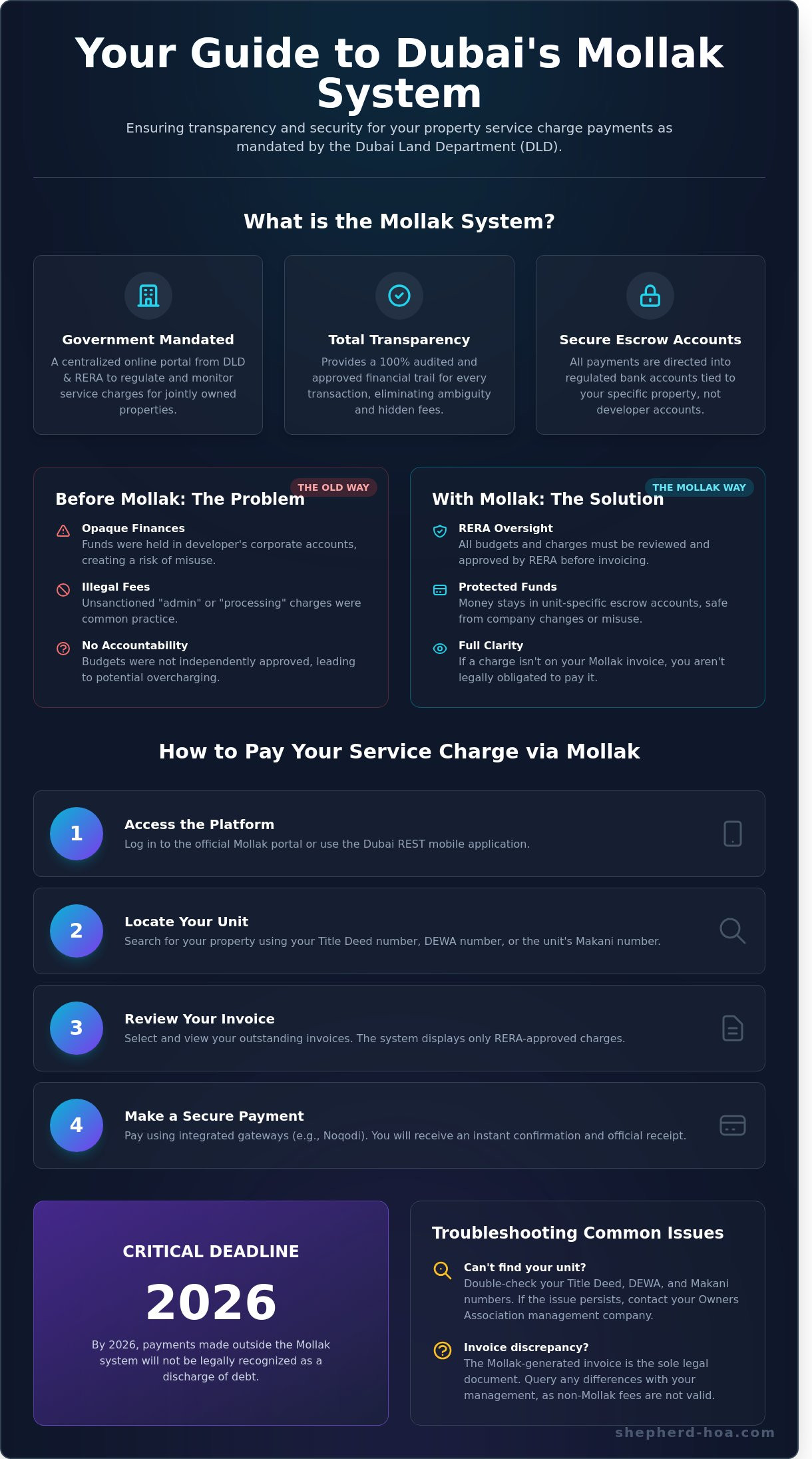
Mollak is the specialized online portal designed by the Dubai Land Department (DLD) to bring total transparency to the management of jointly owned properties. The system serves as a digital guardian for homeowners, ensuring that every fils contributed toward community upkeep is tracked and accounted for. The Real Estate Regulatory Agency (RERA) mandates the use of this platform to eliminate the financial ambiguity that previously existed in the real estate market. It's a centralized hub where developers, management companies, and owners interact within a strictly regulated environment.
The introduction of Law No. (6) of 2019 marked a significant shift in how Dubai handles community finances. Before this regulation, developers often held service charge funds in their own corporate accounts, which led to concerns regarding the misuse of money. Today, that's impossible. Every dirham you pay is directed into a regulated escrow account specifically tied to your property unit. Learning how to pay service charge mollak is the first step toward securing your rights as a homeowner. By 2026, the DLD has made it clear that payments made outside this system won't be legally recognized, meaning you won't receive an official discharge of debt unless the transaction flows through the Mollak framework.
This oversight is rigorous. The DLD monitors every transaction to ensure that management companies don't overcharge residents or underfund essential services. It's a system built on trust and verified data. When you understand how to pay service charge mollak, you're participating in a sophisticated financial ecosystem that protects the long-term health of your building. It replaces stress with organized control.
The Core Objectives of the Mollak Framework
The primary goal of the Mollak system is to create a seamless, professional relationship between all parties involved in property management. It provides a 100% audited trail for every community financial transaction. Management companies can't simply invent a budget; they must submit detailed financial plans to RERA for approval. Once approved, the system generates invoices based on these verified figures. This ensures that your service charges are fair, accurate, and directly linked to the actual costs of maintaining your community's gyms, pools, and common areas.
Regulatory Oversight: RERA reviews and approves all service charge rates before they reach the owner.
Financial Integrity: Independent auditors must verify the community's financial statements annually.
Operational Clarity: Management companies are held accountable for the delivery of services promised in the budget.
How Mollak Protects Your Property Investment
Your property is a significant asset, and Mollak acts as its protective backbone. By standardizing the billing cycle across all freehold areas, the system prevents the erratic invoicing that once plagued the market. It effectively eliminates illegal "admin fees" or "processing charges" that weren't sanctioned by the government. If a fee isn't visible on your Mollak-generated invoice, you aren't legally obligated to pay it. This protection keeps your maintenance costs predictable and fair.
The system also ensures that funds stay in unit-specific escrow accounts. This means that even if a management company changes, your community's money remains safe and accessible for its intended purpose. It prevents funds from being diverted to other projects or developer expenses. This level of oversight preserves your property's value by ensuring that maintenance is never neglected due to missing or mismanaged funds. It's a reliable mechanism designed to give you peace of mind while your investment grows in value over time.
Step-by-Step: How to Pay Your Service Charge via Mollak
Managing your property obligations in Dubai shouldn't feel like a burden. The Mollak system, governed by the Dubai Land Department (DLD), provides a transparent framework that ensures your community fees are handled with the highest level of fiduciary care. By following a structured process, you can fulfill your financial responsibilities in minutes. Understanding how to pay service charge mollak effectively allows you to bypass administrative delays and ensures your funds reach the regulated escrow account designated for your specific building or community.
Finding Your Unit in the Mollak Database
Your journey begins at either the official Mollak portal or the Dubai REST app. To locate your property, you'll need specific identifiers found on your Title Deed. Common search parameters include the Building Name, the specific Area such as Business Bay or Jumeirah Village Circle, and your unique Unit ID. If your unit details don't appear, it's often because the Owners Association (OA) manager hasn't updated the master community record since the last title transfer. In these cases, you must contact your property manager to sync the DLD records. Always verify that the owner name displayed matches your Title Deed exactly to prevent misallocated funds.
Choosing the Right Payment Channel
Dubai provides several secure avenues for settlement, but the Dubai REST app remains the most efficient choice for mobile users. Most owners utilize Noqodi, which is the primary payment gateway for Dubai government services. It's a reliable bridge between your bank and RERA. While international credit cards offer convenience, they often incur processing fees ranging from 1.5% to 2.5%. Local bank transfers are a cost-effective alternative for residents, though they may take 2 to 3 business days to reflect in the system. For those seeking a more streamlined approach to community oversight, using a digital management partner can help clarify these financial workflows.
Verifying Your Payment and Receipt
Security is paramount when handling property assets. You must distinguish between a genuine Mollak invoice and an informal request from a developer. Every legitimate demand for payment must include a breakdown of the 100% RERA-approved budget, detailing exactly where your Dirhams are allocated. Look for the 'RERA Approved' watermark and a unique QR code on the document. An Electronic Service Charge Invoice is the only legally valid billing document for community fees in the Emirate of Dubai. Once the transaction is complete, the system generates an official receipt. Download this document immediately; it serves as your primary evidence of compliance during property sales or tenancy disputes.
The transition to the Mollak system in 2019 revolutionized how Dubai handles community management. It eliminated the ambiguity of "hidden fees" and replaced it with a ledger-based system that honors the rights of the homeowner. By mastering how to pay service charge mollak, you aren't just paying a bill; you're actively participating in the financial health and long-term value preservation of your neighborhood. The process is designed to be intuitive, ensuring that even first-time buyers can navigate the requirements without professional assistance. Keep your records organized, check your unit status quarterly, and always prioritize the official DLD channels for all financial interactions.
Troubleshooting Common Mollak Payment Issues
Technical hitches shouldn't derail your commitment to community maintenance. While the Mollak system provides a streamlined framework for financial transparency, users occasionally encounter friction during the digital journey. Most obstacles stem from data synchronization lags between the Dubai Land Department (DLD) and the Mollak portal. Understanding how to pay service charge mollak payments effectively requires knowing how to bypass these common administrative roadblocks.
When the System Doesn't Recognize Your Property
The "Unit Not Found" error is a frequent frustration for new homeowners or those who've recently completed a property transfer. This usually happens because the Title Deed data hasn't fully migrated to the RERA database. If you've purchased your property within the last 15 days, the system might still be processing the ownership change. You should verify your property status on the Dubai REST app under the "My Properties" section first. If the property appears there but not in Mollak, a data synchronization request is necessary.
Your Community Management company acts as the primary link here. They're responsible for uploading the unit master list and the RERA-approved budget for the current fiscal year. If the management firm hasn't updated the 2024 budget particulars, the system won't generate an invoice for your specific unit. Contacting the DLD directly via their 800 4488 helpline is the fastest way to trigger a manual refresh if the discrepancy persists for more than 48 hours after a Title Deed issuance.
Disputing an Incorrect Service Charge Invoice
Discrepancies between your initial purchase agreement and the Mollak invoice can cause significant concern. It's vital to remember that service charges are based on the RERA Service Charge Index rather than fixed private contracts. You can access the official index on the DLD website to see the approved rate per square foot for your specific project and area. If the invoice reflects a rate higher than the 2024 approved index, you have the right to request a formal clarification from your owners' association board.
Verify the area: Ensure the invoice calculates fees based on the net area listed on your Title Deed, not the gross area.
Check the reserve fund: RERA allows for a specific percentage to be allocated to the sinking fund for long-term repairs.
Audit reports: Owners have a legal right to view the audited financial statements that justify the annual budget.
You shouldn't withhold payment as a primary tactic for dispute. Under Dubai Law No. 6 of 2019, failure to pay can lead to a formal legal notice served via the Notary Public. If the debt remains unpaid after 30 days, the Rental Dispute Centre can issue an enforcement order. This may result in a 12% annual late fee or even a travel ban. It's better to pay under protest and file a formal case with RERA to safeguard your property rights and maintain community harmony.
Resolving Transaction Failures
Payment timeouts often occur when the transaction amount exceeds the daily limit set by your bank, especially for luxury villas where fees might exceed AED 60,000. Always ensure your 3D Secure settings are active. If the gateway fails, don't attempt a second payment immediately; wait 20 minutes to see if a confirmation SMS arrives. You should also ensure your contact details are updated in the RERA system. If your mobile number or email is outdated, you won't receive the OTP required to complete the process of how to pay service charge mollak invoices securely. Updating these details requires a quick visit to a DLD service center with your Emirates ID and Title Deed.
Understanding the RERA Service Charge Index and Budget Approvals
RERA uses the Service Charge Index to set a fair rate for every community in Dubai. This index acts as a calculated benchmark that considers the building's age, location, and the quality of its amenities. For example, a building in Downtown Dubai with three swimming pools and 24-hour concierge services will naturally have a higher index rate than a mid-rise in International City. This system ensures you aren't overcharged compared to similar properties in your district. It provides a protective layer of oversight that keeps community costs grounded in market reality.
Management companies like Shepherd HOA categorize every dirham into two distinct buckets to ensure long-term stability. The General Fund covers recurring monthly expenses like cleaning, security, and DEWA for common areas. The Reserve Fund acts as a financial shield for the future. It accumulates capital for major repairs, such as chiller replacements or facade refurbishments, which typically occur every 10 to 15 years. This separation prevents sudden, massive special levies that can catch homeowners off guard and disrupt their personal finances.
Navigating the Service Charge Index Tool
The Dubai Land Department (DLD) provides a public Service Charge Index tool that allows owners to verify their fees. You can input your specific project name to see the approved range for your building. It's common for two identical apartments in different buildings to have different rates because one might have higher utility consumption or more extensive landscaped areas. The Service Charge Index is updated annually to reflect market maintenance costs.
The Auditor's Role in Your Service Charge
Transparency is the foundation of community trust. Before any invoice is generated, an independent, RERA-approved auditor must verify the proposed budget. These auditors ensure that the management company isn't inflating costs or misallocating funds. This rigorous check is a prerequisite for anyone looking at how to pay service charge mollak, as the system won't issue payment requests without an audit. The Mollak system prevents management companies from overspending by locking the budget once it's approved by RERA.
Homeowners hold the right to view these audited financial statements. Accessing these documents through the DLD portal allows you to confirm your money is being handled with fiduciary care. When management companies maintain a clean audit trail, it directly impacts the neighborhood's reputation. Clear budgeting and a healthy reserve fund lead to higher property valuations because buyers feel confident in the building's physical and financial health. This organized control turns a complex administrative task into a predictable financial plan for every resident.
Keep your community's finances transparent and secure by choosing a partner that values integrity. Manage your community budget with Shepherd HOA to ensure every dirham is accounted for.
How Shepherd HOA Simplifies Your Mollak Compliance
While understanding how to pay service charge mollak is vital for individual homeowners, the backend infrastructure required to generate those invoices is a heavy lift for any Owners' Committee. Shepherd HOA serves as the essential bridge between volunteer board members and the rigorous requirements of Dubai’s Real Estate Regulatory Agency (RERA). We replace the stress of technical compliance with a structured, reliable process. Our team manages the transition from raw financial data to the approved Mollak invoices that appear in your portal. This ensures that your community's financial health remains stable and protected. We don't just manage software; we safeguard your community's fiduciary standing.
Our proactive approach starts long before a homeowner logs in to make a payment. We initiate budget planning and Mollak registration cycles at least 90 days before the fiscal year ends. This foresight prevents the common bottleneck of delayed invoices that can starve a community of its operating funds. By handling the administrative heavy lifting, we allow Board Members to focus on strategic decisions rather than drowning in spreadsheets. Our involvement provides a layer of ethical governance that builds trust between the board and the residents they serve.
We provide a comprehensive suite of services to ensure your community remains compliant with Dubai's evolving regulations:
Budget Preparation: Drafting detailed annual budgets that align with RERA’s strict cost-code requirements.
Data Integrity: Scrubbing unit owner records to ensure 100% accuracy in the Mollak system.
Audit Coordination: Managing the mandatory external audit process required for budget approval.
Financial Reporting: Delivering monthly statements that reflect the actual financial health of the community in AED.
Our Expert Mollak Management Services
Managing a community's budget isn't just about math; it's about regulatory precision. We handle the complex back-end data entry and budget uploads required by the Dubai Land Department. By maintaining strong professional relationships with regulators, we often secure budget approvals 25% faster than self-managed boards. Our experts translate complex ledger entries into jargon-free financial summaries. This transparency helps homeowners understand exactly where their AED is going. We ensure every file meets the high accuracy standards required for RERA registration, preventing the delays that often plague community associations during the first quarter of the year. This precision makes the process of how to pay service charge mollak a simple, one-click experience for your residents.
Why Professional Guidance Matters
Non-compliance with Law No. (6) of 2019, commonly known as Dubai's Strata Law, carries significant legal and financial risks. Errors in budget filing can lead to frozen bank accounts or the inability to issue valid service charge invoices. Shepherd HOA eliminates these vulnerabilities by acting as a watchful guardian for your community assets. We focus on preserving property values and maintaining community harmony through fair, transparent financial oversight. When homeowners see clear, RERA-approved billing, trust increases across the neighborhood. This professional approach typically reduces late payments by an average of 18% within the first year of our management. You don't have to struggle alone with the technicalities of the Mollak system. Let Shepherd HOA guide your community toward seamless financial management.
Take Control of Your Dubai Property Management
Mastering the digital landscape of Dubai real estate starts with understanding how to pay service charge mollak efficiently. By utilizing the RERA Service Charge Index to verify costs and following the 2026 payment protocols, you ensure your community remains compliant and financially stable. These steps protect your AED investments and maintain the high standards expected in Dubai's residential districts. Staying informed about budget approvals and audit requirements prevents unnecessary penalties and keeps your neighborhood running smoothly.
Shepherd HOA has delivered RERA-approved management services since 2010, offering specialized expertise in Dubai Strata Law compliance. We're specialists in Mollak system integration, removing the administrative burden from board members so they can focus on community growth. Our team acts as a steady guide, ensuring every financial transaction and legal filing meets the strictest regulatory standards. You don't have to navigate these complex systems alone when you have a partner dedicated to your community's long-term health.
Your property is in safe hands when you prioritize transparency and expert oversight.
Frequently Asked Questions
Can I pay my Dubai service charges in installments through Mollak?
You can pay in installments if your specific bank offers a payment plan for government services via the DubaiPay gateway. Most UAE banks like Emirates NBD or Mashreq provide 3 to 12 month installment options at 0% interest for these transactions. Check with your card issuer before you finalize the payment to ensure your specific credit card qualifies for this financial flexibility.
What happens if I miss the service charge payment deadline in Dubai?
Owners face financial penalties and legal restrictions if they miss the 30 day grace period following a formal invoice. Law No. (6) of 2019 empowers the Dubai Land Department to issue a legal notice, and failure to pay within 30 days of that notice can lead to a case in the Rental Dispute Centre. This process ensures the community remains funded and property values stay protected for all residents.
Is it possible to pay service charges for a property I am renting out?
You remain legally responsible for service charges even if you rent out your unit to a tenant. Article 22 of Law No. (26) of 2007 clarifies that the landlord pays these fees unless the tenancy contract specifically shifts the burden to the tenant. Learning how to pay service charge mollak ensures you maintain your fiduciary duty to the community while protecting your investment from potential legal liens.
Why is my developer still asking for direct payment instead of using Mollak?
Developers cannot legally collect service charges directly if the project is registered under the Mollak system. Since 2019, RERA requires all funds to go into a project specific escrow account to ensure full transparency. If a developer asks for a direct bank transfer, ask for their official RERA approval letter or check the Mollak portal to see your unit's verified invoice.
How do I get a refund if I accidentally overpaid my service charge?
You must submit a formal request to your Owners Association Management company to process a refund for any overpayments. Once the management team verifies the surplus in the Mollak system, they typically issue a bank transfer or credit within 15 working days. Keep your digital receipt from the DubaiPay transaction as your primary proof of the overage during this administrative process.
Does the Mollak system store my credit card information for future payments?
The Mollak system doesn't store your sensitive credit card information on its internal servers for security reasons. It utilizes the DubaiPay gateway, which adheres to international PCI DSS security protocols to protect your financial data during every transaction. This setup provides a seamless experience while maintaining the high level of oversight required for community financial management.
Can I use Mollak for commercial properties or only residential units?
Mollak is the mandatory system for both commercial and residential freehold properties across Dubai. Whether you own a studio in Dubai Marina or a 2,500 square foot office in Jumeirah Lake Towers, you must use this portal for fee settlements. It provides a unified platform that brings professional standards and clarity to every type of community association in the emirate.
What is the difference between a service charge and a master community levy?
Service charges cover the maintenance of your specific building while the master community levy funds the broader neighborhood infrastructure. For example, your service charge pays for your building's gym and 24 hour concierge, but the levy covers the street lighting and parks in the wider district. Understanding how to pay service charge mollak helps you stay compliant with both sets of fees through one central system.
Comments