
Mastering Your Community's Budget: The 2026 Guide to Financial Stewardship
- Sohrab Virani

- 35 minutes ago
- 13 min read
Did you know that 91% of community associations reported a budget increase for 2026? In the United Arab Emirates, rising insurance premiums and labor costs are putting unprecedented pressure on boards and owners alike. Mastering your community's budget isn't just about managing numbers; it's about acting as a steady guardian for your neighbors' most valuable assets. You likely feel the weight of this responsibility, especially when homeowners push for lower fees while regulatory demands for transparency reach an all-time high.
It's natural to feel overwhelmed by the complexity of the Mollak system or the specific requirements of the RERA Service Charge Index. We're here to help you replace that operational stress with a sense of organized control and peace of mind. This guide will show you how to build a transparent, compliant, and sustainable financial plan that protects property values and ensures long-term stability. We'll provide a clear roadmap for annual approvals, strategies for lower costs through efficient tendering, and the essential steps for securing official approvals for your community.
Key Takeaways
Transform your annual budget from a simple expense list into a strategic roadmap designed for long-term asset preservation and social harmony.
Navigate complex regulatory frameworks with confidence by ensuring your financial filings and transparency standards align with the latest legal requirements.
Learn the precise methodology for mastering your community's budget by balancing immediate resident comforts with the robust reserve funds required for future structural integrity.
Reduce operational expenses by shifting toward value-based procurement and proactive facility management that prevents costly emergency repairs.
Discover how professional community management acts as a protective backbone, providing the technical expertise and oversight needed for sustainable financial stewardship.
Table of Contents
The Anatomy of a Professional Community Budget
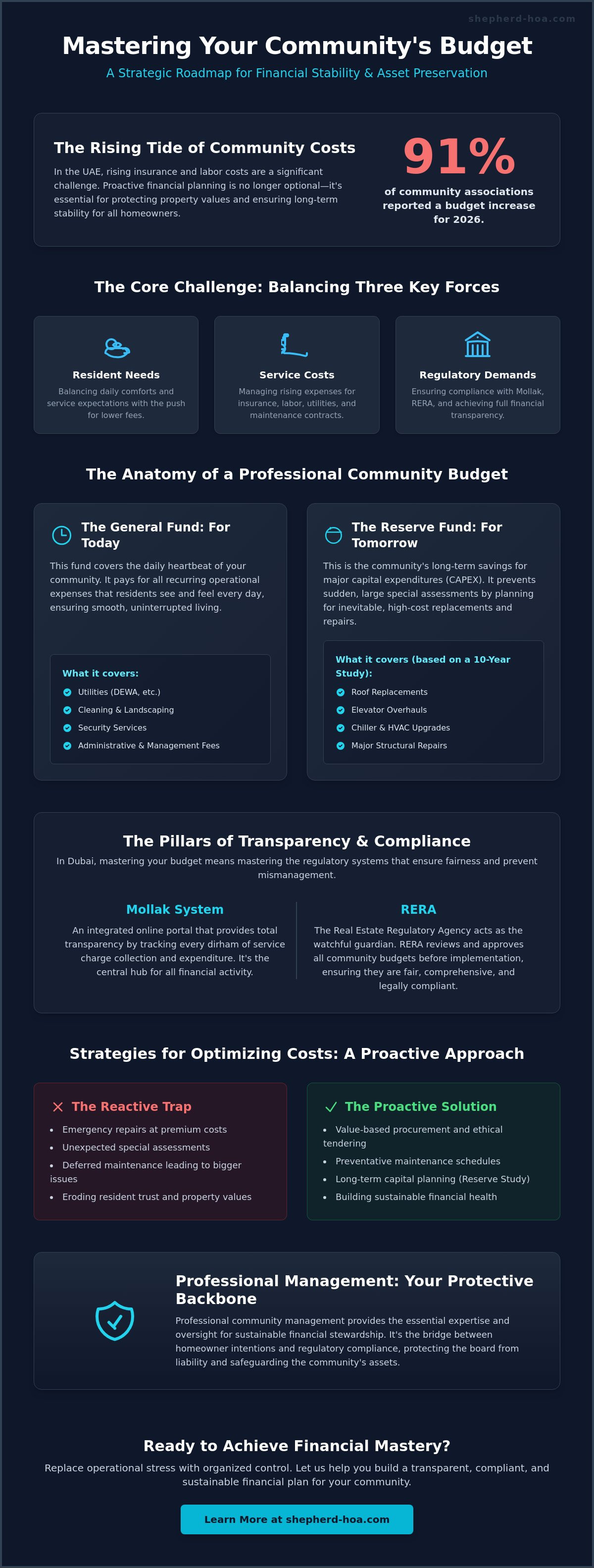
A professional community budget is much more than a list of expenses; it's a strategic roadmap for asset preservation. Think of it as a blueprint that ensures your building or neighborhood remains a desirable place to live for decades. Mastering your community's budget requires a deep understanding of how three distinct forces interact: the evolving needs of residents, the rising costs of service providers, and the strict demands of regulatory standards. When these three elements align, the community thrives. When they clash, the resulting friction often leads to deferred maintenance and falling property values.
The primary revenue source for this financial ecosystem is the service charge. This collection is the lifeblood of every operation, from landscaping to legal compliance. While the scale differs, the underlying principles of a government budget apply here too. You must balance projected income against essential expenditures while maintaining a transparent trail for every dollar spent. Boards that take a reactive approach often find themselves trapped in a cycle of emergency repairs and special assessments. In contrast, proactive financial guardianship focuses on preventing issues before they occur, which is essential given that 91% of community associations reported budget increases in 2026 according to shepherd-hoa.com.
Defining the General Fund
The general fund covers the daily heartbeat of your community. It pays for the essential services that residents see and feel every day, such as utilities, cleaning, security, and administrative costs. This fund must remain liquid and easily accessible to ensure that service providers are paid on time and operations never grind to a halt. A healthy general fund is the foundation of resident satisfaction. If the bins aren't collected or the pool isn't cleaned because of cash flow issues, trust in the board evaporates quickly. Professional Budget Planning ensures these recurring costs are accurately forecasted so the community's daily life remains uninterrupted.
The Essential Role of the Reserve Fund
While the general fund handles today, the reserve fund protects tomorrow. This is the community's dedicated "savings account" for major capital expenditures, often referred to as CAPEX. These funds are set aside for high-ticket items that don't happen every year but are inevitable over time. Examples include roof replacements, elevator overhauls, or chiller upgrades. Mastering your community's budget involves conducting a reserve fund study with a 10-year outlook. This long-term perspective prevents the "sticker shock" of a sudden multi-million dollar repair. By contributing consistently to the reserve fund, you ensure that the cost of major upgrades is shared fairly across generations of owners rather than falling on whoever happens to live there when the roof finally fails.
Regulatory Framework: Compliance and Financial Transparency
The days of developers holding unilateral control over community finances are fading. In the modern landscape, the shift toward owner-led governance means homeowners have a direct seat at the table. This transition brings a high degree of responsibility that requires more than just good intentions. Professional owners association management serves as the essential bridge here, ensuring every financial decision aligns with national laws and local regulations. Mastering your community's budget is impossible without this legal backbone; it protects the board from liability and ensures funds are handled with total integrity. A key part of this process is ethical tendering. You must ensure that third-party contracts for security, cleaning, or maintenance are chosen based on merit and value rather than convenience.
Mollak and RERA: The Pillars of Transparency
For those managing properties in Dubai, the Mollak system stands as the ultimate pillar of transparency. It's an integrated online portal that tracks every dirham of service charge collection and expenditure. The Real Estate Regulatory Agency (RERA) acts as the watchful guardian of these funds, reviewing and approving budgets before they're officially implemented. These government-mandated systems are designed to prevent the mismanagement of community funds. They provide a level of oversight that mirrors the rigorous standards found in a Local Government Finance and Budgeting Guide. This layer of protection ensures that resident contributions are used solely for the benefit of the community assets.
Quarterly Reporting and Audit Readiness
Trust is the currency of community living. To maintain it, independent financial audits are a necessity. These audits verify that the community's accounts are accurate and that all spending follows the approved budget. We recommend sharing quarterly progress reports with homeowners to maintain a culture of open communication. These reports shouldn't just be dry spreadsheets; they should tell the story of how the budget is being used to improve the community's daily life. When it's time to request a service charge increase, having a history of transparent reporting makes the government approval process much smoother. If you're feeling overwhelmed by the paperwork, reaching out for expert help with Mollak and RERA approval can provide the organized control you need to stay compliant.
Securing these approvals requires a methodical approach to data. You'll need to provide detailed evidence of previous spending and clear justifications for future costs. This level of preparation is what separates a struggling board from one that's truly mastering your community's budget. By staying audit-ready throughout the year, you avoid the frantic energy of last-minute filings and ensure the long-term stability of your collective assets.
Strategic Allocation: General Fund vs. Reserve Fund
Mastering your community's budget requires a disciplined approach to fund separation. It's a delicate balancing act where you ensure the comfort of today's residents doesn't compromise the financial solvency of tomorrow. You are essentially acting as a guardian for the community's future. The calculation of community service charge budgets typically relies on the total unit area of each property. This method ensures that every owner contributes a fair share proportional to their footprint, creating a logical and transparent basis for all collections.
An underfunded reserve fund is a significant risk that often leads to property devaluation. When major systems fail and there's no money in the bank, boards are forced to issue special assessments. These sudden, high-value invoices cause immediate financial stress for homeowners and can make the community less attractive to prospective buyers. If your community is fortunate enough to have a budget surplus, handle it with care. Strata laws often have specific requirements for excess funds, usually mandating they be credited to the following year's budget or moved into the reserve fund to bolster long-term security.
Managing Operational Cash Flow
Consistent cash flow is the backbone of a well-run community. You need a robust strategy for Service Charge Collection that minimizes arrears and keeps the general fund healthy. We recommend using professional Utility Account Setup to track and reduce common area consumption. This data allows you to identify waste and lower recurring costs. It's also vital to maintain a "working capital" buffer. This small pool of liquid funds allows you to handle unforeseen minor repairs without dipping into your long-term savings or disrupting daily operations.
The 10-Year Capital Expenditure Plan
A professional reserve fund study is the most effective tool for mastering your community's budget over the long term. This study guides you through the process of calculating the "useful life" of every major asset, from the lobby flooring to the central cooling plant. By knowing exactly when an asset is likely to fail, you can spread the replacement cost over several years. A healthy reserve fund doesn't just pay for repairs; it acts as an insurance policy for property resale values. Buyers are much more likely to invest in a community that demonstrates organized control over its future liabilities.
By treating the budget as a living document rather than a static spreadsheet, you provide the steady guidance your community needs. This proactive stance replaces the anxiety of unexpected costs with the peace of mind that comes from being fully prepared for whatever the future holds.
Practical Strategies for Optimizing Community Operational Costs
Efficiency in community management isn't about choosing the cheapest option; it's about securing the best value for every dirham spent. Mastering your community's budget requires a shift from "lowest-bid" procurement to a "value-based" model. While a cut-price contract might look good on paper today, it often leads to subpar service and hidden costs that emerge months later. By selecting vendors based on their track record and long-term reliability, you protect the community from the disruption of poor maintenance. Consolidating service contracts, such as combining security and cleaning under a single provider, often unlocks better rates and simplifies communication for the board.
Proactive facility management acts as a primary shield against rising operational costs. When systems are maintained according to a rigorous schedule, they run more efficiently and last longer. This reduces the immediate pressure on your general fund and delays the need for major capital withdrawals from your reserve fund. It's a methodical approach that replaces the frantic energy of emergency repairs with the calm reliability of a well-oiled machine. If you're looking to streamline these processes, the expert Budget Planning services offered by Shepherd HomeOwners' Association can help you identify where costs can be safely optimized without sacrificing quality.
Energy and Water Conservation
Utilities often represent the largest variable expense in any community. LED retrofitting and smart irrigation systems aren't just environmental choices; they're powerful budget-saving tools. We recommend implementing sub-metering to encourage individual accountability for consumption, as this often leads to a significant drop in common area usage. To identify "invisible" waste, check for leaks in irrigation lines, ensure AC settings in common areas are optimized for occupancy, and verify that parking lot lighting is on a functional timer.
Ethical Tendering and Contract Oversight
A fair and transparent bidding process is essential for maintaining owner trust. Start by creating a clear scope of work so all vendors bid on the same requirements. Incorporate Key Performance Indicators (KPIs) into your service contracts to ensure providers meet their obligations. This professional oversight prevents overpayment for services that aren't being delivered. When you maintain strict administrative compliance, you ensure that every contract serves the community's best interests while keeping costs predictable and manageable.
By focusing on these practical optimizations, you transform the budget from a source of stress into a tool for community excellence. This level of oversight is a hallmark of mastering your community's budget, ensuring that your financial stewardship remains both sustainable and effective for years to come.
Professional Stewardship: The Conclusion of Financial Mastery
Mastering your community's budget is the culmination of technical precision, legal adherence, and long-term strategic thinking. It's not a once-a-year administrative task; it's a continuous commitment to the health and longevity of your collective assets. Professional community management acts as the invisible backbone of this process. It provides the essential structure and expert oversight that volunteer boards need to navigate an increasingly complex financial landscape. While some homeowners may view management fees as a simple line-item expense, they're actually a strategic investment in asset protection. This professional guidance prevents the costly errors, legal penalties, and deferred maintenance that eventually drain a community's value and reputation.
We invite you to evaluate your current financial health against 2026 standards. As insurance costs rise and safety regulations become more stringent, the traditional methods of managing books on a basic spreadsheet are no longer sufficient. You need a partner that understands how to blend modern technology with traditional service values. This ensures your community remains a stable, well-maintained sanctuary for everyone who calls it home. By prioritizing professional stewardship, you replace operational anxiety with a sense of organized control and peace of mind.
Why Professional Governance Matters
Experts who understand the nuances of living in a community provide more than just administrative help. They bring the calm reliability that comes from RERA-approved compliance and a deep familiarity with government-mandated systems like Mollak. Beyond the paperwork, professional managers serve as neutral mediators during financial disputes between owners. This role is essential for maintaining social harmony. It ensures that service charge collection efforts remain professional and objective rather than personal or confrontational, protecting the relationships that make a neighborhood a true community.
Securing the Future of Your Assets
At its core, mastering your community's budget is an act of guardianship. You're protecting the social fabric and the financial value of every home under your care. A budget that has been truly mastered is easy to identify because it's built on three pillars. It's transparent, meaning every owner clearly understands how their contributions are used. It's solvent, with a robust reserve fund ready for future capital needs. Finally, it's compliant, meeting every regulatory filing requirement with methodical precision.
If your community's current financial plan feels like a source of stress rather than a roadmap for success, it's time to seek expert guidance. Our team is ready to provide the sophisticated tools and simple interactions you need to succeed. Reach out to us today for professional Budget Planning support and take the first step toward securing your community's long-term legacy.
Securing Your Community's Legacy Through Strategic Oversight
Mastering your community's budget is the culmination of technical precision, legal adherence, and long-term strategic vision. It's not a once-a-year administrative task; it's a continuous commitment to the health and longevity of your collective assets. Professional management acts as the invisible backbone of this process, providing the structure and expert oversight that volunteer boards need to navigate an increasingly complex financial landscape. While some homeowners may view management fees as a line-item expense, they're actually a strategic investment in asset protection. This professional guidance prevents the costly errors and legal penalties that eventually drain a community's value and reputation.
We invite you to evaluate your current financial health against 2026 standards. As insurance costs rise and safety regulations become more stringent, the traditional methods of managing books on a simple spreadsheet are no longer sufficient. You need a partner that understands how to blend modern technology with traditional service values. This ensures your community remains a stable, well-maintained sanctuary for everyone who calls it home. By prioritizing professional stewardship, you replace operational anxiety with a sense of organized control and peace of mind.
Why Professional Governance Matters
Experts who understand the nuances of living in a community provide more than just administrative help. They bring the calm reliability that comes from RERA-approved compliance and a deep familiarity with government-mandated systems like Mollak. Beyond the paperwork, professional managers serve as neutral mediators during financial disputes between owners. This role is essential for maintaining social harmony. It ensures that service charge collection efforts remain professional and objective rather than personal or confrontational, protecting the relationships that make a neighborhood a true community.
Securing the Future of Your Assets
At its core, financial mastery is an act of guardianship. You're protecting the social fabric and the financial value of every home under your care. A budget that's been truly mastered is easy to identify because it's built on three pillars. It's transparent, meaning every owner clearly understands how their contributions are used. It's solvent, with a robust reserve fund ready for future capital needs. Finally, it's compliant, meeting every regulatory filing requirement with methodical precision.
If your community's current financial plan feels like a source of stress rather than a roadmap for success, it's time to seek expert guidance. Our team is ready to provide the sophisticated tools and simple interactions you need to succeed. Secure your community's financial future with Shepherd HomeOwners' Association's expert budget planning and take the first step toward securing your community's long-term legacy.
Frequently Asked Questions
What is the difference between a general fund and a reserve fund in a community budget?
The general fund covers recurring operational expenses like security, cleaning, and daily administration, while the reserve fund is a dedicated savings account for major capital replacements. You'll use the general fund to pay monthly utility bills and the reserve fund for once-in-a-decade projects like roof replacements or elevator overhauls. This separation ensures that current comfort doesn't drain the resources needed for future structural integrity. It's a fundamental step in mastering your community's budget and protecting property values.
How are service charges calculated for individual units under national law?
Service charges are calculated by dividing the total budgeted expenses by the total area of all units in the community to find a rate per square foot. Each individual unit owner then pays based on their specific unit's area. This method ensures a fair and proportional distribution of costs across the entire development. It's the standard practice under national law to maintain transparency and equity among residents while ensuring the community's assets are fully funded.
Is it mandatory to use the Mollak system for financial reporting in 2026?
Yes, the Mollak system is the mandatory platform for all financial governance and service charge collections in Dubai for 2026. Every community must submit its budget through this portal to receive the necessary RERA approval. This system ensures that funds are handled transparently and prevents the unauthorized use of community money. Without Mollak compliance, a community cannot legally collect service charges from its owners or pay its service providers.
How often should a community conduct a reserve fund study?
A community should commission a professional reserve fund study every three to five years. While the study provides a 10-year outlook, market costs for labor and materials change frequently. Updating the study ensures your savings plan remains realistic and solvent. Regular updates are a hallmark of mastering your community's budget, as they prevent the need for sudden, stressful special assessments when major assets reach the end of their useful life.
What happens if a community has a budget deficit at the end of the year?
A budget deficit at the end of the year usually requires the board to recover the shortfall through the following year's service charge increase or a one-time special assessment. Both options typically require government oversight and approval from RERA to ensure they're justified. To avoid this operational stress, boards should maintain a "working capital" buffer within their general fund to handle minor unforeseen costs without sliding into a deficit.
Can an owners' committee change service providers without RERA approval?
No, an owners' committee cannot unilaterally change service providers without following the established regulatory process. All new contracts must be tendered ethically and then uploaded to the Mollak system for government review and approval. This oversight ensures that providers are qualified and that the contract terms are fair for the homeowners. Professional management helps the committee navigate these administrative steps to ensure every change remains legally compliant and transparent.
How can we legally reduce our community's service charges?
You can legally reduce service charges by implementing energy-saving measures and optimizing your procurement strategy. Transitioning to LED lighting or smart irrigation systems significantly lowers utility bills, which are often the largest variable expense in any community budget. Additionally, consolidating service contracts and using value-based tendering helps secure better rates from providers. These proactive steps lower the overall budget requirement without compromising the quality of maintenance or the safety of the community.
What role does the owners' committee play in the budget approval process?
The owners' committee acts as the representative voice of the homeowners during the budget development process. Their role is to review the proposed figures, endorse the strategic direction, and ensure the budget aligns with the community's needs. Once the committee endorses the plan, it is submitted for final RERA approval. This collaborative approach ensures that the financial roadmap has the support of the people it serves while meeting all legal and professional standards.


Comments