
The Essential Homeowner Checklist for Property Handover in Dubai: 2026 Edition
- Sohrab Virani

- 15 hours ago
- 12 min read
Your mortgage won't cover your closing costs anymore, and missing a single structural defect during your final walk-through could cost you thousands in repairs later. It's natural to feel a sense of anxiety regarding hidden defects or the complex multi-agency regulations that govern Dubai's real estate market. By following a professional homeowner checklist for property handover dubai, you can replace this operational stress with a sense of organized control and peace of mind. We understand that this transition is about more than just keys; it's about the long-term guardianship of your new asset.
You deserve a move-in process that's both efficient and legally secure. We'll help you navigate the entire transition with professional precision, from snagging inspections to final documentation. This guide provides a clear roadmap for achieving a defect-free home and ensuring full compliance with RERA and Mollak standards. We'll preview the essential steps for utility account setup and explain how to manage service charges effectively, especially as many communities see a 10-15% reduction in rates this year. Your journey toward a stable, well-managed home starts with these clear, actionable steps.
Key Takeaways
Identify structural defects during the critical snagging window to ensure your developer remains accountable for repairs before you sign the handover certificate.
Secure your asset's legal standing by verifying Title Deeds and registering service charges through the Mollak system for maximum financial transparency.
Streamline your move-in process by coordinating utility account setup and understanding the specific regulatory requirements for DEWA and cooling services.
Utilize a professional homeowner checklist for property handover dubai to navigate the transition with organized control and protect your long-term investment value.
Protect your property beyond the first day by maximizing the 12-month Defect Liability Period and engaging with your community Owners Committee.
Table of Contents
Understanding the Property Handover Framework in 2026
The property handover process in Dubai is a formal legal transition that marks the shift of liability from the developer to you, the owner. It's far more than a simple exchange of keys. This stage represents the moment you assume full responsibility for the asset's physical condition and financial standing. In the current market, this transition is strictly governed to ensure transparency and protect the long term value of the community. Using a professional homeowner checklist for property handover dubai ensures that you don't miss critical steps during this high stakes window.
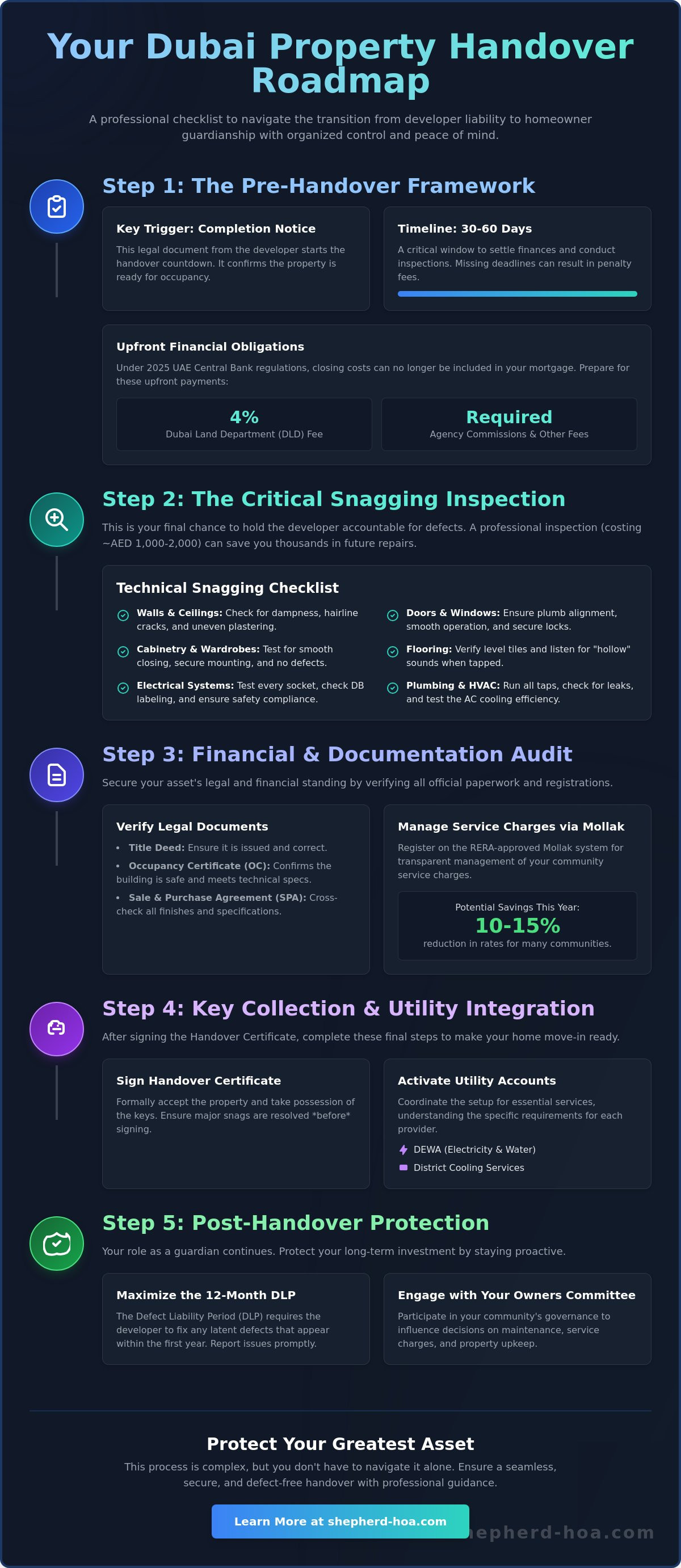
Receiving your Completion Notice is the primary trigger for this process. This document isn't just an invitation to view your home; it's a legal declaration that the property is ready for occupancy. Once issued, a countdown begins for your final financial obligations. Under the UAE Central Bank regulations established in February 2025, you must pay all transaction fees, including the 4% Dubai Land Department fee and agency commissions, upfront. These costs can no longer be financed as part of your mortgage. This makes timing and liquidity essential for a smooth transition.
Successful handovers involve several key stakeholders working in a regulated ecosystem. The developer is responsible for delivering the unit according to the Sale and Purchase Agreement (SPA). The Real Estate Regulatory Agency (RERA) provides the framework that ensures both parties meet their obligations. Finally, the Community Manager steps in to oversee communal areas and maintain social harmony. Adopting a "guardian" mindset at this stage is vital. By providing rigorous oversight today, you prevent structural or administrative issues from degrading your investment tomorrow.
The Legal Landscape of Possession
Your rights during handover are primarily rooted in your SPA and the 2026 regulatory updates. The developer must provide an Occupancy Certificate (OC) issued by the relevant authority, such as Dubai Municipality or Trakhees. This certificate proves the building is safe and meets all approved technical specifications. Without a valid OC, the handover cannot legally proceed. You have the right to demand that all major snags are resolved before you sign the Handover Certificate, protecting your position under the law.
Timeline of a Standard Handover
A typical handover follows a methodical 30 to 60 day roadmap. Once the Completion Notice arrives, you generally have 14 to 30 days to settle the final purchase price and any outstanding service charges. Following payment, you'll schedule your physical inspection. It's critical to meet these deadlines. Missing the handover window can result in daily penalty fees or, in extreme cases, the developer issuing a notice of default. Staying organized with a homeowner checklist for property handover dubai helps you track these milestones and avoid unnecessary financial risks.
The Physical Inspection: A Technical Snagging Checklist
The physical inspection is perhaps the most critical 120 minutes of your ownership journey. It's the moment when marketing promises meet structural reality. While a professional snagging company typically costs between AED 1,000 and AED 2,000, the value of identifying defects early is immeasurable. Implementing a rigorous homeowner checklist for property handover dubai allows you to approach the inspection with clinical precision. These checks aren't just about aesthetics; they're about the long-term preservation of your asset's value. You must document every hairline crack, damp patch, or alignment issue to ensure the developer rectifies them before you take full possession.
Ensuring the finishing matches your Sale and Purchase Agreement (SPA) protects your investment's resale potential and your personal peace of mind. To help you stay organized, follow these essential physical checks:
Inspect all walls and ceilings for signs of dampness or uneven plastering.
Check the alignment of door frames and window casings to ensure they're plumb.
Test all cabinetry and wardrobes for smooth operation and secure mounting.
Verify that all flooring tiles are level and free from "hollow" sounds when tapped.
Electrical and Plumbing Deep-Dive
A thorough audit requires testing all systems under load. Don't just flip switches; use a plug-in tester for every socket to verify earthing and safety compliance. Check the Distribution Board (DB) for clear labeling and secure connections. On the plumbing side, run every tap and flush every toilet simultaneously to test water pressure and drainage capacity. This helps identify silent leaks behind tiles or cabinets before they cause expensive damage. If your unit includes smart home features, verify that the IoT connectivity is stable and integrated as promised. If you find the technicalities overwhelming, we can assist with professional property handover support to ensure nothing is overlooked.
HVAC and Environmental Systems
In Dubai's climate, the HVAC system is your home's most vital organ. Use a digital thermometer to check temperature differentials at the vents and inspect duct cleanliness for construction debris. Poorly maintained systems lead to higher utility bills and poor air quality. You should also examine the insulation and glazing around windows. Check for air leaks that compromise thermal efficiency, as these can significantly impact your future cooling costs. For a more detailed breakdown of what to look for, refer to this comprehensive property handover checklist. The Defect Liability Period (DLP) serves as your primary safety net, providing a 12-month window where the developer is legally obligated to rectify non-structural faults. By being a watchful guardian during the initial inspection, you set the standard for your home's long-term care and social harmony within the community.
The Financial and Documentation Audit
Securing your home's physical integrity is only half the battle. A truly robust homeowner checklist for property handover dubai must prioritize the financial and legal audit to prevent future liability. You're not just buying a unit; you're entering a regulated community ecosystem. Ensuring your Title Deed is correctly registered and your service charges are cleared is essential for protecting your equity. Under current Dubai Land Department regulations, the 4% transfer fee and administrative costs must be settled upfront, as these can no longer be bundled into your mortgage. This requires precise financial planning before you even reach the doorstep.
The Title Deed remains your ultimate proof of ownership. For apartments and offices, expect a registration fee of approximately AED 580. However, the true complexity lies in the ongoing financial relationship with the community. You must verify that the developer has cleared all outstanding liabilities before you sign the handover certificate. Inheriting unpaid utility bills or construction-related fees can lead to immediate administrative friction and may even block your ability to obtain necessary permits later.
The Mollak and RERA Compliance Check
Transparency in community costs is now a digital standard. You should use the Mollak system to verify that the service charges proposed by your developer are officially approved by RERA. In 2026, we've seen a 10-15% reduction in these fees across mid-market areas like JVC and JLT, where rates now average between AED 10 and AED 17 per square foot. By cross-referencing the RERA Service Charge Index, you ensure your budget planning is based on fair, regulated pricing. A professional Community Manager acts as a guardian here, ensuring every dirham collected is accounted for and utilized for the preservation of communal assets.
Required Paperwork for Possession
Your formal handover won't proceed without a specific set of documents. The No Objection Certificate (NOC) is the most critical; it's the gatekeeper that confirms the developer has no financial claims against the unit. NOC fees typically range from AED 500 to AED 5,000 depending on the developer. Ensure you have these five essentials ready:
Original Sales and Purchase Agreement (SPA)
Valid Passport and Emirates ID
Final payment receipts for the property and DLD fees
A valid NOC from the developer
The Oqood (initial registration document)
Digital records are your best defense. Create a secure digital vault for these documents to ensure you can prove compliance and ownership at a moment's notice. This organized approach replaces operational stress with a sense of control, allowing you to focus on the social harmony of your new neighborhood.
Key Collection and Utility Integration
The formal sign-off is the final gate between your investment and your residency. You shouldn't feel pressured to sign an unconditional Handover Certificate if significant snags remain. Instead, ensure the document clearly lists all pending repairs with agreed-upon completion dates. This is a vital part of your homeowner checklist for property handover dubai. Once you sign this certificate, the developer's liability for minor cosmetic issues begins to shift, though the 12-month Defect Liability Period (DLP) remains your primary safety net for functional defects.
Utility integration is the next logical step in establishing control over your asset. You need to activate your accounts with the Dubai Electricity and Water Authority (DEWA) and your specific district cooling provider, such as Empower or Emicool. These services require security deposits, which are often overlooked in initial budgeting. For apartments, DEWA deposits are typically AED 2,000, while villas require AED 4,000. Managing these connections early ensures your home is habitable the moment you receive the keys, preventing the discomfort of a dark or uncooled unit.
Activating Essential Services
Digital transformation has simplified utility activation significantly. You can now link your UAE PASS to the DEWA portal for near-instant account creation. When you first enter the property, verify the smart meter readings. Ensure the starting figure matches the developer’s final reading to avoid paying for construction-related consumption. For cooling, you'll need to submit your Title Deed and Emirates ID to the provider to initiate service. If you require assistance with these administrative hurdles, we offer specialized utility account setup services to streamline your transition and ensure all deposits are correctly registered.
Transitioning to Residency
Moving into a managed community requires more than just a moving truck. Most buildings and gated communities in Dubai require a formal move-in permit issued by the community manager. This permit ensures that the management team is aware of your arrival and can protect common areas from damage during the move. You should also take time to review the community rules and regulations to understand your rights and responsibilities regarding noise, parking, and communal facility use.
Logistics are equally important for a smooth start. You must book the service elevator in advance, as many towers have strict windows for moving furniture. Simultaneously, register your household members and vehicles with the community security team to receive your RFID access cards and fobs. This organized approach fosters social harmony and ensures your first night in your new home is peaceful. By treating this phase with the same precision as your financial audit, you act as a responsible guardian of your new environment and its long-term value.
Post-Handover: Protecting Your Long-Term Investment
Transitioning from the technical steps of the homeowner checklist for property handover dubai to long-term asset guardianship is where many owners lose momentum. Handover isn't a one-off event; it's the beginning of your duty of care toward your home. Your active participation in the community's governance ensures that the social harmony and financial health of the building remain stable for years. This phase is about moving from the role of a buyer to that of a stakeholder, where your oversight directly impacts the community's reputation and your unit's future market value.
The Defect Liability Period (DLP) is your primary safety net during the first 12 months of occupancy. It's during this time that you must remain vigilant for issues that weren't apparent during the initial snagging process. Simultaneously, you should explore joining the Owners Committee. This group represents the collective voice of the homeowners, providing a platform to influence community decisions and ensure transparency in how your service charges are spent. In 2026, active committees have been instrumental in auditing budgets to reflect the 10-15% reduction in service charges seen in several mid-market districts, ensuring that savings are passed directly to the owners.
Managing the DLP and Warranties
Latent defects, such as slow-developing leaks, electrical surges, or hairline cracks in non-structural walls, often only appear once a unit is fully occupied and systems are running daily. You should keep a methodical log of every issue and report it to the developer's maintenance team immediately. It's essential to distinguish between the 10-year structural warranty, which covers the building's core integrity, and the 1-year MEP warranty that covers mechanical, electrical, and plumbing systems. Shepherd HomeOwners' Association acts as the invisible backbone for your community’s stability, ensuring these technical standards are upheld consistently and that developer obligations are met without delay.
The Role of the Community Manager
A high-performing community manager is the primary driver of long-term property value. By overseeing professional owners association management, they ensure that communal assets like gyms, pools, and elevators are maintained to elite standards. This attention to detail directly correlates with higher rental yields and resale prices. Effective management also involves the ethical tendering of third-party contracts for security, cleaning, and landscaping, ensuring that every dirham of your service charge is used efficiently. Maintaining social harmony is the human element of this work, as clear rules and fair enforcement prevent the friction that often plagues unmanaged buildings. Ensure your community is managed with integrity—Contact Shepherd HomeOwners' Association today.
Securing Your Future as a Property Guardian
Transitioning into your new home is a significant milestone that requires meticulous attention to detail. By utilizing a comprehensive homeowner checklist for property handover dubai, you ensure that every physical defect is documented and every financial obligation is transparently settled. This process protects your capital investment and establishes a foundation for social harmony within your community. Your journey doesn't end when the keys are handed over. It evolves into a long-term commitment to maintaining the asset's value through active oversight and professional collaboration.
We provide the professional backbone needed to manage these complexities with ease. Our RERA approved community management and Mollak-integrated financial reporting ensure your interests are always protected. We prioritize integrity through ethical tendering for facility management, ensuring your community thrives. Partner with the guardians of community value; discover Shepherd HomeOwners' Association management services. You've done the hard work of finding your home. Now, let us help you protect it.
Frequently Asked Questions
Is professional property snagging mandatory in Dubai?
Professional snagging isn't legally mandatory, but skipping it is a significant risk for any new owner. You have the right to conduct the inspection yourself or hire a specialist to identify issues. Using a homeowner checklist for property handover dubai helps you spot technical defects that might otherwise be missed. Most owners find that the cost of a professional report is far less than the price of fixing hidden structural or MEP issues later.
What happens if I find major defects after I've signed the handover certificate?
Major defects discovered after signing are covered under your statutory warranty periods. You should document the issue with clear photos and submit a formal request to the developer's maintenance department immediately. Since you're within the 12 month Defect Liability Period, the developer is legally obligated to rectify functional faults. For structural issues, your protection extends significantly longer under Dubai's real estate regulations.
How long is the developer legally responsible for structural defects?
Developers in Dubai are legally responsible for structural defects for a period of 10 years from the date of building completion. This long term warranty covers the core integrity and load bearing elements of the property. For non structural items like plumbing fixtures or electrical switches, the responsibility typically lasts for one year. This distinction ensures the long term stability of your investment and provides peace of mind for a decade.
Can I refuse to take handover if the service charges seem too high?
You can't usually refuse handover based solely on the cost of service charges if they're RERA approved. Service charges are calculated based on the RERA Service Charge Index and must be registered in the Mollak system. If you believe the charges are incorrect, you should verify them against the official index. Delaying the handover over approved charges could trigger financial penalties from the developer.
What is the Mollak system and why does it matter for new homeowners?
Mollak is the Dubai Land Department's integrated system for monitoring and regulating service charges in co owned properties. It matters because it ensures every dirham you pay is audited and approved by RERA before collection. This system prevents developers from charging arbitrary fees and ensures your community management team is fully licensed. It's the primary tool for financial transparency and protecting your rights as a stakeholder.
How do I set up my DEWA and chiller accounts for a new property?
You can set up your DEWA account digitally using the DEWA website or smart app by providing your Title Deed and Emirates ID. Chiller accounts for district cooling must be opened separately with providers like Empower or Emicool. This process involves a security deposit and is a vital part of your homeowner checklist for property handover dubai. Completing these registrations early ensures your home is habitable before your move in date.
What is the "Defect Liability Period" and what does it cover?
The Defect Liability Period is a 12 month window starting from the handover date during which the developer must repair any non structural defects. This covers mechanical, electrical, and plumbing systems as well as finishing issues like cabinetry or tiling. It serves as your primary protection against latent defects that only become apparent once you start using the property's systems daily. It's your first line of defense for asset preservation.
Do I need to pay the full year of service charges upfront at handover?
It's standard practice in Dubai to pay the first year of service charges upfront during the handover process. Developers typically require this payment before they'll issue the No Objection Certificate (NOC) needed for key collection. While some developers might offer quarterly installments, you should budget for the full annual amount. This payment ensures the community management team has the necessary funds to maintain communal areas and essential services.


Comments