
RERA Compliance for Communities: The Definitive 2026 Guide to Regulatory Excellence
- Sohrab Virani

- May 18
- 13 min read
In 2026, a single administrative oversight in the Mollak system isn't just a technical glitch; it's a direct risk to your community's financial stability and your reputation as a guardian of owner interests. You likely feel the pressure of these evolving Dubai Land Department requirements, especially with the new permit regimes introduced under Dubai Law No. 4 of 2026. It's exhausting to keep up with shifting regulations and technical audit nuances while trying to maintain resident trust. We understand the personal stakes involved in community governance and the weight of avoiding hefty non-compliance penalties.
This rera compliance for communities 2026 guide will show you how to transform these complex legal obligations into a streamlined system of professional excellence. You'll learn how to master the latest Mollak auditing standards and the specific steps needed to secure your community's assets without the stress of unexpected fines. We'll explore how transparent financial reporting and proactive budget planning don't just satisfy RERA; they actively increase your property's market value and foster long-term social harmony. By following this roadmap, you can replace operational stress with a sense of organized control and peace of mind.
Key Takeaways
Understand how Dubai Law No. 4 of 2026 and Law No. 6 of 2019 redefine the legal responsibilities and permit requirements for modern shared communities.
Learn to master the Mollak system to ensure service charge collections are transparent, automated, and fully audited by the Dubai Land Department.
Clarify the specific governance roles of the Owners' Committee to prevent administrative overlap and protect members from legal liabilities.
Follow this rera compliance for communities 2026 guide to standardize your tendering processes and ensure all facility management providers hold valid RERA licenses.
Discover how professional budget planning and expert oversight act as a protective backbone for your community’s financial health and long-term asset value.
Table of Contents
Understanding the RERA Regulatory Landscape in 2026
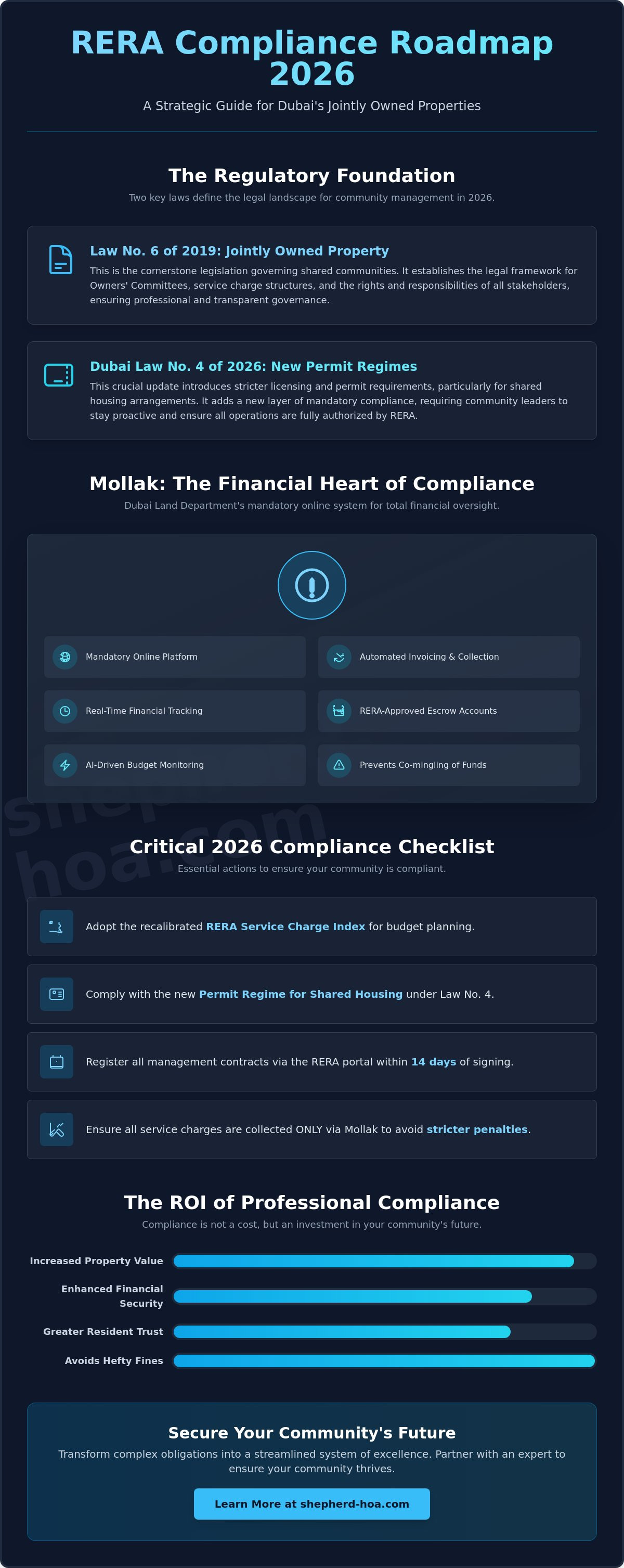
The Real Estate Regulatory Agency, commonly known as RERA, functions as the dedicated regulatory arm of the Dubai Land Department. It provides the essential framework that keeps our shared spaces functional, secure, and legally sound. For anyone tasked with community oversight, this rera compliance for communities 2026 guide serves as a vital roadmap for navigating a complex administrative environment. The legal foundation rests on Law No. 6 of 2019, which governs Jointly Owned Property. By 2026, the application of this law has evolved into a sophisticated digital ecosystem where transparency isn't just encouraged; it's mandatory for every community.
Compliance acts as the primary engine for property appreciation. In a market as competitive as Dubai, investors look for communities that demonstrate professional governance and clear financial records. When your community meets every RERA standard, you're doing more than avoiding fines. You're actively preserving the long-term value of every unit. This shift toward total digital transparency means that every service charge collected and every dirham spent is visible to the authorities and the owners alike. It's a system designed to replace administrative confusion with a sense of calm, organized control. It's about protecting your investment through diligent oversight.
The Core Objectives of Real Estate Regulation
RERA's primary mission is to protect the rights of everyone involved in the real estate cycle. This includes owners, developers, and management firms. By standardizing service delivery across all residential and commercial zones, the agency ensures that no community is left behind. These regulations draw inspiration from global standards, such as the principles found in the Real Estate (Regulation and Development) Act, 2016, which emphasizes accountability and resident protection. Ethical financial practices are now enforced through mandatory government portals, ensuring that your community's funds are used exactly as promised. This standardization builds a foundation of trust between residents and governance bodies.
Key Legislative Changes for 2026
The 2026 landscape introduces specific updates that require your immediate attention. The RERA Service Charge Index has been recalibrated to reflect current market costs for facilities management, which directly impacts your annual budget planning. Additionally, Dubai Law No. 4 of 2026 has introduced a new permit regime for shared housing, adding another layer of responsibility for community leaders. You must also ensure that all community management contracts are registered through the official RERA portal within 14 days of signing. Stricter penalties are now in place for any unauthorized service charge collections, making it more important than ever to have a professional partner who understands the technical nuances of the Mollak system. Staying ahead of these changes ensures your community remains a model of regulatory excellence.
The Mollak System: The Financial Heart of Compliance
Mollak is the mandatory online system administered by the Dubai Land Department. It serves as the financial backbone for all jointly owned properties in the emirate. By 2026, the system has moved beyond simple record-keeping to become a real-time oversight tool. It automates service charge invoicing and ensures every payment is tracked with absolute precision. One of its most critical functions is preventing the co-mingling of community funds. By directing all payments into RERA-approved escrow accounts, the system protects the community’s assets from being diverted for unauthorized uses. Staying current with this rera compliance for communities 2026 guide requires a commitment to consistent financial data entry. This level of diligence replaces operational stress with a sense of professional mastery.
In 2026, the demand for real-time financial data has intensified. RERA now utilizes AI-driven tools to monitor budget variances and collection trends across the city. This means that delayed entries or mismatched figures can trigger immediate system flags. For an Owners' Committee, this digital scrutiny acts as a protective shield. It ensures that the management company is operating with total integrity and that the community's financial health is preserved. When your data is accurate and up-to-date, the system becomes an invisible backbone that supports every decision you make.
Navigating the Budget Approval Process
Getting a budget approved through Mollak is a methodical journey. It starts with a detailed draft budget prepared by the management team, reflecting actual maintenance costs and sinking fund requirements. This draft must then be reviewed and certified by a RERA-registered auditor. These auditors verify that every projected expense aligns with market rates and historical data. Once the audit is complete, the budget is submitted to RERA for final approval. Common bottlenecks often occur when documentation is incomplete or when service contracts aren't properly registered. If you're feeling overwhelmed by these technical requirements, exploring expert community management services can provide the steady guidance you need.
Transparency for Homeowners
Transparency is the most effective way to build resident trust. Through the Mollak service charge management portal, homeowners can verify the legitimacy of every invoice they receive. They no longer have to wonder where their money is going. This data is also linked directly to the Dubai REST app, giving owners instant access to their financial standing from their smartphones. When residents see that their community is governed with integrity and that funds are handled through official channels, collection rates naturally improve. This openness creates a harmonious environment where owners feel like valued stakeholders rather than just fee-payers.
Owners' Committee Governance: Rights and Liabilities
The transition from Owners' Associations to Owners' Committees represents a fundamental shift in how Dubai communities operate. Under Law No. 6 of 2019, the executive power moved from the developer to a structured oversight model. This rera compliance for communities 2026 guide emphasizes that while the committee holds significant influence, its role is strictly advisory and supervisory rather than executive. This distinction is a protective measure for volunteers. It ensures that the burden of day to day operations rests with the professional management company, while the committee acts as a watchful guardian of the owners' collective interests. By 2026, this model has matured into a system that balances resident advocacy with professional accountability.
Adhering to a strict code of conduct is no longer optional for committee members. Ethical requirements in 2026 focus on total transparency and the elimination of conflicts of interest. Members must act in the best interest of the community as a whole, rather than pursuing individual agendas. You can mitigate personal liability by following RERA mandated procedures for every decision. When the committee operates within its legal boundaries, it creates a stable environment where asset values are preserved and social harmony is maintained. This structured approach replaces the stress of governance with a sense of organized control.
Forming and Registering Your Committee
Eligibility for the Owners' Committee is strictly regulated as of March 2026. To run for a position, you must be a registered owner on the property Title Deed and have zero outstanding service charges. The nomination process is time sensitive; you must submit your candidacy at least 21 days before the Annual General Assembly. Once the vote is finalized, the elected committee must be registered through the RERA portal within 14 days. This mandatory registration ensures that the committee is legally recognized by the Dubai Land Department and can fulfill its oversight duties effectively. Regular meetings are required, and every session must be documented with formal minutes to maintain a clear audit trail.
The Committee’s Role in Financial Oversight
Financial oversight is the committee's most vital function. You're responsible for reviewing quarterly progress reports and ensuring that the management company is adhering to the approved financial plan. This includes scrutinizing how the community service charge budget is allocated across various operational needs. A key focus in 2026 is the sinking fund, which typically makes up 5-10% of the total budget. This fund is a critical safety net for major future repairs. By approving the selection of third party service providers based on fair market value and RERA licenses, the committee ensures that every dirham spent contributes to the community's long term health and stability.
Operational Compliance: Tendering and Facility Management
Operational excellence in 2026 is built on a foundation of rigorous vendor selection. RERA mandates that every service provider, from security teams to MEP specialists, must hold a valid license specifically approved for jointly owned property management. This requirement isn't just a legal checkbox. It's a protective measure that ensures only qualified professionals handle your community's vital infrastructure. By standardizing the tendering process, your committee can achieve fair market value, reflecting the 10 to 15 percent reduction in facilities management costs seen in several mid market communities this year. Documenting all service contracts within government mandated systems creates a permanent, transparent record of every operational commitment. This rera compliance for communities 2026 guide highlights that such diligence is the only way to ensure your community remains a safe and well maintained asset.
Performance audits for facility management (FM) have become more sophisticated. In 2026, RERA expects management companies to track Key Performance Indicators (KPIs) that align with the approved budget and service levels. When you have a clear audit trail of FM performance, you can hold providers accountable for the quality of their work. This proactive oversight replaces the stress of reactive repairs with a sense of organized control. It ensures that the funds collected from residents are directly translated into high quality service delivery and asset preservation.
Ethical Tendering Practices
A transparent Request for Proposal (RFP) process is the only way to eliminate bias and ensure the best outcome for the community. Your management partner plays a critical role here by vetting the technical capabilities of bidders before the committee reviews the final proposals. This objective layer prevents conflicts of interest and ensures that the lowest price doesn't come at the cost of safety or reliability. It's about building a network of partners who value your community's long term health as much as you do. To ensure your vendors meet these strict 2026 standards, consider partnering with Shepherd HOA for professional community management.
Maintaining Community Standards
Safety is non negotiable in Dubai's high rise landscape. RERA's 'Life and Safety' compliance requirements involve strict adherence to fire safety protocols and regular structural integrity audits. In 2026, there's also a heightened focus on sustainability, aligning with the Dubai 2040 Urban Master Plan. Communities are now encouraged to provide energy efficiency and sustainability reporting to promote greener living environments. Managing common area usage rights through clearly defined community rules ensures that every resident enjoys shared spaces fairly. This level of oversight preserves social harmony and protects the lifestyle your owners invested in.
Securing Your Community’s Future with Shepherd HOA
Shepherd HOA stands as a steady, expert guide for communities navigating the complexities of Dubai's real estate market. We act as the watchful guardian of your collective interests, ensuring every administrative and financial detail aligns with current government standards. Managing a community as a volunteer is a significant responsibility that often leads to operational stress. By choosing professional owners association management, you remove the heavy burden of compliance from your shoulders. Our team handles the technical intricacies of the Mollak system and RERA approvals, allowing you to focus on the high-level governance that truly matters. This rera compliance for communities 2026 guide has outlined the many challenges boards face; Shepherd HOA provides the definitive solution to meet them all.
Financial transparency remains our priority. We ensure that every dirham of the service charge collection is accounted for and protected through RERA-approved channels. With over 15 years of experience navigating RERA regulations, we possess a deep understanding of the local landscape. We've seen the transition from traditional management to the modern digital ecosystem, and we've evolved alongside it. This longevity allows us to provide oversight that is both technologically savvy and rooted in traditional service values. We don't just manage properties; we preserve the human and financial outcomes of every community we serve. It's about building a foundation of trust that lasts for decades.
Our Guardian Approach to Management
We replace the frantic energy of administrative troubleshooting with organized, authoritative control. Instead of one-size-fits-all models, we develop customized compliance roadmaps for both residential and commercial assets, addressing the unique needs of your specific community. This methodical rhythm ensures that nothing is left to chance. Proactive communication is at the heart of what we do. By keeping owners informed and engaged, we foster social harmony and build the trust necessary for a thriving environment. We act as the invisible backbone that supports your board's decisions and protects your asset's long-term value through diligent care.
Next Steps for Your Board
The path to regulatory excellence begins with a clear understanding of your current standing. We recommend requesting a comprehensive compliance audit of your operations to identify any potential gaps or risks before they become liabilities. Transitioning to a RERA-approved management partner is a logical step toward long-term stability and peace of mind. Our team is ready to guide you through this process, ensuring a smooth handover and immediate implementation of best practices. Don't let the weight of administrative duties overwhelm your committee. Contact Shepherd HomeOwners' Association today for expert guidance and secure your community's future.
Your Path to Regulatory Excellence and Community Stability
Mastering the 2026 regulatory landscape requires more than just awareness; it demands a systematic approach to governance and financial integrity. This rera compliance for communities 2026 guide has highlighted how the Mollak system serves as your financial heart, ensuring every dirham is protected and every audit is transparent. By clearly defining the advisory role of your committee and standardizing your tendering processes, you preserve both resident trust and property value. These steps are essential for any board that values long-term stability over short-term fixes.
Transitioning to a professional management model replaces administrative stress with a sense of organized control. Since 2010, Shepherd HOA has acted as a steady guide for communities across Dubai. We provide full Mollak and RERA approval expertise, combined with ethical tendering and transparent reporting that builds long-term social harmony. We don't just manage tasks; we serve as the invisible backbone that protects your assets and your peace of mind. Your community deserves the protection of an expert guardian who understands the personal stakes involved in governance.
Ensure your community is RERA compliant with Shepherd's expert management and take the first step toward a more secure, professionally governed future. Let's work together to preserve your property's value and ensure a harmonious living environment for all residents.
Frequently Asked Questions
Is it mandatory for every community to be registered on the Mollak system in 2026?
Yes, registration on the Mollak system is strictly mandatory for every jointly owned property in Dubai. This platform acts as the financial backbone of your community, regulating the payment and allocation of all service charges. Without an active Mollak profile, a community cannot legally issue invoices or have its annual budget audited and approved by RERA. This system ensures that every dirham collected is tracked and utilized for the community's benefit.
Can an Owners' Committee legally fire a community management company?
The Owners' Committee holds an advisory role and can formally recommend the termination of a management company if service standards aren't met. However, the actual removal must follow the specific terms of the management contract and requires RERA's oversight to ensure a smooth transition. Following the steps in this rera compliance for communities 2026 guide helps committees navigate these contractual obligations without triggering legal disputes or service interruptions.
What happens if a homeowner refuses to pay service charges approved by RERA?
Homeowners who fail to pay approved service charges face significant legal consequences through the Rental Dispute Center. Once a budget is approved in Mollak, the debt is legally binding. Failure to pay can lead to the suspension of community services for that unit, travel bans, or even the court ordered auction of the property to recover the funds. These strict measures protect the financial stability of the entire community.
How often must a community management company submit progress reports to RERA?
Management companies are generally required to submit detailed financial and operational progress reports on a quarterly basis. These submissions allow the Dubai Land Department to monitor budget adherence and ensure that service charge collections are being managed ethically. Regular reporting provides a transparent audit trail that replaces administrative uncertainty with a clear record of professional governance and community health.
Are there specific RERA licenses required for community managers in 2026?
Yes, every firm providing community management services must hold a valid license specifically issued by RERA for this activity. Furthermore, individual managers are required to maintain certifications through the Dubai Real Estate Institute. These licensing requirements ensure that the professionals guarding your community’s assets are fully trained in the latest legal and technical standards required under Dubai Law No. 4 of 2026.
What is the difference between a General Fund and a Reserve Fund in RERA compliance?
The General Fund is used for the daily operational costs of the community, such as security, cleaning, and utility bills. The Reserve Fund, or sinking fund, is a separate account dedicated to major future repairs and capital improvements, like replacing HVAC systems or elevators. In 2026, RERA guidelines suggest that the sinking fund should typically comprise 5 to 10 percent of the total annual service charge budget.
How does the RERA Service Charge Index affect our annual budget planning?
The RERA Service Charge Index serves as a mandatory benchmark that limits service charge increases by comparing them to market averages for similar communities. During the budget planning process, your management company must demonstrate that the proposed fees are fair and reflect actual maintenance needs. This index has contributed to the 10 to 15 percent reduction in service charges seen in several mid market communities throughout 2026.
Can a developer manage their own community after the handover is complete?
Developers cannot manage a community directly in an executive capacity once the handover process is finalized. Law No. 6 of 2019 requires the appointment of a RERA licensed management company to ensure independent oversight. While a developer may have a licensed subsidiary, they must still undergo a transparent tendering process and obtain committee approval to ensure there is no conflict of interest in the community’s governance.


Comments