
The Role of the Owners Committee in the UAE: A 2026 Governance Guide
- Sohrab Virani

- 2 days ago
- 12 min read
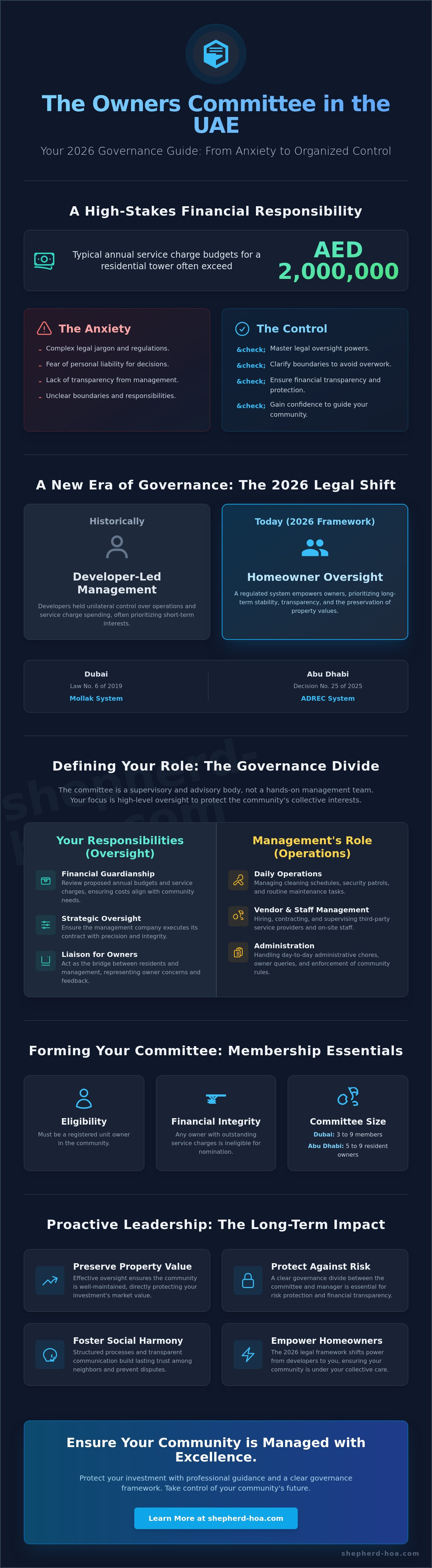
With annual service charge budgets for a standard Dubai residential tower often exceeding AED 2,000,000, mastering the role of the owners committee in uae is a high-stakes financial responsibility. You likely joined to protect your home and investment, yet the weight of legal jargon and the fear of personal liability can quickly turn that commitment into a source of stress. It's frustrating when management transparency feels lacking, leaving you to wonder where your oversight ends and their daily operations begin.
This 2026 governance guide is designed to replace that operational anxiety with organized control and peace of mind. You'll learn the legal oversight powers and advisory responsibilities required to protect your community investment while maintaining social harmony. We will break down the latest regulatory updates, including Dubai's Law No. 3 of 2026 and Abu Dhabi's new governance framework, clarify your boundaries regarding service charge budgets, and show you how to act as a steady guide for your community without becoming an unpaid administrator. By the end, you will have the confidence to ensure your management company delivers the value your property deserves.
Key Takeaways
Understand how the 2026 legal framework shifts governance power from developers to homeowners, ensuring your community remains under your collective care.
Master the specific boundaries of the role of the owners committee in uae to maintain effective oversight without the stress of daily operational management.
Learn why a clear governance divide between committee members and professional managers is essential for financial transparency and risk protection.
Discover how a structured annual calendar and transparent communication foster lasting social harmony and trust among your neighbors.
Explore the direct link between proactive committee leadership and the long-term preservation of your property’s market value.
Table of Contents
The Legal Framework of Owners Committees in the UAE
The role of the owners committee in uae is fundamentally that of a guardian. It's an elected body of homeowners who act as the collective voice for everyone who has invested capital and life into a community. This committee serves as the essential bridge between the residents and the professional management company, ensuring that the building remains a safe, well-maintained, and high-value asset. While the committee doesn't handle the daily cleaning or security schedules, it provides the vital oversight that keeps those services accountable.
The UAE has undergone a significant transition from developer-led management to a regulated system of homeowner oversight. Historically, developers held unilateral control over community operations and service charge spending. Today, the legal landscape empowers owners to take the lead. This shift prioritizes long-term stability and transparency, moving away from the short-term interests of a developer and focusing on the preservation of property values. For communities in Dubai, staying aligned with RERA regulations is the standard for national compliance and operational integrity.
Legal Recognition and Regulatory Standing
UAE property law is built upon the legal framework of strata title, which provides a structured way for individuals to own private units while sharing responsibility for common areas. In 2026, this framework is more robust than ever. In Dubai, Law No. 6 of 2019 serves as the primary pillar, while Abu Dhabi has implemented Administrative Decision No. 25 of 2025 to modernize governance standards. These statutes recognize the committee as a formal advisory and oversight body rather than an executive one. Committees must register through official portals, such as Mollak in Dubai or the ADREC system in Abu Dhabi, within 14 days of their election to gain full legal standing.
Eligibility and Membership Requirements
To serve on a committee, you must be a registered unit owner. In Abu Dhabi, the latest 2026 framework requires that committees consist of five to nine members who are resident unit owners, ensuring those making decisions are directly impacted by them. Dubai maintains a flexible range of three to nine members. Financial integrity is a non-negotiable prerequisite; any owner with outstanding service charges is ineligible for nomination. This rule ensures that those providing oversight are themselves compliant with the community's financial requirements. Elections occur during the Annual General Assembly, and members typically serve for a fixed term, providing a steady cycle of leadership that prevents stagnation and encourages fresh community involvement.
Core Responsibilities: What the Committee Actually Does
The role of the owners committee in uae is often misunderstood as a hands-on management position. It's actually a supervisory and advisory function. You don't need to be an expert in plumbing or HVAC systems to be effective. Instead, you act as the community's strategic board. Your primary duty is to ensure the management company executes its contract with precision and integrity. By focusing on high-level oversight, you protect the collective interests of all owners without getting bogged down in daily administrative chores.
One of your most influential powers is the ability to recommend improvements to community rules and regulations. Whether it's updating parking policies or refining move-in procedures, your input ensures that the community's governing documents reflect the current needs of the residents. You also serve as a vital liaison. When owners have concerns, they look to you to represent those views to the management firm. This creates a structured feedback loop that prevents minor frustrations from escalating into community-wide disputes. Professional Community Management support can help formalize these processes and ensure your recommendations lead to real change.
Financial Oversight and Service Charge Review
Financial guardianship is perhaps your most critical task. You're responsible for reviewing the proposed annual budget before it reaches the regulator. This involves a deep dive into the Mollak system and service charges to ensure every dirham is allocated correctly. You must verify that the proposed costs align with the actual needs of the building. For instance, if the budget for landscaping increases by 20%, you have the right to ask for the data justifying that jump. Additionally, you must monitor the reserve fund. This is the community's savings account for major long-term repairs, such as roof replacements or chiller overhauls. Ensuring this fund is adequately capitalized protects owners from sudden, unplanned special levies in the future.
Maintenance and Facility Management Supervision
While the management company handles the vendors, the committee monitors their performance. You should regularly review the quality of cleaning, security, and technical maintenance. If the lobby isn't being cleaned to the agreed standard or security response times are lagging, your feedback is the mechanism for correction. You also play a key role in major capital expenditure projects. When it's time to upgrade the gym equipment or repaint the facade, the committee reviews the proposals and provides a recommendation on which direction best serves the community's long-term asset value. This ensures that large-scale investments are transparent and well-vetted.
Committee vs. Management Company: Navigating the Governance Divide
Successful community governance relies on a sharp distinction between those who oversee and those who execute. Understanding the role of the owners committee in uae requires recognizing that you are the community’s guardian, not its service provider. One of the most common sources of operational stress is the blurring of these lines. To protect yourself and your neighbors, you must maintain a professional distance. Committee members are volunteers with a duty of care, but they aren't employees of the building. You shouldn't find yourself directing a security guard or negotiating a cleaning contract personally.
Legal and financial safety nets are built into this divide. Members of the committee do not handle cash, and they don't sign service contracts directly. These executive actions are the responsibility of the management company. By remaining in an advisory capacity, you avoid the personal liability that comes with executive decision-making. A professional owners association management partner is essential because they provide the licensed expertise to handle these technical tasks. This partnership allows you to focus on high-level strategy while they manage the administrative machinery.
Micro-management is a significant risk to community harmony and asset value. When committee members attempt to manage daily tasks, it creates confusion and slows down essential repairs. Trust the systems you've put in place. Your power lies in your ability to review, question, and recommend. If you're constantly intervening in minor operational details, you lose the objective perspective needed to evaluate the management company’s overall performance fairly.
The Responsibility Matrix
To keep operations flowing smoothly, it's helpful to view the community's needs through a responsibility matrix:
Management Company Tasks: Service charge collection, property handover coordination, budget planning, utility account setup, and managing technical staff.
Owners Committee Tasks: Reviewing financial reports, recommending improvements to community rules, monitoring contractor KPIs, and acting as the voice of the owners.
The management company serves as the executive engine that drives the community, while the owners committee acts as the steering wheel that provides direction and oversight.
Conflict Resolution and Decision Making
Disagreements are a natural part of governance, but they don't have to lead to dysfunction. If the committee and the management company reach an impasse, the first step is a formal review of the management agreement and current RERA or ADREC guidelines. Clear, documented communication is your best tool for resolution. If performance issues persist, you have the right to request regulatory mediation. In cases of documented negligence or failure to meet contractual obligations, the committee can initiate the legal process to replace the management company. This ensures the community's interests always come first, providing a clear path to restoring high service standards.
Best Practices for Running an Effective Owners Committee
Efficiency in community governance doesn't happen by accident. It's the result of structured planning and a commitment to transparency. To excel in the role of the owners committee in uae, your group should establish a comprehensive annual calendar. This schedule should align with regulatory requirements, such as the quarterly meetings mandated under Abu Dhabi's 2026 framework. By setting dates for budget reviews and service provider evaluations months in advance, you replace reactive stress with a sense of organized control. Diverse representation is also vital. Ensuring the committee includes owners from different unit types helps prevent bias and ensures the needs of all residents are considered during policy discussions.
Data-driven decision making is the hallmark of a sophisticated committee. In 2026, relying on gut feelings or anecdotal evidence isn't enough to protect a multi-million dirham asset. Utilize the analytics provided by your community management software to track utility consumption trends and service charge collection rates. This objective data allows you to make informed recommendations that actually lower costs and improve service quality. For committees looking to streamline these administrative hurdles, partnering with experts for professional Community Management ensures your governance remains both compliant and efficient.
Conducting Productive Governance Meetings
Meetings should be engines of progress, not endless debates. Always distribute a clear agenda at least 48 hours before the session and stick to strict time limits for each item. This respect for time encourages higher attendance and more focused contributions. Recording minutes isn't just a best practice; it's a legal necessity. These records must be filed on national digital platforms like Mollak or the ADREC portal within 14 days of the meeting to maintain your regulatory standing. Follow the "one-owner, one-vote" principle where applicable to ensure every member's voice carries equal weight in the decision-making process.
Communication and Community Harmony
Transparency is the most effective tool for building trust with your neighbors. When owners understand how their service charges are being spent, they're more likely to support the committee's initiatives. Use digital newsletters and owner portals to provide regular updates on budget approvals and the status of ongoing maintenance projects. When handling resident complaints, it's essential to remain a neutral guide. Direct residents to the formal complaint procedures managed by the firm rather than engaging in personal disputes. This professional distance preserves social harmony and protects you from the emotional fatigue often associated with volunteer work.
Protecting Asset Value Through Expert Guidance
The ultimate measure of success for any committee is the long-term appreciation of the property’s value. In the competitive UAE market, buyers don't just purchase a unit; they invest in the governance of the entire building. A strong, transparent role of the owners committee in uae correlates directly with higher resale values. When prospective buyers see audited accounts and healthy reserve funds, their confidence grows. This financial health distinguishes your community in the secondary market, ensuring it remains a premium choice for investors who prioritize stability.
Environmental sustainability is another key driver of asset value that falls under your guardianship. Committees that prioritize energy-saving initiatives, such as smart chiller management or LED lighting retrofits, significantly reduce the community's operational footprint. These improvements lower service charges over time, making the property more attractive to both owners and high-quality tenants. A proactive approach to green building standards ensures your community remains relevant and desirable as national regulations evolve toward higher efficiency requirements.
The Shepherd HomeOwners' Association Advantage for Committees
Shepherd HomeOwners' Association acts as the invisible backbone for your community leadership. We understand that committee members are volunteers with full-time lives outside of their governance duties. Our team reduces your administrative burden by handling the technical complexities of Mollak compliance, property handover, and service charge collection. We provide the financial clarity you need to conduct confident budget reviews, replacing guesswork with precise, actionable data. By taking care of the heavy lifting, we allow you to focus on the high-level strategic oversight of your investment.
Securing Your Community’s Future
A proactive, well-informed owners committee is the best defense against property depreciation. If you've recently been elected, your first priority should be a thorough review of the current community management agreement and the building's financial history. Understanding the current state of the reserve fund is essential for long-term planning and avoiding unexpected special levies. Our experts are here to help you transition into your new role with confidence and ease. Contact our team for a professional community management consultation to learn how Shepherd HomeOwners' Association can support your vision for a thriving, high-value community.
Leading Your Community with Confidence
Effective governance is the cornerstone of a thriving residential investment. By understanding the role of the owners committee in uae, you've taken the first step toward replacing operational stress with organized control and peace of mind. You now know that your power lies in strategic oversight and advisory influence rather than the daily grind of administrative execution. This clear distinction protects your time and limits your personal liability; it ensures your community remains a high-value asset for years to come.
Success in this volunteer position requires a partner that values transparency as much as you do. As a RERA approved management partner, we provide the expert guidance for volunteer committees needed to navigate complex 2026 regulations. We handle the technical heavy lifting, from transparent Mollak financial reporting to professional budget planning, acting as the invisible backbone for your leadership. You don't have to manage these responsibilities alone. Partner with UAE’s expert community guardians today and secure the long-term stability your property deserves. With the right systems in place, you can lead your community toward lasting harmony and financial strength.
Frequently Asked Questions
Can an Owners Committee fire the community management company?
The committee doesn't have the direct executive power to terminate a contract, but they can initiate the process through regulatory authorities. In Abu Dhabi, committees can request the DMT to compel a change in management if negligence or poor service is proven. In Dubai, the committee provides formal recommendations to RERA based on documented performance reviews. This ensures that any change is legally sound and protects the community from sudden operational gaps or service interruptions.
Are members of the Owners Committee in the UAE paid for their time?
No, committee membership is a voluntary, unpaid position. Owners serve on the committee to protect their investment and contribute to the social harmony of their community. While there's no financial compensation, the role provides direct oversight of how service charges are spent, which helps preserve the property's long-term market value. Professional management companies handle the heavy administrative lifting so that volunteers can focus on high-level advisory tasks without being overwhelmed by daily chores.
How many members should a standard UAE Owners Committee have?
The size of the committee depends on the specific emirate and the size of the development. In Dubai, a committee must have a minimum of three and a maximum of nine members. For properties in Abu Dhabi, the 2026 governance framework requires between five and nine resident unit owners. This range ensures a diverse representation of interests while keeping the group small enough to make efficient, data-driven decisions during their scheduled quarterly meetings.
What is the personal liability for a committee member in the UAE?
Committee members generally have limited personal liability because their role is advisory and supervisory rather than executive. Since members don't sign contracts or handle funds directly, the legal risks are significantly reduced. However, members must always act in good faith and in the best interest of the owner collective. Maintaining clear, documented minutes of all meetings on national portals is the best way to demonstrate compliant and transparent leadership at all times.
How often is the Owners Committee required to meet by law?
Legal requirements for meeting frequency vary by emirate, but regular oversight is essential for community health. Under the 2026 Abu Dhabi framework, the committee is required to meet at least quarterly to review performance and budgets. In Dubai, meeting schedules are typically established during the Annual General Assembly. Establishing a structured annual calendar ensures that the role of the owners committee in uae remains proactive rather than reactive, providing steady guardianship throughout the year.
Can a tenant join the Owners Committee if the owner is absent?
No, only registered unit owners are eligible to join the committee. Tenants cannot serve as members, even if the owner provides a power of attorney specifically for that purpose. The legal framework ensures that those making advisory decisions have a direct financial stake in the property’s long-term asset value. Owners must also be up to date on all service charge payments to qualify for nomination during the election cycle at the General Assembly.
What happens if the committee cannot agree on the annual budget?
If a consensus cannot be reached, the matter may be referred to national regulatory authorities for mediation. Starting January 1, 2026, Dubai has implemented a new Alternative Dispute Resolution (ADR) system for housing contract and governance issues. This system involves a mediation process led by construction experts and judges to reach a decision within 30 days. This ensures that community operations don't stall due to internal disagreements, protecting the building’s essential services and financial stability.
How do we register our committee with the national real estate authorities?
Registration is a mandatory digital process that must be completed shortly after elections are finalized. In Dubai, newly elected committees must be registered through the RERA portal within 14 days of the Annual General Assembly. In Abu Dhabi, the process is handled through the Department of Municipalities and Transport (DMT) systems. These digital platforms ensure that the role of the owners committee in uae is formally recognized, allowing members to access financial reports and provide official budget recommendations.


Comments