
Reserve Fund vs General Fund in an HOA: The 2026 Financial Stewardship Guide
- Sohrab Virani

- 1 day ago
- 12 min read
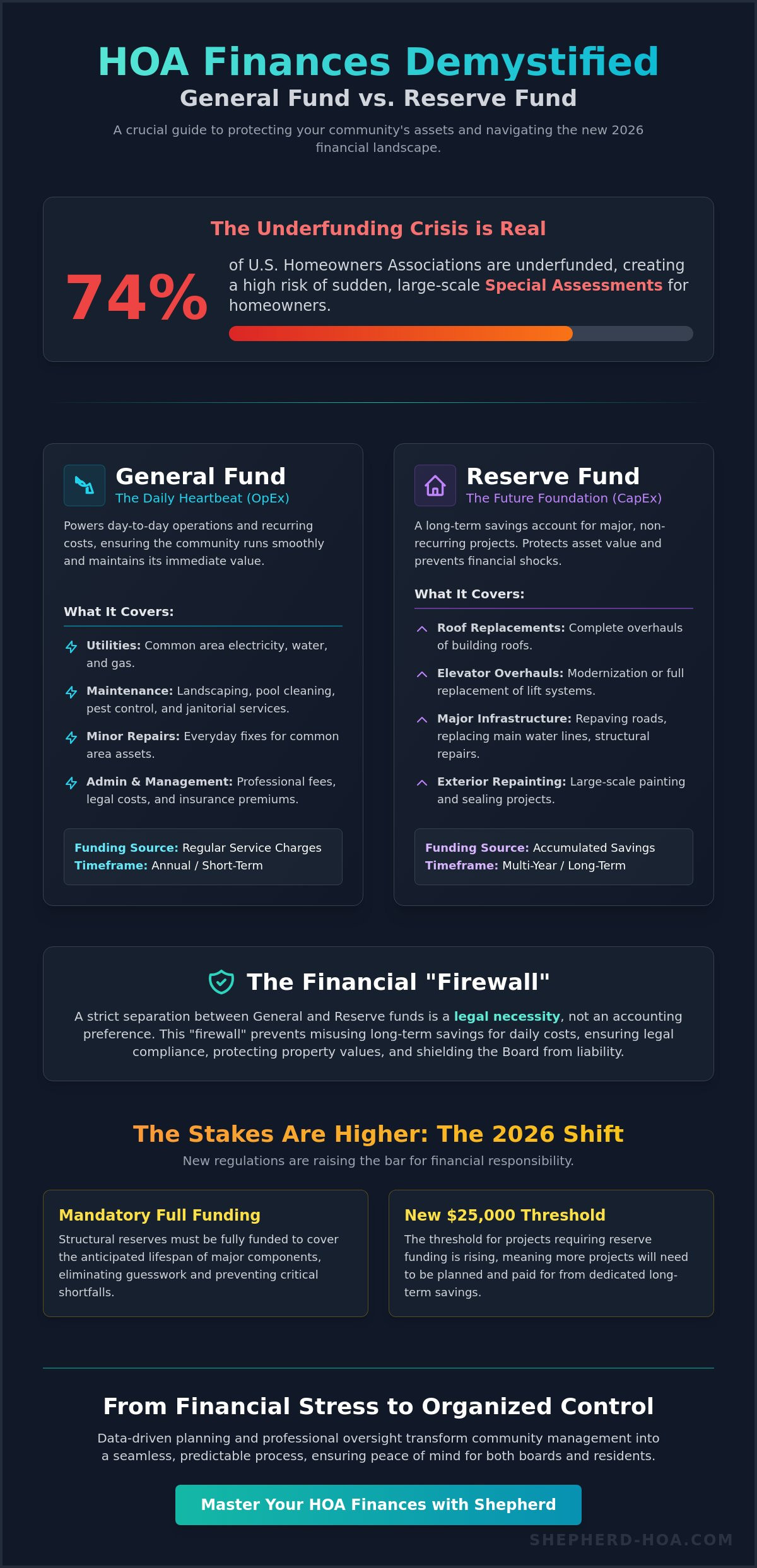
Did you know that approximately 74% of HOAs in the United States are currently underfunded? This isn't just a minor administrative oversight; it's a significant financial vulnerability that often leads to the one thing every homeowner dreads: the special assessment. As of 2026, the stakes are higher than ever, especially with new regulations requiring structural reserves to be fully funded and thresholds for reserve projects rising to $25,000. These shifts make it essential to understand how your money is moving.
Managing a community's finances can feel like a heavy burden, especially when you're trying to balance daily maintenance with the strict requirements of RERA or Mollak standards. It's natural to feel overwhelmed by the complexity of service charge allocations and the fear of legal non-compliance. This guide will help you master the critical differences between a reserve fund vs general fund in an hoa so you can protect your community's assets and your residents' peace of mind. We'll explore the 2026 financial landscape and provide a clear roadmap for long-term budget planning that keeps your community resilient, compliant, and well-maintained for years to come.
Key Takeaways
Distinguish between your community’s daily "heartbeat" expenses and long-term capital investments to maintain asset value.
Understand why maintaining a strict financial "firewall" between the reserve fund vs general fund in an hoa is essential for legal compliance and avoiding board liability.
Learn which recurring costs, like insurance and professional management fees, belong strictly in your operational budget to ensure seamless daily service.
Identify the major infrastructure projects, such as lift overhauls and roof replacements, that require dedicated long-term savings to prevent sudden special assessments.
Discover how data-driven budget planning and RERA-compliant oversight replace administrative stress with organized control and financial peace of mind.
Table of Contents
Defining the Dual-Account System: General Fund vs Reserve Fund Basics
Effective financial stewardship begins with a clear boundary. Think of your community as a living entity. The general fund provides the daily breath. The reserve fund ensures the skeletal structure remains strong for decades. This dual-account system isn't just an accounting preference; it's a legal and operational necessity. By maintaining this separation, the Owners' Committee acts as a guardian. They protect current cash flow while methodically preparing for the inevitable costs of aging infrastructure.
Understanding the balance of the reserve fund vs general fund in an hoa is the first step toward organized control. When these two accounts are managed properly, the community experiences a sense of calm reliability. Residents don't have to worry about whether the pool will be cleaned tomorrow or if the building will fall into disrepair in ten years. The Owners' Committee plays a vital role here. They oversee these separate allocations to ensure that money intended for a new roof isn't accidentally spent on extra landscaping.
The General Fund: The Pulse of Daily Operations
Operating a community involves a constant stream of recurring costs known as Operational Expenditure (OpEx). These are the "heartbeat" expenses that keep the property habitable and attractive on a day-to-day basis. From the security personnel at the gate to the cleaning crews in the lobby, the general fund ensures immediate service delivery. The general fund serves as the primary vehicle for community maintenance and the fulfillment of routine service contracts.
This fund typically covers:
Utility bills for common areas like hallways and parking lots.
Landscaping, pool cleaning, and regular pest control.
Minor repairs and everyday maintenance supplies.
Professional management fees and insurance premiums.
Because these costs are predictable and occur within the current fiscal year, they are funded through regular service charges. A well-managed general fund prevents operational stress and keeps the community running like a well-oiled machine. It allows the board to focus on excellence rather than just survival.
The Reserve Fund: A Sinking Fund for Capital Protection
While the general fund handles the present, the reserve fund focuses on the future through Capital Expenditure (CapEx). In professional management circles, this is often called a "sinking fund." It's a dedicated account designed to accumulate wealth over time to pay for major, non-recurring projects. Examining Reserves for common-interest developments helps clarify how these funds protect property longevity and maintain asset value.
When the roof needs replacement or the elevators require a total overhaul, the reserve fund is there to absorb the financial blow. This proactive approach prevents the need for sudden, high-cost special assessments that cause financial distress for homeowners. By mastering the reserve fund vs general fund in an hoa, boards ensure that today’s residents pay their fair share for the wear and tear they cause. This prevents a massive, unfair bill from landing on future owners. It replaces the anxiety of unexpected costs with a roadmap for long-term budget planning.
The General Fund: Powering Daily Community Excellence
The general fund is the engine room of your community. It ensures that every resident wakes up to a clean environment, working elevators, and a secure perimeter. While the debate of reserve fund vs general fund in an hoa often focuses on big-ticket items, the general fund is what maintains the standard of living residents pay for today. It handles the constant flow of recurring costs like landscaping, pool maintenance, and waste management. These services aren't just amenities; they're the foundation of property value and social harmony.
Beyond the physical property, this fund covers essential administrative overheads. This includes insurance premiums, legal fees, and professional management contract fees. It also facilitates utility management, ensuring that common area electricity and water accounts remain in good standing. To ensure these expenses are covered without friction, boards must develop a community service charge budget that is both realistic and transparent. This document acts as a financial promise to the owners that their contributions are being used efficiently to protect their lifestyle.
Operational Continuity and Service Delivery
A healthy general fund supports the Mollak system, providing the transparent financial reporting required by RERA. It ensures that third-party service providers are paid on time. When vendors are paid promptly, they're more likely to maintain high standards of service. This direct link between financial health and immediate resident satisfaction can't be overstated. If the landscaping looks neglected or the pool is closed for repairs due to unpaid bills, resident trust erodes quickly. Efficient service delivery keeps the community vibrant and ensures that the day-to-day experience remains premium.
Managing Short-Term Liquidity
Maintaining liquidity is a core responsibility of the board. A best practice is to keep a 3-month buffer within the general fund to handle unexpected dips in collection or seasonal fluctuations. For example, utility costs often spike during summer months. Without a buffer, these spikes can create operational stress. Following HOA Reserve Funds: Best Practices helps clarify how to balance these immediate needs against long-term goals while keeping the "firewall" between accounts intact.
Professional owners association management plays a critical role in tracking this daily spend. They provide the oversight needed to ensure that every dirham spent contributes to the community's excellence. By keeping a close watch on cash flow, boards can replace financial anxiety with a sense of organized control. If your board needs assistance in refining its financial strategy, our team can help with professional budget planning to ensure every cost is accounted for.
The Reserve Fund: Protecting Long-Term Asset Integrity
While the general fund powers today, the reserve fund secures tomorrow. It acts as a protective shield for the community's most significant physical assets. Major infrastructure repairs like roof replacements, lift overhauls, and HVAC upgrades aren't just maintenance; they are capital investments that require years of disciplined saving. Without this fund, a building’s aging systems can quickly lead to operational failure and a sharp decline in property value. It's the difference between a community that thrives and one that merely survives.
Beyond structural integrity, the reserve fund covers aesthetic preservation. Repainting common areas or refurbishing gymnasiums and lobbies ensures the community remains competitive in the real estate market. It also serves as a vital safety net for emergency structural repairs that fall outside the scope of daily maintenance. Under UAE strata law, there is a strict legal requirement for a 10-year capital reserve plan. This ensures the board isn't just reacting to crises but is actively guarding the community's future. Understanding the nuances of Operating Funds vs Reserve Funds is essential for any board member aiming for financial resilience. This distinction ensures that the money collected for a lift overhaul ten years from now isn't diverted into this month's landscaping bill.
The Necessity of the Reserve Study
A reserve study is the roadmap for this fund. It must be conducted by certified professionals who calculate the "useful life" of every community asset. By predicting when a chiller or a fire system will reach its end of life, the board can set service charges accurately. This prevents the shock of sudden, massive bills. Data shows that a well-funded reserve directly correlates to higher property resale values. Buyers feel more confident when they see a healthy balance sheet rather than the looming threat of a special assessment. Mastering the reserve fund vs general fund in an hoa balance means you're providing homeowners with long-term financial security.
Compliance with RERA and Mollak Standards
Compliance isn't optional. Securing government approvals for reserve fund expenditures and budget planning is a cornerstone of professional governance. Professional auditors verify the health of these funds annually to ensure transparency and legal standing. Boards must utilize the Mollak Dubai system to maintain service charge transparency and meet RERA standards. This structured approach replaces the anxiety of financial oversight with a steady, expert guide. It ensures that every dirham allocated for capital protection is tracked, approved, and preserved for its intended purpose. By following these standards, the Owners' Committee fulfills its duty of care to the entire community.
Financial Integrity: Why the "Firewall" Between Funds Matters
The firewall between your community's accounts isn't just a suggestion; it's a protective barrier that ensures the long-term survival of your assets. Many boards fall into the trap of "borrowing" from the reserve to cover a temporary shortfall in the general fund. This is a dangerous path. It creates a false sense of security while hollowing out the community's future. When you mix the reserve fund vs general fund in an hoa, you're not just moving numbers; you're compromising the structural and financial health of the entire property. This practice often masks underlying budget inefficiencies that need to be addressed directly rather than hidden with reserve cash.
Legal implications for mixing these funds are severe. Regulatory bodies like RERA treat these accounts as distinct entities with specific legal purposes. Mixing them can lead to formal violations, fines, and even personal liability for board members who fail in their fiduciary duty. Transparency is the ultimate antidote to resident anxiety. When homeowners see exactly where every dirham of their service charge is allocated, trust increases. A strong firewall ensures that funds for a 2030 elevator overhaul remain untouched by 2026 utility bills. This discipline is what prevents the need for unpopular special assessments that can derail a homeowner's personal finances and damage the community's reputation.
The Risk of Underfunded Reserves
Neglected reserves inevitably lead to deferred maintenance. When major repairs are postponed due to lack of funds, the physical asset begins to decay at an accelerated rate. This has a profound psychological impact on residents. A community that looks and feels neglected breeds frustration, lowers pride of ownership, and ultimately drags down property values. Residents shouldn't have to worry if the building can afford its own upkeep. An underfunded reserve is a ticking financial time bomb.
Audit and Accountability in 2026
Modern community management requires a higher standard of oversight than in previous years. Quarterly financial reporting is now a standard expectation for maintaining organized control and peace of mind. Professional managers ensure that third-party contracts undergo ethical tendering processes to prevent favoritism and ensure the community gets the best value for its spend. All financial actions must align strictly with RERA Dubai regulations. This alignment provides a sense of organized control that replaces operational stress with calm reliability. If your board is looking to strengthen its financial position, our service charge collection team can help streamline your cash flow and ensure every account is properly funded and compliant.
Professional Oversight: Navigating HOA Financials with Shepherd
Shepherd HomeOwners' Association acts as the steady, expert guide for committees across the UAE. We replace operational stress with a sense of organized control and peace of mind. Our approach to budget planning is fundamentally data-driven and fully RERA-compliant. By leveraging advanced technology, we provide real-time financial oversight and seamless Mollak integration. This ensures that service charge collection and utility account setup are handled with clinical precision. We act as the invisible backbone for Owners’ Committees, ensuring that the balance of the reserve fund vs general fund in an hoa is maintained with accuracy. Our guardianship protects your collective interests while you focus on community leadership.
Customised Financial Roadmaps
We develop 10-year reserve plans that safeguard your property for the long term. Our experts optimize the general fund to eliminate waste without sacrificing the quality of daily services like security and cleaning. Shepherd HomeOwners' Association delivers on a promise of integrity and ethical governance. We ensure every dirham is utilized effectively to preserve asset value and promote social harmony. This methodical oversight ensures that capital for major future repairs is always available when the time comes.
Secure Your Community’s Future
Professional governance is the primary key to long-term asset preservation and resident satisfaction. Transitioning to our robust financial management model replaces administrative confusion with a clear, actionable path forward. By partnering with us, you ensure your community remains a vibrant, well-funded environment that attracts quality investors. It's time to replace financial anxiety with a steady roadmap for growth. Protect your community assets with Shepherd HomeOwners' Association.
Securing Your Community's Financial Legacy
Maintaining a clear distinction between the reserve fund vs general fund in an hoa is the cornerstone of responsible governance. It ensures that today's comfort doesn't come at the expense of tomorrow's safety. By upholding this financial firewall, boards protect the building's infrastructure while maintaining the liquidity needed for daily excellence. This disciplined approach replaces the fear of special assessments with a roadmap for sustainable growth and resident peace of mind.
Navigating these complexities requires a partner with deep roots in the UAE's regulatory landscape. With RERA approved community management and expert Mollak financial reporting, you can ensure your community remains compliant and prosperous. Our 15+ years of UAE strata law experience provides the steady guidance needed to manage collective assets with total transparency and care. It's time to replace operational stress with a system of organized control.
Request a Professional Community Budget Plan from Shepherd HomeOwners' Association. Together, we can build a future defined by long-term stability and social harmony.
Frequently Asked Questions
Can an HOA use reserve funds to cover a general fund deficit?
No, an HOA should not use reserve funds for operational deficits without strict legal oversight and a clear repayment strategy. Mixing the reserve fund vs general fund in an hoa can lead to RERA violations and personal liability for board members. This practice masks budget inefficiencies and risks the community’s long-term health. Boards must focus on improving collection rates or adjusting the operational budget instead of dipping into capital savings.
How much money should be kept in the HOA reserve fund?
The ideal amount is determined by a professional reserve study, which calculates the replacement costs of all community assets. Most experts recommend maintaining a funding level between 70% and 100% to ensure financial resilience. A fully funded reserve protects residents from sudden special assessments and maintains property values. It acts as a financial cushion that guarantees the building's infrastructure remains strong for decades.
Is a reserve study legally required for communities in the UAE?
Yes, a reserve study and a 10-year capital reserve plan are legal requirements under UAE strata law for all Jointly Owned Properties. These studies must be updated regularly to reflect the current condition of assets and changing market costs. Professional oversight ensures that the community remains compliant with RERA standards. This proactive planning is essential for the long-term protection of the property’s market value.
What happens if a homeowner refuses to pay service charges into these funds?
Homeowners who refuse to pay service charges face significant legal consequences through the Mollak system and RERA. The Owners' Committee can initiate legal proceedings to recover outstanding dues, which may result in travel bans or restrictions on property sales. Consistent service charge collection is vital for maintaining the balance between the reserve fund vs general fund in an hoa. This ensures that the community continues to function without compromising service levels.
How often should the Owners’ Committee review the general fund budget?
The Owners’ Committee should review the general fund budget at least once every quarter to monitor cash flow and operational spending. These regular reviews help identify seasonal fluctuations in utility costs or maintenance needs before they become crises. Consistent oversight ensures that the community maintains its 3-month liquidity buffer. It replaces administrative stress with a sense of organized control and financial stability for all residents.
What is the difference between a reserve fund and a sinking fund?
There is no functional difference; both terms refer to money set aside for future major capital expenditures. In the UAE and other strata-managed regions, "sinking fund" is a common industry term for the reserve account. Both funds serve as a dedicated savings vehicle to replace aging infrastructure like roofs or elevators. Using these terms correctly helps the board communicate clearly with professional auditors and management partners.
How does the Mollak system impact the management of these funds?
The Mollak system centralizes all financial transactions, ensuring that every dirham is tracked and approved by RERA. It creates a transparent digital trail for both general and reserve fund expenditures, making it impossible to mix accounts without detection. This system protects homeowners by ensuring their service charges are used strictly for their intended purposes. It provides the technological backbone for modern, ethical community governance.
Can the reserve fund be used for new community improvements or only repairs?
Reserve funds are primarily dedicated to the repair and replacement of existing common area assets rather than new additions. Using these funds for new improvements, like building a new gymnasium, usually requires a specific vote and approval from the owners. The reserve fund's main purpose is the preservation of current asset value. This ensures that the money saved over years is available for its original, essential structural purpose.


Comments