
How Are Service Charges Calculated in the UAE? The 2026 Homeowner’s Guide
- Sohrab Virani

- May 15
- 12 min read
Updated: May 18
If you feel like your quarterly invoice is a random number generated behind closed doors, you aren't alone. Many homeowners view these fees as a black box of expenses rather than a strategic tool for asset preservation. Understanding how are service charges calculated in uae is the first step toward regaining control. In reality, your invoice is a strictly regulated financial blueprint designed to ensure your property remains a valuable, well-maintained asset for years to come.
You likely want more transparency regarding fee increases and the distinction between your general and reserve funds. Navigating government portals to understand why your community costs differ from neighboring developments can be frustrating. This guide will show you exactly what determines your rates by explaining the RERA Service Charge Index and the specific budgetary components that impact your bottom line. We'll break down the formula based on property size and usage, show you how to verify fees through official channels, and provide the clarity you need to ensure your community management acts as a professional guardian of your collective interests.
Key Takeaways
Understand how UAE Strata Law and RERA provide a protective legal framework for your community assets and financial contributions.
Gain clarity on how are service charges calculated in uae by mastering the formula that balances the total community budget against property square footage.
Distinguish between the General Fund for daily operations and the Reserve Fund, which acts as a guardian for long-term structural preservation.
Learn to navigate the RERA-mandated audit and Mollak approval process to ensure your community's fees are transparent and verified.
Discover how professional governance and bulk procurement strategies can stabilize your service charges while protecting your property's market value.
Table of Contents
The Regulatory Framework Governing UAE Service Charges
Service charges are the financial lifeblood of any modern community. These periodic fees cover the maintenance, cleaning, and security of shared spaces that make your property a home. Without these funds, essential infrastructure like elevators, fire safety systems, and pools would quickly fall into disrepair. In the UAE, these charges are not arbitrary or left to the whim of a developer. They are governed by a robust legal framework designed to protect your investment and ensure long-term social harmony. This system operates on the "Guardian" principle. It mandates that professional community managers oversee funds to prevent mismanagement and ensure every dirham contributes to the building's structural health.
The Role of the Real Estate Regulatory Agency
RERA serves as the ultimate watchdog for property owners across the Emirates. Every year, community managers must submit detailed budgets for approval through specialized government systems. RERA acts as a final auditor for these numbers to ensure the proposed rates align with approved market benchmarks. This oversight is a critical barrier against unjustified fee hikes. Only registered management companies can operate within this system. This mandatory registration ensures that the professionals handling your community's funds meet strict ethical and operational standards. When you ask how are service charges calculated in uae, the answer always begins with this rigorous regulatory validation.
Strata Law and Owner Rights
The UAE Strata Law fundamentally changed the landscape of property ownership. It clarifies that while you own your specific unit, you also share ownership of the common areas. This collective ownership is often managed through a structure similar to a Homeowner Association, where owners possess specific, protected rights. One of the most vital rights is the ability to view audited financial statements. Owners can see exactly how much was spent on utilities, repairs, and administrative costs. Professional management acts as an invisible backbone, ensuring these rights are upheld and that financial records are transparent. This transparency is a cornerstone of the calculation process. It allows owners to verify that expenses are necessary, audited, and fairly distributed across the community.
The Calculation Formula: Square Footage vs. Rate
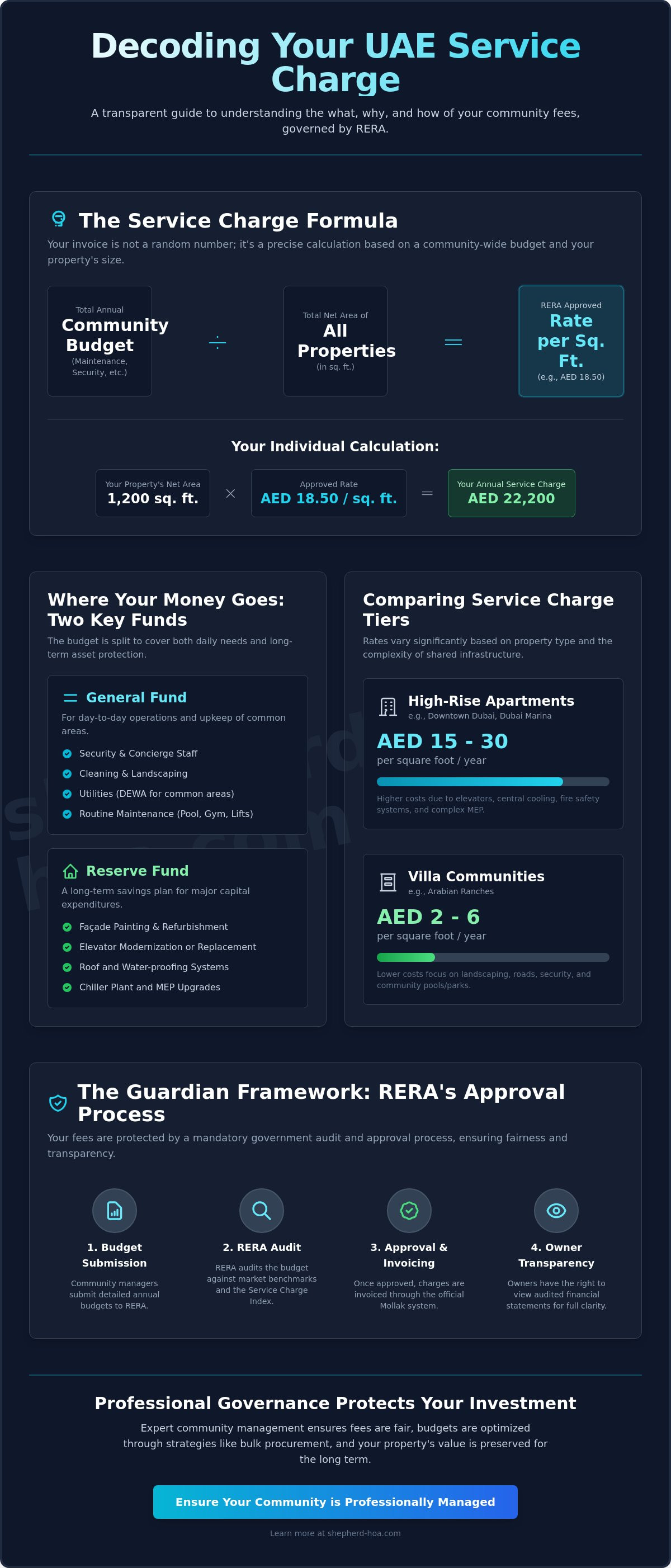
Understanding how are service charges calculated in uae requires looking at the simple arithmetic behind your invoice. The process is a transparent mathematical exercise. It starts with the total annual budget required to run your community. This figure is then divided by the total net area of all units in the development. The result is the rate per square foot that you see on your bill. While some regions use fixed unit fees, the UAE standard relies on this proportional method to ensure fairness. Owners of larger units pay more because they hold a larger share of the common property.
Property type also plays a significant role in the final rate. Commercial units often face higher charges than residential ones. This is due to the increased wear and tear from higher foot traffic and extended operational hours for common facilities. When you partner with experts for comprehensive budget planning, these variables are analyzed to ensure every owner pays their fair share without overextending the community's resources.
Net Area vs. Total Area Calculations
Many owners feel confused when they see the square footage on their service charge bill. Developers typically use the 'Net Area' or 'Suite Area' as defined in the title deed. Balconies and terraces are usually included in this calculation. However, their inclusion can vary depending on the specific community declaration. Parking spaces are often excluded from the square footage calculation for service charges; they are considered a separate entitlement. The Dubai Land Department's Service Charge Index acts as the official benchmark that prevents management companies from deviating from market-approved rates.
Comparing Service Charge Tiers
The type of community you live in dictates the tier of your service charge. High-rise apartments in areas like Downtown Dubai or Dubai Marina often see rates between AED 15 and AED 30 per square foot. These buildings require complex maintenance for elevators, fire safety systems, and centralized cooling. In contrast, villa communities like Arabian Ranches typically range from AED 2 to AED 6 per square foot. This is because they have fewer shared indoor facilities. Luxury towers like the Burj Khalifa can reach AED 67.88 per square foot due to the high cost of maintaining ultra-premium amenities. You can verify your community's approved rate by checking the national index, which ensures your management company stays within the regulated boundaries.
For investors who want to contextualize these service charges within the broader market, YALLA2X offers independent market scoring and historical listing data, providing a deeper layer of transparency for property owners across the UAE.
Anatomy of a Service Charge Budget: Where Your Money Goes
Your service charge payment is more than just a bill; it's a strategic allocation of resources designed to protect your investment. Professional community managers divide this budget into two distinct pillars: the General Fund and the Reserve Fund. This dual-structure approach is the foundation of how are service charges calculated in uae. It ensures that today's operational needs don't compromise tomorrow's structural integrity. By separating daily costs from long-term repairs, the management team acts as a financial guardian for the community's collective assets.
General Fund Components
The General Fund addresses the immediate heartbeat of your community. It covers the recurring costs required to keep the lights on and the hallways clean. These expenses are predictable and form the bulk of your annual invoice. Effective Owners Association Management ensures these contracts are tendered competitively to get the best value for every dirham spent. Typical components include:
Utilities: Electricity and water for common areas, including swimming pool heating and street lighting.
Maintenance Contracts: Regular servicing of elevators, fire alarm systems, and HVAC units.
Soft Services: Daily cleaning, 24/7 security, and professional landscaping.
Administrative Costs: Professional management fees, insurance premiums, and government registration fees.
The Importance of the Reserve Fund
While the General Fund looks at today, the Reserve Fund—often called a Sinking Fund—looks decades into the future. This fund accumulates over time to cover major capital expenditures like chiller replacements, roof repairs, or elevator overhauls. Without a healthy reserve, communities face the risk of "special levies." These are large, unplanned payments required from every owner to fix an emergency. A well-funded reserve prevents these shocks and ensures the community remains financially stable. You can verify the transparency of these allocations and see how they compare to market standards by visiting the Dubai Land Department's Service Charge Index.
Professional managers use their scale to benefit individual owners. By tendering contracts to multiple vendors and using bulk procurement, they secure lower rates for high-quality services. This proactive approach directly impacts the final calculation. It ensures you aren't overpaying for basic maintenance. Finally, a small portion of the budget often supports "Social Harmony" initiatives. These community events and improvements might seem minor, but they create a sense of belonging and keep property demand high. This holistic view of budgeting ensures that your community remains a desirable place to live while maintaining its peak market value.
The Approval and Transparency Process via Government Systems
Understanding how are service charges calculated in uae is only half the battle; knowing who approves these figures is equally critical. The UAE has implemented a rigorous, multi-stage approval process that removes the "black box" from community finance. This workflow ensures that every dirham requested from an owner is justified, audited, and legally compliant. It transforms the management company from a simple bill collector into a professional guardian of the community's financial health. The process follows a strict sequence to maintain total transparency.
Step 1: Budget Preparation. The professional community management company compiles a detailed budget based on actual service contracts and historical utility data.
Step 2: Independent Audit. A RERA-approved, third-party financial firm audits the proposed budget. They verify that every expense is legitimate and that the reserve fund allocations meet regulatory standards.
Step 3: System Submission. The audited budget is uploaded to the Mollak system in Dubai or equivalent regional government portals.
Step 4: Regulatory Approval. Government authorities review the submission against the Service Charge Index. Once approved, the system generates electronic invoices directly for the owners.
The Mollak System Explained
Digital governance is the backbone of property management in the UAE. Systems like Mollak eliminate the risk of developer mismanagement by centralizing all financial data. Through Mollak service charge management, owners receive their invoices directly from the government portal rather than from a private entity. This ensures that the money you pay is deposited into a regulated escrow account, dedicated solely to your community’s upkeep. It provides peace of mind that your contributions are protected and used exactly as intended.
The Role of the Owners Committee
Owners are no longer passive observers in the calculation process. An elected Owners Committee acts as a watchful partner, reviewing the proposed budget before it ever reaches the regulator. They provide feedback on service quality and help ensure that tendering for contracts remains ethical and competitive. This partnership between the committee and the professional manager creates a system of checks and balances that keeps costs optimized. When owners and managers work together, it fosters social harmony and ensures the community's long-term stability.
Navigating these digital portals and audit requirements can be complex for volunteer committees. Our team provides the expert oversight needed to manage professional Mollak registration and compliance services, ensuring your community meets every regulatory benchmark with ease.
Optimizing Service Charges Through Professional Governance
While the mathematical formula behind how are service charges calculated in uae is standardized across the country, the final figures on your invoice depend heavily on operational efficiency. Professional management companies don't just tally expenses; they act as strategic guardians of your community's financial health. By leveraging their scale, managers can reduce costs in ways that an individual or an unorganized committee simply cannot. This proactive approach ensures that your fees remain stable while the quality of your community continues to improve. Efficient community service charge budget planning is the most effective tool for preventing unnecessary financial bloat.
One of the most significant cost-saving measures is the shift from reactive repairs to preventative maintenance. Reactive repairs are often double or triple the cost of regular servicing because they involve emergency labor and last-minute parts procurement. A professional manager implements a rigorous maintenance schedule for elevators, chillers, and fire systems. This foresight extends the lifespan of your community's assets and delays the need to dip into the Reserve Fund. It is a logical, methodical approach that protects your long-term return on investment by keeping the building in peak condition.
Reducing Operational Waste
Operational waste is a silent drain on community funds. Professional managers identify these leaks through detailed energy audits and contract reviews. By installing sensor-based lighting in parking areas or optimizing HVAC cooling cycles, communities can see a noticeable reduction in communal utility bills. Negotiation is another key factor. Management firms manage multiple properties, allowing them to negotiate bulk rates with facility management providers that are unavailable to single developments. Additionally, maintaining high collection rates is vital. When every owner pays on time, the community avoids liquidity issues that could lead to late payment penalties or service interruptions.
Shepherd HomeOwners' Association: Your Partner in Transparency
At Shepherd HomeOwners' Association, we believe that organized control is the foundation of a happy community. Our approach is built on a commitment to RERA compliance and ethical reporting, ensuring that every homeowner feels like a valued stakeholder rather than just a fee-payer. We provide the invisible backbone for your community governance, handling the complex administrative responsibilities so you can enjoy the peace of mind that comes with a well-managed home. Our team focuses on social harmony and the preservation of asset value, acting as a watchful guardian for your collective interests. Protect your investment with Shepherd HomeOwners' Association’s expert community management and experience the difference that professional, transparent oversight makes for your property’s future.
Securing Your Property’s Financial Future
Mastering the nuances of how are service charges calculated in uae transforms you from a passive payer into an informed stakeholder. You now understand that your invoice is a precise reflection of community needs, balanced against your property's square footage and validated by rigorous RERA audits. This regulatory framework ensures your contributions are used ethically to maintain common areas and build a robust reserve fund for future structural requirements. Transparency isn't just a goal; it's a legal standard that protects your asset's long-term value and ensures social harmony.
Since 2010, Shepherd HomeOwners' Association has acted as a steady guide for communities seeking organized control over their administrative responsibilities. We bring RERA-approved management expertise and a specialized focus on Mollak financial reporting to every community we serve. Our commitment to ethical governance ensures that your community budget is optimized for efficiency and long-term stability. Request a Professional Community Budget Review from Shepherd HomeOwners' Association to gain definitive clarity on your community's financial health. With expert oversight, you can enjoy the peace of mind that comes from knowing your investment is protected by a watchful guardian.
Frequently Asked Questions
Is the service charge calculation the same for all UAE properties?
No, the calculation is not uniform across all property types. While the base formula involves dividing the total budget by the total square footage, the specific rate per square foot depends heavily on the community's facilities and location. High-rise apartments in Downtown Dubai typically see higher rates than villa communities in areas like Dubai Hills Estate due to the complexity of maintaining shared elevators, fire safety systems, and central cooling.
Can a developer increase service charges without RERA approval?
No, a developer cannot unilaterally increase fees. All service charges must be approved by the Real Estate Regulatory Agency (RERA) after a mandatory independent audit. The Mollak system ensures that any proposed increase is verified against the approved budget and the Service Charge Index. This regulatory gatekeeping acts as a guardian for your finances, ensuring that any cost adjustments are justified and transparent.
How much of my service charge goes into the reserve fund?
The allocation for the reserve fund typically ranges between 10% and 15% of the total budget, though this figure depends on a professional reserve study. This study forecasts the depreciation of major assets like chillers and elevators over a 10 to 20 year period. By contributing a steady portion now, the community avoids the need for sudden "special levies" when major infrastructure needs replacement. This foresight protects your long term return on investment.
What happens if I refuse to pay my service charges in the UAE?
Non payment leads to significant legal and financial consequences. The management company can file a case through the Rental Dispute Center, which may result in travel bans or the freezing of bank accounts. Additionally, you cannot sell or lease your property without a No Objection Certificate (NOC). This certificate is only issued once all outstanding service charges are settled in full, ensuring the community remains financially viable.
How do I check if my service charge rate is fair?
You can verify the fairness of your rate by accessing the Dubai Land Department’s Service Charge Index. This tool provides a benchmark for approved rates in your specific neighborhood and building category. Understanding how are service charges calculated in uae through this portal allows you to compare your community’s fees with similar developments. This transparency ensures your management company is operating within market standards.
Can the owners committee change the community management company?
Yes, the owners committee has the right to recommend a change in the community management company. This process requires a majority vote and final approval from RERA to ensure the transition is handled professionally. Changing to a more efficient manager can often lead to better budget planning and improved service quality. This directly impacts the long term preservation of your property's market value and community harmony.
Are service charges paid monthly or annually in the UAE?
Service charges are typically paid on a quarterly basis, though some communities offer an annual payment option. These payments are usually made through the DEWA Smart App, the Mollak portal, or other approved government payment gateways. Paying quarterly provides the community with steady cash flow to cover daily operational expenses. It also allows owners to manage their personal finances more effectively throughout the year.
What is the difference between a service charge and a maintenance fee?
In the UAE context, a service charge is a mandatory fee for the upkeep of common areas like lobbies, pools, and security. A maintenance fee often refers to the cost of repairing items within your private unit, such as internal plumbing or AC servicing. Knowing how are service charges calculated in uae is vital because these fees are legally required for communal assets, whereas internal maintenance is a private arrangement you manage independently.


Comments