
10 Essential Questions to Ask Your New Community Manager in 2026

Your community manager is not just another vendor; they are the primary guardian of your property’s financial health and social harmony. In 2026, as regulatory oversight in Dubai and the wider UAE continues to tighten, hiring the wrong firm leads to more than just poor communication. It can result in costly legal fines and depleted reserve funds. Knowing the right questions to ask your new community manager is the only way to ensure your collective investment remains protected and your governance stays beyond reproach.
We understand that the weight of administrative responsibility often feels overwhelming, especially if you've experienced a lack of transparency regarding service charges in the past. You deserve the peace of mind that comes from organized control and expert oversight. This guide provides a clear roadmap for vetting your next partner to ensure they meet the highest standards of integrity. You'll learn how to verify their mastery of the Mollak system, their approach to RERA-approved budget planning, and their strategy for maintaining long-term property value. We have outlined ten critical inquiries that will help you find a reliable partner who acts as a steady, expert guide for your community.
Table of Contents
Understanding the Role of a Professional Community Manager
A professional Community association manager acts as the executive engine for your Owners Association Board. They aren't just a service provider; they're the bridge between the board’s strategic vision and the community’s daily reality. Think of them as a guardian. This individual or firm watches over the social harmony and financial health of the building, ensuring every decision aligns with the owners' collective interests. They provide the invisible backbone that allows a community to function efficiently without placing an undue burden on volunteer board members.
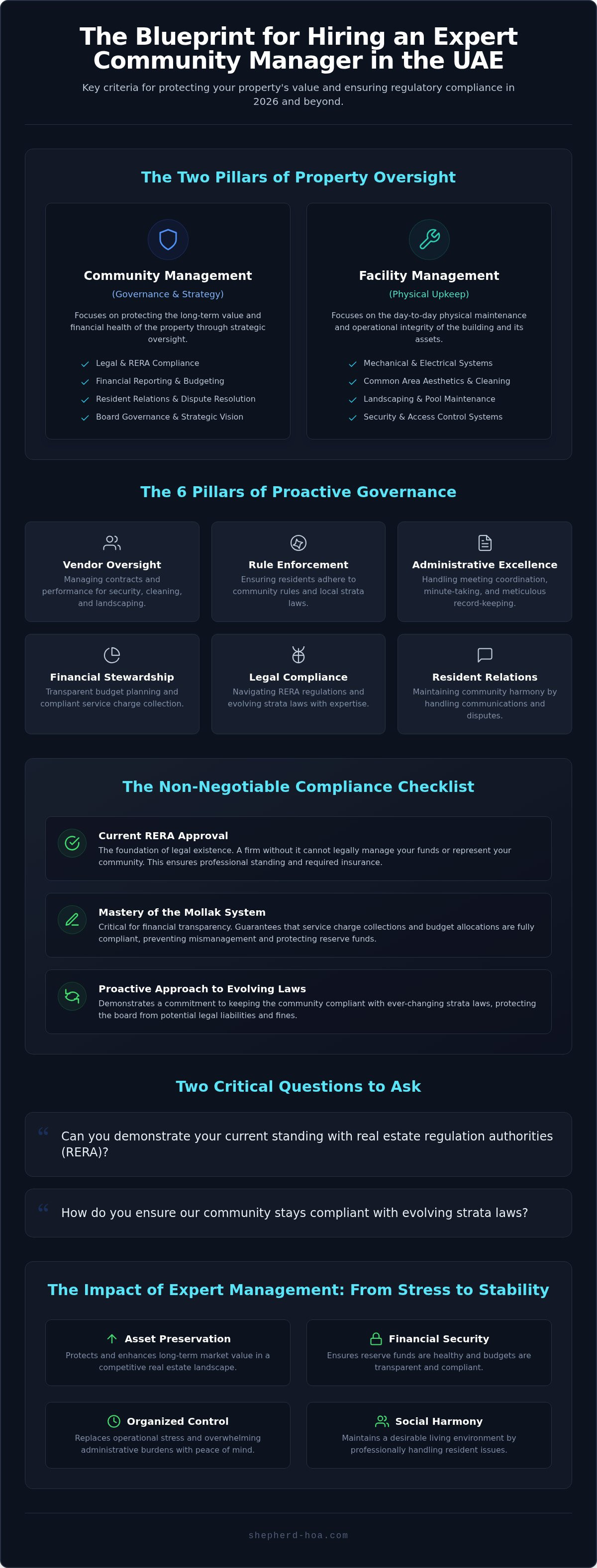
It's easy to confuse community management with facility management, but the distinction is vital. While a facility manager focuses on the physical upkeep of the building, specifically the mechanical systems and common area aesthetics, a community manager focuses on governance. This includes legal compliance, financial reporting, and resident relations. When considering the right questions to ask your new community manager, you must look for a partner who understands this duty of care toward your collective assets. They should offer a sense of organized control that replaces operational stress with peace of mind.
Asset Preservation vs. Basic Administration
Effective management goes far beyond answering emails or attending meetings. It involves a high-level approach to Owners Association management that prioritizes asset preservation. A manager’s oversight directly impacts the long-term market value of your property in the UAE's competitive real estate landscape. Poor management leads to more than just frustration. It results in physical neglect, devalued units, and potential legal liabilities for the board. By choosing a partner who acts as a strategic advisor, you protect your investment from the risks of devaluation and ensure the building remains a desirable place to live.
The Core Responsibilities of an HOA Manager
A high-performing manager handles the complex administrative work that boards often find overwhelming. They serve as the primary point of contact for legal filings and ensure the community remains compliant with evolving regulations. Their core responsibilities include:
Oversight of third-party service providers: Managing contracts and performance for security, cleaning, and landscaping teams.
Rule Enforcement: Ensuring all residents adhere to community rules and local strata laws to maintain order.
Administrative Excellence: Handling meeting coordination, minute-taking, and meticulous record-keeping for future reference.
These tasks require a blend of technical expertise and professional diplomacy. As you prepare your questions to ask your new community manager, remember that you're seeking a steady, expert guide. You need someone who values transparency and integrity above all else, ensuring that the community's assets are managed with the highest level of professional standing.
Questions to Verify Regulatory Compliance and Legal Expertise
In the UAE, regulatory compliance isn't just a box to tick. It's the foundation of your community's legal existence. When you're preparing questions to ask your new community manager, their standing with the Real Estate Regulatory Agency (RERA) must be your first priority. A firm without current RERA approval cannot legally manage your funds or represent your interests. This approval ensures the manager has the professional standing and insurance required to protect your collective assets.
While general Community Manager interview questions often focus on interpersonal skills, residential governance in Dubai requires technical mastery. You need a partner who acts as a steady guide through the maze of local mandates. Start with these two critical inquiries:
Question 1: "Can you demonstrate your current standing with real estate regulation authorities?"
Question 2: "How do you ensure our community stays compliant with evolving strata laws?"
A competent manager won't just give you a "yes." They'll explain their process for monitoring legislative updates and how they implement those changes into your community's specific bylaws. This proactive stance is what separates a basic vendor from a true guardian of your property's value.
Navigating the Mollak System
Question 3: "What is your process for managing service charge invoices through the Mollak system?"
Transparency in financial reporting is a legal mandate. The mollak system was designed to provide owners with visibility into how their money is spent. Your manager must be an expert in this platform. They should handle every aspect of filing, from uploading the initial budget for approval to ensuring that every invoice issued to owners is registered and compliant. If a manager can't explain their Mollak workflow in detail, they're likely to leave your community vulnerable to financial discrepancies or government fines. Ensuring your community remains on the right side of the law requires a partner who understands these complexities; you can explore our RERA-approved community management options for more clarity.
Handling Legal and Administrative Compliance
Question 4: "How do you handle the annual renewal of community management contracts and government approvals?"
Managing a community involves a constant cycle of renewals and registrations. Your manager is responsible for ensuring the Owners Committee is legally constituted, registered, and active. They must also secure all necessary government permits for community operations, from elevator certifications to pool safety permits. A high-performing manager keeps a meticulous calendar of these deadlines, ensuring that no lapse in compliance ever occurs. This organized control provides the peace of mind that your community is operating within the full protection of the law.
Financial Oversight: Probing Budget Planning and Service Charges
The community service charge budget is the lifeblood of your association. Without a precise and transparent financial plan, even the most prestigious property will eventually face operational decay. When evaluating potential partners, the questions to ask your new community manager must probe deep into their fiscal methodology. You need to know how they calculate costs and how they protect the community’s wealth. A professional guardian doesn't just manage money; they preserve it.
Question 5: "What is your methodology for annual budget planning and reserve fund allocation?"
A reliable manager treats your funds with a duty of care. They should explain how they balance the general fund for daily operations with a robust reserve fund for future capital works. In Dubai’s 2026 market, a well-managed reserve fund is essential for maintaining asset value over decades. If a manager lacks a clear strategy for long-term savings, the community faces the risk of sudden, heavy special assessments later.
Question 6: "What is your success rate for service charge collection, and how do you handle arrears?"
Cash flow is critical for maintaining social harmony and building standards. Ask for specific success rates from their current portfolio. A high-performing manager uses firm but fair protocols to handle late payments, ensuring the community doesn't suffer because of a few non-compliant owners. They should demonstrate a deep understanding of the legal avenues available for collection while maintaining a professional relationship with all residents.
Budget Transparency and Reporting
Question 7: "How often will the board receive financial progress reports?"
Transparency is the antidote to administrative stress. You should expect monthly or quarterly reports that account for every dirham collected. These reports must clearly distinguish between operational spending and long-term savings. This level of detail ensures that the board maintains organized control over the association's financial health. Every dirham must be traceable back to the budget approved by RERA through the Mollak system.
Ethical Procurement and Vendor Management
Question 8: "How do you ensure competitive and fair bidding for third-party maintenance contracts?"
The manager’s role is to act as a protective shield for the community’s assets. Ethical tendering is non-negotiable. It prevents kickbacks and ensures you receive the best value for services like security and cleaning. Your manager should actively audit vendor performance against the approved budget. They must find ways to reduce operational costs without compromising the quality of life for residents. By raising these questions to ask your new community manager, you ensure your community’s financial integrity remains unshakeable.
Assessing Operational Efficiency and Resident Communication
Communication serves as the vital bridge between the Owners Association Board and the residents they serve. It's the mechanism that transforms a collection of private units into a cohesive, well-functioning community. When drafting your list of questions to ask your new community manager, you must look beyond their technical skills. You need to evaluate their ability to maintain order while fostering a sense of belonging. A manager who lacks a clear communication strategy will inevitably leave residents feeling neglected and the board feeling overwhelmed by avoidable inquiries.
Question 9: "What is your protocol for handling resident complaints or neighbor disputes?"
A professional guardian doesn't just record a complaint; they resolve it through a documented, fair, and transparent process. You're looking for a partner who acts as a steady, expert guide during moments of friction. They should have a clear escalation path that ensures every resident feels heard without every minor issue reaching the board's desk. This organized control is what allows volunteer board members to focus on high-level strategy rather than daily bickering.
Question 10: "How do you manage emergency situations after hours or during public holidays?"
Infrastructure failures don't follow a business schedule. Whether it's a burst pipe or a security breach, residents need to know that the community's safety is protected 365 days a year. Your manager should demonstrate a robust plan for emergency response that includes reliable third-party contractors and clear contact protocols. This readiness provides the peace of mind that your collective assets are always under a watchful eye.
Digital Tools for Resident Engagement
Modern UAE communities require sophisticated digital tools to stay connected. A centralized portal is no longer a luxury; it's a baseline requirement for transparency. This technology allows homeowners to access governing documents, book amenities, and track service requests in real-time. It ensures that critical announcements reach every owner instantly, replacing the frantic energy of old-fashioned notice boards with a calm, methodical flow of information. By utilizing these tools, a manager can streamline service requests and provide the board with data-driven insights into community needs.
Conflict Resolution and Rule Enforcement
Rule enforcement is often the most challenging aspect of community governance. Your manager must act as a neutral mediator, ensuring that bylaws are applied consistently to every resident. Social harmony is the direct result of clear, transparent rules coupled with consistent and fair enforcement. When rules are applied predictably, it removes the perception of bias and builds long-term trust. This proactive approach prevents small violations from escalating into community-wide disputes that could damage the building's reputation. If you're ready to transition to a more organized and harmonious governance model, learn more about our RERA-approved community management solutions.
Transitioning to a Trusted Partner for Community Governance
Transitioning to a new firm is a pivotal moment that determines the future success of your community governance. It's the point where the guardian metaphor becomes a reality. As you conclude your search and evaluate the final questions to ask your new community manager, you must focus on the logistics of the handover. A seamless transition ensures that residents feel no disruption in service and that the board maintains full visibility into the community's assets. This phase is about replacing the stress of change with a sense of organized control.
The first 90 days are critical. During this window, a high-performing manager will move beyond basic administration to perform a comprehensive health check of the association. They'll review every existing contract, audit previous financial filings, and establish a clear line of communication with all stakeholders. This period is not just about keeping the lights on; it's about setting a new standard for transparency and professional standing. It's the time for your new partner to prove they have the expertise to protect your investment.
The Handover Checklist
A successful transition requires a methodical approach to data and asset transfer. Your new manager should provide a clear checklist to ensure nothing is overlooked. This process includes:
Secure Transfer: Ensuring all financial records, master keys, and third-party contracts are transferred and documented.
Mollak Audit: Reviewing the previous year’s Mollak filings to identify any discrepancies that could lead to future RERA penalties or service charge disputes.
Resident Introduction: Hosting a formal introduction or digital town hall to build trust and explain the new management protocols.
This organized handover replaces the potential chaos of a management change with a comforting cadence of professional reliability.
Why Experience Matters in Community Management
In the complex regulatory environment of 2026, there is no substitute for local expertise. Shepherd HOA’s 15-year legacy, founded in 2010, provides a stable foundation that few firms can match. We use our deep understanding of UAE strata laws to navigate hurdles that often overwhelm less experienced providers. A partner with this level of history treats your community with a genuine duty of care, acting as an invisible backbone for the groups we serve. We prioritize social harmony and the preservation of asset value above all else.
Finalizing your selection should always involve a final verification of RERA certifications and a thorough check of references from similar communities. You want a partner who values integrity and transparency. If you are ready to secure the future of your investment, contact Shepherd HOA for a professional assessment of your community's needs. We provide the expert guidance and steady oversight your community deserves to thrive in the long term.
Securing the Future of Your Community
Selecting a community manager is one of the most significant decisions an Owners Association Board will make. By utilizing the specific questions to ask your new community manager outlined in this guide, you move beyond surface-level vetting to find a true guardian for your investment. You now have the tools to verify RERA compliance, ensure Mollak financial transparency, and establish a framework for social harmony. These steps are essential to protecting your property's market value in the UAE's evolving landscape.
Governance should provide peace of mind, not operational stress. With over 15 years of ethical governance, Shepherd HOA acts as a steady guide for communities across the Emirates. We are RERA-approved experts in the Mollak system, dedicated to enhancing property value through meticulous budget planning and transparent service charge collection. Don't leave your community’s financial health to chance. Secure your community's future with Shepherd HOA's expert management and experience the confidence of organized control. Your community deserves a partner that values integrity and professional standing above all else.
Frequently Asked Questions
What are the most important qualifications for a community manager in 2026?
A valid RERA license remains the most critical qualification for any community manager operating in Dubai. By 2026, managers must also demonstrate advanced proficiency in the Mollak system for financial reporting and service charge management. These technical skills ensure that your community remains compliant with local laws while protecting the board from legal liability. Look for a partner with a proven track record of ethical governance.
How do I check if a community management company is RERA approved?
You can verify a company’s RERA approval by using the Dubai REST app or the official Dubai Land Department website. Simply enter the company’s name or license number into the portal to confirm their current standing. It's vital to perform this check before finalizing your list of questions to ask your new community manager. This verification ensures you're partnering with a firm that meets the government's strict standards.
Can a community manager change our service charges without board approval?
A community manager cannot change service charges without the explicit approval of the Owners Association Board and subsequent RERA validation. Their role is to act as the executive arm that prepares the budget based on actual community needs and vendor contracts. Once the board approves the figures, the manager submits them through the Mollak system for final government certification. This structure maintains organized control and prevents any unilateral financial decisions.
What happens if our community manager fails to file our budget in Mollak?
Failing to file a budget in the Mollak system results in the community’s inability to legally collect service charges from owners. This oversight can lead to significant government fines and a freeze on the association’s bank accounts, stalling essential maintenance and security services. It creates immense operational stress and devalues the property. A reliable manager acts as a guardian, ensuring all filings are handled correctly and on time.
How often should we meet with our new community manager?
Most high-performing communities benefit from formal monthly board meetings to review operational progress and financial reports. In addition to these, you should schedule quarterly strategy sessions to discuss long-term asset preservation and reserve fund status. This regular cadence ensures that the board remains informed without being overwhelmed by daily administrative tasks. Clear communication schedules help replace uncertainty with a sense of steady, expert oversight and professional reliability.
What is the difference between a property manager and a community manager?
A property manager typically handles individual units, tenant relations, and rent collection for specific owners. In contrast, a community manager focuses on the governance of the entire building, including common area maintenance, legal compliance, and the collective financial health of the association. While property managers serve individuals, community managers act as guardians for the whole group. Understanding this distinction is essential when preparing your questions to ask your new community manager.
How do we handle a transition if our current manager refuses to hand over records?
If a previous management company refuses to hand over essential records, the board should immediately escalate the matter to RERA for mediation. Legal mandates require managers to return all association data, financial records, and master keys upon contract termination. A professional new partner will guide you through this process, documenting the lack of cooperation to support your legal standing. This firm approach ensures that your community’s transition remains as smooth and secure as possible.
Is it possible for a community manager to help reduce our annual service charges?
An expert community manager can often reduce service charges by implementing ethical tendering processes for third-party maintenance contracts. By auditing existing vendor performance and negotiating competitive rates for security and cleaning, they eliminate waste and inflated costs. They focus on operational efficiency while ensuring that the quality of service remains high. This proactive budget planning preserves the building’s asset value while providing financial relief to homeowners through more accurate cost allocations.


Comments