
The Essential Onboarding Checklist for New HOA Board Members in 2026

Stepping onto an HOA board isn't just a volunteer role; it's a formal appointment as a guardian of your community's most valuable assets. You likely joined the board to protect your neighborhood's future, but the sudden reality of UAE strata law and Mollak compliance can feel heavy. It's natural to feel operational stress when facing potential legal liabilities or the technicalities of RERA regulations. This is why following a professional onboarding checklist for new hoa board members is the most effective way to replace confusion with a sense of organized control.
We understand that you're balancing a busy personal life with the duty of care required for community governance. We promise to provide a comprehensive, UAE-compliant framework that clarifies your specific role versus that of your management company. This guide ensures you have the tools to preserve asset values and foster social harmony without the fear of administrative missteps. We will walk through the essential 2026 RERA reporting deadlines, the mechanics of service charge collection through the Mollak system, and the foundational documents every board member must master to serve with confidence and integrity.
Table of Contents
From Resident to Steward: The Reality of HOA Board Membership
The moment you are elected to your community board, your relationship with your neighborhood changes. You're no longer just a resident concerned with your own villa or apartment; you've become a steward of a collective asset. Developing a foundational understanding the role of a Homeowner Association is the first step toward effective governance. This shift requires moving beyond personal interests to embrace a mindset of collective guardianship, where every decision is weighed against its impact on the entire community's long term health.
Governing your neighbors is a unique psychological challenge. It's difficult to enforce a parking fine or a noise complaint against someone you share a lift with or see at the gym. However, professional stewardship demands a level of objective distance. Without a standardized onboarding checklist for new hoa board members, the transition from resident to professional steward often becomes a source of unnecessary stress. A structured process provides the invisible backbone you need to act with authority while maintaining social harmony.
The Fiduciary Duty of an HOA Board Member
Board members are bound by fiduciary duties that dictate every action they take. These include the duty of loyalty, which requires putting the community's needs above your own, and the duty of obedience, which ensures you follow all applicable laws and governing documents. In the context of UAE property law, the duty of care requires board members to act with the same level of diligence and competence that an ordinarily prudent person would exercise under similar circumstances to protect the community’s shared interests. You'll often have to set aside personal preferences. For example, you might prefer to delay a service charge increase, but your duty of care may require that increase to fund essential structural repairs that preserve property values for everyone.
Why 'Ad Hoc' Onboarding Fails Communities
When a board relies on informal "handover chats" rather than a formal onboarding checklist for new hoa board members, the community suffers. Institutional knowledge is lost during every election cycle, leaving new members to reinvent the wheel. This lack of structure leads to tangible risks:
Service Charge Delays: Confusion over the Mollak system and RERA approval processes can stall budget cycles, leading to cash flow shortages for essential services.
Legal Vulnerability: New members might unknowingly violate UAE strata law, exposing themselves and the association to liability.
Depreciating Asset Value: Disorganized governance often results in deferred maintenance, which directly lowers the resale value of properties within the community.
A professional approach to onboarding ensures that every new member understands the community's five year plan and current contractual obligations from day one.
The Regulatory Landscape: RERA, Mollak, and Strata Law
The regulatory framework in Dubai is designed to protect both the developer and the homeowner. For a new board member, the Owners Association Management in Dubai framework serves as your primary operational map. The Real Estate Regulatory Agency (RERA) acts as the watchful overseer of this landscape, ensuring that all jointly owned properties operate with transparency and financial integrity. Any robust onboarding checklist for new hoa board members must prioritize a deep dive into Law No. 6 of 2019, commonly known as the Strata Law, which establishes the legal rights and obligations of the board.
Understanding these regulations isn't just about avoiding fines; it's about fulfilling your duty as a guardian of community assets. These laws provide the structure required to maintain social harmony and preserve property values. When the board operates within these clear legal boundaries, residents feel a sense of organized control and peace of mind.
Mastering the Mollak System
Mollak is the mandatory, RERA-governed online platform that serves as the single source of truth for community finances. It's where all service charge invoices are issued and where every dirham of the community budget is scrutinized. Your role on the board involves reviewing and approving these budgets via the Mollak portal before they're sent to RERA for final validation. This system eliminates financial ambiguity by ensuring that service charges are based on actual costs rather than estimates. For a detailed breakdown of how this affects your daily operations, review our guide on Understanding Mollak Dubai.
RERA Compliance Essentials
A board cannot legally function without being RERA approved and officially seated. This process involves submitting specific documentation to prove the board was elected according to the community's constitutive documents. Once seated, you must use the RERA Service Charge Index to ensure your budget stays within approved market rates. Following best practices for HOA directors means maintaining high levels of transparency during this process. Failing to comply with RERA directives can result in administrative fines or the total suspension of the board's legal authority to manage community funds. If your team finds these requirements overwhelming, seeking professional community management can provide the expertise needed to navigate these technical mandates efficiently.
Administrative vs. Strategic Onboarding: Setting the Agenda
Effective onboarding isn't just about getting a key to the community office or a login for the portal. It's a dual-track process that separates immediate administrative orientation from long-term strategic alignment. While the administrative side ensures the lights stay on, the strategic side ensures the community's value grows over the next decade. The most successful onboarding checklist for new hoa board members prioritizes this distinction to prevent the board from becoming bogged down in daily minutiae that should be handled by professional management.
To lead effectively, you must understand where the management company's duties end and your decision-making authority begins. The management company acts as the operational arm, executing the "how" of community life. The board, however, owns the "what" and the "why." Establishing a clear communication rhythm, such as a structured monthly board meeting with a pre-set agenda, ensures that both parties stay in their respective lanes while working toward shared goals.
The Administrative Deep Dive
Your first 30 days should focus on gaining total visibility into the community's current standing. This starts with a thorough review of the community service charge budget to understand where every dirham is allocated. You must also secure a copy of the Jointly Owned Property Declaration (JOPD), which acts as the community's constitution, outlining the specific boundaries of common areas and private units.
Auditing current third-party service contracts is equally vital. You should review the performance and terms of providers handling:
Mechanical, Electrical, and Plumbing (MEP) maintenance
Security and life safety systems
Landscaping and pool cleaning
Waste management and general cleaning services
Strategic Asset Preservation
Once you've grasped the paperwork, you must look toward the future. A professional onboarding checklist for new hoa board members includes a deep dive into the community's five-year maintenance plan. This requires a clear understanding of the difference between the General Fund, used for daily operations, and the Reserve Fund, which is a protected pool of capital for major structural replacements. Reviewing the most recent building condition survey will tell you if the Reserve Fund is adequately funded for upcoming projects like chiller replacements or facade refurbishments.
These high-level decisions directly influence the living experience in a community. A board that plans strategically avoids the need for sudden, large special assessments, which preserves both social harmony and the long-term resale value of the property. Your role as a guardian is to ensure the community remains a desirable place to live for years to come.
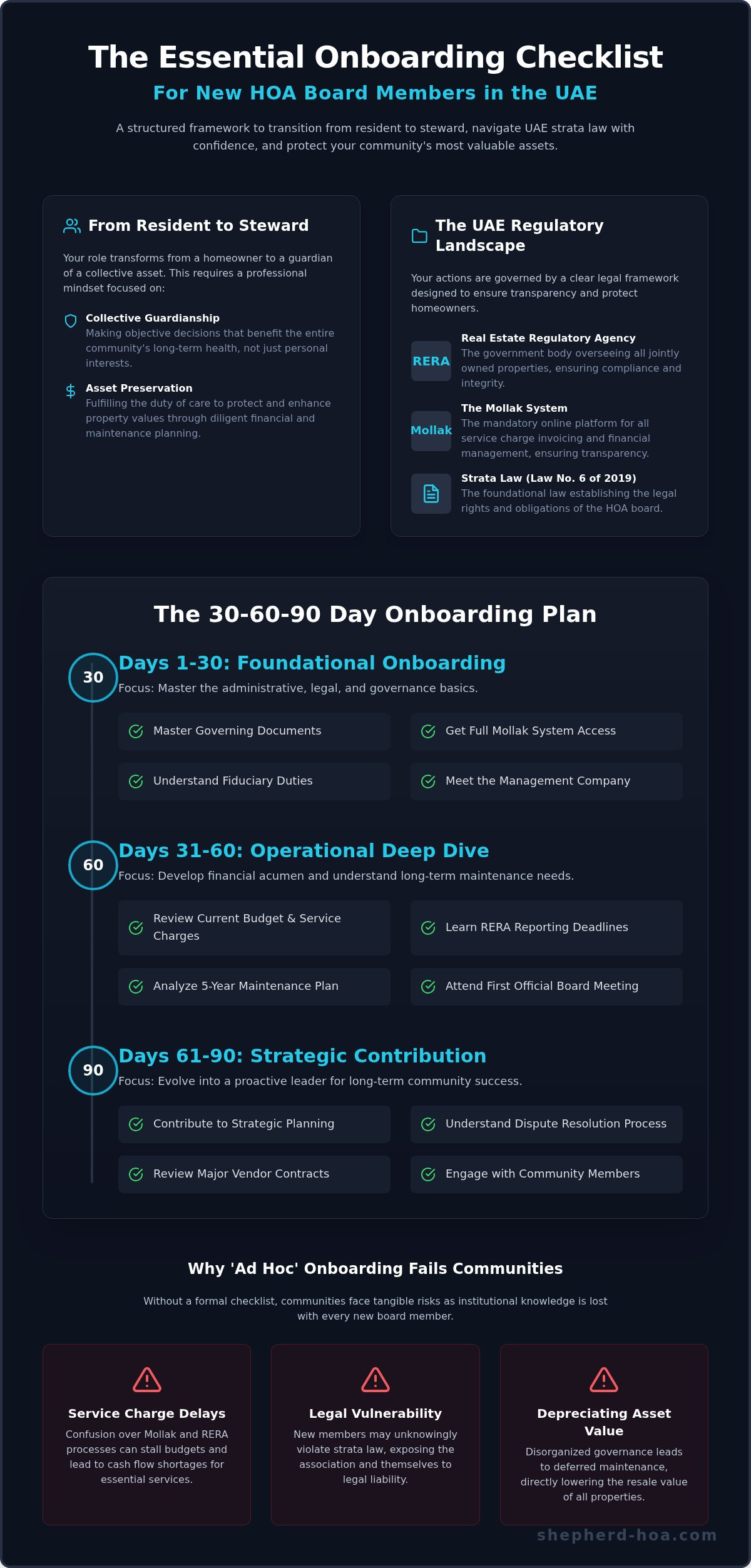
The Ultimate 30-60-90 Day HOA Onboarding Checklist
Transitioning into a board role requires a methodical approach to ensure no regulatory requirement or community need is overlooked. Using a structured onboarding checklist for new hoa board members allows you to move from a state of observation to one of active stewardship. This phased timeline provides a clear roadmap for your first quarter in office, replacing operational stress with a sense of organized control. It ensures you're not just reacting to problems, but proactively guarding the community's interests.
Phase 1: The First 30 Days (Orientation)
The first month is dedicated to information gathering and legal orientation. You must establish your status as a RERA approved member and secure the necessary tools to monitor community health. This phase is about building the foundation of your authority.
Sign the Code of Conduct and Conflict of Interest forms: This establishes your ethical commitment to the community and protects you from potential legal challenges.
Obtain access to the Mollak dashboard and community management software: These digital tools are your primary windows into financial transparency and daily operations.
Review the last 12 months of meeting minutes: Understanding historical context and pending decisions prevents you from repeating past mistakes.
Walk the common areas with the facility manager: Seeing the physical state of the assets you protect is essential for informed decision-making.
Phase 2: Days 31-60 (Operational Fluency)
During the second month, your focus shifts to the community's financial heartbeat and operational mechanics. This is when you begin to verify that the management company is meeting its obligations and that service charge collection is on track.
Analyze the current service charge collection rate: Identify potential cash flow risks that could impact essential services or the reserve fund.
Meet with the lead community manager to discuss ongoing disputes: Understanding resident concerns early helps you maintain social harmony and avoid escalations.
Review the insurance policy for the common areas: Ensure the community has adequate protection against asset loss or structural damage.
Phase 3: Days 61-90 (Strategic Integration)
By the third month, you move from learning to leading. You should be ready to contribute to the community's long-term vision and evaluate whether current vendors are providing the value the residents deserve.
Propose one improvement to the community rules: Use your fresh perspective to enhance safety, aesthetics, or the overall resident experience.
Participate in the quarterly budget review: Ensure that spending aligns with the RERA approved plan and that the community remains financially stable.
Evaluate the performance of current service providers: Assess vendors against their contractual Key Performance Indicators (KPIs) to ensure high service standards.
This onboarding checklist for new hoa board members also serves as a vital accountability tool. It provides a benchmark to ensure your community management company is providing the transparency and support you need to fulfill your fiduciary duties. If you find gaps in the information provided during this 90-day window, it may be time to partner with an expert community management firm that prioritizes RERA compliance and asset protection.
Partnering for Success: How Professional Management Supports the Board
Volunteer board members shouldn't have to spend their weekends chasing contractors or deciphering technical RERA circulars. Professional community management acts as an invisible backbone, providing the structure and expertise needed to manage complex assets effectively. When you follow a professional onboarding checklist for new hoa board members, you'll quickly realize that your most critical task isn't performing the administrative legwork itself. Instead, it's overseeing the results to ensure they align with the community's long term vision and the preservation of property values.
This transition from "doing" to "overseeing" is essential for your effectiveness as a leader. It reduces operational stress and allows you to function as a strategic guardian rather than an administrative assistant. By delegating technical tasks to experts, you also significantly reduce your personal liability. Professional oversight ensures that every financial transaction and legal filing is handled with precision, protecting you from the risks of administrative errors that can occur when volunteers are stretched too thin.
The Shepherd Advantage in Board Onboarding
Shepherd HomeOwners' Association simplifies the transition for new members by automating the most complex aspects of the role. We provide customized orientation packs that translate dense legal requirements into actionable insights for the board. Our team handles the technical heavy lifting of budget planning and service charge collection, ensuring full compliance with the Mollak system and RERA mandates. Most importantly, we ensure every board action is meticulously documented. This creates a clear paper trail that serves as your primary legal protection, instilling a sense of organized control and peace of mind.
Next Steps for Your Board
Now that you have a foundational onboarding checklist for new hoa board members, it’s time to put it into practice. Start by scheduling a dedicated board workshop to align on your community’s specific goals for 2026. This is the best time to review your current management contract to ensure it meets modern standards for transparency and accountability. If your board feels unsupported or overwhelmed by technical requirements, request a consultation for professional Owners Association Management. A steady, expert guide can replace confusion with organized control, giving you the confidence to lead your community with integrity.
Securing Your Community’s Future Through Professional Stewardship
Effective governance begins with a clear plan. By moving from a resident's perspective to a professional stewardship mindset, you protect the long term value of your community's assets. Mastering the complexities of the Mollak system and RERA regulations ensures your board remains compliant and transparent. Utilizing a structured onboarding checklist for new hoa board members provides the organized control you need to lead with confidence during your first 90 days and beyond.
You don't have to navigate these administrative challenges alone. As RERA approved management experts with over 15 years of Dubai community expertise, Shepherd HomeOwners' Association acts as the steady guide your board deserves. We are Mollak system specialists who handle the technical heavy lifting so you can focus on strategic decisions that foster social harmony and preserve property values.
Request a Professional Board Orientation Pack from Shepherd HomeOwners' Association to simplify your transition and secure your community's legacy. Your commitment to excellence is the first step toward a thriving, well governed neighborhood.
Frequently Asked Questions
What are the most important documents a new HOA board member should read?
You should prioritize reading the Jointly Owned Property Declaration (JOPD), the community's constitutive documents, and UAE Law No. 6 of 2019. These provide the legal framework for your authority. Additionally, review the current RERA approved budget and the last year of meeting minutes to understand ongoing projects. Mastering these documents early ensures you act with organized control and fulfill your duty of care toward the community's shared assets.
How much time should I expect to commit to board duties each month?
Most board members commit between five and ten hours per month to their duties. This time typically includes attending a monthly board meeting, reviewing management reports, and conducting brief site inspections. If you have a professional management partner acting as your invisible backbone, your time is spent on high level oversight rather than administrative tasks. This balance prevents volunteer burnout while ensuring the community remains well governed and financially stable.
Can an HOA board member be held personally liable for community issues?
Board members are generally protected from personal liability as long as they act in good faith and fulfill their fiduciary duties. However, gross negligence, fraud, or intentional violations of UAE strata law can expose individuals to legal risks. Ensuring your association has Directors and Officers (D&O) insurance is a critical step in your onboarding checklist for new hoa board members. This coverage provides peace of mind and financial protection while you serve.
What is the difference between an Owners' Committee and an HOA Board in the UAE?
In the UAE, specifically Dubai, the term "Owners Committee" is the legally recognized designation under Law No. 6 of 2019. While often referred to as an HOA board, the Owners Committee primarily serves an advisory and oversight role rather than holding independent executive power. They work closely with a RERA licensed management company to ensure the developer or manager maintains the property according to the agreed standards and approved budgets.
How does the Mollak system impact my role as a board member?
The Mollak system is the mandatory platform where you must review and approve the community's annual service charge budget. It acts as the single source of truth for all financial transactions, ensuring that every dirham collected is spent on RERA approved expenses. Your role involves utilizing this portal to maintain financial transparency and ensure that residents receive accurate, legally validated invoices. This system eliminates ambiguity and instills confidence in the community's financial management.
What happens if a board member has a conflict of interest with a service provider?
If a conflict of interest arises, the board member must formally disclose the relationship and recuse themselves from any related discussions or votes. Transparency is the best defense against claims of impropriety. Documenting this disclosure in the meeting minutes protects both the individual and the board from legal challenges. Maintaining high ethical standards ensures social harmony and reinforces the board's reputation as a trustworthy guardian of collective interests.
How do we handle a board member who isn't following the onboarding checklist?
Addressing non compliance requires a firm but professional approach centered on the established onboarding checklist for new hoa board members. If a member skips essential training or orientations, the board chair should initiate a private discussion to emphasize the importance of regulatory compliance. Consistent failure to follow the framework can lead to operational errors or legal liability. In such cases, seeking guidance from your community management partner can help realign the board's focus.
Can the community management company make decisions without board approval?
A community management company can only make operational decisions that fall within the RERA approved budget and their specific management contract. Strategic decisions, such as changing service providers or approving unbudgeted capital expenditures, always require formal board approval. This clear division of labor ensures that the management company handles the daily work while the board maintains strategic oversight. It creates a system of checks and balances that protects the community's long term financial health.


Comments