
Reserve Fund Study Requirements in Dubai: Creating a Long-Term Capital Expenditure Plan

What if a single oversight in your community's financial planning led to a sudden "special levy" of 25,000 AED per unit? For many homeowners in the UAE, the fear of unexpected repair costs is a constant source of stress that can strain neighborly relations and damage property values. You likely already understand that maintaining a premium building requires more than just day-to-day cleaning; it demands a strategic vision for the future of your assets. By understanding the specific reserve fund study requirements in the UAE, you can transform your community management from a reactive struggle into a model of organized control.
This article provides a clear roadmap to help you master the regulatory landscape of Law No. 6 of 2019 and the Mollak system. We will explore how a professional study replaces operational anxiety with a predictable capital expenditure plan, ensuring full compliance with RERA's three-year update cycle. You'll learn the practical steps to secure your building's financial health, protect your investment, and provide the peace of mind that every resident deserves. This guide serves as your expert partner in navigating technical mandates while preserving the long-term value of your property.
Table of Contents
Understanding Reserve Fund Study Requirements in Dubai
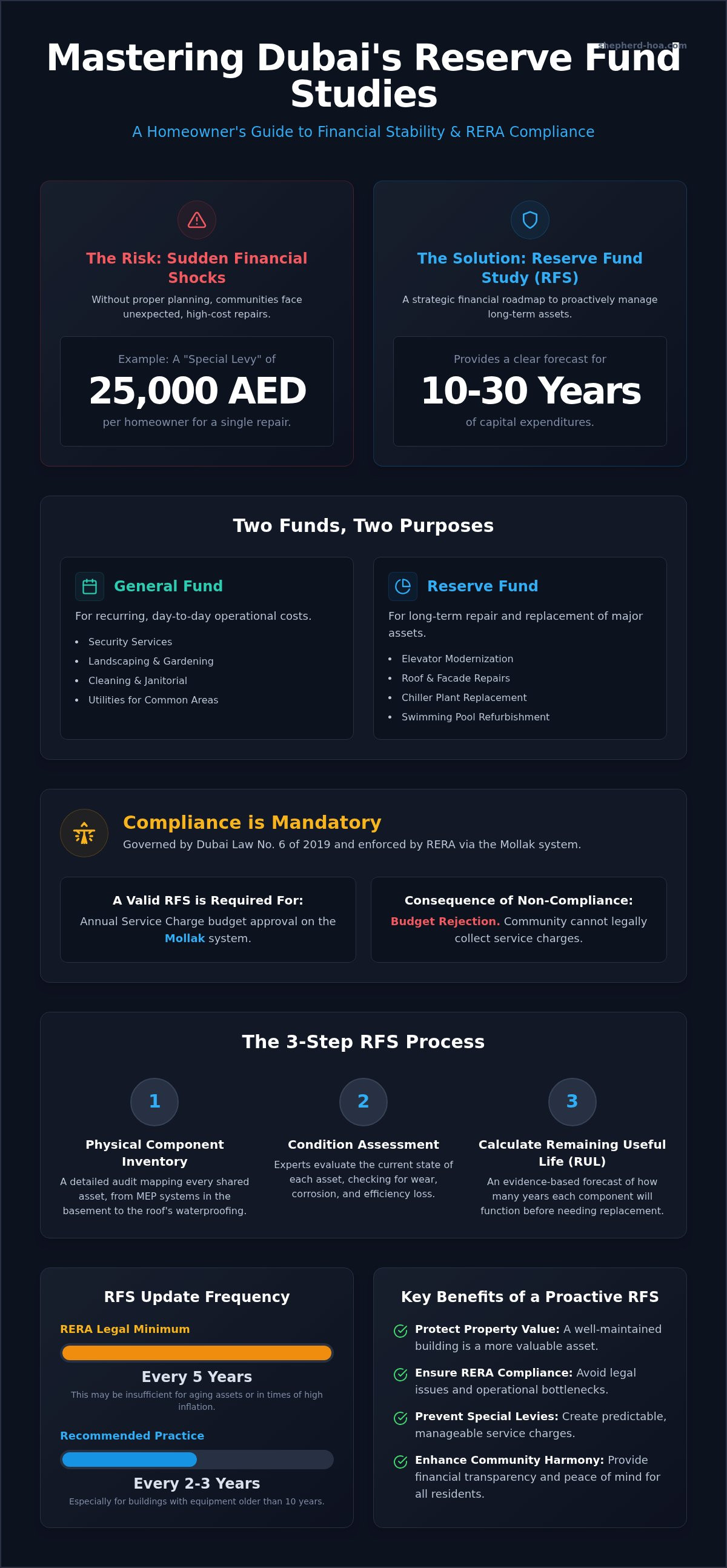
A Reserve Fund Study (RFS) acts as a financial shield for your community. It provides a detailed 10 to 30 year forecast of the costs required to maintain, repair, and replace the common areas of a building. By Understanding Reserve Fund Studies, board members can transition from reactive crisis management to proactive guardianship. The study ensures that when a major asset like a chiller or elevator reaches the end of its life, the money is already in the bank. It's a strategic roadmap that provides clarity for everyone involved in community governance.
It's vital to distinguish between your community's two primary accounts. The General Fund covers recurring operational costs like security, landscaping, and cleaning. In contrast, the Reserve Fund is strictly for long-term capital expenditure. The primary goal is to eliminate the need for "special levies". These sudden, high-value invoices can cause financial distress for homeowners and damage the social harmony of the building. A well-funded reserve protects the property's reputation and ensures that owners aren't hit with unexpected bills for 50,000 AED or more for roof repairs.
The Legal Framework: Law No. 6 of 2019
Compliance isn't optional. Under Dubai’s Law No. 6 of 2019, often called the Strata Law, RERA mandates that every jointly owned property maintains a healthy reserve fund. This legislation ensures that developers and management companies protect the building's structural integrity over decades. Meeting the reserve fund study requirements dubai sets is a prerequisite for getting your annual service charge budget approved. RERA auditors use these studies to verify that the reserve portion of your budget is realistic. Without a valid study, the Mollak system will likely reject your budget submission. This leaves the community unable to legally collect service charges, creating a significant operational bottleneck and potential legal liabilities for the board.
Mandatory Frequency and Timing
While RERA establishes a five-year interval as the legal minimum for updates, this is rarely sufficient for aging assets. We recommend that communities with equipment older than ten years consider updates every two to three years. This frequency allows for more accurate adjustments based on actual wear and tear. It's much easier to explain a small, incremental service charge increase to owners than a massive jump because a five-year-old forecast was out of date.
Market conditions in 2026 have introduced new variables. Significant inflation in the cost of raw materials and specialized labor means that forecasts made just a few years ago may now be dangerously underfunded. A timely update ensures your financial roadmap reflects current AED values. This proactive approach safeguards the community against future shortfalls and keeps the building's market value competitive in a rapidly evolving landscape.
The Technical Anatomy of a Long-Term Capital Expenditure Plan
A professional reserve fund study is much more than a simple spreadsheet; it's a rigorous technical audit of a building's physical health. To meet the reserve fund study requirements dubai mandates, consultants must first perform a granular physical component inventory. This process involves mapping every shared asset within the community, from basement MEP systems to the roof's waterproofing membrane. By documenting the quantity, type, and location of these assets, the study creates a transparent record that serves as the foundation for all future financial decisions.
Once the inventory is complete, a condition assessment determines the current state of each asset. Experts look for signs of wear, corrosion, or efficiency loss that might not be visible during routine maintenance. This data allows them to calculate the Remaining Useful Life (RUL) for every system. Remaining Useful Life is the estimated years an asset will function before requiring replacement. Accurate RUL calculations prevent the shock of a chiller failure or elevator breakdown years before expected, allowing the board to act as a watchful guardian of the owners' investments.
Component Categorization
Effective studies categorize assets into three primary groups to ensure nothing is overlooked. Mechanical, Electrical, and Plumbing (MEP) systems are the vital organs of any Dubai high-rise. These include central cooling plants, fire suppression systems, and water pumps. The building envelope comprises the "skin" of the property, such as facades, balconies, and roofing. Finally, interior finishes and amenities cover the common areas, gyms, and swimming pools that define a community's lifestyle. Properly identifying these categories ensures that the reserve fund covers both structural necessities and the aesthetic upgrades that maintain property value.
Financial Modeling and Inflation
Forecasting replacement costs requires adhering to RERA rules and regulations while applying international lifecycle costing standards. In the UAE, the cost of raw materials and specialized labor can fluctuate significantly. A robust study applies local inflation indices to ensure that the AED values projected for 2035 or 2045 remain realistic. This leads to the "Percent Funded" metric, which is the ultimate indicator of a community's financial health. It compares the cash currently in your reserve account against the theoretical amount needed to meet all future liabilities. Aiming for a high funding percentage ensures that the community remains resilient against market shifts. Expert budget planning helps board members interpret these technical metrics to make informed, confident decisions for their residents.
How to Create Your Community’s Capital Expenditure Roadmap
Creating a strategic roadmap requires a methodical approach that begins long before a surveyor sets foot on your property. To satisfy the reserve fund study requirements dubai mandates, the process must be initiated through a formal board resolution. This ensures the study is recognized as an official community project with a dedicated budget. Once the resolution is passed, the board must oversee a transparent tendering process to find a qualified partner who can act as a steady guide through the technical complexities ahead.
Step 1: Selecting a RERA-Approved Consultant
Selecting the right consultant is the most critical decision a board will make. You should prioritize firms with RICS certification and a proven track record in similar UAE communities. It's essential to use an independent third-party assessor to avoid any conflict of interest with your existing maintenance providers. Shepherd HomeOwners' Association acts as a watchful guardian during this phase, assisting boards in the ethical tendering of these technical contracts. We ensure that the scope of work is comprehensive and that the consultants are vetted for their expertise in Dubai's specific regulatory environment.
The site audit is a pivotal moment in the process. During this walkthrough, a technical surveyor inspects shared assets like the chiller plant and basement drainage. To get the most value from this visit, you must provide the consultant with original MEP drawings and historical maintenance logs. This data allows the surveyor to compare the theoretical lifespan of equipment with its actual performance history. Without these records, the study remains a generic estimate rather than a customized financial shield for your specific building.
Step 2: Technical and Financial Data Integration
Once the physical data is collected, it must be integrated with your community's financial reality. This involves collaborating closely with your facility management team to validate asset performance. A high-quality study doesn't just provide a 30-year forecast; it distills that data into a 5-year action plan. This shorter-term roadmap gives the board immediate clarity on which projects require funding in the next few budget cycles. It allows you to validate the consultant's cost estimates against current market benchmarks in the UAE, ensuring your reserve contributions are neither too high for owners nor too low for the building's safety.
The final stage is the formal review and adoption of the report. The board should analyze the findings to ensure they align with the community's long-term goals. Once approved, this document becomes the backbone of your financial planning, providing the evidence needed to justify service charge levels to both residents and RERA auditors. This organized control replaces operational stress with a clear, actionable path toward long-term stability.
Navigating RERA Approvals and Mollak Integration
Once your technical report is finalized, the next phase involves securing official validation through Dubai's digital infrastructure. The Mollak system acts as the primary gatekeeper for all community finances. To satisfy the reserve fund study requirements dubai mandates, your management team must upload the full technical report into the portal. RERA auditors don't just look at the final figures; they scrutinize the RFS to justify the specific "Reserve Fund" portion of every unit owner's invoice. This data-driven approach ensures that the funds collected are strictly proportional to the building's actual needs, preventing arbitrary fee hikes and ensuring financial transparency.
This digital synchronization is a cornerstone of mastering the community service charge budget in Dubai. When your capital expenditure plan is correctly integrated into Mollak, it provides a clear audit trail that simplifies the annual approval process. It transforms a complex administrative hurdle into a streamlined, predictable workflow that protects the board from liability and ensures the community remains in good standing with the regulator.
The Mollak Approval Workflow
A common challenge for many boards is managing a discrepancy between the study’s recommendations and the community's current bank balance. If your reserve is underfunded, RERA requires a clear plan to bridge the gap. Professional owners association management in Dubai provides the necessary oversight to navigate these technicalities. Shepherd HomeOwners' Association provides the expertise to help you present a corrective strategy that shows how the community will reach 100% funding over a realistic timeline. This level of organized control is what ensures your budget moves through the Mollak portal without rejection or delay.
Transparency and Owner Communication
Transparency serves as the most effective tool for maintaining social harmony within a building. During the Annual General Assembly (AGA), board members can use the reserve fund study as a definitive source of truth to answer owner queries. Instead of vague explanations, you can show residents exactly how their contributions are being saved for specific future upgrades, such as elevator modernizations or facade repainting. A well-funded reserve isn't just a legal necessity; it's a powerful asset that protects individual property resale values. When potential buyers see a professional capital expenditure plan, they gain confidence that they won't be hit with sudden financial burdens after their purchase.
Ensure your community is fully compliant and financially secure by partnering with Shepherd HomeOwners' Association for expert Mollak and RERA approval services.
Optimizing Your Reserve Fund for Long-Term Value
Meeting the baseline reserve fund study requirements dubai mandates is a vital first step, but true financial health comes from moving beyond simple compliance. At Shepherd HomeOwners' Association, we advocate for a strategic guardianship approach. This means treating your reserve fund study not as a static document to be filed away, but as a dynamic financial engine. By actively managing these funds, boards can ensure that the community remains resilient against market fluctuations while maintaining the high standards that residents expect from a premium Dubai development.
A critical part of this optimization involves sophisticated investment strategies. RERA guidelines require reserve funds to be held in separate, dedicated accounts to ensure they aren't used for daily operational costs. However, keeping these significant sums in low-interest environments can lead to value erosion due to inflation. We guide boards in balancing the need for immediate liquidity with RERA-approved, low-risk growth opportunities. This disciplined approach ensures that the AED value of your savings keeps pace with the rising costs of specialized labor and materials in the UAE.
Continuous monitoring is what separates successful communities from those facing financial shortfalls. While the law mandates updates every five years, a proactive board reviews the capital expenditure plan annually. If a major system like a chiller plant performs better than expected or if a facade requires earlier attention due to environmental factors, the plan should reflect these realities immediately. This regular calibration keeps your Percent Funded metric accurate and prevents the need for drastic service charge hikes in the future.
Strategic Guardianship of Community Assets
The emotional style of community governance often shifts from operational stress to a sense of organized control when a professional framework is in place. Volunteer board members frequently feel overwhelmed by the technical and financial weight of their roles. Shepherd HomeOwners' Association acts as the invisible backbone for these individuals, providing the expertise needed to make confident decisions. By protecting the community's legacy through disciplined oversight, we help preserve not just the building's physical structure, but the social harmony and peace of mind of every homeowner.
Next Steps for Your Board
If you haven't reviewed your financial roadmap recently, now is the time to audit your status. A study that is more than five years old is legally expired, and even a three-year-old study may be inaccurate given recent shifts in the Dubai property market. We recommend a simple three-step check for your board:
Verify the date of your last professional reserve fund study.
Compare your current bank balance against the Target Funding levels identified in that report.
Identify any major assets nearing the end of their Remaining Useful Life within the next 24 months.
Don't leave your community's financial future to chance. Professional oversight ensures that your long-term plans are actually followed and that your assets remain protected for decades to come. Secure your community's future with Shepherd HomeOwners' Association budget planning services and experience the confidence that comes with expert guardianship.
Securing Your Community's Financial Legacy
A professional capital expenditure plan is the foundation of a resilient community. By moving beyond basic compliance, you transform your reserve fund from a legal obligation into a strategic asset that preserves property value for decades. You've learned how detailed asset mapping and condition assessments provide the clarity needed to avoid the shock of sudden special levies. Navigating the specific reserve fund study requirements dubai mandates through the Mollak system ensures your community remains in good standing while building trust with every homeowner.
True peace of mind comes from knowing that your building's future is professionally planned and protected. Shepherd acts as your steady guide, offering RERA-approved management practices and transparent financial reporting that simplify the complexities of community governance. Our role as a professional guardian of property value allows you to focus on fostering social harmony rather than managing administrative crises. Take the first step toward organized control today. Partner with Shepherd for Expert Community Budget Planning and ensure your community thrives in Dubai's evolving real estate landscape. You have the tools to build a secure future; let us help you implement them with confidence.
Frequently Asked Questions
Is a reserve fund study mandatory for all communities in Dubai?
Yes, a reserve fund study is mandatory for every jointly owned property under Law No. 6 of 2019. RERA requires this document to verify that the community is collecting enough money for long-term repairs. Without a valid study, the Mollak system will not approve your annual service charge budget, which prevents the legal collection of fees from owners.
How often does RERA require a reserve fund study update in 2026?
RERA mandates that you update your study at least every five years to remain compliant. However, the current industry standard in 2026 is an update every three years. Frequent updates are vital to account for UAE market inflation and the actual wear and tear of building systems, ensuring your financial roadmap remains accurate and realistic.
What happens if a community does not have enough money in its reserve fund?
The board must develop a corrective funding plan to bridge the deficit over a set period. RERA auditors will review this plan to ensure the community reaches 100% funding safely. This usually involves incremental increases in the reserve portion of the service charge to avoid the sudden, high-cost "special levies" that homeowners fear.
Can the reserve fund be used for daily maintenance or operational costs?
No, the reserve fund is strictly reserved for major capital expenditures and the replacement of shared assets. Daily expenses like security, cleaning, and minor repairs must be paid from the General Fund. Using reserve money for operational costs is a regulatory violation and leaves the building vulnerable when expensive systems like chillers eventually fail.
Who is qualified to conduct a professional reserve fund study in the UAE?
Only RERA-approved technical consultants with RICS certification are qualified to perform these studies. These professionals must be independent third parties to ensure an unbiased assessment of the building's health. Hiring a certified expert ensures that the reserve fund study requirements dubai mandates are met with the highest level of technical and financial accuracy.
How does the reserve fund study affect my annual service charge?
The study directly determines the "Reserve Fund" line item on your annual service charge invoice. It calculates the exact AED contribution required from each owner based on the building's future needs. While it may lead to small adjustments, a professional study prevents massive, unexpected price hikes by spreading the cost of major repairs over many years.
What is the difference between a building condition survey and a reserve fund study?
A building condition survey identifies current physical defects that need immediate attention. In contrast, a reserve fund study includes a condition assessment but adds a 30-year financial forecast for future replacements. It connects the physical state of the building to a long-term cash flow plan, providing a complete roadmap for the community's financial health.
Can a developer be held responsible for an underfunded reserve fund at handover?
Developers are legally responsible for repairing structural defects for ten years after completion under Law No. 6 of 2019. While they don't typically provide the cash for the reserve fund, they must provide an accurate initial budget and maintenance logs at handover. A professional study conducted during the handover phase ensures the community starts with a clear and fair financial baseline.


Comments