
Common Property Handover Issues in Dubai: The 2026 Homeowner’s Guide to Protection

Your property handover is not the finish line of your investment; it's the critical moment where your asset's long-term value is either secured or compromised. While receiving your keys is a major milestone, many owners are blindsided by common property handover issues dubai residents face, ranging from hidden structural defects to unexpected administrative hurdles. Under the New UAE Civil Code effective June 1, 2026, developers now face stricter disclosure requirements. However, the practical burden of identifying physical and legal discrepancies still rests firmly on your shoulders.
It's natural to feel a sense of operational stress when faced with developer delays or the complexities of Mollak and RERA regulations. We understand that you want a seamless transition into your new community without the fear of hidden costs or structural failures. This guide provides the expert oversight you need to manage these challenges, ensuring your home is defect-free and your documentation is fully compliant. We will examine how to resolve service charge disputes, manage utility connections, and protect your rights under the latest 2026 legal frameworks, giving you the peace of mind that comes with organized control.
Table of Contents
Physical Defects and Snagging: Identifying Common Property Handover Issues in Dubai
Financial Transparency and Mollak: Navigating Service Charge Inception
Developer Delays and Dispute Resolution: Protecting Your Rights Under RERA
Beyond the Keys: Professional Oversight for Long-Term Community Excellence
Physical Defects and Snagging: Identifying Common Property Handover Issues in Dubai
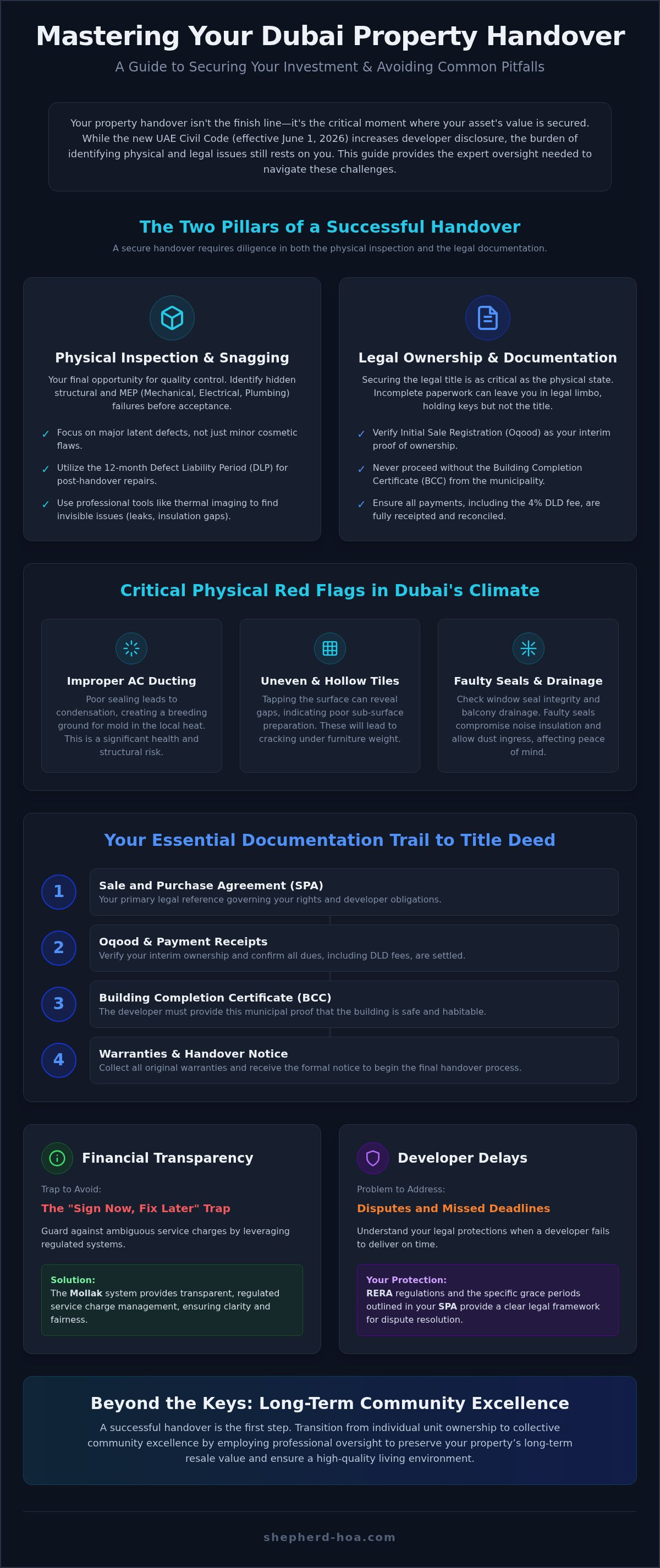
The snagging process is your final opportunity for rigorous quality control before you formally accept a property. It's the moment where you transition from a buyer to a guardian of your investment. While a unit might look pristine during a quick walkthrough, common property handover issues dubai owners face are often buried within the building's infrastructure. MEP (Mechanical, Electrical, and Plumbing) failures are the most frequent challenges, ranging from improperly grounded circuits to slow-leaking pipes that can cause catastrophic damage over time. You must distinguish between minor cosmetic flaws, such as a paint scuff, and major latent defects that impact the long-term habitability and value of the home.
The Defect Liability Period (DLP) serves as your primary safety net, providing a 12-month window from the date of completion where the developer is legally required to rectify any minor repairs or snags identified by the owner.
The Professional Snagging Process
Modern construction requires modern inspection tools. We utilize thermal imaging to detect hidden water leaks and insulation gaps that are invisible to the naked eye but lead to high utility bills and structural rot. It's vital to test every electrical socket and water outlet under a full load to ensure the systems are robust enough for daily life. Documenting every finding with clear photographic evidence and a formal tracker ensures developer accountability. This organized approach creates a clear record that the Real Estate Regulatory Agency (RERA) can recognize should you need to escalate a dispute regarding the quality of the finish.
Critical Physical Red Flags to Watch For
Dubai's unique climate creates specific risks that you shouldn't ignore. Improper AC ducting is a significant red flag; poor sealing leads to condensation, which quickly becomes a breeding ground for mold in the local heat. You should also check for uneven flooring or hollow tiles by tapping the surface; these gaps indicate poor sub-surface preparation and will lead to cracking under furniture weight. Finally, pay close attention to balcony drainage and window seal integrity. A faulty seal won't just let in dust; it fails to protect your home from the high-decibel noise of a bustling city, compromising your peace of mind and the unit's resale potential.
The Documentation Minefield: Securing Your Legal Ownership
Securing the legal title to your new home is just as critical as the physical inspection. One of the most overlooked aspects of common property handover issues dubai buyers encounter is the failure to verify Initial Sale Registration (Oqood). This document acts as your interim proof of ownership before the final Title Deed is issued. Before you accept the keys, you must ensure that every payment, including the final installment and the 4% Dubai Land Department fee, is fully receipted and reconciled. Without these records, the transition of ownership can stall, leaving you in a legal limbo where you hold the keys but not the title.
You should never proceed with a handover without confirming the Building Completion Certificate (BCC). This document, issued by the municipality, verifies that the entire building is safe, habitable, and compliant with all local codes. Once the BCC is in place, the developer will issue a formal 'Handover Notice'. This is the official starting gun for the official DLD handover process. It signals that the unit is ready for your final inspection and key collection. If the developer cannot produce the BCC, you're within your rights to delay the handover to protect your interests.
Essential Handover Paperwork Checklist
Your Sale and Purchase Agreement (SPA) is the primary legal reference for this entire transition. It contains the specific terms that govern your rights as an owner. To secure your permanent Title Deed, you must work through the DLD, providing proof of all settled dues and the original Oqood registration. Additionally, ensure the developer hands over all original warranties for appliances and structural components. These documents are essential for future maintenance and preserving your asset's value. If the paperwork feels overwhelming, our team can provide the professional guidance necessary to keep your investment secure.
SPA: The definitive contract outlining completion dates and penalty clauses.
Oqood: Proof of registration in the interim real estate register.
Title Deed: The final document issued by the DLD confirming full ownership.
Warranties: Manufacturer guarantees for AC units, kitchen appliances, and MEP systems.
Utility and DEWA Integration
Activating your home requires a coordinated effort across multiple service providers. You'll need to complete your utility account setup dewa dubai by submitting your Title Deed or Ejari certificate. Water and electricity are the priorities, but don't forget about third-party connections for gas and district cooling (chiller). These providers often require separate security deposits and registration forms. Managing these connections early prevents delays in moving in or leasing the unit, ensuring your property is functional from day one.
Financial Transparency and Mollak: Navigating Service Charge Inception
Financial oversight is the cornerstone of community stability and long-term asset preservation. One of the most persistent common property handover issues dubai homeowners encounter is the lack of clarity regarding initial service charges. Developers often push a "Sign Now, Fix Later" approach, pressuring owners to clear administrative fees and advance service charges before they've even inspected the unit. You should resist this pressure. Settling these dues prematurely can leave you with limited leverage if structural snags are discovered later. The mollak dubai system ensures financial transparency by centralizing all service charge billing and preventing unauthorized fee collection.
Transparency isn't just a buzzword; it's a regulatory requirement. Before you make any payment, verify that the service charges have been approved by the Real Estate Regulatory Agency (RERA). These figures must be visible in the Mollak portal, which acts as the only legal platform for such transactions. By insisting on this process, you protect your investment from arbitrary price hikes and ensure your funds are handled with the professional oversight they deserve.
Mollak System Transparency
You can verify your unit's specific service charge status through the Dubai REST app. It's critical to receive a RERA-approved invoice rather than a developer's estimate. This official document provides a clear breakdown of where your money goes. Specifically, it distinguishes between the general fund, used for daily operational costs like security and cleaning, and the reserve fund. The reserve fund is your community's long-term savings account, designed to cover major capital repairs like roof replacements or elevator overhauls years down the line. Understanding this breakdown gives you a sense of organized control over your property's financial health.
Understanding Service Charge Inception
Your legal liability for service charges typically begins once the developer issues the formal Handover Notice, provided the building has its Completion Certificate. However, you should carefully review your SPA to confirm the exact trigger point. Don't be caught off guard by "hidden" administrative or move-in fees. If a fee doesn't appear on a RERA-approved invoice, it's likely non-compliant. A professional community management partner acts as a watchful guardian in these scenarios, overseeing the transition of funds to ensure they are used exclusively for community upkeep. This collective management preserves the social harmony and resale value of the entire development.
Developer Delays and Dispute Resolution: Protecting Your Rights Under RERA
Delays are among the most stressful common property handover issues dubai investors encounter. You've likely planned your finances or relocation around a specific date, only to find the construction progress lagging. To regain a sense of organized control, your first step is a thorough review of your Sale and Purchase Agreement (SPA). This contract defines the 'Anticipated Completion Date' and usually includes a standard 12-month grace period. This clause permits the developer to delay the handover for up to one year without facing legal penalties. However, once this window closes, your rights to seek compensation or even contract termination become actionable.
Law No. 13 of 2008 provides the legal framework for interim real estate registration and serves as a vital safeguard for your investment. It ensures that developers cannot indefinitely hold your capital without delivering the asset. If a delay becomes excessive, you must maintain a professional, documented trail of all interactions. Save every email, record the dates of all phone calls, and keep copies of all formal notices. This evidence is essential if you need to prove the developer's failure to meet their contractual obligations during a formal dispute.
Legal Rights for Excessive Delays
You don't need to guess about the status of your building. The RERA project status tracker allows you to verify actual construction progress against the developer's claims. If the data shows a significant gap, it may qualify as a 'material breach' of contract under UAE law. While mediation is the preferred first step, the Dubai Real Estate Court is available to resolve high-value disputes that cannot be settled through standard channels. This authoritative body ensures that the law is applied fairly to protect owner interests and maintain market integrity.
How to File a RERA Complaint
Navigating the complaint process requires a logical, step-by-step approach to ensure your case is robust. Start by sending a formal notification to the developer via registered mail or a legal notice, clearly stating your grievance and the desired resolution. Next, prepare your evidence file, which should include your SPA, all payment receipts, and any official delay notifications. Finally, utilize the Dubai Land Department's online portal to initiate a formal dispute resolution process. If the administrative burden feels overwhelming, our experts offer professional property handover services to act as your watchful guardian through every legal hurdle.
Beyond the Keys: Professional Oversight for Long-Term Community Excellence
Receiving your keys is a significant milestone, but it's not the end of your journey as a homeowner. Once you move past the individual unit inspections, your focus must shift toward the collective health of the entire development. Many common property handover issues dubai investors face occur during the transition of common areas from the developer to the homeowners. If the building's elevators, cooling plants, or fire safety systems aren't handed over with the same level of scrutiny as your living room, your service charges will inevitably climb to cover premature repairs. Transitioning your perspective from "my unit" to "our community" is the most effective way to safeguard your long-term resale value.
Professional owners association management dubai acts as the watchful guardian of these shared interests. A steady management partner ensures that the developer doesn't just walk away from the master community without meeting their structural obligations. This oversight replaces the operational stress of managing a large building with a sense of organized control, ensuring that the social harmony and financial stability of your new home remain intact for years to come.
Transitioning to Community Management
The role of the Owners' Committee is vital during the first year of a building's life. This group of elected volunteers represents homeowner interests directly to RERA, providing a formal channel for resolving community-wide disputes. Professional managers support this committee by coordinating rigorous common area inspections. We verify that gyms, pools, and essential MEP systems are fully operational and compliant with local safety standards. Ensuring the developer hands over the master community properly is a complex technical process, but it's essential for preventing the "Sign Now, Fix Later" traps that often plague new developments.
Long-Term Asset Protection
Proactive maintenance is a financial strategy, not just a cleaning schedule. We provide quarterly progress reports and transparent financial auditing to ensure every dirham of your service charge is used efficiently. By implementing proactive maintenance schedules early, we prevent the need for costly special levies in the future. Shepherd HomeOwners' Association acts as the invisible backbone for your community, managing third-party facility contracts through ethical tendering processes to ensure you receive the best value for your investment. This methodical approach preserves the asset's value and ensures a seamless living experience for every resident. To secure the future of your investment, Partner with Shepherd HomeOwners' Association for seamless community management and handover oversight.
Securing Your Future in Dubai’s Real Estate Market
Your property handover represents more than just a key collection; it's the moment you assume responsibility for a significant financial asset. By identifying common property handover issues dubai residents face, such as structural MEP failures or incomplete Oqood registration, you set a foundation for long-term stability. Rigorous snagging and the verification of Building Completion Certificates ensure your home is safe and legally sound from day one. Utilizing the Mollak system for service charge transparency further protects you from unauthorized fees and ensures your community’s funds are managed with professional oversight.
As a RERA-approved management firm and Mollak system experts, we're dedicated to asset value preservation. You don't have to navigate these administrative complexities alone. Our team provides the organized control necessary to transition from a new buyer to a confident homeowner. Secure your investment with Shepherd HomeOwners' Association’s professional property handover and community management services.
We're here to act as your watchful guardian, turning the stress of property ownership into a seamless and rewarding experience for years to come.
Frequently Asked Questions
Can I refuse a property handover if snags are found?
You can refuse to accept the handover if the property has major structural defects or latent issues that make it uninhabitable. For minor cosmetic snags, the standard practice is to accept the unit while ensuring all defects are documented in a formal snagging report. This ensures the developer remains responsible for rectifications during the 12-month Defect Liability Period without delaying your possession.
How long does the developer have to fix snags after the handover process?
Developers generally aim to rectify minor snags within 14 to 30 days of the initial inspection. Your primary protection is the 12-month Defect Liability Period (DLP), which legally obligates the developer to fix non-structural defects discovered during your first year of ownership. For any major structural issues, UAE law provides an extended ten-year warranty period for the building's integrity.
What happens if my property handover is delayed by more than 12 months?
When a delay exceeds the standard 12-month grace period defined in your SPA, you're entitled to seek legal recourse through the Real Estate Regulatory Agency (RERA). This situation often allows you to pursue compensation for rental losses or, in severe cases, a full contract termination. Addressing common property handover issues dubai owners face regarding delays requires a documented trail of all communication to support your claim.
Do I have to pay service charges immediately upon receiving the handover notice?
Your obligation to pay service charges typically begins once the developer issues the formal Handover Notice, provided the Building Completion Certificate (BCC) is active. You shouldn't pay these fees into a developer's general account. All service charge payments must be processed through the Mollak system following the issuance of a RERA-approved invoice to ensure financial transparency.
What is the role of the Mollak system during the property handover?
The Mollak system acts as a financial guardian by regulating all service charge transactions for jointly owned properties. During the handover phase, it ensures that the fees you're asked to pay are verified and approved by RERA. This prevents developers from charging arbitrary administrative fees and ensures your money is held in a secure, audited account for community maintenance.
Is professional snagging mandatory for new properties in Dubai?
Professional snagging isn't a legal requirement, but it's the most effective way to identify common property handover issues dubai investors might miss. Experts use specialized tools, such as thermal imaging and load testers, to find hidden leaks or electrical faults. This technical oversight provides a detailed report that forces the developer to meet the quality standards promised in your SPA.
How do I set up my DEWA and utility accounts after receiving the keys?
You can activate your utility accounts through the DEWA website or the Dubai REST app using your Title Deed or Ejari certificate. You'll need your Emirates ID and will be required to pay a security deposit. It's best to coordinate this immediately after key collection to ensure that water, electricity, and cooling services are active before you move in.
Can a developer withhold my keys if I refuse to sign the snagging report?
Developers usually release keys only after you've settled final dues and signed the handover form. If you refuse to sign because of major defects, a stalemate can occur where the developer withholds the keys. In these cases, you should escalate the matter to RERA for mediation, as developers cannot force you to accept a unit that fails to meet basic habitability standards.


Comments