
Dubai HOA Board Responsibilities: 2026 Owners' Guide to Financial Reporting and Governance

Could a single administrative oversight in the Mollak system lead to a AED 2,000,000 fine for your community? For many Owners' Committee members in communities across the UAE, the transition from a volunteer mindset to a formal governance role feels heavy. You likely stepped up to protect your property value, but now you're facing the pressure of strict hoa financial reporting standards dubai requires for the 2026 cycle. It's natural to feel concerned about legal liability or the technical complexities of IFRS compliance and mandatory RERA audits.
This guide serves as your professional roadmap to master these administrative and financial duties with total confidence. We'll clarify the boundaries between your oversight role and professional management tasks, ensuring you act as a steady guardian for your community assets. You will gain the tools to review financial audits effectively and learn to use the Mollak system as a source of transparency rather than stress. We'll provide the clarity you need to maintain high governance standards while protecting the long-term value of your home.
Table of Contents
The Legal Foundation: Understanding HOA Board Responsibilities in Dubai
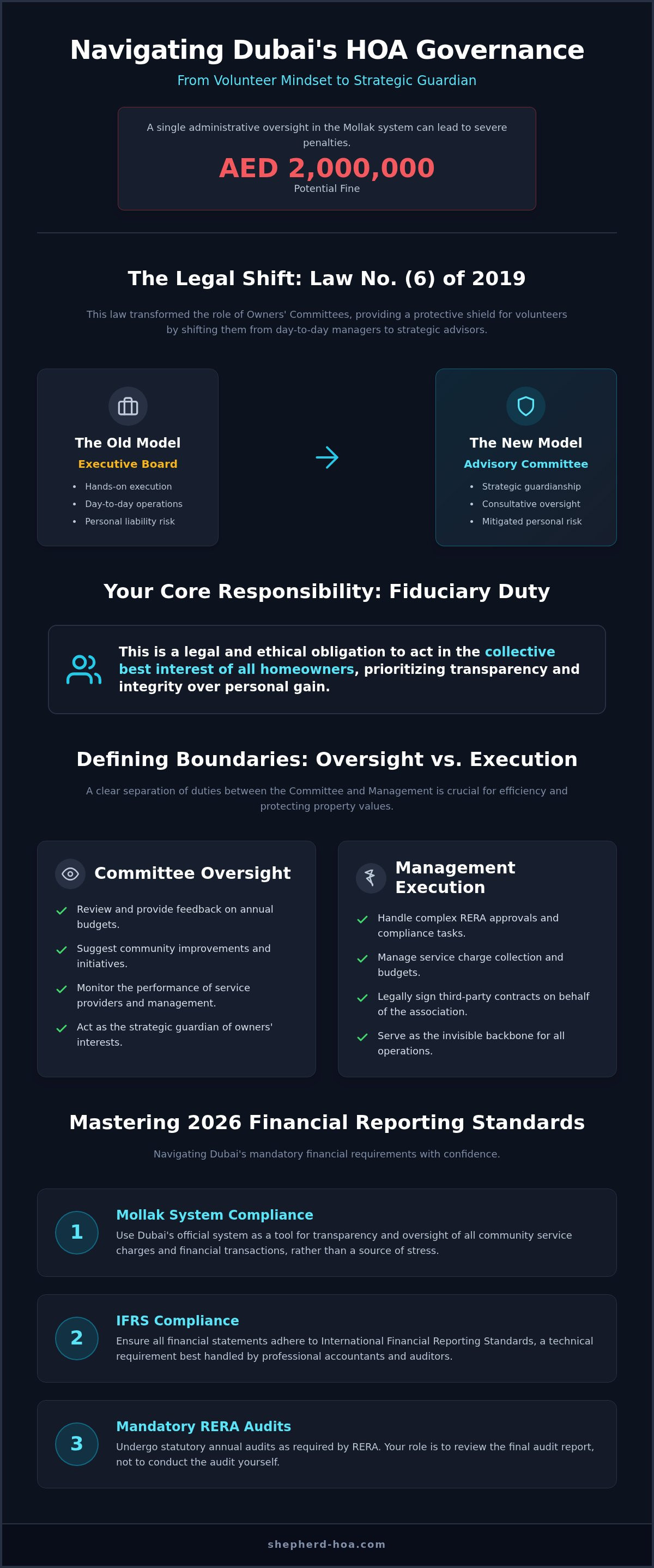
Dubai's real estate sector underwent a transformative shift with the implementation of Law No. (6) of 2019. This legislation effectively replaced the traditional executive board model with a more structured Owners' Committee. While many residents still use the term homeowner association (HOA) to describe their community's leadership, the legal reality in Dubai is now far more sophisticated. This modern framework provides a protective shield for volunteers, ensuring that committee members act as strategic guardians rather than unpaid property managers. By understanding these legal roots, you can navigate the hoa financial reporting standards dubai requires with clarity and peace of mind.
The primary benefit of this legal evolution is the mitigation of personal risk. Under the current law, the Owners' Committee operates as an advisory body. This means you aren't personally responsible for the day-to-day operational or financial liabilities of the building. Instead, your role is to provide oversight and ensure the professional management company remains RERA compliant in every action they take. This separation of powers is designed to foster social harmony and protect your long-term asset value without placing an unfair burden on your personal life.
Law No. (6) of 2019: The Strata Law Explained
This law, often referred to as the Strata Law, applies to all jointly owned properties across the UAE. It categorizes developments into three distinct tiers to ensure management styles match the project's scale. Major developments are overseen by the developer, hotel projects have specialized management requirements, and all other jointly owned properties are managed by RERA-licensed companies. For large-scale communities, the law makes it mandatory to appoint a professional management firm. This ensures that technical tasks, such as complex budget planning and utility account setup, are handled by experts while the committee maintains its role as a watchful guardian of the owners' interests.
The Advisory Nature of the Owners' Committee
The transition to an advisory role is the most significant change for committee members. Your duties are consultative; you're there to review annual budgets, suggest community improvements, and monitor the performance of service providers. It's a role of high-level oversight rather than hands-on execution. For instance, while you have the authority to review and discuss maintenance contracts, the committee cannot legally sign third-party contracts on behalf of the association. That responsibility falls to the licensed management company. Your specific governance rules are further defined by your community's Constitution, which acts as a secondary guide to ensure all decisions align with the unique needs of your neighborhood.
Key Roles and Fiduciary Duties of Owners' Committee Members
Serving on an Owners' Committee is a position of significant trust. At its core, every member carries a fiduciary duty to the community. This means you're legally and ethically bound to act in the collective interest of all homeowners rather than seeking personal gain or favoring specific neighbors. True guardianship requires a commitment to transparency and integrity in every decision, from approving a minor repair to reviewing large-scale service contracts. When committee members embrace this mindset, it creates a culture of calm reliability that reassures every resident their investment is being protected.
While the committee provides the vision, professional owners association management serves as the functional backbone of these efforts. A management partner handles the complex administrative heavy lifting, allowing you to focus on high-level oversight. This partnership ensures that your community's governance remains robust and that all actions align with the latest RERA regulations. If you're looking for ways to streamline these responsibilities, expert administrative guidance can help your committee operate with greater precision and less stress.
The Chairperson: Leading the Consultative Process
The Chairperson acts as the primary moderator for the committee, ensuring that meetings remain productive and focused on the community's long-term health. Rather than acting as a solo decision-maker, the Chairperson facilitates open dialogue and liaises directly with the professional management firm. Their goal is to set effective agendas that prioritize property value preservation and resident harmony. By acting as a steady guide during sessions, the Chairperson ensures that every member's voice is heard and that the committee reaches a consensus that serves the entire building.
Treasurer and Secretary: Oversight and Documentation
The Treasurer and Secretary hold roles that are vital for maintaining the community's "paper trail" and financial integrity. It's a common misconception that the Treasurer must be a professional accountant; in reality, their role is one of oversight. They review financial audits and ensure the management company is adhering to the hoa financial reporting standards dubai requires, specifically following International Financial Reporting Standards (IFRS). This high-level review provides an extra layer of protection for the community's reserve funds.
The Secretary’s duty is equally critical for legal protection. They ensure that every meeting's minutes are accurately recorded and promptly submitted to RERA through the Mollak system. Clear, professional documentation is your primary defense against future community disputes or legal challenges. It provides a transparent record of why decisions were made, proving that the committee acted with due diligence and followed the established Constitution. This organized approach replaces operational chaos with a sense of controlled, professional governance.
Board Oversight vs. Management Execution: Defining the Boundaries
Friction within a community often stems from a single source: blurred lines between strategy and operations. When committee members feel they must handle every vendor call, and managers feel restricted in their daily duties, the community's stability suffers. Adhering to the hoa financial reporting standards dubai mandates requires a clear division of labor to ensure both accuracy and regulatory compliance. When these boundaries are respected, the community functions with the organized control that residents expect from professional leadership.
Micro-management is a common pitfall that doesn't just cause stress; it leads to tangible operational inefficiency. If a committee insists on approving every minor repair invoice or choosing specific cleaning supplies, the management company can't respond quickly to emergencies. This creates a bottleneck that can delay essential maintenance and eventually lead to higher service charges due to increased administrative costs. A healthy framework for collaboration relies on the committee setting the "what" while the professional manager determines the "how."
The Management Company’s Domain
The management firm acts as the community's operational engine. Their primary responsibility involves the technical execution of the committee's vision. This includes facility management, vendor tendering, and the rigorous daily mollak dubai reporting that keeps the building in RERA's good graces. They are the experts in managing service charge collection and enforcing payment through established legal channels. Crucially, a professional manager must prioritize national health, safety, and environmental standards above all else. They are legally bound to follow RERA regulations, even if those rules occasionally conflict with a committee's personal preferences.
The Board’s Strategic Domain
As a committee member, you're the strategic architect of the community. Your focus should remain on the "big picture" items that preserve asset value over the long term. This involves setting a 5-year vision for facility upgrades, such as gym renovations or sustainability initiatives that lower utility costs. You're also responsible for reviewing and providing critical feedback on the annual community service charge budget before it's submitted for approval. By acting as the "voice of the residents," you ensure that the management company’s execution aligns with the unique lifestyle and expectations of your specific neighborhood. This oversight role provides the necessary checks and balances to keep the community moving forward with integrity.
Financial Reporting Standards and the Mollak System in 2026
The Mollak system acts as the digital heart of Dubai’s real estate governance. It’s no longer just a recommendation; it is the mandatory national platform for every financial transaction and reporting requirement. By centralizing all data, RERA ensures that the hoa financial reporting standards dubai requires are met with absolute precision. This includes the strict application of International Financial Reporting Standards (IFRS), which provides a universal language for your community’s balance sheets. Unlike some corporate environments where audits might be optional, RERA mandates annual statutory audits conducted by approved firms for all managed communities. For those with a December 31 year-end, the submission deadline for these audited statements is May 30, 2026.
Budgeting for the 2026 cycle also requires a deep dive into the RERA Service Charge Index. This index provides the benchmark for approved rates, ranging from AED 2 to AED 6 per square foot for villas to over AED 70 for luxury towers in Downtown Dubai. If your proposed budget exceeds these benchmarks, you'll need robust justification backed by Mollak data. If you need assistance navigating these technical requirements, Shepherd HOA provides the administrative backbone to ensure your community remains fully compliant.
Navigating the Mollak Platform for Committee Members
One of the most powerful tools at your disposal is the 'Board Member' view within the Mollak interface. This specialized dashboard offers real-time financial tracking, allowing you to see exactly how funds are flowing without waiting for a monthly summary. You can verify that service charges are being collected and utilized strictly according to the approved budget. We recommend reviewing these figures at least quarterly. Consistent quarterly reporting isn't just a regulatory checkbox; it's the most effective way to maintain resident trust and demonstrate that the committee is acting as a responsible guardian of community wealth.
Ensuring Service Charge Transparency
Resident objections to service charges are common, but they're easily managed when you have Mollak-verified data on your side. When owners question why they're paying AED 15 per square foot in Business Bay, you can point to the audited financial reports to justify necessary maintenance or long-term capital expenditures like chiller replacements. This transparency replaces suspicion with understanding. Transparent financial governance directly correlates with higher property resale values because savvy buyers prioritize well-managed, financially stable communities. Using these reports to show a healthy reserve fund provides peace of mind to current owners and potential investors alike.
Strategic Governance: Partnering with Shepherd HomeOwners' Association
Effective community governance shouldn't feel like a second full-time job. While the legal and financial requirements for Owners' Committees are strict, they don't have to be overwhelming. Shepherd HomeOwners' Association acts as the administrative backbone for your board, transforming complex regulatory demands into a manageable, organized process. By partnering with an expert guide, you ensure that your building meets the hoa financial reporting standards dubai mandates without sacrificing your personal time. We navigate the intricate national legal framework of the UAE so you can focus on the strategic vision for your home.
Our team handles the heavy lifting of RERA approvals and Mollak filings. We ensure your community remains in good standing with the Dubai Land Department, managing everything from budget planning to the final submission of audited accounts. This professional oversight replaces operational stress with a sense of calm reliability. We invite you to experience a partnership that prioritizes social harmony and the long-term preservation of your assets. As a wholly Emirati-owned company with RERA-approved management experience since 2010, we provide the steady hand your community needs to thrive.
The Shepherd Advantage for Volunteer Boards
We understand that most committee members aren't financial experts. That's why Shepherd HomeOwners' Association provides clear, digestible financial reports that make oversight simple. You won't have to wade through raw data; we present the facts in a way that allows for quick, confident decision-making. Our commitment to integrity extends to our ethical tendering processes. We ensure your community receives the best value for third-party maintenance and service contracts through transparent, competitive bidding. This ensures that service charges, which can range from AED 10 to AED 30 per square foot for standard apartments, are utilized with maximum efficiency.
Beyond the balance sheet, we act as a neutral party in community life. We provide professional mediation to resolve neighbor disputes, using clear living in a dubai community rules as our guide. This proactive approach prevents small misunderstandings from becoming legal challenges, fostering a peaceful environment for every resident. By maintaining these standards, we act as an invisible backbone for your committee, allowing you to lead with confidence.
Securing Your Community’s Future
Professional management is an investment in your property’s future. When a community is governed ethically and transparently, the quality of life for all residents improves. You'll see the results in well-maintained common areas, efficient utility management, and a sense of collective pride. These factors have a direct, long-term impact on property investment returns and community stability. By choosing a partner that values asset preservation as much as you do, you secure a legacy of excellence for your building. Our expertise in IFRS standards ensures that your financial history is a testament to your committee's integrity.
Are you ready to bring professional clarity to your Owners' Committee? Request a professional community management proposal from Shepherd HomeOwners' Association today and discover how we can support your governance journey.
Lead Your Community with Professional Confidence
Navigating the 2026 regulatory landscape requires a shift from administrative burden to strategic leadership. By embracing your role as a consultative guardian, you protect yourself from liability while ensuring your community thrives. The Mollak system isn't just a compliance hurdle; it's your primary tool for absolute transparency. Adhering to the hoa financial reporting standards dubai requires is a strategic choice that secures every owner's investment and fosters lasting social harmony.
You don't have to carry this administrative weight alone. As a wholly Emirati-owned firm, Shepherd HomeOwners' Association has provided a professional administrative backbone for volunteer boards since 2010. We handle complex Mollak filings and expert RERA compliance management so you can focus on the vision for your neighborhood. We're here to replace operational stress with organized control and peace of mind.
Request a professional community management proposal from Shepherd HomeOwners' Association and begin your journey toward stress-free governance today. Your community's future is in steady hands.
Frequently Asked Questions
What is the difference between an HOA and an Owners' Committee in 2026?
The Owners' Committee is the legal successor to the traditional executive board model under Law No. (6) of 2019. While many residents still use the term homeowner association (HOA), the committee now serves an advisory and consultative role rather than an executive one. This structure ensures that a RERA-licensed management company handles daily operations while owners provide strategic oversight.
Can an Owners' Committee member be held personally liable for community debts?
Committee members aren't typically held personally liable for the community's financial obligations under the advisory model. Because the management company carries the operational responsibility, volunteers are protected as long as they act within their consultative mandate. You should always act with due diligence and transparency to maintain this legal shield and ensure the community's assets remain protected.
What are the mandatory financial reporting standards for HOAs in Dubai?
All communities must adhere to International Financial Reporting Standards (IFRS) and undergo annual statutory audits by RERA-approved firms. These hoa financial reporting standards dubai requirements ensure that every transaction is transparent and recorded within the Mollak system. For the 2026 cycle, audited statements for many developments must be submitted by May 30 to maintain full compliance.
How much time does serving on a community board typically require?
You can expect to spend approximately two to four hours per month on committee duties when a professional management company is in place. This time is usually split between attending a monthly consultative meeting and reviewing financial reports or vendor proposals. A professional administrative backbone ensures you don't get bogged down in daily maintenance calls or service charge collection tasks.
Can the Owners' Committee fire the management company?
The committee has the right to recommend a change in management, but RERA holds the final authority over licensing and appointments. If a management firm fails to meet its contractual or legal obligations, the committee presents its findings to the Dubai Land Department. This regulatory oversight prevents sudden disruptions in community services and ensures that any transition is handled according to UAE law.
Are committee members paid for their service in the UAE?
Committee membership is a voluntary, unpaid role according to Dubai's jointly owned property laws. Members cannot receive a salary, sitting fees, or any other financial benefits from the association to ensure decisions remain unbiased and focused on the collective interest. The primary benefit of serving is the ability to directly influence the preservation of your property’s long-term market value.
How do I ensure our community's service charges remain fair and transparent?
Fairness is ensured by comparing your community's rates against the RERA Service Charge Index and utilizing Mollak-verified data. For example, if your villa charges are within the AED 2 to AED 6 per square foot range, you're aligned with market averages. Regular quarterly financial reporting through the Mollak dashboard provides the transparency needed to justify expenditures and build resident trust.
What is the role of RERA in the day-to-day operations of our committee?
RERA acts as the supreme regulator that provides the legal framework and the Mollak platform for all committee activities. While they don't attend your daily meetings, they approve your annual budgets, license your service providers, and enforce the "No Cash" policy for service charges. Their involvement guarantees that your committee operates within a stable, transparent environment that protects all homeowners.


Comments