
Energy Efficiency Tips for Residential Buildings: A 2026 Strategic Guide for Owners Associations
- Sohrab Virani

- 1 day ago
- 13 min read
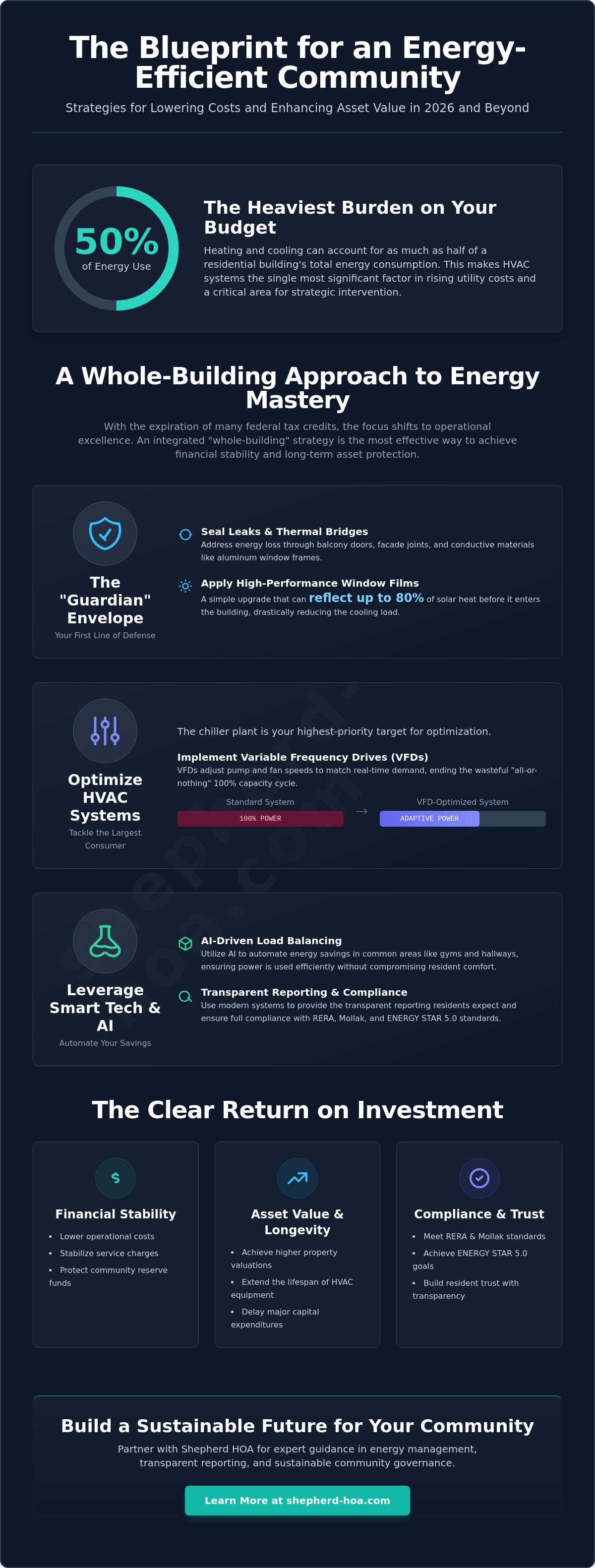
Heating and cooling can account for as much as 50% of a residential building's energy usage, which often makes it the heaviest burden on your annual budget. If you're struggling with rising utility costs and the frequent maintenance of aging HVAC systems, you're certainly not alone in this challenge. Implementing strategic energy efficiency tips for residential buildings is the most reliable way to lower operational costs while fulfilling your duty to protect the community's long-term interests.
We understand that managing a building's energy footprint can feel overwhelming, especially with the expiration of several federal tax credits at the start of 2026. This guide offers a steady hand, showing you how to enhance property value through professional energy management and modern technology. You'll learn how to achieve higher valuations through green certifications and how to use the Mollak system to provide the transparent reporting your residents expect. From the latest ENERGY STAR standards to building envelope improvements, we'll provide the clarity you need to maintain a stable and thriving residential community.
Key Takeaways
Learn why a "whole-building" approach is the most effective tool for lowering service charges and improving community financial stability in 2026.
Explore the "Guardian" strategy for optimizing building envelopes, including advanced glazing and sealing techniques to protect against high-rise heat gain.
Discover how smart technology and AI-driven load balancing can automate energy savings in gyms, hallways, and other common community areas.
Implement practical energy efficiency tips for residential buildings by leveraging reserve funds for upgrades that provide a clear, measurable return on investment.
Understand how professional community management ensures transparent reporting and full compliance with the latest RERA and Mollak sustainability standards.
Table of Contents
The Strategic Importance of Energy Efficiency in Residential Buildings
Managing a residential community requires a shift from reactive maintenance to proactive guardianship. For Owners Associations in 2026, energy efficiency represents the most significant lever for controlling operational costs. A whole-building approach is essential for high-rise structures and gated communities alike. This methodology views the building as an integrated system where the envelope, mechanical systems, and resident behavior interact. By treating the property as a single organism, boards can identify how a gain in one area, such as lighting, reduces the cooling load required from the HVAC system. This integrated philosophy of care is similar to how holistic health providers like dubaihomeoclinic.com treat the human body as a whole system to achieve optimal wellness.
The financial landscape has changed significantly as we enter 2026. With the expiration of several federal tax credits for energy upgrades at the end of 2025, the focus has shifted toward operational excellence and long-term asset value. Implementing low-energy building design principles is no longer an optional "green" initiative; it's a fiscal necessity. These strategies provide the most effective way to stabilize service charges and protect the community's reserve funds from the volatility of rising utility rates. When an Owners Association prioritizes energy oversight, they're not just saving money; they're fulfilling their duty of care to every homeowner.
Asset Preservation Through Efficiency
Energy-efficient buildings experience less mechanical strain, which directly extends the lifespan of expensive communal assets. When HVAC systems don't have to work overtime to compensate for heat gain, the wear on chillers and pumps decreases. This preservation of equipment delays the need for massive capital expenditures from the reserve fund. Beyond the mechanical benefits, sustainable operations contribute to higher property valuations. Buyers in the 2026 market prioritize buildings with proven low operational costs. By integrating energy efficiency tips for residential buildings into your annual maintenance plan, you're actively building equity for every member of the association.
Regulatory Drivers and Green Standards
National sustainability goals and local regulations are becoming increasingly stringent. In the UAE, RERA building ratings now heavily weigh energy performance and transparent reporting. Buildings that fail to meet these evolving standards risk lower ratings, which can negatively impact resident retention and investment appeal. Preparing for 2026 means staying ahead of potential carbon reporting requirements and ensuring your building meets the latest ENERGY STAR 5.0 standards for mechanical equipment. Utilizing energy efficiency tips for residential buildings ensures your community remains compliant and positioned as a premium, forward-thinking destination. This commitment to transparency and efficiency builds the social harmony that defines a well-governed community, a standard of excellence championed by luxury developers such as modeluxdevelopments.com.
Similarly, for individual homeowners and boards looking to modernize their properties, Projeco Contracting LLC | Villa Construction | Apartment Interiors Fit Out provides the specialized design and build services necessary to align luxury living with 2026 sustainability goals.
Optimizing the Building Envelope and HVAC Systems
The building envelope serves as the primary shield against the harsh external environment. A "Guardian" approach to this envelope focuses on eliminating thermal bridges, which are areas where heat transfers directly through conductive materials like aluminum window frames or concrete balcony slabs. These bridges can bypass even the best insulation, leading to massive energy waste. By sealing these gaps, an Owners Association protects the building's internal climate and reduces the constant strain on cooling equipment.
Sealing the Building Envelope
Common leak points in residential towers often hide in plain sight at balcony door seals and facade expansion joints. In desert climates, high-performance window films offer a substantial return on investment by reflecting up to 80% of solar heat before it enters the building. This simple upgrade significantly reduces the cooling load on individual apartment units and communal chillers. Thermal imaging cameras provide a visual roadmap of energy loss by detecting infrared radiation, allowing managers to see exactly where cool air escapes through invisible gaps in the building facade.
HVAC and Chiller Plant Optimization
The chiller plant is often the single largest energy consumer in a residential building, making its optimization your highest priority. Variable Frequency Drives (VFDs) act as the silent heroes of this system; they adjust pump and fan speeds to match the actual demand rather than running at 100% capacity at all times. By implementing these energy efficiency tips for residential buildings, boards can achieve immediate reductions in monthly utility bills while extending the life of expensive mechanical assets.
Moving from scheduled maintenance to a predictive model is another essential step toward organized control. Instead of changing filters or servicing motors on a fixed calendar date, use sensors to monitor pressure drops and motor vibrations. This proactive oversight ensures systems operate at peak performance and helps prevent the operational stress that often plagues volunteer boards. These Energy-saving tips from the Department of Energy highlight how even small adjustments to thermostat set-points in common areas like gyms and hallways can yield significant cumulative savings.
Balancing resident comfort with efficient management requires a methodical approach to set-point control. We recommend maintaining common areas at a steady temperature that provides relief without overtaxing the central plant. If your board needs assistance in auditing these complex systems, professional community management partners can provide the technical oversight required to protect your asset value. Regular duct sealing and insulation audits ensure that the cool air your plant produces actually reaches its destination without leaking into unconditioned ceiling voids.
Leveraging Smart Technology and IoT for Community Oversight
Technology now serves as the invisible backbone of modern community governance. By 2026, smart technology and the Internet of Things (IoT) have evolved from luxury additions to essential tools for property oversight. These systems provide boards with the real-time data needed to make informed decisions about communal assets. AI-driven load balancing is a particularly powerful development; it automatically shifts high-energy tasks, such as pool filtration or basement ventilation, to off-peak hours when utility demand is lower. This strategy reduces the building's peak load and protects the electrical infrastructure from unnecessary stress. Implementing these advanced energy efficiency tips for residential buildings aligns with broader EPA energy efficiency guidelines, which emphasize the importance of automated controls in reducing overall consumption.
Integrated Building Management Systems (BMS)
A modern BMS acts as a central hub for all mechanical operations, replacing fragmented controls with a single, authoritative interface. Instead of managing lighting, water, and cooling in isolation, a synchronized system allows for total building optimization. For example, hallway lighting can be programmed to dim when natural light is sufficient or when occupancy sensors detect no movement in common areas. This level of automation removes human error from the equation, ensuring that energy is never wasted in empty gyms or community rooms. It replaces the stress of manual monitoring with a methodical, software-driven rhythm that guarantees results.
Smart Metering and Resident Transparency
Transparency is the foundation of social harmony in any residential community. Smart metering at the unit level provides residents with clear insights into their own consumption habits, naturally incentivizing conservation. For the board, this data is invaluable for identifying "energy hogs" within community facilities that may require urgent maintenance. Integrating this data with Mollak Dubai ensures that billing is accurate and compliant with the latest 2026 regulations. This transparent approach to financial oversight builds trust between the board and homeowners, as every service charge is backed by verifiable digital records.
IoT sensors also play a vital role in water conservation and leak detection. By monitoring flow rates in real-time, these devices can alert management to hidden pipe bursts before they cause catastrophic damage or inflated utility bills. This protective stance toward the building’s assets is a core part of effective community management. Utilizing these energy efficiency tips for residential buildings creates a predictable environment where operational surprises are minimized and property value is preserved through steady, expert guidance.
Financial Planning for Efficiency: ROI and Service Charge Impact
Strategic financial oversight is the cornerstone of effective community governance. While the initial cost of energy upgrades can sometimes cause "sticker shock" for volunteer boards, viewing these expenses through the lens of a long-term investment reveals their true value. Calculating the payback period allows an Owners Association to move beyond immediate costs and focus on the point where the upgrade pays for itself through utility savings. In the 2026 landscape, where traditional incentives have shifted, the most successful boards are those that treat energy efficiency tips for residential buildings as a primary tool for fiscal stabilization.
One of the most direct benefits of these projects is their ability to lower the community service charge budget. When utility expenses decrease, the total annual collection requirement drops, providing immediate relief to homeowners. Achieving this requires ethical tendering for Energy Service Companies (ESCOs) to ensure the community receives high-quality components and guaranteed performance levels. This professional approach replaces operational uncertainty with a structured, predictable financial roadmap.
The ROI of Energy Retrofits
Consider the impact of a modest 15% reduction in communal energy consumption. For a large residential tower, this translates into significant annual savings that can be redirected toward other essential maintenance or used to bolster the reserve fund. The calculation must also factor in reduced mechanical wear; efficient systems break down less often, lowering the frequency of emergency repairs. The Internal Rate of Return for a solar lighting project represents the annualized rate of earnings on the initial investment based on the cumulative utility savings over the equipment's lifespan. These combined factors ensure that every dirham spent on efficiency works twice as hard for the community.
Budgeting for Sustainability
A comprehensive owners association management plan should always include regular green audits to identify the most impactful areas for improvement. Navigating the Mollak system for the approval of these capital expenditures requires clear, data-driven submissions that demonstrate the long-term benefit to the building's asset value. In 2026, boards should also investigate national green financing or rebate programs that may still be available to offset the costs of large-scale retrofits. Utilizing the reserve fund for these strategic upgrades is a proactive way to protect the community’s financial health.
If your board is looking for professional guidance to navigate these complex financial decisions, our team provides the expert energy efficiency tips for residential buildings and budget planning services needed to ensure your community thrives. By prioritizing transparency and integrity in every financial calculation, you fulfill your duty as a guardian of the collective interest.
Partnering with Shepherd HOA for Sustainable Community Governance
Shepherd HOA operates as the watchful guardian of your building’s energy performance. We understand that volunteer boards face significant pressure to balance resident comfort with fiscal responsibility. Our approach integrates professional facility management with ethical financial oversight to ensure your community thrives. By implementing the energy efficiency tips for residential buildings discussed throughout this guide, we help you achieve a state of organized control. This steady guidance replaces operational stress with the peace of mind that comes from knowing your assets are protected.
Compliance with RERA Dubai remains a top priority in our management strategy. We handle the complexities of sustainability reporting and regulatory alignment so you don't have to. Our goal is to foster social harmony by providing a transparent, efficient living environment where every homeowner feels their investment is valued. We act as a modern partner that values integrity above all else, ensuring that your building remains a premium destination for years to come.
Expert Oversight and Reporting
We provide Owners Committees with detailed quarterly energy performance reports. These documents offer a clear, data-driven view of how your building consumes resources and where further savings can be realized. When it's time for upgrades, we manage transparent tendering processes for third-party energy audits. This ensures you receive the best value from vetted providers who understand the unique needs of high-rise structures. Every recommendation we make is designed to meet the latest strata law requirements. This meticulous attention to detail protects the board from legal risks and ensures long-term stability for the entire association.
The Shepherd Advantage
Our dedicated facility management teams focus on preventative care rather than reactive repairs. By identifying minor issues before they escalate, we preserve the lifespan of your mechanical systems and reduce communal waste. We have a proven track record of helping communities lower their operational footprints without compromising the quality of life for residents. We act as the invisible backbone of your community, allowing you to focus on governance while we handle the technical execution. Our methods are methodical and logical, mirroring the organized nature of the software tools we use to track your building's health.
Your community deserves a partner that treats your assets with a duty of care. If you're ready to enhance your property's value and reduce service charges through expert oversight, contact Shepherd HOA today for a professional community management consultation. Our team is ready to provide the energy efficiency tips for residential buildings and strategic support your association needs to succeed in 2026 and beyond.
Securing Your Community's Sustainable Future
Building a resilient and cost-effective community requires moving beyond basic maintenance toward a philosophy of active guardianship. We've explored how a whole-building approach, combined with smart technology and optimized HVAC systems, creates a foundation for long-term financial stability. By implementing these energy efficiency tips for residential buildings, your board can lower annual operational budgets while significantly enhancing property values through transparent reporting and green certifications.
Managing these complex transitions doesn't have to be a source of operational stress. With over 15 years of UAE property governance expertise, Shepherd HOA provides the steady hand your association needs to navigate modern sustainability standards. Our RERA-approved community management and expert Mollak financial reporting ensure that every efficiency upgrade is compliant and clearly communicated to homeowners. Protecting your collective assets is our primary duty, and we're here to act as the invisible backbone of your community's success.
Take the first step toward a more efficient and harmonious building today. Request a Professional Community Budget & Efficiency Plan from Shepherd HOA to see how we can transform your operational oversight. We look forward to helping you build a legacy of excellence for your residents.
Frequently Asked Questions
How much can an Owners Association save by implementing energy efficiency tips?
Savings vary by building, but addressing heating and cooling is critical since these systems account for as much as 50% of a residential building's energy usage. By implementing energy efficiency tips for residential buildings, associations can often reduce communal energy costs significantly. These savings directly lower the operational budget and protect the reserve fund from unexpected utility spikes. Consistent oversight ensures that these financial gains are sustained over the long term.
Does RERA require residential buildings to meet specific energy standards?
RERA integrates energy performance into its building classification and rating systems to encourage sustainable community management. While specific minimum standards evolve, buildings with higher energy efficiency often receive better ratings, which enhances property value and investor appeal. We ensure your building stays compliant with current 2026 regulations by providing transparent reporting and regular audits. Maintaining high standards is a key part of our duty of care toward your assets.
Can we use the reserve fund for energy efficiency upgrades?
Yes, Owners Associations can utilize the reserve fund for energy efficiency upgrades that are classified as capital improvements. These projects must provide long-term benefits to the building and generally require approval through the Mollak system. Using reserve funds for high-ROI upgrades, such as solar lighting or chiller plant optimization, is a strategic way to preserve the asset's value. It replaces short-term operational stress with a structured plan for community excellence.
How does energy efficiency impact the Mollak service charge index?
Energy efficiency directly lowers the operational expenses that form the basis of the Mollak service charge index. When a building reduces its utility consumption, the required service charge collection decreases, making the property more competitive and affordable for homeowners. Our team uses the Mollak system to provide the transparent reporting required for these budget adjustments. This ensures that homeowners see the direct financial benefit of the board's sustainability initiatives.
What are the most cost-effective energy tips for older residential buildings?
Older buildings benefit most from improving the building envelope and upgrading to LED lighting in common areas. Sealing and insulating can improve the efficiency of heating and cooling systems by as much as 20%, which is a significant gain for aging structures. These energy efficiency tips for residential buildings are often the most cost-effective because they require lower initial capital than full system replacements. They provide immediate relief to the operational budget while extending equipment life.
Is a building management system (BMS) necessary for all residential buildings?
While not strictly mandatory for every small structure, a Building Management System (BMS) is essential for high-rise towers to ensure organized control. A BMS centralizes the oversight of HVAC, lighting, and water systems, allowing for automated adjustments that prevent energy waste. It removes the risk of human error and provides the real-time data needed for professional budget planning. For larger communities, the system pays for itself through increased operational precision and reduced labor costs.
How can residents contribute to the building’s overall energy efficiency?
Residents contribute by managing their individual consumption and following community guidelines for thermostat settings. Setting a thermostat to 78°F in the summer can lead to significant energy savings without compromising resident comfort. We encourage the use of smart meters to provide residents with visibility into their usage, which naturally incentivizes conservation. This collaborative approach fosters social harmony and ensures that the entire community is aligned with the association's sustainability goals.
What is the role of an energy audit in community management?
An energy audit serves as a professional diagnostic tool that identifies exactly where a building is losing energy and money. It provides the baseline data required to calculate the payback period for potential upgrades and ensures that the board's decisions are rooted in fact rather than guesswork. Our management approach includes coordinating these audits to provide a clear roadmap for community improvement. This expert oversight is a core part of protecting the long-term interests of all homeowners.


Comments