
Homeowner Rights and Duties Under RERA: The 2026 Guide to Community Governance
- Sohrab Virani

- 3 hours ago
- 12 min read
The most expensive mistake a homeowner can make in 2026 isn't overpaying for a unit; it's failing to realize that RERA now provides a definitive shield for your bank account. You likely feel the pressure of rising costs and the frustration of seeing maintenance issues go ignored while your service charges remain high. It's exhausting to deal with a lack of transparency when you're simply trying to protect your investment. This guide empowers you to master the legal framework of property ownership so you can handle managing common area defects from developer teams with total confidence. We will explore the latest 2026 regulations, including the one year claim limit for latent defects under the new Civil Code and the shift toward three year fixed service charge budgets. You'll gain the legal clarity needed to reduce operational stress and ensure your community remains a well-governed, high-value asset.
Key Takeaways
Understand how the RERA framework balances the relationship between developers and owners to protect your long-term property investment.
Learn the specific legal procedures for managing common area defects from developer teams to ensure your community remains safe and fully functional.
Discover how the Mollak system provides financial transparency by requiring government approval for all service charge invoices.
Identify your primary duties as a homeowner, from timely service charge payments to following the Master Community Declaration.
Explore how an expert community management partner like Shepherd HomeOwners' Association acts as a guardian for your assets through ethical tendering and transparent reporting.
Table of Contents
What is the Real Estate Regulatory Agency (RERA) Framework?
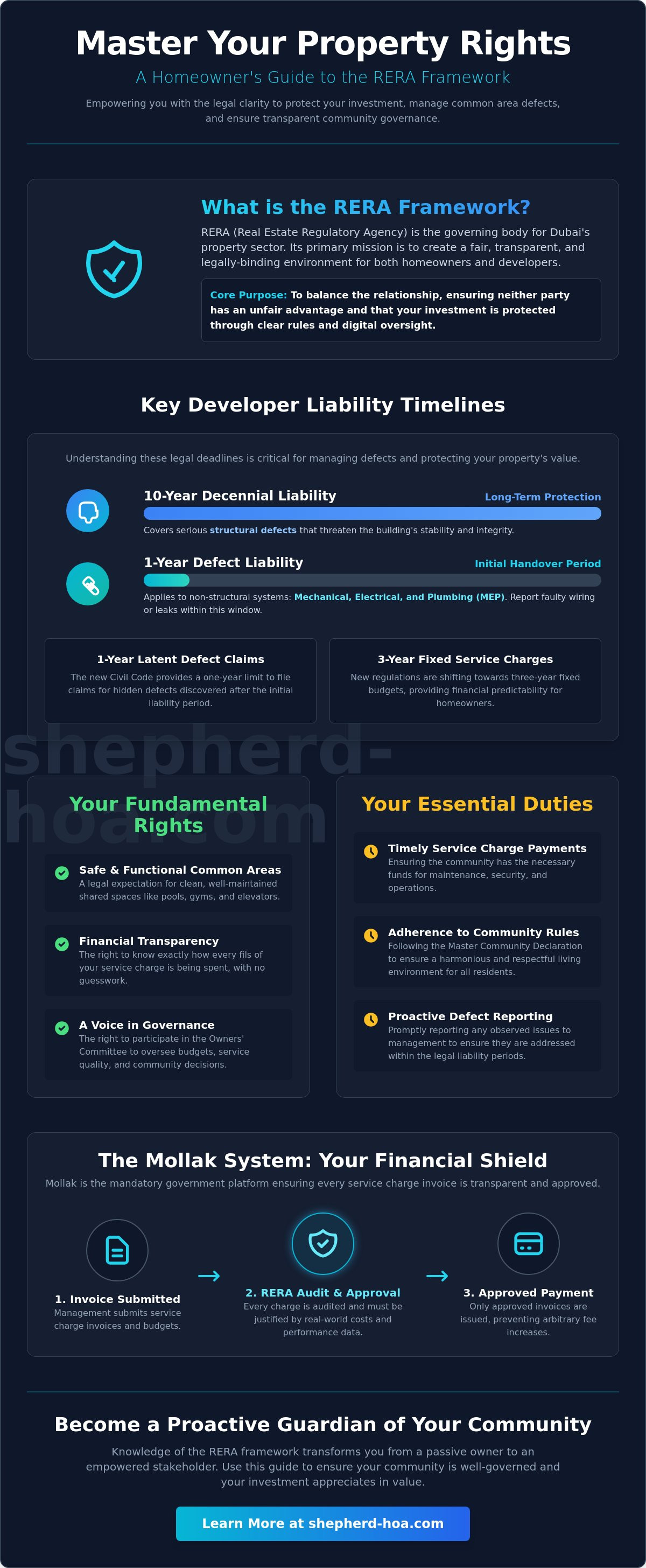
The Real Estate Regulatory Agency (RERA) acts as the primary governing arm for Dubai's property sector, functioning as a vital bridge between developers and homeowners. Its fundamental goal is to maintain a balanced relationship where neither party holds an unfair advantage. By establishing clear rules for transparency and accountability, RERA ensures that your investment remains secure throughout its lifecycle. RERA serves as the national standard for real estate transparency and ethical governance within the United Arab Emirates. In the 2026 landscape, this oversight has become increasingly digital-first, requiring mandatory compliance through platforms like Mollak and the Dubai REST app to ensure every transaction is recorded and verified.
Understanding this RERA Framework is essential when you're managing common area defects from developer teams. It provides the legal weight needed to hold builders accountable for structural or mechanical issues. Without this structured oversight, homeowners would often find themselves in a lopsided battle against corporate entities. Instead, the law creates a predictable environment where asset preservation is the shared priority of all stakeholders.
The Core Purpose of Property Regulation
The primary objective of these regulations is to standardize the often-complex interactions between property owners and community management firms. This standardization prevents confusion and ensures that every community operates under the same high expectations. One of the most significant benefits is the empowerment of the owners' committee. These regulations ensure every homeowner has a voice through organized committees that have the legal right to review budgets and service quality. Furthermore, the framework protects your wallet by preventing arbitrary fee increases. Strict index monitoring and RERA-mandated audits mean that any adjustment in service charges must be justified by real-world costs and performance data.
Why Regulatory Knowledge is Your Best Asset
Knowledge of the law is the most effective tool for reducing the operational stress that often burdens volunteer committee members. When you understand the specific timelines for defect liability, such as the ten-year structural guarantee or the one-year MEP warranty, you can act with precision. This understanding allows for organized control of community finances and maintenance schedules. It's not just about solving today's problems; it's about building a foundation for long-term property value appreciation. By utilizing the RERA framework, you shift from a reactive stance to a proactive one, acting as a steady guardian of your community's collective interests. This professional approach ensures that your building remains a prestigious and functional place to live for decades to come.
Fundamental Homeowner Rights Regarding Common Area Defects
Every property owner in Dubai holds an absolute right to receive common areas that are safe, clean, and fully functional. This isn't just a preference. It's a legal expectation. When you're managing common area defects from developer entities, you're exercising your right to protect the value of your asset. You deserve a community where the elevators work and the pools are pristine. National standards mandate that transparency in financial reporting is a non-negotiable right. This ensures you know exactly how every fils of your service charge is used. There's no room for guesswork when it involves your hard-earned investment.
Homeowners are also entitled to a specific "duty of care" from their appointed community management company. This company acts as your professional partner, ensuring that day-to-day operations align with RERA standards. Participation in the Owners Committee is another key right. It facilitates community harmony and provides a formal platform for oversight. By joining this committee, you move from being a passive observer to an active guardian of your community's future. It's a role that replaces operational stress with a sense of organized control.
Understanding Developer Liability Timelines
Legal protection in Dubai is structured around specific timelines that every owner must understand. For non-structural items, such as mechanical, electrical, and plumbing (MEP) systems, there's a 1-year defect liability period. This starts from the handover date. It's your window to catch faulty wiring or leaking pipes. For more serious issues, the law provides a 10-year decennial liability for structural defects that might threaten the building's integrity. These timelines are strict and require immediate action if an issue is found. To stay ahead of these deadlines, it's helpful to consult the RERA Dubai: The Complete 2026 Guide to Real Estate Regulation for specific compliance benchmarks.
Right to Financial Transparency and Audits
Financial clarity is the backbone of a healthy community. You have the right to view approved budgets and audited financial statements every year. This ensures that service charges are spent exclusively on community maintenance and the mandatory reserve fund. They shouldn't be diverted elsewhere. If you encounter issues, there's a formal, government-approved recourse for addressing defects in common property. Having a professional firm to manage your property handover ensures these rights are protected from day one. This proactive approach prevents disputes before they even begin.
Effective management of these rights requires a methodical approach. It's about documentation and timely communication. When defects are identified, they must be reported through the correct channels to ensure the developer's liability is triggered. A professional management partner acts as an invisible backbone here, handling the technical mechanisms while you enjoy the results of a well-maintained home. Managing common area defects from developer teams becomes much simpler when you have an expert guide who values integrity above all else.
Essential Homeowner Duties for Community Stability
Ownership in a Dubai community is a partnership that requires active participation to thrive. While the law provides robust protections, it also outlines specific duties that ensure the long-term stability of your investment. Timely payment of service charges is the primary duty of every homeowner. These funds ensure community continuity, covering everything from security to landscaping. When you're managing common area defects from developer teams, having a fully funded service charge account is essential for professional inspections and legal filings. Adherence to the Master Community Declaration and internal regulations is mandatory to maintain a high standard of living for everyone.
Maintaining your individual unit isn't just a personal choice; it's a duty to the collective. Neglected leaks or structural changes can damage common property or neighboring units, leading to costly disputes. Active participation in community votes and administrative requirements ensures proper governance. Your voice helps shape the future of the building, turning a simple residence into a well-managed community. This proactive involvement replaces operational stress with a sense of organized control.
Financial Obligations and Service Charges
Service charges act as the invisible backbone of your property's market value. They fund the essential services that keep a building functional and attractive to future buyers. In Dubai, you have a duty to pay these fees only through approved government systems like Mollak. This ensures that your money is handled with total transparency and government oversight. Failing to meet these obligations has serious consequences. Non-payment can lead to legal restrictions on property usage or even challenges when you decide to sell the unit. Keeping your account current is the simplest way to maintain peace of mind and protect your asset.
Ethical Conduct and Community Rules
Living in a shared environment requires a commitment to social harmony. This means respecting common area usage times and adhering to noise regulations to ensure everyone's comfort. If you plan to renovate, ensure any unit modifications follow the Owners Association Management in Dubai: The 2026 Guide to Community Excellence standards. These rules aren't meant to be restrictive; they're designed to preserve the aesthetic and structural integrity of the entire development. Responsible ownership and a proactive approach to dispute resolution are what separate a chaotic building from a prestigious community. By fulfilling these duties, you act as a steady guide for your neighbors, fostering an environment of mutual respect and long-term stability.
Navigating the Mollak System for Fee Transparency
Mollak is the mandatory online system for managing service charge invoices and payments across Dubai's jointly owned properties. It serves as a digital shield, ensuring that no management company or developer can request funds without explicit government approval. This system prevents financial mismanagement by requiring audited budget approvals before any invoice is generated. To benefit from this protection, homeowners must verify their contact details in the system to receive legal invoices and official notifications. Without this verification, you risk missing critical updates regarding your property's financial health and legal standing.
When you're managing common area defects from developer teams, Mollak becomes an essential tool for accountability. It ensures that funds earmarked for maintenance and repairs are actually available and properly allocated. By centralizing these financial records, RERA provides a level of oversight that was previously impossible. This transparency is what allows a community to maintain its prestige and functionality in the competitive 2026 market. It's about moving from a place of uncertainty to one of total financial clarity.
How to Verify Your Service Charge Invoice
Every legal invoice in Dubai must feature a unique Mollak reference number. If this number is missing, the request for payment is not government-sanctioned and should be questioned immediately. You should always compare your invoice against the approved understanding mollak dubai service charge index to ensure the rates align with RERA's mandates. Finally, ensure all payments are made directly to the designated escrow account rather than a private entity's bank account. This simple check protects your funds from being diverted or misused by unauthorized parties.
Digital Oversight and Asset Preservation
Digital systems like Mollak replace the operational stress of manual bookkeeping with organized control for the homeowner. You can access real-time tracking of community spending and monitor the status of the reserve fund. This is particularly important for managing common area defects from developer projects, as the reserve fund is the primary source for long-term repairs and structural maintenance. Transparency isn't just a legal requirement; it's a strategy for maintaining long-term asset value. A building with a clear, audited financial history is always more attractive to savvy investors than one shrouded in mystery. It provides the peace of mind that comes from knowing your investment is being watched over by a reliable system.
For those seeking expert assistance in navigating these systems, securing Mollak and RERA approval through a professional partner ensures your community remains compliant and financially sound from day one.
The Shepherd HomeOwners' Association Approach: Your Guardian in Governance
Shepherd HomeOwners' Association acts as a steady, expert guide through the complexities of managing common area defects from developer teams. We recognize that volunteer board members often feel overwhelmed by the technicalities of construction and law. Our mission is to replace that operational stress with a sense of organized control. We prioritize ethical tendering for all maintenance contracts, ensuring that every dirham (AED) is spent on high-quality service providers rather than inflated markups. This commitment to transparent reporting protects your collective interests and ensures that your community remains a prestigious place to live. We bridge the gap between technical legal requirements and accessible community living, making complex RERA mandates easy to understand and execute.
Our approach is rooted in the metaphor of guardianship, where we act as a watchful protector of your shared assets. We don't just manage buildings; we preserve the financial and social health of the groups we serve. By utilizing active oversight and direct communication, we ensure that every stakeholder understands their rights and duties. This professional partnership allows homeowners to enjoy their property while we handle the technical mechanisms of community governance and developer accountability. It's about creating a stable environment where asset value is protected by design, not by chance.
Expert Oversight for Owners Committees
We provide the administrative support necessary to empower volunteer board members to challenge developers effectively. When managing common area defects from developer projects, having a professional partner ensures that your claims are backed by technical evidence and legal precedent. Our team ensures all community operations meet the highest national regulatory standards for safety and financial oversight. We lead with a genuine "duty of care" that treats every managed community as our own investment. This protective stance ensures that potential issues are caught early, reducing the long-term costs of maintenance and preserving the building's structural integrity.
Securing the Future of Your Investment
Strategic budget planning is the cornerstone of our service model. We balance current operational needs with the long-term health of the reserve fund, ensuring that major repairs in the future don't require sudden, unplanned levies. Our professional dispute resolution framework maintains the harmony essential for living in a dubai community. We act as a modern partner that values transparency and integrity above all else, providing the invisible backbone your association needs to thrive. By utilizing our expertise in Mollak and RERA compliance, we ensure your assets are protected and your community governance is flawless. Contact Shepherd HomeOwners' Association for professional community management to discover how we can preserve your property's value and your peace of mind.
Secure Your Community's Future Through Informed Governance
The transition from operational stress to organized control begins with the knowledge you've gained about the 2026 RERA landscape. You now understand that the path to preserving your investment is paved with financial transparency and a firm grasp of your legal rights. Managing common area defects from developer entities is no longer a daunting task when you're equipped with structural liability protections and the digital oversight of the Mollak system. These tools exist to safeguard your community's future and ensure your home remains a source of pride rather than a burden of maintenance disputes.
Shepherd HomeOwners' Association has provided RERA-approved management since 2010, offering expert Mollak system integration for 100% transparency. We are dedicated to ethical governance and the preservation of your asset's value through every stage of community life. Partner with Shepherd HomeOwners' Association for Expert Community Management to ensure your property receives the professional guardianship it deserves. You have the power to foster social harmony and long-term stability by choosing a partner that values integrity above all else.
Frequently Asked Questions
What happens if I refuse to pay my service charges under RERA?
Refusing to pay service charges leads to legal action through the Rental Disputes Center (RDC). Management companies have the legal right to file cases against defaulting owners to recover outstanding amounts. This can result in travel bans, blocks on property transactions, or additional legal costs added to your balance. It's always better to settle disputes through RERA while keeping your payments current to avoid these severe restrictions on your property rights.
Can a developer increase service charges without homeowner approval?
Developers cannot increase service charges without formal approval from RERA after a strict audit process. Every budget must reflect actual community needs and be verified through the Mollak system. As of 2026, RERA has capped annual service charge increases at 5% unless significant capital improvements are proven. If you see an unapproved hike on your invoice, you should verify it against the Mollak system to ensure it has the required government sanction.
What is the difference between the 1-year and 10-year developer liability periods?
The 1-year liability period covers non-structural defects like mechanical, electrical, and plumbing (MEP) systems starting from the handover date. In contrast, the 10-year decennial liability specifically addresses structural defects that threaten the building's integrity. Understanding these timelines is vital when managing common area defects from developer teams, as it dictates the specific window for filing formal rectification claims and holding the builder accountable for their work.
How can I check if my community management company is RERA approved?
You can verify a community management company's RERA approval through the Dubai REST app or the Dubai Land Department website. These platforms maintain a live database of licensed firms and their current compliance status. Working with an approved firm ensures that your community is managed according to national standards. It also guarantees that all financial transactions are handled through secure, government-monitored channels that protect your investment from mismanagement.
Is the Mollak system mandatory for all property owners in managed communities?
The Mollak system is mandatory for every property owner within a jointly owned community in Dubai. It's the only legal platform for issuing service charge invoices and processing payments. By using this system, the government ensures that no funds are collected without an approved budget. It provides the transparency needed to track how your money is used for community maintenance and reserve fund allocations, ensuring total financial oversight.
How do I file a formal complaint against a developer for common area defects?
To file a formal complaint, you must first document the issue and report it to your community management company in writing. If the developer fails to respond within the liability period, you can escalate the matter to RERA through the Dubai REST app. This process is essential for effectively managing common area defects from developer teams. Ensure you keep all correspondence and professional inspection reports as evidence for your formal legal filing.
What rights do I have regarding the maintenance of common areas like pools and gyms?
Owners have a legal right to common areas that are safe, clean, and fully functional at all times. This includes essential amenities like swimming pools, gyms, and elevators. The management company has a "duty of care" to rectify any issues using the service charge funds collected from owners. Transparency in how these funds are allocated for amenity maintenance is a non-negotiable right that ensures your community remains a high-value asset.
Can RERA regulations help resolve disputes regarding noise or neighbor conduct?
RERA regulations provide the framework for enforcing community rules found in the Master Community Declaration. These rules cover noise levels, pet ownership, and general conduct to maintain social harmony within the building. If a neighbor repeatedly violates these regulations, the owners' committee and management company can issue formal warnings. Persistent issues can be escalated to RERA or local authorities to ensure the peaceful enjoyment of your property is protected.


Comments