
The Step-by-Step Process for Electing an OA Board in the UAE
- Sohrab Virani

- 2 days ago
- 13 min read
Could a single administrative oversight turn your community's hard-earned election results into a legal nullity? For many owners, the process for electing an oa board feels like walking a tightrope between community service and complex legal compliance. You want to ensure your building is managed by a capable team, but the fear of RERA declaring your vote void because of a missed deadline is real. It's frustrating when you're volunteering your time only to face technical hurdles that threaten the stability of your home.
You don't have to manage this burden alone. This guide provides the precise legal and administrative steps required to elect a compliant Owners Association board under current RERA and Mollak regulations. We've mapped out the exact process, from navigating nomination windows to verifying voter eligibility based on service charge records. You'll gain a clear roadmap for the mandatory 14-day registration period, ensuring your next General Assembly is a model of transparency and legal integrity.
Key Takeaways
Ground your community governance in the legal requirements of Law No. 6 of 2019 to ensure your Owners Committee has full legal standing.
Navigate the process for electing an oa board with confidence by using the Mollak system to confirm that only owners in good financial standing participate.
Avoid procedural voiding by following the mandatory 21-day notice period and the 14-day window for candidate nominations.
Streamline your General Assembly using approved electronic voting methods and ensure your new board is registered within the required 14-day timeframe.
Protect your community's interests by understanding how professional management prevents the common administrative errors that lead to election invalidation.
Table of Contents
Understanding the Legal Framework for OA Board Elections
In the UAE, community governance isn't just about neighborhood harmony; it's a strictly regulated legal requirement. Law No. 6 of 2019 serves as the foundation for the ownership of jointly owned properties in Dubai. This legislation mandates that every community must have a structured representative body to protect the collective interests of all homeowners. While many residents use the term "Board of Directors," the legal designation in the UAE is the Owners Committee. This distinction is vital because it defines the specific boundaries of their authority and their relationship with the management company. The process for electing an oa board is supervised by Dubai's Real Estate Regulatory Agency (RERA), which ensures that every step follows the letter of the law to prevent future legal disputes.
RERA acts as the primary regulator and guardian of transparency for all election proceedings. They don't just oversee the vote; they validate the entire timeline, from the initial notice to the final registration of the committee members. It's a common misconception that the management company holds the power in a community. In reality, the management company serves an executive function, while the Owners Committee provides essential oversight and advisory support. This balance ensures that the community's assets are protected by people who actually live there and have a personal stake in the property's long-term value.
The Role of the Owners Committee under UAE Law
The Owners Committee acts as the voice of the homeowners, tasked with overseeing community management and service quality. Their duty is to verify that the management company is maintaining the building to the highest standards and managing the budget responsibly. It's essential to understand that this is an advisory role rather than an executive one. The committee doesn't sign contracts or handle day-to-day operations; those tasks fall to the licensed management company. This partnership is at the heart of Owners Association Management in Dubai, where clear communication between the advisory board and the executive manager creates a sense of organized control.
Who Can Serve on the Board?
Not every owner is eligible to hold a seat on the committee. RERA sets strict criteria to ensure that those leading the community are personally and financially invested in its success. Navigating the process for electing an oa board requires a meticulous check of these credentials before the first notice is ever sent.
Ownership and Residency: Candidates must be registered owners within the project. While some exceptions exist for legal representatives, being a resident owner often provides the best perspective for governance.
Financial Standing: This is the most common hurdle. To run for a seat, you must have zero outstanding service charges. If there's even a small balance on your Mollak statement, your candidacy will be rejected.
Conflict of Interest: To maintain transparency, developers and employees of the management company are legally barred from serving on the committee. This prevents any bias in decision-making regarding service contracts or maintenance priorities.
Preparing for the Election: Voter Eligibility and Mollak
Before any ballots are cast, the foundation of a valid election rests on the accuracy of the voter list. In Dubai, this isn't a simple manual spreadsheet. The process for electing an oa board is tethered directly to the Mollak system. This digital platform serves as the definitive record for the electoral roll, eliminating guesswork and ensuring that only those with a legal right to influence community decisions are permitted to do so. It acts as a digital shield, protecting the integrity of the vote from unauthorized participation.
The management company acts as the guardian of this data. They must conduct a comprehensive audit of the unit owner list to ensure 100% accuracy. This involves cross-referencing internal records with the latest Mollak data to generate a formal eligibility report. This report is the backbone of the election, preventing the inclusion of individuals who may have recently sold their units or who don't meet the financial requirements. While the specific rules for community associations are governed by RERA, looking at an official election announcement from other regulatory bodies highlights a consistent theme: strict adherence to eligibility criteria is non-negotiable for institutional integrity.
The Impact of Service Charges on Voting Rights
The "Good Standing" rule is absolute. Under RERA guidelines, only owners with zero service charge arrears are eligible to vote. Partial payments don't grant voting rights. If you owe even a small balance, your right to participate is suspended. This is why Understanding Mollak Dubai is so critical for owners who want their voices heard. We strongly advise owners to settle all outstanding arrears at least 14 days before the General Assembly. This window allows the system to update and ensures your name appears on the final eligibility report. If you're unsure of your status, our team can assist with service charge collection inquiries to ensure your account is clear before the deadline.
Verifying Unit Ownership and Proxies
Not every owner can attend the General Assembly in person. Proxies are a vital part of the process for electing an oa board, but they are heavily regulated to prevent abuse. A valid proxy form must be signed by the registered owner and clearly identify the representative. There are strict limits on how many units a single proxy can represent to prevent any individual from exerting undue influence over the community's direction.
During the registration phase, every Title Deed must be verified against the Mollak database. This step ensures that the person casting the vote is the legal owner or a properly authorized representative. This level of scrutiny protects the community from fraudulent activity and guarantees a fair, transparent result that RERA will recognize and uphold. It's a methodical approach that replaces operational stress with a sense of organized control.
The Election Timeline: From Notice to General Assembly
Successful community governance depends on a methodical schedule. The process for electing an oa board is not a single day event but a sequence of time-bound requirements designed to ensure every owner has a fair opportunity to participate. Precision is your best defense against administrative challenges. If a community fails to meet these specific windows, RERA can invalidate the entire meeting, forcing the association to restart the process at significant cost and effort. Following a structured timeline replaces operational stress with a sense of organized control.
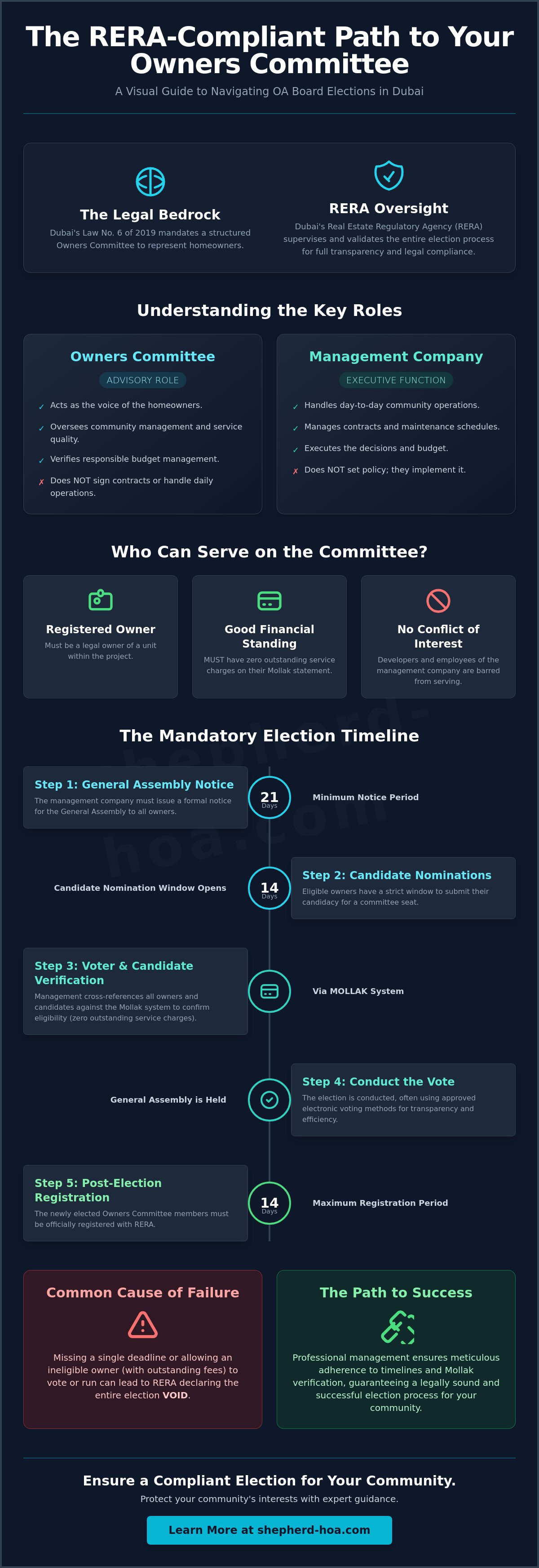
The journey to a compliant election follows five essential steps:
Step 1: Formal Notification. At least 21 days before the General Assembly, you must send a formal notice to all owners via email and the Mollak system. This notice must include the date, time, and location of the meeting.
Step 2: Nomination Window. Open the nomination period for a minimum of 14 days. This allows interested owners to prepare their applications and ensures the community has a diverse pool of candidates.
Step 3: Compliance Review. Once nominations close, the management company reviews each application. This step verifies that candidates meet the financial and residency requirements discussed in previous sections.
Step 4: Agenda Circulation. At least 7 days before the vote, circulate the final agenda and candidate profiles. This gives voters time to make an informed decision based on the bios provided.
Step 5: The General Assembly. Conduct the official vote during the assembly, ensuring all proceedings are recorded for RERA submission.
Meeting Quorum Requirements
A General Assembly cannot proceed without a quorum. For the first call, the law typically requires the presence of owners representing at least 50% of the total owned area in the project. If this threshold isn't met, the meeting must be adjourned. The rules for a second call are more flexible, often allowing the meeting to proceed with those present, provided the correct notice was given. RERA Dubai supervises these thresholds closely to ensure that a small minority cannot make major decisions for the entire community without proper representation.
Transparency in the Nomination Process
Integrity begins with the nomination process. Candidates must submit a brief bio and a statement of intent through the official management portal. This digital trail ensures that every application is timestamped and recorded. The management company then verifies that each candidate is in "Good Standing," meaning they have no outstanding service charges. By requiring these details upfront, the community gains a clear view of who is seeking to serve as a guardian of their collective interests.
Conducting the Vote and Post-Election Registration
The day of the General Assembly is the culmination of weeks of meticulous preparation. For many owners, this is where the process for electing an oa board moves from administrative theory into collective action. Modern UAE governance favors accessibility, allowing owners to cast their ballots through several channels. While in-person voting at the assembly remains a traditional staple, electronic voting and the Mollak app have become the gold standard for ensuring high turnout. These digital tools provide a transparent, timestamped trail that eliminates the risk of manual counting errors or lost paper ballots.
Integrity is maintained through strict oversight. RERA representatives or independent observers often attend these meetings to supervise the count and ensure all proceedings follow Law No. 6 of 2019. Once the last vote is cast, the management company must record the minutes and the final tally with absolute precision. This documentation serves as the legal evidence of the community's will. It's not enough to simply announce a winner; the results must be verified against the eligibility reports generated from Mollak to confirm that every vote cast was legally valid. This methodical approach ensures the final outcome is beyond reproach.
Appointing Committee Roles
Once the five to nine members are elected, the committee must organize itself to function effectively. The members meet internally to select a Chairperson, a Secretary, and a Treasurer. The Chairperson acts as the primary liaison between the owners and the management company, while the Secretary ensures all meetings and decisions are properly documented. The Treasurer holds a particularly critical role, providing oversight for the community's financial health. To understand the depth of this responsibility, new members should review our guide on Mastering the Community Service Charge Budget, which outlines how the board manages collective assets.
Registering the Board with RERA
The process for electing an oa board isn't complete until the government officially recognizes the new committee. You must submit the election results, meeting minutes, attendance sheets, and Mollak eligibility reports to RERA for certification. According to current regulations, newly elected committees must be registered within 14 days of their election to maintain legal standing. Once approved, RERA issues a Certificate of Registration, which typically remains valid for two or three years. This certificate is the committee's "license" to act as the guardian of the community's interests. If you need assistance navigating these final administrative hurdles, our team at Shepherd HomeOwners' Association can ensure your Mollak and RERA approval is handled swiftly and accurately.
Why Professional Management is Critical for Board Success
Attempting a "DIY" election often leads to unintended legal consequences that can haunt a community for years. While the steps might seem straightforward on paper, the process for electing an oa board requires a level of administrative precision that's difficult for volunteer committees to maintain alone. A single missed deadline or a miscalculated quorum can result in the invalidation of all subsequent decisions. This includes the legal standing to collect service charges or sign maintenance contracts. When an election is declared void by RERA, it creates a legal vacuum that can paralyze community operations and lead to significant financial liability for the association.
Shepherd HomeOwners' Association acts as the watchful guardian of this entire cycle. We provide the technical infrastructure and legal oversight needed to ensure every vote is compliant with current RERA standards. Our role is to replace the operational stress of governance with a sense of organized control. By positioning ourselves as a steady, expert partner, we allow board members to focus on the strategic vision for their community rather than the minutiae of regulatory filings. This professional distance is essential for maintaining integrity and avoiding the appearance of bias during the voting process.
Shepherd HomeOwners' Association’s Guardian Approach to Governance
Our methodical approach centers on seamless Mollak integration and rigorous voter verification. We handle the heavy lifting of cross-referencing title deeds and financial standing with the official database to ensure the electoral roll is beyond reproach. This objectivity is essential for maintaining social harmony within the building. When the system dictates eligibility based on clear, verifiable data, it removes the personal friction that often arises during community disputes. Our commitment to asset preservation means we treat your property's governance with the same duty of care as the physical structure itself, ensuring that every board member is legally empowered to protect the community's interests.
Ensuring Long-Term Community Stability
Stability doesn't end when the election results are finally certified. The transition between outgoing and incoming boards is a critical moment that often determines the success of the next term. Shepherd HomeOwners' Association provides the necessary continuity, ensuring that historical records, financial budgets, and ongoing maintenance projects are handed over without any loss of information. We offer ongoing support for budget planning and regulatory compliance, acting as a steady guide through the complexities of UAE property law. This long-term perspective is what distinguishes a well-run community from one plagued by administrative turnover.
Managing a community is a significant responsibility, but it doesn't have to be an overwhelming burden. With the right partner, your board can operate with transparency and integrity, preserving the value of every owner's investment for years to come. We invite you to discover our community management services and see how our expertise can support your next process for electing an oa board with absolute compliance and peace of mind.
Secure Your Community's Future through Compliant Governance
A successful election is the backbone of a thriving community. By aligning with Law No. 6 of 2019 and utilizing the Mollak system for voter verification, you protect your building's assets and ensure long-term social harmony. We've seen how a methodical timeline and precise registration with RERA prevent the operational stress that often follows administrative errors. When you follow the correct process for electing an oa board, you transition from a state of uncertainty to one of organized control and collective peace of mind.
Shepherd HomeOwners' Association has been a RERA-approved management partner since 2010. As experts in Mollak system integration, we act as the guardian of your community's governance, ensuring every vote is transparent and legally binding. Don't leave your building's leadership to chance or risk the invalidation of your General Assembly. Ensure your next board election is RERA-compliant with Shepherd HomeOwners' Association. We're here to provide the steady guidance your community deserves, helping you build a stable and prosperous home for every resident.
Frequently Asked Questions
How many members should be on a UAE Owners Committee?
A UAE Owners Committee typically consists of five to nine members. In Abu Dhabi, Administrative Resolution No. (26) of 2025 specifically mandates this range to ensure balanced representation. In Dubai, the specific number is often dictated by the community's constitutive documents but generally follows this five to nine member standard. This range provides enough diversity of opinion without making the decision-making process administratively unwieldy for the volunteer members.
Can a tenant be elected to the Owners Association board?
No, tenants are not eligible for election to the Owners Committee. Law No. 6 of 2019 and subsequent RERA regulations specify that only registered owners or their legally authorized representatives can serve on the board. This restriction ensures that the individuals overseeing the property have a direct financial stake in the asset's long-term value and management. It aligns the interests of the committee with the preservation of the community's collective investment.
What happens if a quorum is not reached at the General Assembly?
If the first meeting fails to reach the 50% quorum, it must be adjourned and rescheduled for a second call. The second meeting can typically proceed with those present, provided the initial notice was legally compliant and sent via the correct channels. This mechanism prevents a lack of attendance from permanently stalling the process for electing an oa board. It ensures that the community can continue its essential administrative and financial functions.
How long is the term of office for an elected board member?
The standard term of office for an elected committee member is typically two or three years. In Abu Dhabi, the term is fixed at two years, though it can be extended by one additional year by the ADREC Director General. Dubai projects generally follow a similar two or three-year cycle. Once this term expires, a new election must be held to ensure the committee maintains a fresh mandate from the current homeowners.
Can an owner with unpaid service charges still vote in the election?
No, owners with outstanding service charges are disqualified from voting or running for a committee seat. The "Good Standing" rule is strictly enforced through the Mollak system and RERA's automated portals. You must settle all arrears at least 14 days before the meeting to ensure your eligibility is updated in the official records. This rule ensures that only those who contribute to the community's financial health have a say in its governance.
Is electronic voting through Mollak legally binding for board elections?
Yes, electronic voting conducted through RERA-approved platforms or the Mollak app is fully legally binding. These digital systems provide a secure, transparent, and auditable trail that RERA uses to certify the election results. Digital integration has become the preferred method for managing the process for electing an oa board because it significantly increases voter turnout. It also eliminates the human errors often associated with manual paper ballot counts during the General Assembly.
What is the role of the Chairperson in a UAE Owners Committee?
The Chairperson acts as the primary representative and spokesperson for the Owners Committee. They are responsible for leading meetings, coordinating with the management company, and ensuring that the committee’s advisory decisions are communicated clearly. While they don't have the executive power to sign contracts independently, they serve as the vital link between the homeowners and professional managers. Their role is to ensure the committee remains focused on its duty of oversight.
Can the developer appoint board members in a new community?
Developers are generally prohibited from serving on or appointing members to the Owners Committee to avoid conflicts of interest. In Abu Dhabi, this restriction is explicit under Administrative Resolution No. (26) of 2025. The committee must be independently elected by the homeowners once the registration threshold is met. In Abu Dhabi, for example, a committee must be formed once 30% of the total units are registered to multiple owners in the Land Registry.


Comments