
Insurance Requirements for Owners Associations: A 2026 Guide to National Compliance
- Sohrab Virani

- 1 day ago
- 11 min read
Homeowners insurance now accounts for a record 9% of typical total monthly housing costs, a figure that continues to climb as we move through 2026. For those serving on a board, staying ahead of the shifting insurance requirements for owners associations can feel like a full-time job rather than a volunteer commitment. You likely worry about whether your current coverage meets the latest national standards or if a simple oversight could lead to a service charge rejection. It's a heavy burden to carry when the financial health of your community and your own personal liability are on the line.
We understand that you need clear, actionable guidance to act as a steady guardian for your association's assets. This guide provides professional clarity on the complex legal and financial mandates required for national compliance, including the latest 2026 Fannie Mae updates and RERA standards. We'll walk you through specific liability minimums, the new 15% reserve allocation rules, and how to verify your coverage annually. By the end of this article, you'll have a logical roadmap to ensure your community remains protected, compliant, and financially stable.
Key Takeaways
Understand why national strata law mandates specific coverage to preserve common assets and maintain community harmony.
Navigate the complex insurance requirements for owners associations to ensure your property and public liability policies meet 2026 standards.
Learn how to align your insurance documentation with Mollak and RERA requirements to avoid delays in service charge approvals.
Shield your Owners Committee from personal liability risks by securing comprehensive Directors and Officers (D&O) coverage.
Discover how professional management acts as a bridge to the insurance market, helping you secure competitive rates through ethical tendering.
Table of Contents
The Legal Mandate for Owners Association Insurance
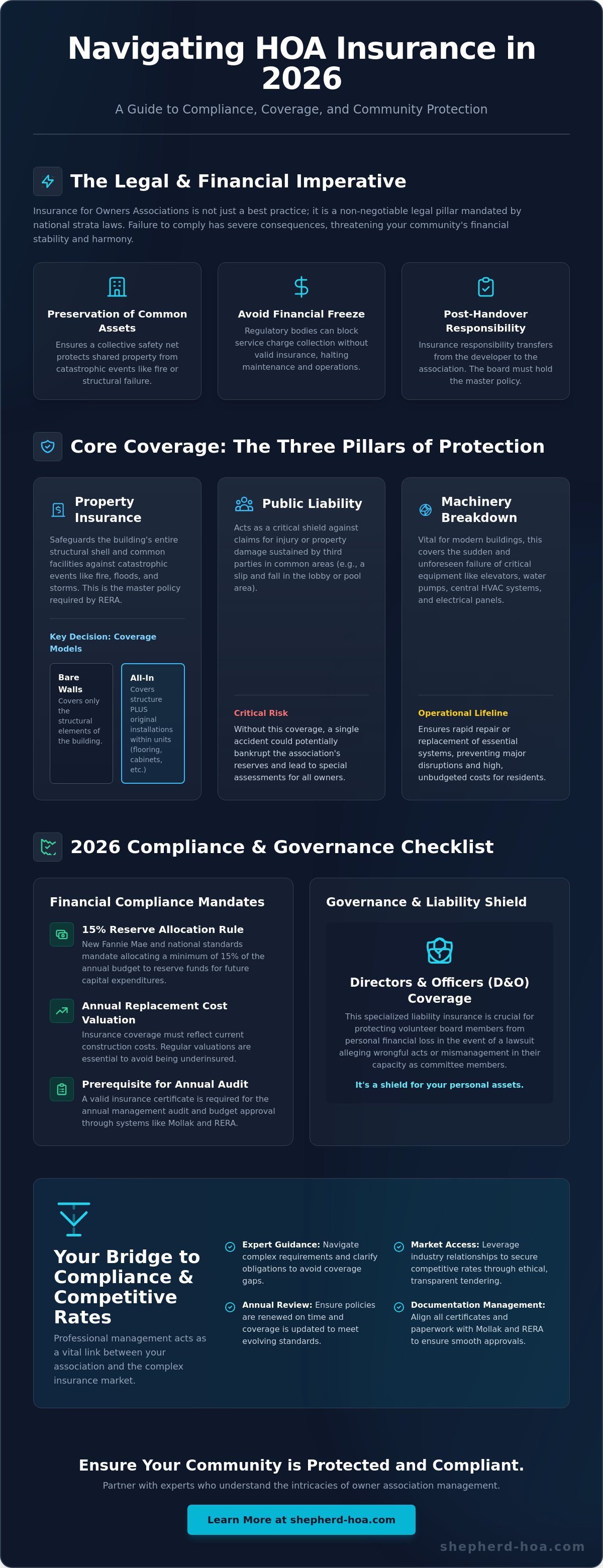
Insurance isn't just a best practice for well-managed communities; it's a non-negotiable legal pillar. National strata laws mandate that every jointly owned property maintains comprehensive coverage to protect the collective interest. This statutory requirement ensures that the physical structure and the financial stability of the community remain intact, regardless of individual unit owner circumstances. When a homeowner association operates without adequate protection, it risks more than just property damage. It risks the social harmony of the entire neighborhood.
The primary purpose of these mandates is the preservation of common assets. If a fire or structural failure occurs, the burden of repair shouldn't fall on a single individual or a fractured group of neighbors. Instead, the law requires a collective safety net. Failing to meet the specific insurance requirements for owners associations can lead to severe legal penalties. In many jurisdictions, regulatory bodies will block the collection of service charges if valid insurance certificates aren't present. This effectively freezes the association's ability to maintain the property, creating a downward spiral of neglect and declining asset value.
A critical shift occurs during the property handover phase. While the developer initially carries the insurance, the responsibility transfers entirely to the association once the handover is complete. The board must ensure they hold the master policy in the association's name. Relying on a developer’s legacy policy is a common mistake that can leave a community legally exposed and financially vulnerable.
Understanding the Master Policy Requirement
A Master Policy serves as the primary shield for the entire building structure and shared facilities. Unlike individual unit owner policies, which typically only cover "walls-in" contents and personal liability, the Master Policy covers the structural integrity of the entire project. Individual policies cannot replace this collective mandate. The Real Estate Regulatory Agency (RERA) strictly enforces these standards, requiring proof of a Master Policy to ensure that the building's replacement value is fully protected against catastrophic loss.
Statutory Compliance in 2026
In 2026, compliance standards have become more rigorous. National authorities now require minimum coverage limits that reflect current construction costs and inflation rates. Expert owners association management dubai services help boards stay on the right side of the law by conducting regular replacement cost valuations. These valuations are essential because an insurance certificate is a prerequisite for the annual management audit. Without it, your association cannot demonstrate financial transparency or legal standing, making it impossible to secure budget approvals for the upcoming year.
Core Coverage: Protecting Common Areas and Assets
Every community needs a robust foundation of protection to withstand the unexpected. The insurance requirements for owners associations center on three primary pillars: property insurance, public liability, and machinery breakdown. Property insurance safeguards the structural shell against catastrophic events like fire or floods. Public liability coverage acts as a shield against claims arising from injuries sustained in shared spaces. Without these, a single accident could bankrupt the association's reserves. Machinery breakdown is equally vital, especially in modern high-rises where elevators, water pumps, and complex HVAC systems are the building's lifeblood. If a central cooling unit fails in mid-summer, the cost of repair and the impact on residents can be devastating without the right policy in place.
Deciding between coverage models is a common challenge for boards. The "All-In" model covers original installations within units, such as flooring and cabinetry, while "Bare Walls" only protects the structural elements. Choosing the wrong one can lead to massive coverage gaps during a claim. If you're unsure which model your governing documents require, professional community management support can help clarify your obligations and ensure your policy aligns with your master declaration.
Defining Common Area Boundaries
Identifying what constitutes a common element is essential for accurate underwriting. Your policy must extend to recreational facilities like pools, gyms, and rooftop gardens to ensure full protection. Common areas are all parts of the property not exclusively owned by a single unit holder. Misidentifying these boundaries often leads to underinsurance, leaving the board vulnerable to litigation if an uncovered asset is damaged.
Specialized Supplemental Coverages
Standard policies often leave specific risks exposed. We recommend including these specialized coverages to provide a complete safety net:
Fidelity Guarantee: This protects community funds against internal mismanagement, theft, or fraud by staff or board members.
Terrorism and Sabotage: This is often a requirement for high-profile residential towers in urban centers to mitigate unique security risks.
Environmental and Pollution Liability: Modern sustainable developments need this to cover leaks from shared cooling systems or accidental contamination incidents.
By addressing these specific areas, you act as a vigilant guardian of the community's collective wealth. Comprehensive coverage doesn't just satisfy a legal checklist; it preserves the long-term value of every home within the development.
Navigating Financial Compliance through the Mollak System
Financial transparency is the backbone of a stable community. In the current regulatory environment, the Mollak system serves as the ultimate gatekeeper for association funds. Insurance premiums aren't just administrative costs; they're critical line items that must be accurately reflected in the annual budget you submit for approval. If your records are incomplete or your policy has expired, RERA will withhold approval for service charge collections. This digital gatekeeping ensures that every community maintains the necessary protection before a single dirham is collected from homeowners.
Accurate reporting prevents the operational stress of coverage lapses. When insurance data is transparently managed, the board can ensure premiums are paid on time, maintaining its role as a steady guardian of the association's assets. It's also vital to consider the role of the reserve fund. While the master policy covers major damage, the association must have the liquidity to handle policy deductibles. Planning for these costs within the budget prevents sudden, unplanned special levies that can disrupt community harmony and cause friction among residents.
Integrating Insurance into the Service Charge
Apportioning these costs requires a logical approach based on unit entitlement. Every owner contributes a fair share to the collective safety net that protects their investment. To navigate this process effectively, understanding mollak dubai is essential for board members who want to ensure seamless budget approvals. Your budget must also account for annual premium inflation. With market trends showing steady increases in global insurance costs, building a realistic buffer for market adjustments is a prudent way to protect the association’s long-term financial health.
Audit Requirements and Documentation
Compliance isn't a one-time event; it's a continuous cycle of oversight. The Mollak system tracks the compliance status of the entire association by linking valid certificates directly to your financial profile. You must maintain precise digital records for all policy renewals and historical claims. These documents serve as the primary evidence used during the annual RERA-mandated financial audit of the insurance account. A well-organized digital archive doesn't just satisfy the auditor; it provides the Owners Committee with the peace of mind that their insurance requirements for owners associations are fully met and legally documented.
Liability and Governance: Shielding the Owners Committee
Serving on an Owners Committee is a commitment to the collective well-being of your neighbors, but it shouldn't put your personal assets at risk. Directors and Officers (D&O) Liability insurance is the specific shield designed to protect volunteer board members from personal lawsuits. These claims often arise from decisions regarding property maintenance, financial management, or the enforcement of community rules. Without this coverage, a single disgruntled resident could target the personal savings of a committee member, creating a barrier that prevents qualified, high-quality leaders from stepping forward to serve.
The legal system generally recognizes a distinction between honest mistakes and willful negligence. If a board member makes a decision in good faith that later proves incorrect, D&O insurance covers the legal defense and potential settlements. However, it does not protect against intentional fraud or malicious acts. By addressing the insurance requirements for owners associations early, the board demonstrates a commitment to professional governance. This proactive stance ensures that administrative "Errors and Omissions" don't become personal financial disasters for those who have volunteered their time to guide the community.
Managing these risks effectively requires a logical partnership between the committee and professional experts. If your board feels exposed or overwhelmed by the technicalities of fiduciary duty, you can secure your community's future by partnering with a dedicated owners association management team to handle the heavy lifting of compliance and risk mitigation.
The Duty of Care in 2026
In 2026, the board's fiduciary responsibility includes a strict mandate to maintain adequate community insurance based on current replacement values. Professional management reduces the personal risk profile of individual committee members by providing expert oversight and ensuring all administrative actions align with national standards. D&O insurance provides the necessary backbone for confident community leadership. It allows the board to focus on long-term strategy and social harmony rather than fearing the personal consequences of every meeting vote.
Managing Third-Party Service Contracts
Protection must extend beyond the board to include every vendor that enters the property. You should ensure that all facility management contractors carry their own independent liability insurance before they begin work. We recommend standardizing these requirements for all vendors, from cleaning crews to specialized elevator technicians. Utilizing "Additional Insured" clauses is a critical step; this ensures the association's interests are protected if a contractor's actions lead to a third-party claim. This layers your defense, ensuring the association's master policy remains a last resort rather than a primary target for vendor-related incidents.
Professional Management: Ensuring Comprehensive Protection
A professional management company serves as the vital bridge between your volunteer board and the complex insurance market. While board members bring community passion, we bring the technical expertise needed to translate the specific insurance requirements for owners associations into a comprehensive policy. This partnership replaces administrative stress with a sense of organized control. By acting as a watchful guardian, a management partner ensures that the association's legal obligations are met without the board having to navigate the technical jargon alone.
Ethical tendering is a cornerstone of professional oversight. We don't simply renew the existing policy out of habit. Instead, we actively survey the market to secure the best coverage at competitive rates. This process involves a transparent comparison of policy terms, deductibles, and exclusions, ensuring that your association isn't overpaying for inadequate protection. This methodical approach maintains high standards of financial integrity and ensures that every dirham spent on premiums contributes to the community's long-term safety.
When an incident occurs, the claims management process can be a significant source of anxiety for the Owners Committee. We manage the entire lifecycle of the claim, from initial reporting to the final reimbursement. We coordinate with surveyors, loss adjusters, and repair contractors to ensure common assets are restored to their original state as quickly as possible. This hands-on management prevents the catastrophic gaps in coverage that often occur when policy renewals or claim deadlines are missed.
The Shepherd Guardianship Model
Our team provides a steady, expert guide for your community's legal and financial safety. We conduct annual insurance reviews and detailed risk assessments to ensure your coverage keeps pace with 2026 market values and construction costs. This level of oversight is fundamental to the experience of living in a dubai community where social harmony and asset preservation are the primary goals. We act as the invisible backbone of your association, ensuring that protection is always active and compliance is never in question.
Taking the Next Step for Your Association
Stability begins with a clear understanding of your current standing. We invite you to request a comprehensive insurance audit for your community to identify any hidden risks or coverage gaps in your existing policies. As a RERA-approved management partner, Shepherd offers the professional oversight needed for long-term financial stability and peace of mind. Contact our team today for an initial consultation on your association's specific insurance requirements for owners associations and discover how we can simplify your governance journey.
Securing Your Community’s Financial Legacy
Meeting the 2026 insurance requirements for owners associations is about more than just legal adherence. It's about protecting the collective wealth and social harmony of your residents. By ensuring your master policy is robust and your board is shielded by D&O liability, you build a community that can withstand any challenge. Proper integration with the Mollak system is the final piece of the puzzle, ensuring that your financial approvals remain seamless and your service charge collection stays consistent.
Managing these complex mandates doesn't have to be a burden. Shepherd brings over 15 years of national community governance experience to every association we serve. As RERA-approved management experts and specialists in Mollak financial compliance, we act as the steady guardian your assets deserve. We replace administrative anxiety with organized control, allowing your committee to focus on leadership rather than liability.
Secure your community's future with Shepherd's professional OA management. Take the first step toward lasting peace of mind today.
Frequently Asked Questions
Is it mandatory for a UAE Owners Association to have insurance?
Yes, maintaining comprehensive insurance is a statutory requirement under Law No. (6) of 2019. Every association must hold a master policy that covers the building's structural integrity and all common areas. This mandate ensures the community remains financially protected against catastrophic losses, forming a core part of the insurance requirements for owners associations.
What happens if our Owners Association fails to renew its insurance policy?
Failure to renew leads to immediate legal and financial restrictions. RERA will withhold approval for your annual budget in the Mollak system, which effectively freezes your ability to collect service charges from owners. Beyond these regulatory hurdles, board members face significant personal liability risks if an incident occurs while the property lacks active coverage.
Does the Master Policy cover damage inside my individual apartment?
The master policy typically only covers the structural shell, permanent fixtures, and common elements of the building. It doesn't cover your personal belongings, internal furniture, or liability for accidents that happen exclusively within your private unit. We always recommend that individual owners maintain their own "walls-in" insurance to ensure their personal assets are fully protected.
What is Directors and Officers (D&O) insurance, and do we really need it?
D&O insurance is a specialized policy that protects the personal assets of committee members from lawsuits related to their governance decisions. You definitely need it because it acts as a vital safety net for volunteers. It ensures that an honest administrative mistake doesn't result in a personal financial disaster for those who give their time to serve the community.
How do insurance premiums affect our annual service charge budget?
Insurance premiums are a fixed operational cost included in the community's general fund. These costs are shared among all owners based on their specific unit entitlement or square footage. We monitor market trends to ensure your budget accounts for annual premium inflation, which prevents sudden, unplanned spikes in your yearly service charge payments.
Can our Owners Association choose any insurance provider in the market?
You can choose any provider as long as they're licensed by national authorities and meet the minimum coverage standards set by RERA. We recommend a transparent tendering process that compares at least three competitive quotes. This methodical approach ensures you secure the best value and the most comprehensive protection for your community's unique requirements.
Who is responsible for paying the insurance deductible in the event of a claim?
The Owners Association typically pays the deductible from the community's reserve fund or general operational budget. If a claim results from a specific owner's negligence, the board may decide to recover that cost from the individual responsible. Proper financial planning ensures these out-of-pocket expenses don't disrupt the association's daily maintenance activities.
How does the Mollak system verify that our community is properly insured?
The Mollak system requires the digital upload of a valid insurance certificate during the annual budget approval cycle. RERA's automated system verifies the policy's validity and ensures the coverage limits align with the building's registered replacement value. This digital check is a critical part of the insurance requirements for owners associations, ensuring no community operates without a professional safety net.


Comments