
How to Amend Community Bylaws: A 2026 Guide to UAE Governance
- Sohrab Virani

- 3 days ago
- 12 min read
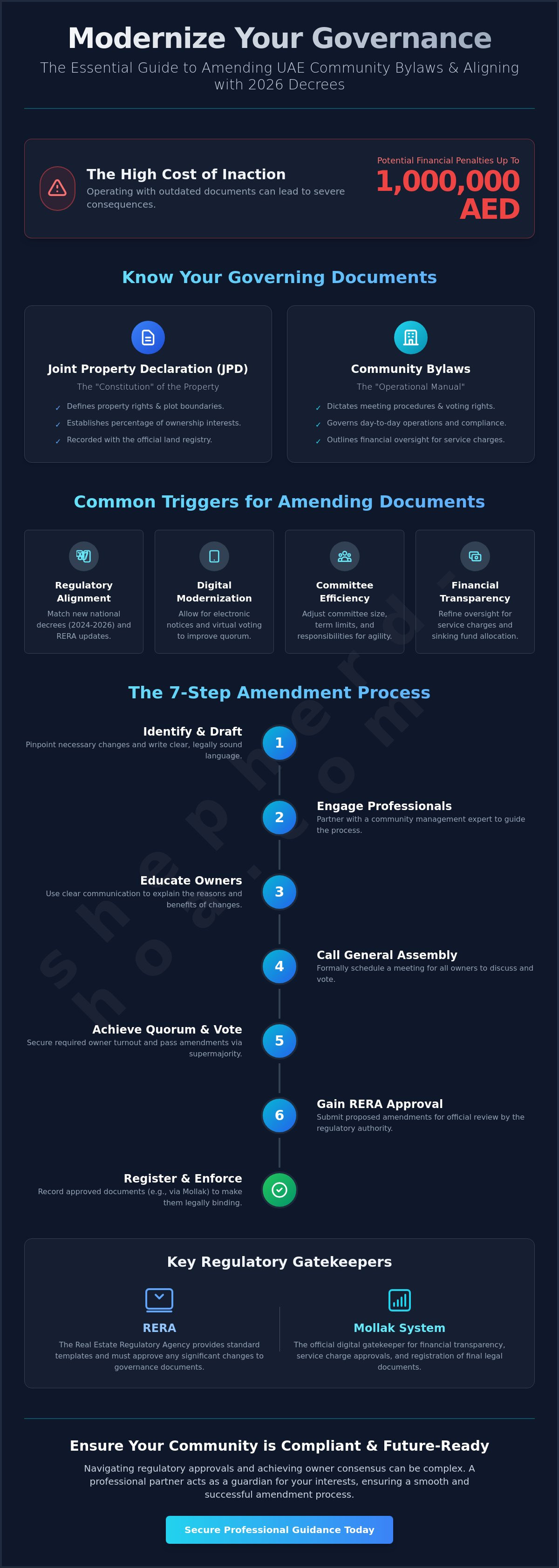
Did you know that operating under outdated community documents in Dubai can lead to financial penalties reaching up to 1,000,000 AED? Many owners' committees feel trapped between rules that no longer serve their residents and the daunting complexity of legal updates. Learning how to amend community bylaws isn't just about changing words on a page. It's a vital act of guardianship that safeguards your property's value and ensures your governance aligns with the latest 2026 real estate decrees.
We understand the frustration of trying to reach a quorum or distinguishing between simple community rules and a formal Joint Property Declaration. It's easy to feel overwhelmed by the administrative weight of RERA or ADREC requirements. This guide provides a definitive roadmap to modernize your governance documents while maintaining full legal compliance. You'll discover the specific regulatory steps for both Dubai and Abu Dhabi, the role of professional management companies in the amendment process, and how to navigate the newest 2026 resolutions to foster a more harmonious living environment for every resident.
Key Takeaways
Understand how community bylaws serve as the essential framework for financial oversight and the preservation of shared asset value.
Align your community documents with the latest 2026 UAE real estate decrees to ensure full legal compliance and avoid heavy penalties.
Master the step-by-step procedure of how to amend community bylaws by identifying specific needs and drafting legally sound language.
Learn effective communication strategies to solve low owner turnout and reach the necessary supermajority for successful voting.
Discover how a professional community management partner acts as a guardian for your interests, navigating complex regulatory approvals with ease.
Table of Contents
Defining Community Bylaws and Why They Require Updating
Community bylaws act as the internal governance framework that dictates how an association operates and manages its shared assets. While a global Homeowner association (HOA) model often provides the blueprint, in the UAE, these documents are strictly regulated to ensure they protect the collective interests of all unit owners. They establish the precise structure of the advisory committee, voting rights, and the critical financial oversight required for service charges. Without updated bylaws, a community risks falling into administrative stagnation or, worse, legal non-compliance.
Updating these documents is essential when national laws change or when community needs evolve beyond the original developer-issued rules. Modern bylaws serve as a shield for homeowners. They ensure transparency and ethical management of the collective reserve fund, which is the financial lifeblood of any property. When you understand how to amend community bylaws, you're not just performing a clerical task; you're acting as a guardian of your property's long-term value and social harmony.
Bylaws vs. The Joint Property Declaration
A common point of confusion for many owners is the difference between the Joint Property Declaration (JPD) and the community bylaws. The JPD is a foundational document recorded with the land registry. It defines property rights, plot boundaries, and the percentage of ownership interests. It's essentially the "constitution" of the building.
In contrast, bylaws serve as the operational manual. They focus on meeting procedures, administrative compliance, and the day-to-day mechanics of governance. Understanding which document contains the specific rule you wish to change is the first step in the amendment process. Attempting to change a property right through a bylaw amendment is a common mistake that leads to regulatory rejection.
Common Reasons for Amending Governance Documents
The regulatory environment in the UAE is dynamic. Understanding how to amend community bylaws allows your committee to stay ahead of these changes. Common drivers for updates include:
Regulatory Alignment: Ensuring all internal rules match new national real estate decrees or regulatory updates issued between 2024 and 2026.
Digital Modernization: Updating communication methods to allow for official electronic notices and virtual voting, which significantly improves quorum reach.
Committee Efficiency: Adjusting the size or term limits of the owners committee to ensure the board remains agile and effective.
Financial Transparency: Refining the oversight process for service charge collection and the allocation of the sinking fund to meet modern auditing standards.
By proactively addressing these areas, committees replace operational stress with a sense of organized control. This methodical approach ensures that the community remains a stable, well-governed environment for all residents.
The Regulatory Landscape: National Real Estate Laws and Decrees
In the UAE, all community governance must align with the Joint Property Law and subsequent administrative decrees. This ensures that the collective interests of homeowners remain protected against arbitrary changes. Regulatory agencies provide the legal oversight required to ensure that any proposed modifications don't infringe on individual owner rights. If you're researching how to amend community bylaws, you'll find that the process is strictly governed by these national frameworks to maintain social harmony and asset value.
The Mollak system acts as the digital gatekeeper for financial transparency and service charge approvals. Every amendment you make must be reflected in this official system to be recognized by the government. Failure to register amendments with the proper authorities renders the new rules unenforceable and legally void. This registration isn't just a formality; it's the legal backbone that makes your rules stick. Without it, your committee lacks the authority to enforce updated regulations or collect adjusted fees.
The Role of RERA in Community Governance
The Real Estate Regulatory Agency (RERA) provides the standard templates and guidelines that all community bylaws must follow. RERA approval is required for any significant changes to the Joint Property Declaration or management structure. Ensuring RERA Dubai standards are met prevents future disputes and legal challenges. This authoritative oversight replaces operational stress with a sense of organized control, ensuring that your community's rules are both fair and legally sound.
Compliance with Decree 33 and Modern Strata Regulations
Recent decrees have clarified the relationship between developers, management companies, and owners committees. Your bylaws must reflect the current legal standing of the owners committee as a supervisory body rather than an executive one. Decree 33 is the primary legislation governing community management roles in the UAE. For those operating in the capital, following Abu Dhabi's process for amending community property is equally essential to ensure your governance remains valid under the Department of Municipalities and Transport guidelines.
Navigating these complex regulations alone can be daunting for volunteer committees. Seeking professional assistance for Mollak and RERA approval ensures your community stays compliant without the administrative headache. This methodical approach ensures that your governance documents are always a definitive solution to administrative challenges rather than a source of confusion.
The Step-by-Step Process to Amend Your Community Governance
Successfully updating your governance documents requires a methodical approach that mirrors the structure of a well-organized formal meeting. When you understand how to amend community bylaws, you move from administrative confusion to a state of organized control. The first step involves identifying a specific operational gap and verifying that your proposed change aligns with the official UAE legislation portal. This ensures your efforts aren't wasted on amendments that regulators will ultimately reject for non-compliance with national standards.
Once the need is clear, you must consult with a professional community management partner. They act as an invisible backbone, helping you draft language that is functional and direct. This partnership ensures that your new rules don't contradict the master community declaration or land registry records. After drafting, you must issue a formal notice to all homeowners. In the UAE, this notice period is strictly defined in your existing documents, typically requiring 14 to 21 days of lead time before a meeting can legally occur. The process generally follows these stages:
Identify the specific need for change and verify legal compliance.
Consult a professional partner to draft legally sound language.
Issue formal notices to all owners within the mandatory timeframe.
Hold a General Assembly meeting to conduct a formal vote.
Submit approved minutes and documents to the regulator for final registration.
Drafting the Amendment for Legal Review
Drafting is about more than just legal jargon; it's about community benefit. Your focus should be on practical outcomes, such as reducing community operational costs through more efficient vendor selection rules or modernizing administrative fees. A professional review at this stage is a protective measure. It prevents ambiguous terms from causing future disputes among residents. Clear, declarative language provides a definitive solution to common administrative challenges and instills confidence in the committee's leadership.
The General Assembly Meeting and Voting
The General Assembly is where your preparation meets reality. Before the vote begins, you must verify the quorum requirements specified in your current bylaws. Reaching a quorum is often the biggest hurdle for volunteer committees. To overcome this, use approved electronic voting platforms. These tools maximize participation and provide a transparent, tamper-proof record of the results. Meticulously document the voting results in the meeting minutes. Finally, submit these minutes and the amended documents to the relevant regulatory authority for registration. Only after this final step are the changes legally enforceable.
Overcoming Obstacles: Quorum, Voting, and Registration Challenges
Even with a clear roadmap, committees often face resistance in the form of resident apathy. Low owner engagement is the primary reason amendment attempts fail; proactive communication is the only effective solution. When you're determining how to amend community bylaws, you'll likely find that significant changes, such as those impacting financial structures or common area usage, require a supermajority of 75% of the total ownership. This high threshold makes the quorum not just a legal requirement but a test of community unity and leadership. Without a strategic approach to engagement, your governance updates may stall before they even reach the regulator's desk.
Registration delays are another common hurdle that can derail months of hard work. These delays often occur when the submitted minutes don't match the strict format required by the Mollak system or when owner data is outdated. Resolving these administrative friction points is essential for maintaining the momentum of your community's progress. By treating these challenges as manageable steps rather than insurmountable barriers, you act as a steady guide, replacing operational stress with a sense of organized control and peace of mind for your neighbors.
Strategies for Achieving a Quorum
A successful vote begins weeks before the actual meeting date. Launch a community awareness campaign that explains the "why" behind the amendment, focusing specifically on how the change protects asset value or improves daily life. Use proxies effectively, ensuring they're legally executed and recorded according to the owners association management guidelines. A second General Assembly meeting can often proceed with those present if the first fails to meet quorum. This fallback provision ensures that a small group of active owners can still drive necessary progress when the broader community remains disengaged.
Navigating the Mollak Registration Process
Passing the vote is only half the battle. All financial or structural amendments must be reflected in the Mollak system to maintain understanding Mollak protocols and ensure full legal enforceability. The regulator will meticulously review your meeting minutes to ensure the gathering was called and conducted according to the law. Any discrepancies in owner data or title deeds must be resolved before the amendment is finalised. This methodical verification process acts as a safeguard, ensuring that every change to your community's governance is transparent, fair, and beyond legal reproach.
Professional oversight replaces this administrative burden with a definitive solution. If you're struggling with the registration phase or reaching a quorum, our team provides expert assistance for Mollak and RERA approval to ensure your new bylaws are legally valid and enforceable.
Securing Professional Oversight for Governance Success
Professional management acts as the invisible backbone of a well-governed community. While board members bring passion and local knowledge, expert managers provide the methodical guidance needed to navigate complex regulatory approvals without stress. A partner like Shepherd HOA ensures that every administrative step is taken with integrity and transparency. By handling the technical mechanisms of the Mollak system and direct RERA liaison, we allow board members to focus on what matters most: community harmony and the resident experience.
Learning how to amend community bylaws is only the first part of the journey. The second part is execution. Our role is to replace the administrative weight of these tasks with a sense of organized control. We provide the protective oversight necessary to ensure that your governance documents don't just exist on paper; they must function to preserve the collective interests of all owners. This steady hand prevents the common pitfalls that lead to regulatory rejection or internal community disputes, ensuring your updates are legally sound from day one.
The Value of an Authoritative Management Partner
Shepherd HOA provides the steady, expert guide needed to protect your collective assets and property values. Our deep experience with national compliance ensures your amendments are accepted by regulators on the first attempt. We focus on the preservation of asset value through meticulous budget planning and administrative oversight. When you partner with us, you gain a modern ally that values transparency above all else. We act as a watchful guardian, ensuring the process of how to amend community bylaws is handled with professional standing and care.
Next Steps for Your Community Board
If your governance documents haven't been updated in several years, they likely don't reflect the current legal environment. Taking action now prevents future liabilities and ensures your community remains a desirable place to live. Consider these immediate steps:
Audit your current bylaws against the latest 2026 national real estate regulations to identify gaps in compliance.
Identify the pain points in your current governance that hinder living in a community harmony or slow down decision-making.
Review your financial oversight protocols to ensure they meet the latest Mollak transparency requirements.
Don't let administrative complexity stand in the way of community excellence. Contact Shepherd HOA today to schedule a consultation on modernising your community bylaws and securing the long-term stability of your assets. Our team is ready to act as your supportive partner, providing the simple interactions and sophisticated tools you need for success.
Advancing Your Community Toward Modern Governance
Modernizing your governance documents is a proactive act of guardianship that protects both property values and social harmony. By aligning your internal rules with the latest 2026 national real estate decrees, you ensure your community remains legally compliant and administratively efficient. Success requires a methodical approach to drafting amendments, engaging owners to reach a quorum, and meticulously registering changes within official government systems. Mastering how to amend community bylaws replaces operational stress with a sense of organized control; it provides a definitive solution for long-term stability.
Since 2010, our team has focused on ethical governance and protective oversight for associations across the UAE. As a RERA approved community management partner, we provide expert Mollak system integration to ensure your administrative updates are accepted without delay. We act as a steady guide, handling the technical mechanisms so you can focus on the human side of community leadership. Ensure your community governance is compliant and effective with Shepherd HOA. Your commitment to better governance today builds a more resilient and harmonious community for tomorrow.
Frequently Asked Questions
Can the board of directors change community bylaws without an owner vote?
No, the owners committee cannot unilaterally change community bylaws. Major governance modifications require a formal vote by the General Assembly and subsequent approval from regulators like RERA or the DMT. The committee's role is primarily supervisory and advisory; they don't have the legal authority to bypass the collective decision-making process of the owners. This ensures that any changes reflect the interests of the entire community.
What is the difference between community bylaws and house rules?
Community bylaws focus on the administrative and legal framework of the association, such as committee structures, voting rights, and financial oversight. House rules are operational and dictate daily resident behavior, including pool hours, noise limits, or parking regulations. While house rules are easier to update for management purposes, bylaws are foundational documents that require a more rigorous legal process to modify and register.
How many owners must agree to an amendment for it to be legally binding?
Most community governance documents require a supermajority of 75% of owners to approve a significant amendment. This high threshold ensures that changes have broad support across the community. You should always check your specific Joint Property Declaration, as some documents might specify different percentages. Reaching this number is the most critical hurdle when learning how to amend community bylaws successfully.
Do we need to hire a lawyer to amend our community bylaws?
While hiring a private lawyer isn't strictly mandatory, seeking professional legal or management review is highly recommended. A professional community management partner can draft amendments that align with current RERA templates and UAE legislation. This expert oversight ensures the language is legally sound and prevents the regulator from rejecting your submission due to technical errors or clauses that contradict national decrees.
What happens if our new bylaws contradict national real estate laws?
Any internal bylaw that contradicts national real estate decrees is legally void and unenforceable. UAE federal and emirate-level laws always take precedence over community-level documents. If a conflict is discovered during the review process, the regulator will reject the registration of the amendment. This is why verifying every change against the latest 2026 regulations is a vital step in the modernization process.
How long does the process of amending and registering bylaws typically take?
The entire process typically takes between three to six months to complete. This timeline includes the initial drafting phase, the mandatory notice period for the General Assembly, the voting process, and the final registration with the authorities. Delays often occur during the registration phase if the meeting minutes don't meet the strict formatting requirements of the Mollak system or if owner data is incomplete.
Is electronic voting legally acceptable for amending bylaws in the UAE?
Yes, electronic voting is legally acceptable and increasingly encouraged by UAE regulators to improve owner participation. Utilizing approved digital platforms ensures a transparent, auditable record of the vote. This technology is a definitive solution for communities struggling to reach a quorum, as it allows non-resident owners to participate in the governance of their assets from anywhere in the world.
Can a developer prevent an owners association from amending the original bylaws?
Developers cannot prevent amendments once the property is handed over and the management structure is officially registered. While original bylaws are often developer-issued, owners have the legal right to update these documents to better suit the community's evolving needs. Understanding how to amend community bylaws empowers owners to take control of their governance and transition toward a model that prioritizes resident interests and asset preservation.


Comments