
The Definitive Guide to Managing Vendor Contracts for an HOA in 2026
- Sohrab Virani

- 1 day ago
- 12 min read
In 2026, a handshake deal isn't a sign of trust; it's a direct threat to your community's financial stability. You likely feel the weight of responsibility that comes with overseeing collective assets while facing rising insurance premiums and the strict requirements of RERA or Mollak compliance. It's exhausting to chase underperforming contractors or worry about the transparency of your financial reporting when homeowners are looking to you for steady, reliable leadership. We recognize that the volunteer nature of board work doesn't make the personal stakes any lower.
We believe that managing vendor contracts for an hoa should provide peace of mind rather than operational stress. This guide will help you master these complexities by providing a professional framework for tendering, insurance compliance, and performance oversight. You'll learn how to implement a rigorous governance shield that preserves asset value and ensures transparent reporting. We will walk through the essential steps to protect your community from legal disputes while maintaining the high-quality standards your residents expect and deserve.
Key Takeaways
Learn a five-step ethical tendering framework that prioritizes technical expertise and vendor reputation over the lowest bid to ensure long-term community value.
Discover why managing vendor contracts for an hoa requires specific Service Level Agreements (SLAs) and Key Performance Indicators (KPIs) to protect against disputes.
Understand how to utilize the Mollak system to maintain transparent financial reporting and secure vendor payments that align with regulatory standards.
Shift from passive oversight to active governance by implementing regular performance audits that prevent service charge inflation and asset depreciation.
Gain a professional framework for overseeing community maintenance that balances administrative control with the personal stakes of volunteer board members.
Table of Contents
The Critical Importance of Vendor Contract Management for HOAs
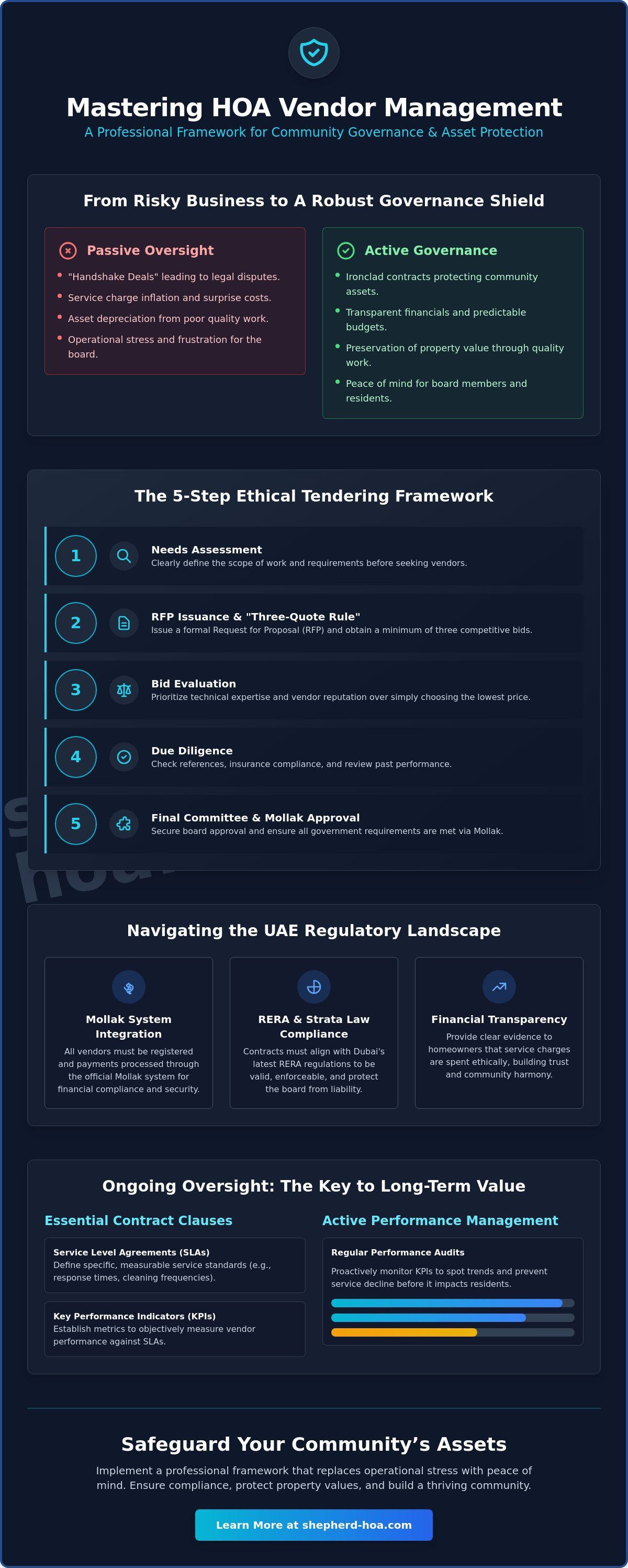
A Homeowner association (HOA) relies on a complex network of third-party service providers to function daily. These vendors handle everything from MEP maintenance to security and landscaping, making their contracts the true backbone of community governance. Effective managing vendor contracts for an hoa isn't just an administrative chore; it's a vital exercise of your fiduciary duty. When oversight is passive, service charge inflation and asset depreciation become inevitable. You must transition from a reactive state of "fixing what's broken" to a proactive lifecycle where every contract is a tool for long-term stability.
Passive management often leads to a slow decline in community standards. Without a professional framework, costs can creep upward while service quality slips. This creates a cycle of operational stress for the Owners Committee and frustration for residents. By treating contract management as a continuous process rather than a one-time signing event, you ensure that the community’s financial resources are used efficiently. Proactive management allows you to spot performance trends before they become expensive failures.
Guardianship of Community Assets
Professional contract management acts as a protective shield for your property values. It replaces the operational stress of chasing contractors with a sense of organized, authoritative control. When vendors understand that their performance is monitored against specific standards, they deliver higher quality work. This reliability directly impacts resident satisfaction and social harmony. A well-maintained gym or a pristine lobby isn't just a luxury; it's a tangible result of a board that takes its duty of care seriously. High-quality vendor performance preserves the physical integrity of the building, which is the primary driver of long-term asset value.
Navigating the UAE Regulatory Landscape
In the UAE, the legal framework for community management is precise and demanding. Your vendor agreements must align with the latest RERA regulations and Strata Law to remain valid and enforceable. The Owners Committee holds the critical responsibility of approving and overseeing these service contracts, ensuring they are registered and managed through the Mollak system. This isn't just a matter of legal compliance. It's about ensuring all community operations meet national standards for transparency. Proper managing vendor contracts for an hoa involves several key regulatory steps:
Approval through Mollak: Ensuring all service providers are registered and payments are processed through the official system.
RERA Compliance: Aligning contract terms with the legal requirements for community service providers in Dubai.
Financial Transparency: Providing homeowners with clear evidence that their service charges are being spent ethically and effectively.
By maintaining this level of oversight, you protect the board from potential liability and foster a culture of trust. A transparent approach to vendor management ensures that every decision is backed by data and legal standing, providing the peace of mind that comes with professional governance.
Implementing an Ethical Tendering Process for Community Services
Ethical tendering is the cornerstone of professional community governance. It transforms the often-stressful task of selection into a transparent, repeatable process that protects the board from accusations of favoritism. When you approach managing vendor contracts for an hoa with a structured framework, you ensure that every dirham of the service charge budget is allocated based on merit and value. This process begins with a commitment to the "Three-Quote Rule," a non-negotiable standard that provides the committee with a clear view of the market rate and available expertise.
A professional tender follows a five-step framework: needs assessment, RFP issuance, bid evaluation, due diligence, and final committee approval. Moving beyond the lowest price is essential. You must evaluate technical expertise and vendor reputation to avoid the "cheap is expensive" trap where poor service leads to asset depreciation. To maintain integrity, all board members should sign a conflict of interest disclosure before the process begins. Finally, ensure all necessary government approvals are secured through the Mollak system before any contract is signed, as this protects the association's legal standing.
Crafting a Robust Request for Proposal (RFP)
A high-quality RFP is your primary tool for ensuring an "apples-to-apples" comparison between vendors. It must include a detailed scope of work, clear timelines, and specific compliance requirements. By standardizing the response format, you make it easier for the committee to identify which vendor truly understands the community’s unique needs. Set firm deadlines and submission protocols to maintain a level playing field. This organization replaces administrative chaos with a methodical, calm approach to selection.
Selection Criteria and Vendor Due Diligence
Due diligence is where you act as the guardian of your community’s assets. You must verify trade licenses, RERA approvals, and ensure the vendor carries adequate insurance coverage. As a best practice in 2026, look for general liability limits between $1 million and $2 million per occurrence to shield the association from risk. Assessing a vendor’s capacity to serve a community of your specific scale is equally vital. This is where the expertise of owners association management dubai becomes invaluable, as they can vet potential partners against a database of proven performance. If you feel overwhelmed by the technicalities of vetting, aligning with professional community management partners can provide the administrative backbone your committee needs to make confident decisions.
Essential Clauses Every HOA Vendor Agreement Must Include
A generic service agreement is a liability, not a safeguard. When you're managing vendor contracts for an hoa, the document acts as your primary instrument of protection against operational failure and financial loss. Standard contracts provided by vendors are often designed to protect their interests, not yours. To act as a watchful guardian of your community’s assets, you must insist on bespoke agreements that address the specific risks of shared residential spaces. This involves shifting the focus from simple price points to robust legal protections and performance guarantees.
Every agreement must include comprehensive indemnity and insurance clauses. In 2026, it's a best practice to require vendors to carry general liability insurance with limits between $1 million and $2 million per occurrence. Ensure the association is listed as an "additional insured" on these policies. This provides the community with direct protection under the vendor's coverage. Payment terms should also be structured to align with your community’s budget cycle. Avoid prepayments; instead, tie disbursements to the successful completion of verified milestones to maintain financial transparency and control.
Defining Scope of Work and Performance KPIs
An unambiguous Statement of Work is the only way to prevent scope creep and hidden costs. You need to define exactly what is included in the service and, just as importantly, what is not. Supplement this with clear Service Level Agreements (SLAs) and Key Performance Indicators (KPIs). For example, a landscaping contract should specify the frequency of pruning rather than just "regular maintenance." Set measurable targets for response times, such as a four-hour window for emergency plumbing repairs. Always build in "remedy periods" that allow a vendor a defined window, such as 48 hours, to correct sub-standard work before the board pursues further action.
Termination, Renewals, and Dispute Resolution
Flexibility is vital for long-term stability. Your contracts should include a "termination for convenience" clause, allowing the board to exit the agreement with 30 or 60 days' notice without needing to prove a breach of contract. This prevents the association from being locked into poor service or outdated pricing. Managing vendor contracts for an hoa also requires a proactive approach to renewals. Avoid clauses that allow for automatic price hikes or "evergreen" renewals that bypass committee review. Finally, establish a methodical path for dispute resolution that prioritizes mediation. This keeps conflicts out of the courts and preserves the social harmony that is essential for any thriving community.
Ongoing Oversight: Performance Reviews and Financial Transparency
Signing a contract is only the beginning of a successful partnership. Real protection for your community happens during the delivery phase. Managing vendor contracts for an hoa requires a methodical approach to oversight that lasts for the entire lifecycle of the agreement. You can't rely on trust alone when the value of collective assets is on the line. Implementing monthly or quarterly performance audits ensures that the promises made during the tendering process are actually kept. This steady rhythm of review replaces operational stress with a sense of organized control and peace of mind.
A digital trail is your best defense against disputes and financial mismanagement. Every work order, invoice, and compliance document should be stored in a centralized, accessible system. This creates an auditable history that protects the Owners Committee from liability. When you link service charge collections directly to vendor payment schedules, you maintain a healthy cash flow. It ensures the community remains solvent while vendors are held accountable for their output. This level of financial transparency is essential for building trust among homeowners.
Monitoring Vendor KPIs and Service Delivery
Regular site inspections are mandatory to verify that work completed matches the contractual scope. You need to see the results with your own eyes or through professional reports to ensure standards aren't slipping. Don't forget to include the residents in this process. A feedback loop allows you to gauge vendor effectiveness from the perspective of those who use the services daily. Use these data-driven reports to inform your community service charge budget dubai. This ensures your financial planning reflects real-world performance rather than just estimates.
Managing Payments Through the Mollak System
In Dubai, transparency isn't just a best practice; it's mandated by law. You must understand the mollak dubai requirements for all vendor disbursements. Every payment must be justified, documented, and approved by RERA through the official system. Professional community management plays a critical role here. They act as the expert bridge between the committee and the regulatory authorities. This ensures all financial transactions are ethical, transparent, and fully auditable. If you want to ensure your community meets every regulatory hurdle with ease, partner with Shepherd HomeOwners' Association for professional community management today. We provide the administrative backbone needed to keep your community's finances and operations in perfect alignment.
How Shepherd HomeOwners' Association Safeguards Your Community’s Assets
Managing a community shouldn't be a source of constant worry. At Shepherd HomeOwners' Association, we act as the steady, expert guide for Owners Committees who are often overwhelmed by the technical demands of governance. With over 15 years of experience in the UAE property market, we've refined a process for managing vendor contracts for an hoa that prioritizes long-term stability over short-term fixes. We understand the personal stakes involved for volunteer board members. Our role is to replace operational stress with a sense of organized control, allowing you to focus on the community's vision while we handle the administrative heavy lifting and regulatory hurdles.
A professional management partner provides the expertise that software alone cannot offer. Shepherd HomeOwners' Association combines advanced digital tools with deep industry knowledge to ensure your community thrives. By acting as a watchful guardian, we protect the physical and financial health of your property. This proactive approach prevents the service charge inflation and asset depreciation that often plague communities with passive oversight. We believe in building long-term partnerships based on integrity, transparency, and a shared commitment to excellence.
Professional Oversight as a Shield
We function as the invisible backbone for your community governance. This means ensuring that every contract, every tender, and every payment adheres strictly to rera dubai standards. Shepherd HomeOwners' Association's approach to ethical tendering and administrative compliance isn't just about following rules; it's about protecting your collective assets through a duty of care. We provide a level of transparency and integrity in financial reporting that builds trust among homeowners. By maintaining rigorous oversight, we ensure that every dirham spent is a dirham invested in the property’s future. This protective stance shields the committee from liability and ensures that third-party providers meet the high standards your residents expect.
Requesting a Professional Management Consultation
Transitioning to a professional vendor management model is the most effective way to preserve your community’s asset value. Shepherd HomeOwners' Association works with you to audit existing agreements and implement the rigorous KPI frameworks and SLA standards discussed throughout this guide. This shift leads to more than just better maintenance; it fosters social harmony by removing the friction caused by poor service or financial lack of transparency. Our team guides you through the complexities of budget planning and service charge collection, ensuring your community remains financially robust. Taking the first step toward professional management is a commitment to a well-governed, thriving community. If you're ready to master the complexities of managing vendor contracts for an hoa, we invite you to consult with our team to see how our guardianship can benefit your residents.
Securing Your Community’s Future Through Professional Governance
Effective governance isn't a static achievement; it's a continuous commitment to quality and transparency. You now have the framework to move beyond basic oversight and implement a rigorous governance shield for your residents. By prioritizing ethical tendering and insisting on precise contractual clauses, you protect the community’s financial health and physical assets. Remember that the Mollak system and RERA regulations are essential tools that ensure every dirham of the service charge budget is spent with integrity. Mastering the nuances of managing vendor contracts for an hoa requires a steady hand and deep market knowledge.
You don't have to carry this administrative burden alone. Shepherd HomeOwners' Association provides the professional backbone that allows Owners Committees to lead with confidence and clarity. Our team brings 15+ years of UAE market expertise and RERA approved management to every community we serve, ensuring fully Mollak-compliant financial reporting. Partner with Shepherd HomeOwners' Association for Professional Community Management to replace operational stress with organized control. Your community deserves a guardian that values asset preservation and social harmony as much as you do.
Frequently Asked Questions
What is the role of an Owners Committee in managing vendor contracts?
The Owners Committee acts as the primary decision-making body responsible for approving and supervising all service agreements. They ensure that managing vendor contracts for an hoa aligns with the community’s budget and long-term maintenance goals. While committee members don't handle daily operations, they must verify that all vendors are registered in the Mollak system and that their performance meets the standards agreed upon during the selection process.
How many quotes should an HOA obtain before awarding a contract?
You should obtain at least three competitive quotes from qualified providers before awarding any contract. This "Three-Quote Rule" is a non-negotiable standard for ethical governance and financial transparency. It allows the committee to establish a fair market rate and evaluate technical expertise beyond just the lowest price. Comparing multiple proposals ensures you aren't overpaying for services while providing a clear audit trail for homeowners.
Can an HOA terminate a vendor contract before it expires?
Yes, an HOA can terminate a contract early provided the agreement includes specific termination clauses. A well-drafted contract should feature both "termination for cause," used when a vendor fails to meet KPIs, and "termination for convenience," which allows the board to exit with 30 or 60 days' notice. Having these options ensures the committee isn't locked into poor service or outdated pricing structures that could harm the community.
How does the Mollak system affect vendor payments in Dubai?
The Mollak system centralizes all financial transactions, meaning vendor payments are processed through a regulated, transparent platform. This system ensures that every disbursement is documented and approved by RERA before funds are released. It eliminates the risk of financial mismanagement and provides homeowners with the assurance that their service charges are being used appropriately. Vendors must be registered and compliant to receive payments through this official channel.
What insurance should a vendor provide to an HOA?
Vendors must provide proof of General Liability insurance and Workers' Compensation coverage at statutory limits. In 2026, it's a best practice to require a minimum of $1 million to $2 million per occurrence for liability to protect the association from potential claims. You should also insist that the HOA is listed as an "additional insured" on the vendor's policy. This provides the community with direct protection and simplifies the claims process if an accident occurs.
Is it mandatory to use a RERA-approved management company for vendor tendering?
While the Owners Committee holds decision-making power, using a RERA-approved management company is essential for ensuring the tendering process meets all legal standards. A professional manager acts as your expert guide, vetting vendors and handling the technical complexities of Mollak compliance. This partnership provides the administrative backbone needed to protect the committee from liability and ensures that managing vendor contracts for an hoa is handled with professional integrity.
How often should vendor contracts be reviewed by the board?
You should review vendor performance on a quarterly basis, with a comprehensive contract review conducted annually before the budget planning cycle begins. Regular audits allow the board to address sub-standard work through defined remedy periods before issues escalate. Waiting until the renewal date to evaluate a vendor is a reactive approach that can lead to service gaps or unexpected price increases that disrupt the community's financial stability.
What are the risks of using verbal agreements with HOA vendors?
Verbal agreements are fundamentally unenforceable and pose a significant risk to the community's legal and financial security. Without a written contract, there's no clear scope of work, no defined payment terms, and no performance KPIs to hold the vendor accountable. This lack of clarity often leads to neighbor disputes and service charge inflation. Written agreements are the only way to ensure the board fulfills its fiduciary duty to protect homeowner assets.


Comments