
HOA Budget Approval Process in Dubai: A Complete 2026 Guide
- Sohrab Virani

- Jul 30
- 12 min read
What if the most important document for your community's harmony isn't the building code, but your 2026 financial plan? A regulatory-approved budget is more than a legal requirement; it's a strategic roadmap that acts as a guardian for your property's long-term value. We understand that the HOA budget approval process mandates can feel overwhelming, particularly when you're balancing regulatory caps on service charge increases against the rising costs of premium maintenance. It's natural to feel the weight of responsibility when navigating the official digital management platform's technicalities while trying to avoid the sting of non-compliance fines.
This guide will help you master the complexities of regulatory compliance and the official digital management platform to ensure your community's financial health and regulatory approval. You'll learn how to secure an audited budget that meets mandatory reserve fund allocation requirements and provides the transparency homeowners expect. We'll break down the specific steps for 2026, from initial auditing to final approval, so you can lead your community with confidence and peace of mind.
Table of Contents
Understanding the HOA Budget Approval Framework in Dubai
A community's annual budget is more than a simple spreadsheet of costs; it's the strategic roadmap for your property's preservation. At its core, the budget for a Homeowner Association (HOA) serves as an operational blueprint for common area maintenance, security, and utility management. In Dubai, this process is strictly regulated to ensure every dirham collected from owners is utilized with integrity and foresight. The hoa budget approval process dubai requires is a methodical cycle that transforms community needs into a RERA-sanctioned financial reality.
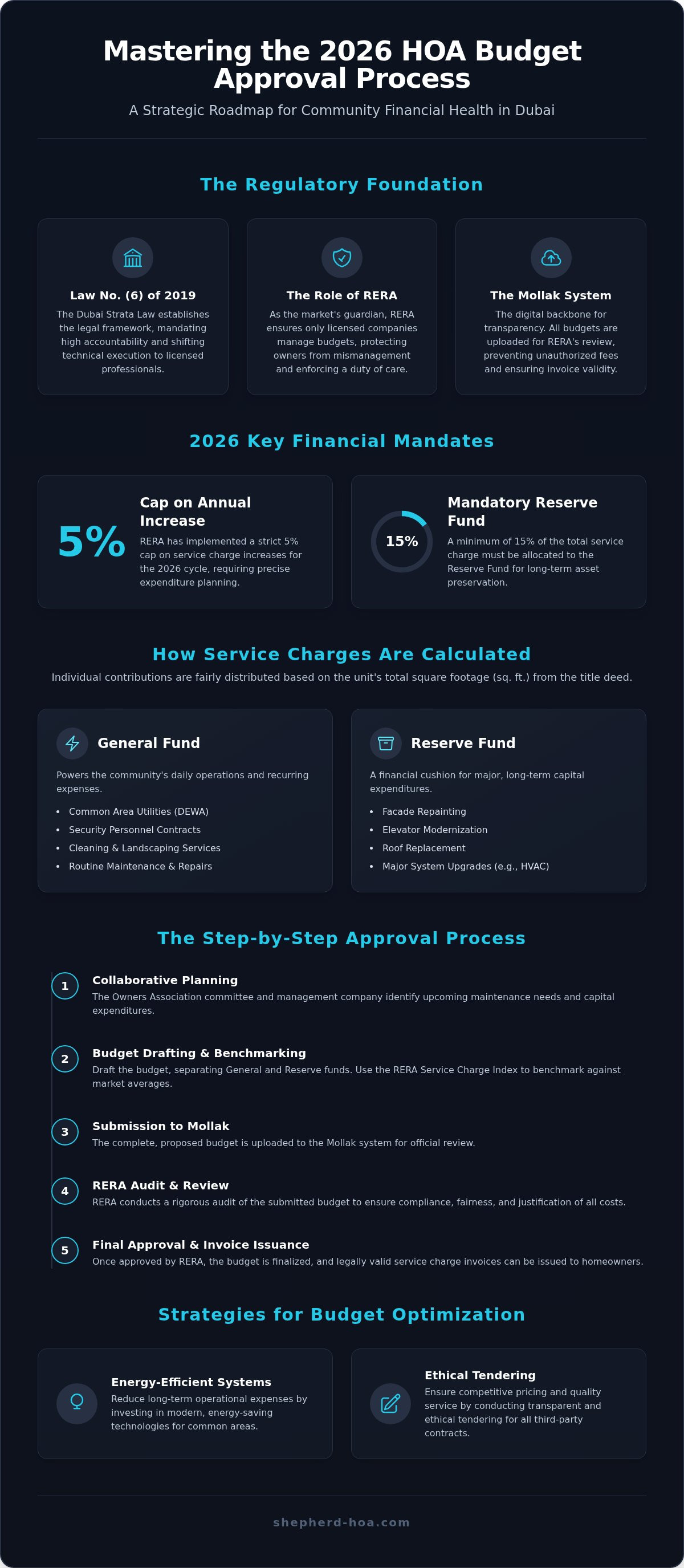
The legal foundation for these financial activities is Law No. (6) of 2019, often referred to as the Dubai Strata Law. This legislation fundamentally changed community governance by mandating that all management entities operate with a high degree of accountability. It ensures that the Owners Association (OA) remains the primary advocate for the community's interests while shifting the technical execution to licensed professionals. For the 2026 cycle, being proactive is essential. With RERA implementing a 5% cap on annual service charge increases, boards must plan their expenditures with precision to avoid funding gaps that could compromise property standards.
Initiating the budget cycle early is the best way to maintain control. The OA committee works alongside the management company to identify upcoming maintenance needs and capital expenditures. This collaborative effort ensures that the community doesn't just react to repairs as they happen but instead builds a resilient financial cushion for the future. It's about shifting from a mindset of "paying bills" to one of "asset guardianship."
The Role of RERA and the Strata Law
RERA acts as the ultimate guardian of Dubai's real estate market. Under the current framework, only RERA-licensed management companies can facilitate the budget approval cycle. This requirement protects owners from mismanagement and ensures that those handling the community's funds possess the necessary expertise. Board members carry a significant duty of care, meaning their financial decisions must prioritize the long-term health of the asset over short-term savings. For a deeper look at how these regulations shape community life, explore our guide on Owners Association Management in Dubai.
The Mollak System as a Tool for Transparency
The Mollak system is the digital backbone of Dubai's real estate transparency. Every proposed budget must be uploaded to this platform for RERA's review and approval. This centralized system serves as a protective shield for homeowners, as it prevents any unauthorized or arbitrary fee increases. By digitizing the hoa budget approval process dubai has standardized, the government ensures that service charge invoices are only issued after a rigorous audit. This intersection of technology and oversight provides the peace of mind that your community's financial contributions are being managed with absolute clarity.
How Service Charges are Calculated: General vs. Reserve Funds
Calculating service charges isn't a guessing game; it's a precise mathematical exercise rooted in transparency. In Dubai, your individual contribution is determined by the total square footage (sq. ft.) of your unit as recorded on the title deed. This ensures a fair distribution of costs across the community. The hoa budget approval process dubai requires is built on the foundation of two distinct financial pools: the General Fund and the Reserve Fund. Each serves a unique purpose in protecting the community's lifestyle and asset value.
To verify if your proposed rates are reasonable, RERA provides the Service Charge Index. This public benchmark allows owners to compare their community's costs against area averages. For instance, while Downtown Dubai averages around AED 21 per sq. ft., luxury towers in the same district might exceed AED 50 per sq. ft. due to higher amenity standards. Using this index as a benchmark ensures that the budget remains competitive and justifiable to the homeowners who fund it. Maintaining a balanced budget between these two funds is the only way to ensure long-term asset guardianship and avoid the stress of sudden financial shortfalls.
The General Fund: Powering Daily Operations
The General Fund acts as the community's heartbeat, covering all recurring expenses that keep the property running smoothly every day. This includes payments to DEWA for common area utilities, security personnel, cleaning services, and landscaping maintenance. It also accounts for professional management fees and the administrative costs of running the Owners Association. If you want to see how these daily costs translate into your quarterly bill, you can learn more about understanding your service charge invoice in Dubai. Ensuring these costs are ethically tendered is vital for keeping service charges sustainable.
The Reserve Fund: Safeguarding the Community's Future
While the General Fund handles the "now," the Reserve Fund focuses on the "next." RERA mandates that 15% of all collected service charges must be allocated to this fund, which is specifically designated for major capital expenditures. This includes significant projects like roof replacements, MEP system overhauls, or structural repairs that occur once every few decades. RERA's new governance framework emphasizes the need for a professional 10-year reserve fund study to accurately predict these future costs. By planning today, communities can avoid the dreaded "special levies" that often occur when a building hasn't saved enough for critical repairs. If your community's long-term planning feels uncertain, our budget planning services can help establish a stable financial future.
The Step-by-Step HOA Budget Approval Process in Dubai
Moving from financial planning to actual collection requires following a specific, government-mandated workflow. The hoa budget approval process dubai utilizes ensures that no single entity has unchecked control over community funds. It's a system of checks and balances designed to protect your investment. Success begins with a clear understanding of these four essential steps:
Step 1: Drafting the Budget: Your management company analyzes historical spending, current service contracts, and projected utility costs to create a comprehensive draft.
Step 2: Owners' Committee Review: The committee reviews the draft to ensure it aligns with the community's standards and long-term goals. This is the time to suggest adjustments or seek clarity on specific line items.
Step 3: Independent Audit: A RERA-approved auditor verifies the financial accuracy of the proposal and checks for compliance with the latest regulations, including the mandatory reserve fund allocation.
Step 4: Mollak Submission: The final audited budget is uploaded to the Mollak system. RERA performs the final review to ensure the budget is fair and compliant before granting the authority to invoice.
The Audit Process: Ensuring Financial Integrity
An audit isn't just a formality; it's a rigorous health check for your community's finances. Auditors scrutinize historical spending to ensure past funds were used correctly and evaluate future projections for realism. They specifically look for the mandatory 15% reserve fund allocation and verify that any proposed service charge increases stay within the 5% cap unless significant capital improvements justify a higher rate. RERA often rejects budgets for missing documentation, unjustified cost spikes, or failing to meet the Service Charge Index benchmarks. Once the auditor and RERA are satisfied, you'll receive the Mollak approval certificate. This certificate is the only legal basis for generating service charge invoices in Dubai.
Timeline and Deadlines for 2026 Submissions
Time is a critical factor in maintaining community operations. You should ideally start the hoa budget approval process dubai requires at least 90 days before the current financial year ends. This window allows ample time for committee discussions, the mandatory audit period, and the RERA review cycle. Late submissions can be costly. If a budget isn't approved before the new year begins, the management company cannot legally issue new invoices. This creates a cash flow gap that can lead to delayed payments for security, cleaning, and DEWA bills. Managing the transition between cycles requires a methodical approach to ensure the "invisible backbone" of your community's services never falters.
Strategies for Budget Optimization and Cost Control
Optimizing your community's finances is the most effective way to ensure a smooth hoa budget approval process dubai regulators require. When costs are lean and justified, the path to RERA approval becomes much clearer. Professional oversight plays a critical role here by identifying 'leakage', those small, unnoticed inefficiencies that drain the General Fund over time. Whether it's an outdated maintenance contract or a poorly performing irrigation system, these leaks add up to significant financial strain for homeowners. By acting as a watchful guardian of community assets, we can redirect these wasted funds toward meaningful improvements.
It's often tempting to select the lowest bidder during the budget cycle to keep service charges as low as possible. However, the cheapest vendor often proves the most expensive in the long run. Substandard cleaning or reactive security services eventually lead to property degradation and higher emergency repair costs. A balanced approach prioritizes value over price. This ensures that the community's standards remain high while keeping service charges sustainable for the long term. High-quality maintenance is an investment in the building's future, not just a line item to be cut.
Ethical Tendering and Vendor Management
Building trust with homeowners starts with absolute transparency in how contracts are awarded. By creating a detailed Scope of Works (SOW), we ensure that all vendors bid on the exact same requirements, creating a level playing field. This competitive environment naturally drives down prices without sacrificing the quality of service. Ethical tendering removes the risk of biased selections, which is a key part of reducing community operational costs in Dubai. When owners see a clear, fair bidding process, they're far more likely to support the final budget proposal during the hoa budget approval process dubai mandates.
Technology Integration for Financial Oversight
Modern governance relies on data, not guesswork. Integrating smart meters and IoT sensors allows us to monitor utility consumption in real-time. Since DEWA bills often represent the largest portion of operational spending, even a small reduction in water or electricity use can significantly impact the bottom line. Predictive maintenance technology takes this a step further by identifying potential equipment failures before they become costly emergencies. By leveraging management software for real-time tracking, boards can see exactly where every dirham is going at any moment. This level of control makes the annual budgeting cycle far more predictable and less stressful for everyone involved.
If you're looking to streamline your community's expenses and ensure a RERA-compliant financial plan, explore our professional budget planning services today.
Professional Governance: Why Shepherd is Your Budgeting Partner
Managing a community's finances in a high-stakes market like Dubai requires more than just accounting skills; it demands a deep commitment to asset guardianship. Shepherd HomeOwners' Association acts as the invisible backbone for your community, ensuring every financial decision aligns with the principles of integrity and social harmony. We understand that board members are often volunteers who balance personal lives with significant community responsibilities. Our role is to replace that operational stress with a sense of organized control. By navigating the technical nuances of the hoa budget approval process dubai mandates, we allow you to focus on the bigger picture of community well-being.
Our 2026 commitment to transparent financial reporting is built on the foundation of the Mollak system. We don't just upload data; we ensure your budget is a robust reflection of your community's actual needs and future aspirations. Our RERA-approved team simplifies the entire approval cycle by managing the heavy lifting of audit preparation, committee coordination, and regulatory compliance. From the moment we begin drafting your annual plan to the final stage of service charge collection, we provide the professional oversight necessary to protect your property's value and your owners' interests.
Our Legacy of Excellence Since 2010
Experience is a vital asset in the Dubai real estate landscape. Since 2010, we've helped diverse communities maintain their financial health through changing regulations and market shifts. Our 2024 rebranding from Sheffield to Shepherd HomeOwners' Association marked a strategic move toward modern, technological governance while staying rooted in our traditional service values. We manage both residential towers and commercial communities with the same level of precision and care. By leading with the benefit of peace of mind, we ensure that board members feel supported rather than overwhelmed. Our steady, expert guidance ensures that your community remains a stable and desirable place to live or work.
Get Started with Your 2026 Budget Plan
The first step toward a successful 2026 is a comprehensive health check of your current finances. We coordinate closely with Owners' Committees to identify immediate maintenance priorities and long-term capital requirements. This collaborative approach ensures that your budget isn't just a document for RERA, but a practical tool for community excellence. We'll guide you through the initial auditing phase, ensuring all historical spending is accounted for and future projections are realistic. Don't let the hoa budget approval process dubai requires become a source of anxiety for your committee. Let us provide the structure and expertise you need to succeed.
Ready to secure your community's financial future? Request a Community Budget Plan from Shepherd HomeOwners' Association and experience the peace of mind that comes with professional guardianship.
Securing Your Community's Financial Future
Mastering the hoa budget approval process dubai mandates is about more than just checking boxes; it's about protecting the social and financial fabric of your community. By focusing on transparent Mollak reporting and maintaining the mandatory 15% reserve fund, you ensure your property remains a valuable and harmonious place to live. Our team has served Dubai communities since 2010, acting as a steady guide through the complexities of RERA compliance and ethical vendor management. We provide the professional oversight needed to turn operational stress into organized control.
As RERA Approved Community Management and Mollak system experts, we're ready to help your board navigate the 2026 cycle with confidence. Whether you're optimizing daily operational costs or planning for long-term capital repairs, we offer the expertise to keep your community thriving. Request a RERA-Compliant Budget Plan for Your Community today and take the first step toward a stable financial future. You don't have to navigate these responsibilities alone; we're here to be the backbone of your governance.
Frequently Asked Questions
What is the RERA Service Charge Index and how does it affect my budget?
The RERA Service Charge Index is a public benchmark provided by the Dubai Land Department that sets the standard for maintenance rates across different zones. It acts as a protective guide for homeowners by ensuring that community costs remain within market averages. If your proposed budget exceeds the index for your specific area, RERA will likely require additional justification or a cost-reduction plan before granting approval.
Can an Owners Association increase service charges without RERA approval?
No, an Owners Association cannot increase service charges independently. Every adjustment must be reviewed and approved by RERA through the Mollak system to be legally enforceable. For the 2026 cycle, RERA has maintained a 5% cap on annual increases; any request beyond this limit requires documented proof of significant capital improvements or essential operational changes.
What happens if a homeowner refuses to pay the service charge in Dubai?
Failure to pay results in a structured legal process that begins with a formal notice issued through the Mollak system. If the dues remain unpaid after the notice period, the management entity can escalate the matter to the Rental Dispute Center. This can result in travel bans, the freezing of bank accounts, or legal actions that prevent the sale or transfer of the property.
How is the Reserve Fund different from the General Fund in community management?
The General Fund handles the daily heartbeat of the community, covering recurring costs like security, cleaning, and DEWA bills. The Reserve Fund is a protective savings account for long-term capital projects, such as elevator replacements or structural repairs. Dubai law requires that 15% of all collected service charges be allocated to the Reserve Fund to ensure the building's long-term preservation.
What are the mandatory audits required for Mollak budget approval?
Every budget must undergo a financial audit by a RERA-approved independent firm before it is submitted for final review. This auditor verifies that all historical spending is accurate and that the new proposal follows the hoa budget approval process dubai requires. They specifically check for the mandatory 15% reserve allocation and ensure all third-party contracts have been ethically tendered.
How often should a community conduct a reserve fund study in Dubai?
A community should ideally update its reserve fund study every three years to reflect current market costs and the building's actual condition. While RERA requires a 10-year outlook for financial planning, regular updates ensure that the community is saving enough to cover major repairs. This proactive approach prevents the need for sudden "special levies" that can cause financial stress for homeowners.
What is the role of the management company in the Mollak system?
The management company acts as the technical administrator and the "invisible backbone" of the community's financial operations. They are responsible for preparing the draft budget, coordinating with independent auditors, and navigating the hoa budget approval process dubai mandates through the Mollak portal. Their expertise ensures that all documentation is compliant and submitted within the required regulatory timelines.
Can we use the service charge budget for individual property repairs?
No, service charge funds are strictly reserved for the maintenance and operation of common areas and shared facilities. Repairs inside an individual apartment or villa are the private responsibility of the property owner. The collective budget is designed to protect the shared assets that benefit the entire community, such as the swimming pool, gym, hallways, and exterior facade.


Comments