
How to Run an Effective Owners Committee Meeting: The 2026 Board Guide
- Sohrab Virani

- 12 minutes ago
- 12 min read
What if your next board meeting didn't feel like a marathon of grievances, but a 45-minute masterclass in community leadership? Many committee members across the UAE feel trapped by circular debates and the constant pressure of RERA compliance. Learning how to run an effective owners committee meeting is the difference between a community that thrives and one that stalls under the weight of administrative friction. It's time to replace operational stress with a sense of organized control and peace of mind.
We understand that you've volunteered your time to serve your neighbors, not to get lost in legal jargon or manage heated arguments. You deserve a process that honors your commitment and protects the collective value of your assets. This guide provides a professional 2026 framework to streamline your governance, ensuring every session is productive and fully aligned with Mollak requirements. We will explore a repeatable meeting structure, tactics for handling difficult members, and the specific steps needed to maintain national legal standards with confidence.
Key Takeaways
Transform meetings from administrative chores into strategic sessions that protect your community’s asset value and social harmony.
Learn how to run an effective owners committee meeting by mastering the architecture of preparation, including RERA-compliant notice timelines and high-impact agendas.
Understand the legal mechanics of a quorum to ensure every decision made by the board is binding and enforceable under UAE law.
Establish a "source of truth" with accurate minute-taking and seamless Mollak data synchronization for transparent service charge management.
Discover how a professional community management partner acts as an invisible backbone, handling the heavy lifting of administrative compliance while you lead.
Table of Contents
What is an Effective Owners Committee Meeting?
An owners committee meeting is much more than a casual gathering of neighbors in a lobby or community room. It's a formal, legally mandated session where elected representatives execute community policy and fulfill their fiduciary duties. These meetings serve as the primary mechanism for transparent decision-making and the preservation of property values. When you master how to run an effective owners committee meeting, you aren't just checking a box for regulatory compliance. You're actively protecting the financial health and social stability of your investment.
These sessions act as a critical bridge between the diverse needs of residents and the professional execution of the management team. Without this structured dialogue, community governance can become fragmented and reactive. By following a clear framework, committees ensure that every decision is documented, legal, and focused on the long-term stability of the building or villa community. It's a professional obligation that requires a balance of leadership, empathy, and strict adherence to strata regulations.
The Purpose of Governance Meetings
Effective meetings prioritize strategic oversight over minor day-to-day maintenance fixes. While it's tempting to spend an hour discussing a single repair, the board’s true role is to act as the guardian of the community’s collective assets. This means focusing on reserve fund health, service charge collection rates, and major capital expenditures. Beyond the balance sheet, these meetings aim to foster social harmony. A well-led meeting prevents disputes from escalating by replacing conflict with clear, actionable resolutions that benefit the entire community.
Board vs. Management: Who Does What?
Clarity in roles is the secret to a stress-free committee experience. The owners committee is responsible for setting policy and making high-level approvals. Your professional management partner is there to execute the administrative and technical tasks. Meetings should be reserved for direction and final votes, not for performing manual administrative labor or micromanaging staff. This distinction ensures the board remains focused on leadership while the management team handles the heavy lifting.
For example, the committee decides on the budget priorities for the year, while the manager handles the technical Owners Association Management tasks like compliance reporting and utility account setups. To maintain order during these discussions, many boards utilize a simplified version of Robert's Rules of Order. This ensures that only one person speaks at a time and every motion receives a fair vote. This separation of powers allows the board to lead with authority without becoming overwhelmed by the technical mechanisms of community management.
The Architecture of Preparation: Setting the Stage
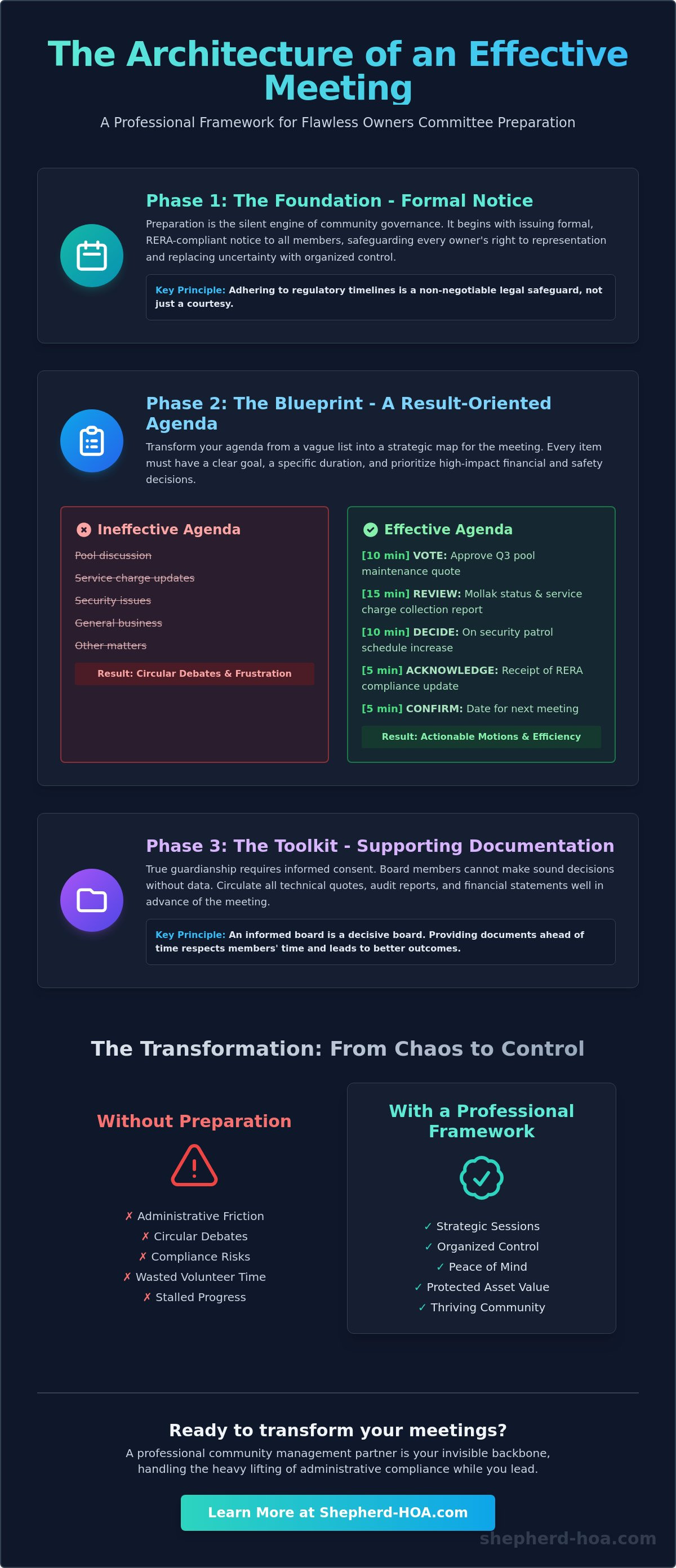
Preparation is the silent engine of community governance. It transforms a potential collision of opinions into a structured pathway for progress. To master how to run an effective owners committee meeting, you must treat the pre-meeting phase with the same rigor as the session itself. This begins with issuing formal notice to all members. In the UAE, adhering to regulatory timelines isn't just a courtesy; it's a legal safeguard that ensures every owner's right to representation is honored. When you provide clear, timely notice, you replace uncertainty with a sense of organized control.
A strategic agenda acts as your map for the session. Instead of listing vague topics, prioritize high-impact financial and safety decisions that directly affect the community's well-being. Ensure that every participant understands the specific objectives before the chairperson calls the meeting to order. This alignment reduces friction and allows the board to act with the decisiveness of a true guardian. When everyone arrives knowing exactly what needs to be decided, the meeting becomes a tool for efficiency rather than a source of frustration.
Crafting a Result-Oriented Agenda
Shift the focus of your documents from "General Discussion" to "Actionable Motions." Every item on your agenda should have a clear goal: a vote, an approval, or a formal acknowledgement. Time-boxing is essential here. Assigning specific durations to each topic prevents meeting fatigue and ensures that critical items, like Mollak status reports and RERA compliance updates, receive the attention they require. This methodical approach mirrors the organized nature of professional community management and keeps the board focused on results.
The Role of Supporting Documentation
True guardianship requires informed consent. Board members cannot make sound decisions without reviewing technical facility management quotes or audit reports well in advance. Circulate these documents at least 7 days before the meeting. This practice allows members to digest complex data, such as those found in the RERA Dubai: The Complete 2026 Guide to Real Estate Regulation, ensuring that the Treasurer’s report and financial transparency are maintained. Providing these facts early builds trust and speeds up the decision-making process during the actual meeting.
Managing these moving parts requires precision. If the administrative burden of preparing notices and agendas feels overwhelming, engaging a professional for expert community management can provide the invisible backbone your committee needs to succeed.
Conducting the Meeting: Leadership and Law
The transition from a written agenda to a live session requires a shift in focus. Leadership during the meeting is about maintaining the delicate balance between legal compliance and human interaction. To master how to run an effective owners committee meeting, the Chairperson must step into the role of a steady guide. This starts with the call to order. Every binding decision rests on the foundation of a legal quorum. Without this threshold, the meeting remains a discussion rather than a governing action. Ensuring you meet this requirement protects the board from future claims of invalidity.
Leading with authority doesn't mean being cold or corporate. It means providing the structure that allows others to participate safely and productively. The Chairperson manages the flow of conversation, ensuring that the group stays on task and respects the time-boxes established in the agenda. By leading with calm reliability, you replace the potential for chaos with a sense of organized control. This professional stance instills confidence in the committee and reinforces the identity of the board as a watchful guardian of collective interests.
Quorum and Voting Technicalities
Establishing a legal quorum is the first technical requirement of any session. Under 2026 national regulations, this threshold ensures that a representative portion of the community is involved in the decision-making process. Mastering the mechanics of casting and recording votes is equally vital. Whether you're dealing with simple majorities for maintenance approvals or special resolutions for major budget changes, every vote must be documented to withstand legal challenges. Handling proxies and electronic voting requires precision to ensure that members who cannot attend in person are still fairly represented. This level of detail protects the integrity of the board’s actions and ensures decisions are legally enforceable.
Fostering Productive Dialogue
Dialogue is the heartbeat of community governance. The "Guardian" approach to listening involves validating neighbor concerns without allowing them to derail the established agenda. This technique is essential for managing dominant voices that might otherwise overshadow quieter members. By encouraging every representative to contribute, you foster a sense of social harmony and collective responsibility. When conflict arises, the Chairperson must act as a neutral arbiter. De-escalating disputes through professional governance keeps the focus on property value preservation rather than personal grievances. This commitment to transparency and integrity distinguishes a high-impact board from one that is merely functional.
Post-Meeting Excellence: Minutes, Mollak, and Action
The impact of your governance doesn't end when the Chairperson adjourns the session. In many ways, the most critical phase of how to run an effective owners committee meeting begins the moment the discussion stops. This is the stage where abstract decisions become concrete community improvements. Without a disciplined post-meeting workflow, even the most productive sessions can lose momentum. This leads to resident frustration and administrative backlog. Excellence in this phase requires three things: accurate records, regulatory synchronization, and decisive execution.
Recording accurate minutes is your first priority. These documents serve as the legal "source of truth" for every board action. They're essential for satisfying national auditors and RERA inspectors. Minutes must capture the essence of every motion, the results of every vote, and the specific rationale behind financial approvals. Distributing these records within a set timeline, ideally within 7 to 10 days, builds trust with the wider homeowner base. It ensures transparency is never compromised and keeps everyone aligned on the path forward.
The Legal Weight of Meeting Minutes
Minutes are more than just a summary of conversation. They're a formal record that protects the board from liability. National regulations require specific inclusions, such as the names of attendees, the confirmation of a quorum, and a clear list of all resolutions passed. For committees in the UAE, this documentation is a prerequisite for financial reporting. You should refer to our guide on Understanding Mollak Dubai to see how these records integrate with service charge compliance and official filings.
Bridging the Gap Between Meeting and Implementation
Turning a "motion passed" into a "contract signed" requires professional oversight and a clear chain of command. Once the committee provides direction, the management partner must execute those instructions with precision. This might involve setting up utility accounts, initiating service charge collection, or finalizing a maintenance contract. Tracking these action items through a centralized community management portal ensures that nothing falls through the cracks. It replaces operational stress with a sense of organized control.
The board’s duty is to oversee the execution of the community service charge budget, ensuring that every dirham spent aligns with the approved plan. Communicating these outcomes to homeowners is the final step in the guardianship cycle. When residents see that their committee is active and transparent, it fosters social harmony. It reassures them that their assets are in safe hands. If your current board struggles with this administrative follow-through, consider how a partner for professional community management can streamline your entire post-meeting workflow.
Why a Professional Partner is Your Invisible Backbone
Volunteering for your community's board is a significant act of guardianship. It shows a deep commitment to protecting your home and your investment. However, even when you've mastered how to run an effective owners committee meeting, the sheer volume of administrative tasks can be overwhelming. This is where a professional community management partner becomes essential. We act as the invisible backbone of your committee; we handle the technical and repetitive tasks so you can focus on high-level leadership and decision-making.
Offloading the administrative burden is the first step toward a more productive board. This includes everything from the distribution of formal notices to the meticulous recording of meeting minutes. By removing these chores from your plate, you reduce the risk of burnout among volunteer members. It's about replacing operational stress with a sense of organized control. You lead the meeting; we ensure the machinery behind it runs perfectly. This partnership ensures that your time is spent on strategy rather than paperwork.
Streamlining the Governance Process
Professional managers do more than just attend sessions. They prepare the technical data required for every board decision. Whether it's analyzing facility management quotes or drafting service charge collection reports, we ensure you have the facts before the call to order. Having a RERA-approved partner means every meeting is legally sound from the start. This expertise allows you to navigate RERA approvals and Mollak complexities in real-time, preventing costly delays or compliance errors. It significantly reduces the time commitment for volunteers while increasing the overall effectiveness of the board.
The Shepherd HomeOwners' Association Commitment
Neutrality is another vital benefit of a professional partnership. We act as a neutral buffer during sensitive disputes, whether they involve developers or fellow neighbors. This preserves social harmony by keeping the focus on community rules rather than personal feelings. We also provide essential continuity. Boards change as members move or step down, but your community’s history and records remain preserved and accessible through our systems. This ensures that the progress you make today isn't lost during future transitions.
We view our role as a steady guide and a guardian for your community’s future. We leverage over 15 years of experience to ensure your board meetings are a model of excellence. We don't just provide a service; we provide the peace of mind that comes from knowing your assets are protected. Discover how Shepherd HomeOwners' Association can elevate your next committee meeting and help you master the art of community leadership with confidence.
Securing Your Community’s Future Through Expert Governance
Mastering how to run an effective owners committee meeting is a journey from operational burden to community guardianship. By prioritizing strategic preparation and disciplined post-meeting execution, you protect both the financial value and the social harmony of your community. You don't have to carry the weight of administrative compliance alone. Since 2010, Shepherd HOA has acted as a steady guide for boards across the UAE. As RERA-approved management and Mollak integration experts, we provide the invisible backbone that allows your committee to lead with total confidence.
Replace the stress of regulatory complexity with a sense of organized control and peace of mind. Your role as a community guardian is vital; we're here to ensure you have the professional support to fulfill it. Partner with Shepherd HOA for Professional Committee Support and elevate your next session to a model of excellence. Your community deserves the long-term stability and asset protection that comes from expert oversight.
Frequently Asked Questions
How often should an owners committee meet in the UAE?
Owners committees in the UAE typically meet at least once every quarter to ensure consistent oversight of community affairs. While the specific frequency depends on the complexity of the property, regular sessions are necessary to monitor service charge collection and maintenance schedules. This steady cadence helps the board maintain its role as a guardian of the community’s collective assets without becoming overwhelmed by administrative tasks.
What happens if we cannot reach a quorum for our meeting?
If a quorum is not reached, the meeting can still take place for discussion purposes, but no binding decisions or votes can occur. The Chairperson must formally adjourn the session and reschedule it for a later date. Ensuring a quorum is a foundational part of how to run an effective owners committee meeting, as it guarantees that all resolutions are legally enforceable and representative of the group.
Is it legal to hold owners committee meetings virtually in 2026?
Yes, holding committee meetings virtually is fully legal and widely practiced in 2026. RERA and the Mollak system encourage the use of technology to improve transparency and participation. Digital platforms allow members to join from any location, which often makes it easier to reach a quorum and move forward with essential community decisions while maintaining an organized record of the proceedings.
Who is responsible for taking the minutes during the meeting?
The responsibility for recording minutes typically falls to the Secretary of the committee or your professional community management partner. Having a professional handle this task ensures that the minutes serve as a precise source of truth for all board actions. Accurate records are vital for maintaining compliance with national strata regulations and providing clear evidence of the board’s fiduciary diligence and integrity.
Can a homeowner who is not on the committee attend the meeting?
Generally, committee meetings are closed sessions reserved for elected representatives to discuss sensitive operational and financial matters. While the Annual General Assembly is open to all owners, committee meetings focus on the execution of policy by the board. Keeping these meetings private helps maintain order and allows the committee to handle difficult or confidential issues with professional neutrality and focus.
How long before the meeting must the agenda be sent out?
You should distribute the meeting agenda and all supporting documents at least seven days before the session. This timeline provides members with enough opportunity to review facility management quotes and financial reports. Providing this information early is a key step in how to run an effective owners committee meeting, as it ensures everyone arrives prepared to make informed decisions that protect the community's value.
What is the difference between an AGM and a committee meeting?
An Annual General Assembly is a meeting for all homeowners to vote on major items like board elections and the yearly budget. In contrast, a committee meeting is a smaller gathering of the elected board members to manage day-to-day governance and policy execution. The committee meeting is where the board directs the management partner to implement the community's strategic goals and ensures operational control.
Can the committee make financial decisions without homeowner approval?
The committee can make financial decisions as long as they fall within the service charge budget previously approved by the homeowners and RERA. For any expenditure that exceeds the approved budget or requires a special assessment, the board must seek formal approval from the wider homeowner base. This structure ensures that the board remains a protector of owner funds while maintaining the flexibility to manage essential repairs and utility accounts.


Comments