
Jointly Owned Property Law in the UAE: The 2026 Comprehensive Guide
- Sohrab Virani

- Apr 22
- 12 min read
What if the most valuable asset in your real estate portfolio isn't the square footage, but the legal clarity behind it? For many homeowners in Dubai and Abu Dhabi, the complexities of the jointly owned property law uae often feel like an administrative burden rather than a protective shield. You likely agree that managing service charges and community assets shouldn't feel like a second full-time job. It's stressful to sign off on budgets when you don't fully grasp the underlying statutory requirements or the nuances of Law No. 6 of 2019 and its subsequent 2026 updates.
We're here to act as your expert guide, providing the stewardship needed to transform confusion into organized control. This comprehensive 2026 guide empowers you with the legal knowledge to navigate community living and protect your property investments with ease. We'll examine the latest strata regulations, clarify service charge transparency, and provide a clear roadmap for administrative compliance. By the end of this article, you'll have the peace of mind that comes from knowing your community's financial health is secure and legally sound.
Key Takeaways
Understand the evolution of strata regulations to gain a clear perspective on how your property rights are protected within the modern UAE market.
Distinguish between the roles of the developer, management entities, and the Owners Committee to ensure effective community oversight and governance.
Navigate the financial complexities of the jointly owned property law uae to ensure every Dirham (AED) of your service charges is allocated toward preserving your investment.
Identify your fiduciary obligations regarding unit maintenance to prevent neighbor disputes and uphold the long-term value of your community.
Learn how proactive compliance and expert stewardship transform administrative burdens into a seamless, stress-free management experience for board members.
Table of Contents Foundations of Jointly Owned Property Law in the UAE Homeowner Rights and Fiduciary Obligations Governance Structures: Owners Committees and Management Entities Financial Stewardship: Service Charges and Digital Transparency Ensuring Compliance and Preserving Community Value with Shepherd HOA
Foundations of Jointly Owned Property Law in the UAE
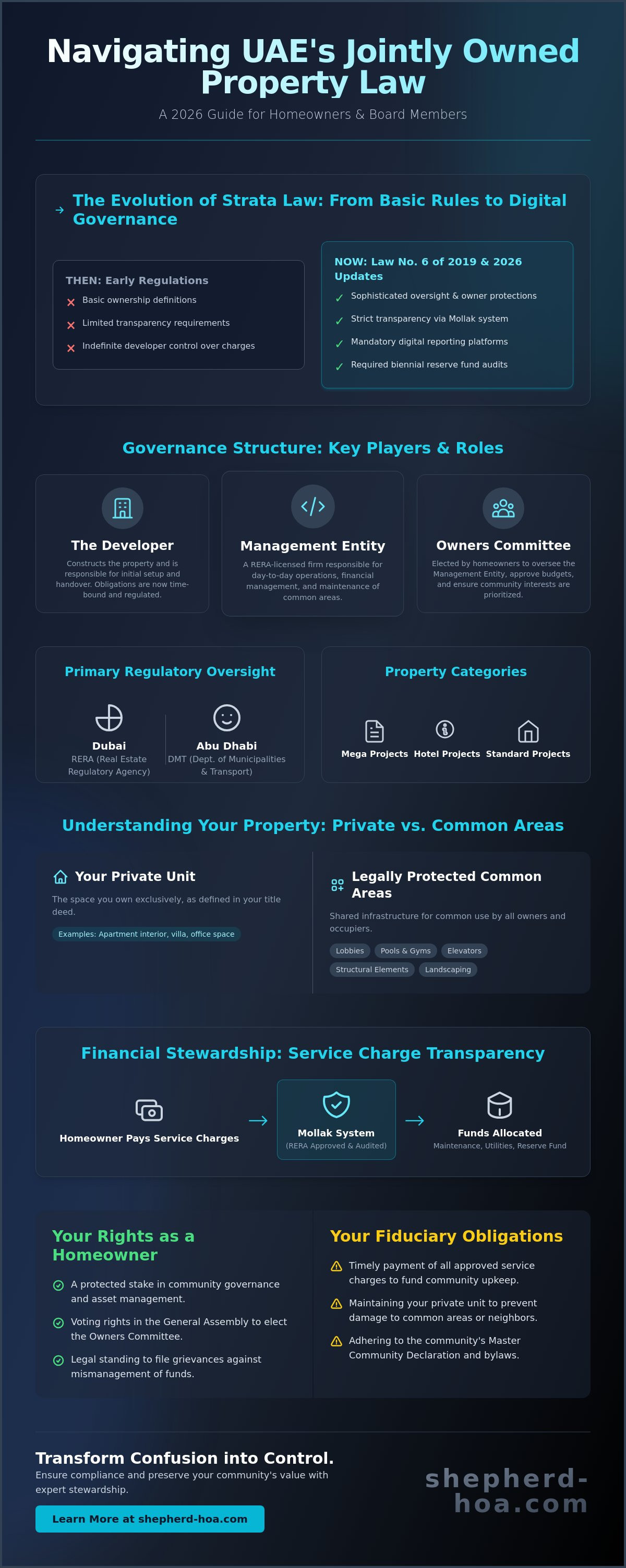
The jointly owned property law uae framework serves as the essential structural backbone for the nation's master-planned communities and high-rise developments. It provides a clear legal environment where individual unit ownership and collective responsibility coexist. This legislation is vital for the national real estate market because it ensures that shared assets, which often represent a homeowner's largest financial investment, remain well-maintained and legally protected. For board members, these laws replace administrative chaos with a sense of organized control.
The evolution of strata law in the UAE reflects a shift toward global best practices in community management. While early regulations focused on basic ownership, modern updates like Dubai's Law No. 6 of 2019 have introduced sophisticated oversight. These changes ensure that developers, management companies, and owners associations operate with transparency. The broader UAE Legal System provides the civil law foundation that enables these specific property regulations to function effectively across all seven emirates.
Primary regulatory oversight falls under specific government bodies. In Dubai, the Real Estate Regulatory Agency (RERA), a branch of the Dubai Land Department (DLD), handles enforcement. In Abu Dhabi, the Department of Municipalities and Transport (DMT) oversees similar functions. These authorities categorize properties into three distinct types to streamline management:
Mega Projects: Large-scale developments with complex infrastructure.
Hotel Projects: Properties requiring specialized hospitality management.
Standard Projects: Traditional residential and commercial buildings.
The Legal Definition of Common Areas
Differentiating between private units and shared infrastructure is critical for financial clarity. Your private unit is the space you own exclusively. Everything else belongs to the collective. According to the latest regulatory standards, common areas comprise the parts of the land and building intended for common use by unit owners and occupiers, including structural elements, mechanical systems, and recreational facilities as registered on the site plan. Legal protections ensure that facilities like pools, gyms, and lobbies cannot be sold off or restricted by the developer once the project is handed over. This protection preserves the long-term value of your community.
Regulatory Hierarchy and Governing Legislation
The jointly owned property law uae relies on a hierarchy of legislation. Federal Law No. 5 of 1985 (the Civil Code) sets the general principles for property rights. However, Emirate-level regulations provide the specific mechanics for daily operations. As of 2026, key updates have focused on digital governance. All management companies must now use approved digital platforms for financial reporting. Additionally, mandatory reserve fund audits are now required every two years to prevent the mismanagement of community wealth. These updates offer board members a definitive solution to the headache of financial oversight, ensuring that every fils of the service charge is accounted for.
Homeowner Rights and Fiduciary Obligations
Ownership in a managed community involves more than holding a title deed; it's a legal partnership with your neighbors. The
jointly owned property law uae
, specifically Dubai’s Law No. (6) of 2019 and similar federal regulations, ensures that every unit owner has a protected stake in community governance. This framework establishes a strict fiduciary duty for those in leadership positions. Whether it’s an elected Owners' Committee or a licensed management firm, these parties must act with transparency and prioritize the community’s financial health over personal or corporate gain. The law acts as a definitive shield against developer overreach. Previously, developers often maintained indefinite control over service charges and maintenance contracts. Today, the Real Estate Regulatory Agency (RERA) oversees these processes via the Mollak system. This system requires all service charges to be approved and audited before they're collected in UAE Dirhams (AED). If a developer fails to meet their obligations or mismanages funds, owners have the legal standing to file formal grievances through the Rental Dispute Center (RDC), ensuring that community assets are never left vulnerable to neglect.
Voting Rights and General Assembly Participation
Your voice is the primary mechanism for community change. Owners exercise this right during the General Assembly, where they vote on annual budgets and elect the Owners' Committee. For these meetings to be legally binding, they must meet a quorum, which usually requires a specific percentage of owners to be present or represented by proxy. Participating in these sessions allows you to influence how your service charges are allocated and ensures that the management entity remains accountable to the people it serves.
Responsibilities Toward Common Property
Individual rights are balanced by clear obligations toward the collective. You're legally required to maintain your private unit to a standard that prevents damage to adjacent properties, such as preventing water leaks or structural deterioration. Additionally, you cannot modify common areas, including balconies or external facades, without written approval from the management body. Timely payment of service charges is a non-negotiable duty, as these funds provide the necessary capital for security, landscaping, and infrastructure repairs. Maintaining this balance of rights and duties is easier when you have an organized management partner to guide the process.
Adhering to these regulations doesn't just ensure legal compliance; it actively preserves the market value of your investment. When every owner fulfills their fiduciary and financial roles, the entire community benefits from a stable, well-maintained environment that attracts long-term tenants and buyers alike.
Governance Structures: Owners Committees and Management Entities
Effective community governance under the jointly owned property law uae relies on a precise division of labor. The law separates the roles of the developer, the Owners Committee (OC), and the professional management entity to ensure transparency and protect property values. This structure prevents any single party from having unchecked control over community funds or maintenance decisions, creating a system of checks and balances that benefits every resident.
The Role of the Owners Committee
The OC functions as the community's eyes and ears, but its power is strictly advisory under current UAE regulations. Members don't have the executive authority to sign service contracts or manage bank accounts directly. Instead, they review financial reports, verify maintenance standards, and provide feedback on behalf of all owners. To qualify for a seat, a member must be a unit owner in good standing, meaning they've paid all outstanding service charges in full.
Ethical standards are high for these volunteer positions. Members must disclose any potential conflicts of interest and prioritize the collective well-being of the building over personal preferences. Learning the specific Responsibilities of an HOA Board Member helps volunteers understand these legal boundaries. This clarity ensures that the committee supports the management company without overstepping into operational territory, maintaining a harmonious living environment.
Professional Management vs. Self-Management
The law mandates professional management for major developments to ensure statutory compliance and financial integrity. While small buildings with fewer than 20 units might sometimes manage their own affairs, larger master communities must appoint a RERA-licensed management partner. This requirement protects owners from the liabilities associated with administrative errors or financial mismanagement. It's a safeguard that ensures the building's long-term viability.
A professional management company acts as a protective barrier for the community's assets. They handle the complex logistics of jointly owned property law uae, including:
Filing annual financial audits with regulatory bodies to ensure every fils is accounted for.
Managing the collection of service charges, which often range from 15 AED to 35 AED per square foot in premium Dubai districts.
Coordinating with third-party contractors for critical infrastructure like elevators, fire safety, and MEP (Mechanical, Electrical, and Plumbing) services.
Maintaining the "Mollak" system records to ensure all financial transactions are transparent and legally sound.
By delegating these tasks to a licensed expert, board members reduce their personal legal exposure. Professional managers provide a steady hand, ensuring the building operates like a well-oiled machine while the OC focuses on high-level community goals. This partnership serves as the invisible backbone of every successful UAE development, turning complex legal requirements into a seamless and stress-free living experience for everyone involved.
Financial Stewardship: Service Charges and Digital Transparency
The
jointly owned property law uae
mandates a rigorous framework for financial management to ensure every dirham contributes to the community's longevity. This legislation removes the ambiguity often associated with property maintenance costs by requiring management companies to use regulated escrow accounts. Owners pay service charges based on the area of their unit, and these funds remain legally protected. They can't be diverted for other projects or used for anything outside the approved scope of the specific community's maintenance and insurance needs.
Understanding the Service Charge Index
Regulatory authorities like RERA use the Service Charge Index to benchmark costs across different districts. This prevents management companies from imposing arbitrary fee hikes. To secure budget approval, managers must submit audited financial records from the previous year. These audits verify that the community's AED reserves are handled with fiduciary care. You can find more details on these benchmarks in our guide on
.
The Mollak System and Regulatory Reporting
Digital integration has transformed how communities handle money. The Mollak system serves as a digital shepherd for community finances, ensuring every dirham is accounted for and protected from unauthorized use. This online gateway requires all service charge invoices to be issued through the platform, providing owners with real-time visibility into their payment history and the community’s overall financial health. Sustainability depends on RERA-approved budget planning. The law requires a portion of the service charges to be allocated to a reserve fund, often called a sinking fund. This fund covers major capital expenditures, like elevator replacements or roof repairs, preventing sudden, massive levies on owners when infrastructure ages.
Consequences for Non-Payment
Financial stability relies on collective contribution. When an owner fails to pay, it places an unfair burden on their neighbors. The
jointly owned property law uae
provides a streamlined recovery process that doesn't require a lengthy court battle. If dues remain unpaid 30 days after a formal legal notice, the management entity can escalate the matter to the Rental Dispute Center. The Execution Court has the authority to sell the property at public auction to recover the outstanding AED balance, ensuring the community's operational budget remains intact.
If you're looking for a partner to simplify your community's financial reporting and ensure total compliance,
.
Ensuring Compliance and Preserving Community Value with Shepherd HOA
Maintaining a community requires more than just routine maintenance; it demands strict adherence to the jointly owned property law uae. Shepherd HOA serves as your protective guide through these regulatory waters. We align your daily operations with 2026 legal standards to ensure your board remains protected and your community thrives. Our proactive strategy identifies potential friction points before they escalate into costly legal battles. This organized control replaces the typical stress of management with a sense of calm reliability.
Property value is directly tied to the quality of governance. Ethical management practices and transparent facility oversight aren't just moral choices; they're financial imperatives. We treat your assets with a duty of care that preserves long-term market appeal. When buyers see a well-documented, compliant community, their confidence in the investment grows. This shepherding of community interests ensures that your neighborhood remains a desirable place to live for decades to come.
Real-time alignment with RERA's evolving 2026 circulars.
Standardized financial reporting that meets strict UAE auditing requirements.
Professional mediation to resolve owner disputes before they reach the Rental Dispute Centre.
Strategic facility management that extends the lifecycle of community assets.
Navigating RERA Regulations with Ease
RERA requirements often feel like a moving target for volunteer boards. We handle the heavy lifting of government approvals and mandatory reporting. This professional oversight removes the administrative burden from your shoulders. You gain the freedom to focus on community vision while we ensure every filing meets the criteria outlined in our RERA Compliance Guide. It's a seamless process designed to keep your community in good standing without the typical paperwork headaches.
Requesting a Compliance Audit
A professional review clarifies your community’s current legal standing under the jointly owned property law uae. We help you transition to a management model built on transparency and integrity. This shift often results in higher collection rates and more sustainable reserve funds. Our team analyzes your existing CC&Rs and service contracts to ensure they're optimized for 2026 market conditions. We provide the steady, expert guidance needed to protect your fiduciary interests. Ready to secure your community's future? Partner with Shepherd HOA for expert community management today and experience the peace of mind that comes with professional stewardship.
Navigating the Future of UAE Community Governance
Mastering the jointly owned property law uae ensures your community remains a stable, high-value asset. You've seen how strict RERA regulations and the Mollak system create a framework for total financial transparency. Managing these complex fiduciary duties shouldn't be a source of stress for volunteer board members. Since 2010, Shepherd HOA has acted as a steady guide for residential communities across the Emirates. We specialize in navigating the technical requirements of RERA compliance and provide ethical financial reporting that builds trust among owners. By prioritizing digital transparency and organized management entities, you protect both your property's market value and your neighbors' peace of mind. Our team handles the administrative weight so you can focus on the vision for your neighborhood. You're not alone in this journey. We provide the invisible backbone that keeps your association running efficiently and legally.
Your commitment to excellence today builds a stronger, more harmonious community for years to come.
Frequently Asked Questions
What is the primary law governing jointly owned property in the UAE?
Law No. (6) of 2019 is the primary legislation governing jointly owned property law uae, specifically within the Emirate of Dubai. This law replaced the older 2007 regulations to create a more transparent framework for property management. It divides properties into three distinct categories: mega projects, hotel projects, and master communities, ensuring each has a tailored management structure that protects owner interests.
Can a developer manage a community indefinitely under the current law?
Developers can't manage a community indefinitely because Law No. (6) of 2019 requires the appointment of a specialized management company. Once a project reaches completion, the developer must hand over management duties to an entity licensed by RERA. This transition ensures that 100 percent of community operations are handled by professional managers who are accountable to the owners rather than the developer's profit margins.
What happens if a homeowner refuses to pay service charges?
Homeowners who fail to pay service charges face legal enforcement through the Mollak system and the Rental Dispute Center. If the debt remains unpaid 30 days after a formal legal notice is served, the management company can pursue an execution order. This legal process allows for the recovery of funds through various means, including the potential sale of the unit at public auction to clear the outstanding balance.
How is the Owners Committee different from a Board of Directors?
The Owners Committee acts as a supervisory body rather than an executive board with direct spending power. Under the jointly owned property law uae, this committee consists of 3 to 9 members who monitor the management company's performance and review service charge budgets. They don't sign contracts or hire staff directly; their role is to provide oversight and ensure the management company fulfills its fiduciary duties to the community.
Is the Mollak system mandatory for all jointly owned properties?
The Mollak system is mandatory for every jointly owned property in Dubai as per RERA regulations. Any service charge invoice issued outside of this system is considered legally invalid and homeowners aren't required to pay it. This platform ensures that 100 percent of all service fees are deposited into a regulated escrow account, which prevents the commingling of funds and guarantees that money is spent only on approved community expenses.
How are service charge budgets approved by regulatory authorities?
Service charge budgets must be audited by a RERA approved financial firm before they're submitted for final clearance. The management company uploads the detailed expenditure plan into the Mollak system for government review. Regulators compare the proposed costs against historical data and market averages to ensure the fees are justified. This rigorous process prevents arbitrary price hikes and maintains the long term value of the real estate asset.
Can I modify my unit without approval from the management company?
You can't modify your unit without obtaining a No Objection Certificate (NOC) from the management company and the master developer. Structural changes or alterations to the building facade also require permits from the Dubai Municipality or relevant licensing authorities. Performing unauthorized work can lead to fines exceeding 5,000 AED and legal orders to restore the property to its original condition at your own expense.
What are the legal requirements for a community management company to be licensed?
A community management company must be licensed by the Dubai Department of Economy and Tourism and registered with RERA. They're required to maintain a professional indemnity insurance policy to protect the communities they serve. Additionally, their senior staff must complete specialized training and pass RERA certification exams to prove they possess the technical expertise needed to manage complex residential and commercial assets.


Comments